Iranian Sunni Religious Leader Subjected To Torture In Detention
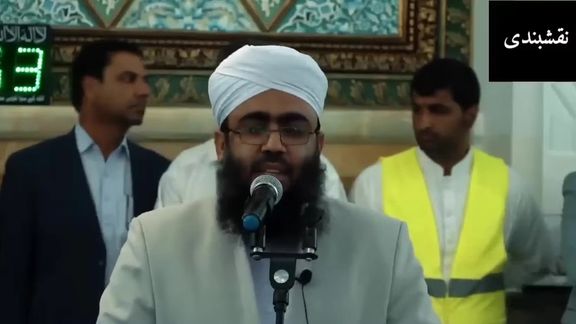
The Friday Prayer Imam of Rask, in Iran's Sistan-Baluchestan Province, has been tortured by intelligence agents during his detention, the family has charged.
The Friday Prayer Imam of Rask, in Iran's Sistan-Baluchestan Province, has been tortured by intelligence agents during his detention, the family has charged.
The son of Mowlavi Fat’hi Mohammad Naqshbandi made a revelation on Saturday, asserting that his elderly father had endured torture involving the use of an "electroshock weapon" and a hot iron at the Zahedan Intelligence detention center.
Abdolqaffar Naqshbandi, in a post on the X social network, lamented, "I received news about a month after my elderly father's detention that he is once again being subjected to physical and psychological torture in Zahedan, the very same place where both he and I endured four years of torment."
The Sistan-Baluchistan Judiciary, August 20th, officially announced the arrest of Mowlavi Naqshbandi on charges that included "disrupting public opinion through false speeches, slander, and defamation against the Islamic Republic of Iran's regime, engaging in activities against national security, and engaging in the unlawful occupation of national lands."
Simultaneously, the Baluchestan news website, Halvash, reported that Naqshbandi had been detained under circumstances involving "humiliation and insult."
In recent months, the situation in Sistan-Baluchestan has markedly deteriorated, with cities in the region experiencing heightened tension, especially on Fridays when residents voice their grievances against the regime through protests.
There have been numerous reports of attacks targeting military and government forces within the province in the months following the tragic death of Mahsa Amini in custody last year, which triggered nationwide protests.


The hacker group Ghiyam ta Sarnegouni (Uprising till Overthrow) which is affiliated to the People's Mojahedin Khalq Organization (MEK) made the announcement Saturday, the first day of the new academic year in Iran and said it had acquired access to over 20,000 documents.
Some of the documents hackers have published on their Instagram and Telegram accounts are related to purging academics who are critical of the government or have supported the Women, Life, Freedom movement.
The purge has opened the way for hiring 15,000 pro-regime professors and other staff in universities. Authorities also plan to adopt new student selection procedures and expelling thousands of students who have been part of the protest movement. They have even greenlighted the acceptance of Iraq’s Shiite Hashd al-Shaabi militias and other proxies in Iranian universities.
The ministry’s public relations in a statement Saturday claimed “vigilant technical experts” had managed to repel the cyber-attack and shut down the ministry’s website temporarily to investigate the incident.
In the past year, MEK-affiliated hackers have targeted the portals of several other government agencies including Tehran Municipality, the state broadcasting corporation (IRIB), the Presidential Office, and the ministries of Foreign Affairs, Agriculture, and Islamic Guidance and published thousands of documents.

A "very confidential” document published by hackers this time reveals the proceedings of a Supreme Council of Cultural Revolution meeting including demographic data about last year’s nationwide protests based on data from intelligence agencies, including the Ministry of Intelligence and the Revolutionary Guards (IRGC) Intelligence Organization (SAS).
Dated October 5, 2022, approximately three weeks after the death of 22-year-old Mahsa Amini in custody sparked nationwide anti-government protests, the document emphasizes that 82 percent of detainees in the first two weeks of the protests were teenagers and young people under the age of thirty, with men comprising the majority at 88 percent of all detainees.
The document also states that authorities had no records related to 93 percent of detainees and that protesters promoted civil disobedience in places such as bazaars, metros and city buses. According to the same document, “hatred towards the Islamic Republic, hostility and civil disobedience” had been observed among protesters.
In a classified letter to President Ebrahim Raisi that hackers claim to have accessed, Higher Education Minister Mohammad-Ali Zolfigol says some university chancellors were reluctant to cooperate with security bodies in suppressing the students and that some academic officials who had signed statements against such measures had been fired.
Zolfigol said in the letter that Sharif University of Technology, one of the top universities in Iran, “had come completely under the control of rioters” and added that the National Security Council (NSC) and Supreme National Security Council (SNSC) officially demanded the chancellor of the university to be sacked.
Sharif University required “fundamental changes” without which it could not be controlled if there was more unrest in the future, the minister said in his letter to the President.
Students in at least 150 universities across Iran held protests during last year’s several-month-long unrest and in many cases were supported by their professors. Documents acquired by hackers from the IRGC-affiliated Fars News Agency in December indicated that at least 51% of the students at state universities had participated in Women, Life, Freedom protests.
The recent purge of academia in Iranian universities dubbed as ‘the second cultural revolution’ has shaken many Iranians who are already grappling with various pressures. The purge comes amid loss of hope in improvement of the country’s circumstances, including its economy, relations with the international community and removal of sanctions, as well as even relative social and political freedoms.


The old document, the 6th Development Plan, was to be implemented between 2016 and 2021, but many parts of it have remained untouched as the government lacked the appropriate resources due to a catalogue of foreign policy and economic problems.
The latest extension of the old plan gives the Iranian government time to catch up with what it has not been able to accomplish during the past seven years. Experts, however, say it is unlikely that the administration, known for its inefficiency,would be able to improve its performance in the next two years. They say the old plan might even be extended for another two years when the Majles reviews the government's performance in about six months from now.
According to former presidential candidate Mostafa Hashemitaba, in the meantime, the government has either to amend the 7th Development Plan, which is by no means acceptable to the parliament, or to come up with new plan to present to the Majles.

According to Hashemitaba, only 20 to 25 percent of the 6th plan has been implemented during the past seven years. He added in an article in the reformist Shargh daily that the 7th plan is simply a "booklet put together by the government" and that "it has nothing to do with the country's future and its people's livelihood. Hashemi Taba further charged that it makes no difference for the officials which direction the country's economy will take as a result of not having a real development plan in hand.
He said those who have drafted the plan either do not know anything about the country's situation or pretend not to know about pressing issues. "When the priorities are forgotten, what comes next is destruction," Hashemitaba said, adding that "what the officials are doing is giving a coat of paint to a building on the verge of collapse."
Meanwhile, reformist commentator Abbas Abdi wrote in a commentary in the reformist Etemad newspaper that Iran's economy heavily relies on state subsidies and the government cannot implement any practical policy as long as it cannot liberalize the prices of bread, fuel and energy because it fears the re-emergence of protests that have taken place in Iran since 2018.
Abdi wrote the government is constantly manipulating the prices of these three items and continues to allocate subsidies to them sometimes selling what it buys at a higher price to the people at a lower subsidized price. However, he pointed out that current rise in the price of bread in Iran cannot be defended, as it puts more pressure on the lower strata of the population. The government's only solution is to rebuild the people's trust in the government and that is difficult.
Hashemitaba also pointed out in his article that the Iranian government has stated at various points that it needs to make tough decisions, meaning to increase the prices of essential commodities, but every time, it took backs down and manipulates the markets without cutting the subsidies.
In another development, Iranian journalist, women's rights activist, and reformist politician Zahra Nejad-Bahram wrote in Etemad newspaper, criticizing the government for treating development plans as perfunctory documents and instead, handling affairs of state on a day to day basis.
She pointed out that the 6th Development Plan is too outdated, it has already been extended twice, and another extension of it will be beneficial. She questioned how an outdated plan could meet the country's future needs. Nejad-Bahram maintained: "Perhaps the officials believe Iran does not need a new development plan!"