Dress Code Restrictions Introduced For Iranian Students
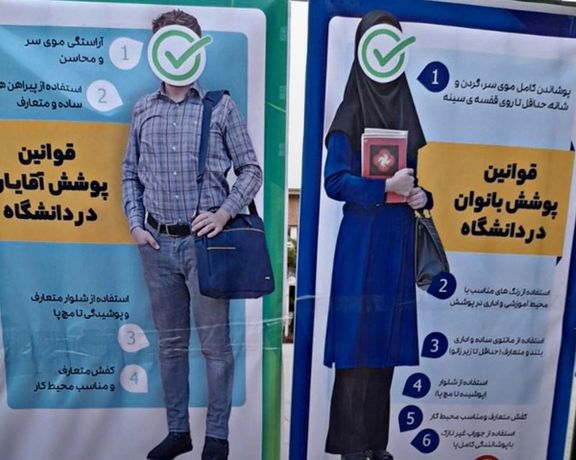
Student activists have revealed a set of new dress code restrictions imposed by the regime across several universities in Iran.
Student activists have revealed a set of new dress code restrictions imposed by the regime across several universities in Iran.
In institutions such as Amirkabir and Tehran Universities, female students are no longer allowed to wear patterned clothing, high-heeled shoes, or artificial nails, or expose tattoos.
Additionally, male students are subject to regulations prohibiting long hair, beards, or mustaches, as well as the wearing of jewelry and piercings.
Recent reports received by Iran International indicate that security forces, Basij militia members, and plainclothes personnel are actively involved in monitoring the entry and exit of students.
The hacktivist group Uprising till Overthrow, which is affiliated to the Albania-based opposition Mujahideen-e Khalq (MEK) organization, announced on Saturday that they infiltrated 500 servers, computers, and websites affiliated with the Ministry of Science, gaining access to a cache of over 20,000 documents.
One of these documents disclosed plans for the installation of 740 active cameras in the Science and Industry University in Tehran, along with the implementation of an initial phase of facial recognition software.
Both students and professors who oppose such measures have consistently emphasized that the university should not be treated as a military institution. They assert that the disciplinary actions, expulsions, and suspensions carried out by the Islamic Republic cannot stifle their voices.
In a joint statement issued on Saturday, the student unions from 12 universities across the country declared that, one year after the people's uprising, the student movement has entered a new phase of activism that will undermine the suppressive efforts of the government.


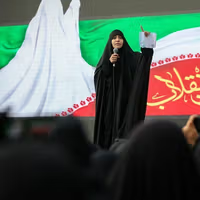
Jamileh Alamolhoda, wife of Ebrahim Raisi, spoke to some of the world’s top media, including ABC and Newsweek as the pair embarked on a prolific propaganda effort.
To Newsweek, Alamolhoda, the daughter of a hardline cleric, spoke of the alleged “women’s rights” enjoyed by Iranian women, who for the last year have been protesting the oppressive conditions of living under the regime under the Women, Life, Freedom movement. Thousands remain in Iranian jails for protesting while hijab rebels remain locked out of public places including transport and education.
Alamolhoda -- who firmly believes a woman’s place is as a mother and wife — claimed Western feminism has no place in Iran where she says women are the center of life and society. Meanwhile, women are on the streets burning the hijab and morality police continue to punish them for not complying with mandatory hijab rules. Just last week, new laws to introduce harsher punishments for these women were passed in parliament as the battle against the rebellion continues to flounder.

On ABC, she continued to reiterate the regime’s lies that the tragic fate of 22-year-old Mahsa Amini, whose death in morality police custody for the ‘inappropriate’ wearing of her hijab sparked protests in which more than 500 civilians were murdered by the security forces, was due to pre-existing illnesses, in spite ample evidence showing she died of blows to the head.
It has sparked a huge backlash across the globe. Activist in exile, Nazanin Boniadi, wrote on X of her disgust at the airtime given to the First Lady when anyone living in Iran speaking out against the regime is silenced, including hundreds of people such as journalists and academics now in prison for their dissenting views.
“Islamic Republic officials crush dissent at home and use Western media and democratic institutions to legitimize themselves, spew their propaganda and whitewash their crimes. Appalling. We should instead give airtime to those who are risking their lives for freedom and are stuck between a homeland that is trying to destroy them and an international community that platforms and negotiates with their oppressors,” she wrote.
US-based Sarah Raviani also called on the world’s media to stop giving a platform to the Raisis whose attendance at the United Nations General Assembly came on the back of a prisoner swap deal releasing five American-Iranian hostages in Iran in exchange for regime agents in the US, and the freeing up $6bn of frozen Iranian funds in South Korea, to be managed by Qatar.
In a powerful open letter to American media and journalists, Raviani wrote on X that media has “become a conduit for the regime's agenda” while hundreds of voices inside and outside of Iran are begging to be heard.
“I hear from the families of the fallen freedom fighters, crying out for the international community to take notice of them as their homes and lives are destroyed by regime security forces. I hear from the families of American hostages abandoned in Iran, begging the media to take notice of their loved ones dire situation. How do you think they feel as you prop up those who are responsible for the death and suppression of their family members?”
UK-based activist and academic, Kasra Aarabi, called the latest propaganda mission a bid “to demoralize Iranians abroad to stop us from mobilizing”. Writing on X, he said, “This won’t work, it’ll only make us more determined”, slamming the decision of ABC to allow the First Lady airtime. “Very sad to see @ThisWeekABC fall into the regime’s propaganda trap.”
The President himself also made the most of the world watching, suggesting some high level orchestration happening behind the scenes, though no PR organization has so far been revealed for its part in the drama.
Not only did Raisi use the UNGA stage to air his views on the Saudi betrayal of the Palestinian people should the nation normalize ties with Israel, and deny his obstruction to International Atomic Energy Agency inspectors, he spoke to CNN and denied the country’s nuclear ambitions.
Earlier this year, the UN nuclear watchdog claimed that Iran's stock of uranium enriched to up to 60 percent purity, close to weapons grade, continues to grow. Just this month, the regime also banned one third of the IAEA’s inspectors. Speaking to CNN, Raisi claimed that “Iran has cooperated fully with the IAEA”, denying the reports announced by Director General Raphael Grossi who made a rare public criticism of the regime for its latest stonewalling.
In his latest bizarre claims, in spite of years of pursuing a potentially dangerous nuclear program and stockpiling highly enriched uranium, he even said, “we have stated many times that nuclear weapons have no place in Iran's defense doctrine, because we neither need them nor believe in nuclear weapons”.
Turning to Islam to defend his claims, he added, “In our opinion and based on the fatwa of the Supreme Leader of the Islamic Revolution, nuclear weapons are among the weapons of mass destruction, and therefore both their production and storage are forbidden, and we adhere to this fatwa. This approach obligates us from a jurisprudential and Islamic point of view not to pursue the production of nuclear weapons in any way, and so far no reason has been found that the Islamic Republic of Iran has acted against this belief”.
Jason Brodsky, United Against A Nuclear Iran, said Raisi's administration is clearly trying to “normalize him in the West”. Writing on X, he said, “I hope @ThisWeekABC invites someone on the show who is actually representative of the people of #Iran and the Woman, Life, Freedom movement to respond to Jamileh after this interview.”


The Fraser Institute, in its latest Economic Freedom of the World report, measured the extent to which a country's policies and institutions support economic freedom, with data from 2021 serving as the basis for the 2023 assessment.
With a paltry score of 4.53 out of 10, Iran shares the lowly position with Libya, outpacing only Yemen, Sudan, Syria, Zimbabwe, and Venezuela in terms of economic liberties. The other low-ranking countries all countries all have “brotherly” ties with the Islamic Republic.
Before the establishment of the Islamic regime, Iran stood at the 32nd position or the second quartile of all states at the time. The country leaped 10 steps from 42 in 1970 to 32 in 1975. Right after the 1979 revolution, Iran's ranking plummeted to the 89th place in 1980.
The number one spot is now occupied by Singapore, followed by Hong Kong, Switzerland, New Zealand, the United States, Ireland, Denmark, Australia, the United Kingdom, and Canada.
The Fraser Institute's annual assessment of economic freedom is measured in five broad areas: size of the government, legal system and property rights, sound monetary policy, freedom to trade internationally, and regulations. The research organization says the cornerstones of economic freedom are personal choice, voluntary exchange, freedom to enter markets and compete, and security of the person and privately-owned property, all of whom lagging behind the international standards.

The size of the Iranian government has been a central concern for the regime in recent years, leading to the launch of various initiatives under the banner of "building organizational agility" within state bodies. Unfortunately, these plans have failed to produce tangible results, primarily because the workers who should be laid off or redundant offices that should be removed are connected to influential figures within the regime.
As government spending, taxation, and the size of government-controlled enterprises continue to grow, government decision-making takes precedence over individual choice, resulting in a reduction in economic freedom. Yet, this factor achieved Iran's highest score among the five categories, with a rating of 6.59 out of 10, placing Iran at 79th in this area.
In terms of the legal system and property rights, which measure protection of persons and their property, Iran scored 3.26. “If property is not secure, if individuals are not safe, if the judiciary is not impartial, or if the rule of law is undermined, then, again, economic freedom is reduced,” the Fraser institute says.
Iran’s monetary policy received a score of 5.90 in the category of Sound Money, essential for safeguarding property rights. The report highlights that when inflation is not only high but also volatile, individuals find it challenging to plan for the future, hindering the effective use of economic freedom. Approximately a year ago, Iran's rial was trading at around 300,000 to the dollar, but in early May, it dropped to as low as 550,000. Currently, it stands above 490,000. This drastic devaluation of the rial illustrates the severity of inflation in Iran. In July, a lawmaker stated that the annual inflation rate was 120 percent, contrary to the 60 or 70 percent figures cited by various politicians and academics. According to World Bank figures from June, Iran's food inflation rate stood at 78 percent.
Iran received its lowest score in the Freedom for International Trade category, with a rating of 2.39, the lowest among the 165 countries assessed by the Fraser Institute. The institute emphasizes that the essence of economic freedom lies in the freedom to exchange, which is hindered when government barriers to trade make it costly or even impossible to engage in commerce with businesses and individuals in other nations. Due to US sanctions, only a limited number of countries are willing to establish trade ties with Iran, risking retaliation from Washington and further isolating Iran.