Activists Pressured For Slamming Green Movement Leaders' House Arrest
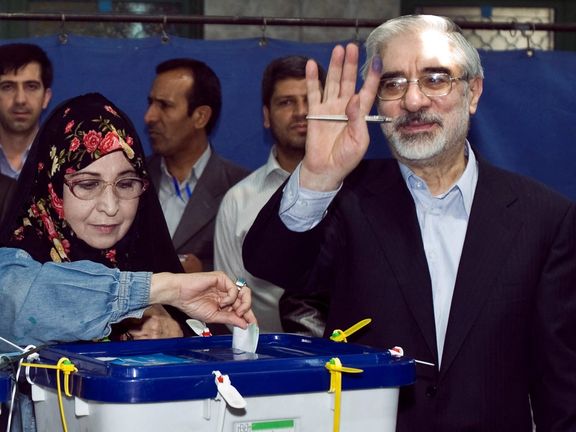
Several signatories of a letter denouncing the 13-year-long house arrest of Green Movement leaders as "gradual murder" have faced threats from the Iranian regime.
Several signatories of a letter denouncing the 13-year-long house arrest of Green Movement leaders as "gradual murder" have faced threats from the Iranian regime.
The ministry of intelligence has pressured them to retract their signatures from the letter.
The Green Movement emerged after the disputed 2009 presidential election, demanding the annulment of Mahmoud Ahmadinejad's re-election. Its leaders, including Mir-Hossein Mousavi, Zahra Rahnavard, and Mehdi Karroubi, have been under house arrest since 2011 due to their perceived challenge to Supreme Leader Ali Khamenei's regime.
On Saturday, over 570 political, social, cultural, and civil activists issued a statement expressing concerns about the continued house arrest of these leaders. The Kalemeh website, close to Mousavi, reported that intelligence agents have contacted the signatories, pressuring them to retract their signatures and prepare for possible summons.
Zahra Shojaei, a prominent signatory and former official under President Mohammad Khatami's tenure, affirmed her commitment to the letter despite attempts to coerce her into withdrawing her signature, saying "I have signed this open letter, and I stand by it."
Fazlollah Arab-Sorkhi, another signatory, revealed similar attempts on social media to persuade or compel individuals to retract their signatures.
Although Iranian authorities previously acknowledged the house arrest was ordered by Supreme Leader Ali Khamenei, the case remains under the jurisdiction of the Supreme National Security Council.
The continued pressure on activists highlights the Iranian regime's determination to silence dissent and suppress criticism of its treatment of Green Movement leaders.


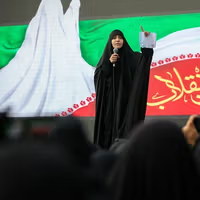
Jamileh Alamolhoda, wife of Ebrahim Raisi, spoke to some of the world’s top media, including ABC and Newsweek as the pair embarked on a prolific propaganda effort.
To Newsweek, Alamolhoda, the daughter of a hardline cleric, spoke of the alleged “women’s rights” enjoyed by Iranian women, who for the last year have been protesting the oppressive conditions of living under the regime under the Women, Life, Freedom movement. Thousands remain in Iranian jails for protesting while hijab rebels remain locked out of public places including transport and education.
Alamolhoda -- who firmly believes a woman’s place is as a mother and wife — claimed Western feminism has no place in Iran where she says women are the center of life and society. Meanwhile, women are on the streets burning the hijab and morality police continue to punish them for not complying with mandatory hijab rules. Just last week, new laws to introduce harsher punishments for these women were passed in parliament as the battle against the rebellion continues to flounder.

On ABC, she continued to reiterate the regime’s lies that the tragic fate of 22-year-old Mahsa Amini, whose death in morality police custody for the ‘inappropriate’ wearing of her hijab sparked protests in which more than 500 civilians were murdered by the security forces, was due to pre-existing illnesses, in spite ample evidence showing she died of blows to the head.
It has sparked a huge backlash across the globe. Activist in exile, Nazanin Boniadi, wrote on X of her disgust at the airtime given to the First Lady when anyone living in Iran speaking out against the regime is silenced, including hundreds of people such as journalists and academics now in prison for their dissenting views.
“Islamic Republic officials crush dissent at home and use Western media and democratic institutions to legitimize themselves, spew their propaganda and whitewash their crimes. Appalling. We should instead give airtime to those who are risking their lives for freedom and are stuck between a homeland that is trying to destroy them and an international community that platforms and negotiates with their oppressors,” she wrote.
US-based Sarah Raviani also called on the world’s media to stop giving a platform to the Raisis whose attendance at the United Nations General Assembly came on the back of a prisoner swap deal releasing five American-Iranian hostages in Iran in exchange for regime agents in the US, and the freeing up $6bn of frozen Iranian funds in South Korea, to be managed by Qatar.
In a powerful open letter to American media and journalists, Raviani wrote on X that media has “become a conduit for the regime's agenda” while hundreds of voices inside and outside of Iran are begging to be heard.
“I hear from the families of the fallen freedom fighters, crying out for the international community to take notice of them as their homes and lives are destroyed by regime security forces. I hear from the families of American hostages abandoned in Iran, begging the media to take notice of their loved ones dire situation. How do you think they feel as you prop up those who are responsible for the death and suppression of their family members?”
UK-based activist and academic, Kasra Aarabi, called the latest propaganda mission a bid “to demoralize Iranians abroad to stop us from mobilizing”. Writing on X, he said, “This won’t work, it’ll only make us more determined”, slamming the decision of ABC to allow the First Lady airtime. “Very sad to see @ThisWeekABC fall into the regime’s propaganda trap.”
The President himself also made the most of the world watching, suggesting some high level orchestration happening behind the scenes, though no PR organization has so far been revealed for its part in the drama.
Not only did Raisi use the UNGA stage to air his views on the Saudi betrayal of the Palestinian people should the nation normalize ties with Israel, and deny his obstruction to International Atomic Energy Agency inspectors, he spoke to CNN and denied the country’s nuclear ambitions.
Earlier this year, the UN nuclear watchdog claimed that Iran's stock of uranium enriched to up to 60 percent purity, close to weapons grade, continues to grow. Just this month, the regime also banned one third of the IAEA’s inspectors. Speaking to CNN, Raisi claimed that “Iran has cooperated fully with the IAEA”, denying the reports announced by Director General Raphael Grossi who made a rare public criticism of the regime for its latest stonewalling.
In his latest bizarre claims, in spite of years of pursuing a potentially dangerous nuclear program and stockpiling highly enriched uranium, he even said, “we have stated many times that nuclear weapons have no place in Iran's defense doctrine, because we neither need them nor believe in nuclear weapons”.
Turning to Islam to defend his claims, he added, “In our opinion and based on the fatwa of the Supreme Leader of the Islamic Revolution, nuclear weapons are among the weapons of mass destruction, and therefore both their production and storage are forbidden, and we adhere to this fatwa. This approach obligates us from a jurisprudential and Islamic point of view not to pursue the production of nuclear weapons in any way, and so far no reason has been found that the Islamic Republic of Iran has acted against this belief”.
Jason Brodsky, United Against A Nuclear Iran, said Raisi's administration is clearly trying to “normalize him in the West”. Writing on X, he said, “I hope @ThisWeekABC invites someone on the show who is actually representative of the people of #Iran and the Woman, Life, Freedom movement to respond to Jamileh after this interview.”