IRGC Renews Threat To Anti-Regime Media
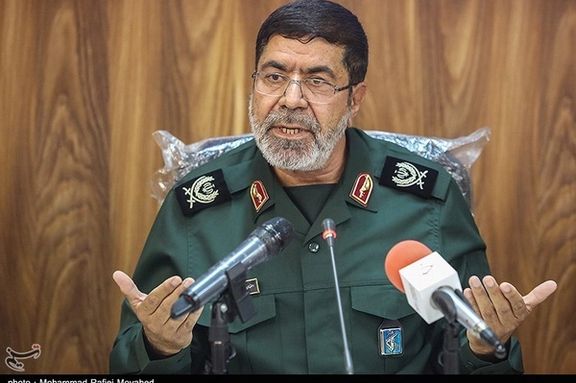
The spokesperson for Iran's Revolutionary Guards has threatened a vigorous response to counter the “hostile activities of the enemy in the media sphere.”

The spokesperson for Iran's Revolutionary Guards has threatened a vigorous response to counter the “hostile activities of the enemy in the media sphere.”
Ramezan Sharif called for launching an offensive against anti-regime media as the revolutionary tide continues to deepen and threaten the Islamic Republic's stability.
Iranian regime authorities, including commanders from the Revolutionary Guard, have frequently issued threats against media outlets operating abroad, such as Iran International.
During his address on Monday, Sharif alleged that media outlets globally are under the control of individuals who shape the narrative for their respective organizations while pursuing their own vested interests.
Last week, Iran's Intelligence Minister, Esmaeil Khatib, issued a stark warning to Persian-language media outlets operating outside Iran, asserting that support from other nations will not dissuade Tehran from pursuing "aggressive" actions against them.
The intelligence ministry had previously labeled Iran International employees as "enemies of the state," vowing punishment for those who allegedly serve foreign interests and betray their country.
The threats come amid widespread arrests of journalists in Iran, particularly during the "Women, Life, Freedom" protests, part of a harsh crackdown on dissent.
International human rights organizations consistently rank Iran among the world's foremost oppressors of journalists and free speech.

As the new academic year begins in Iran, reports confirm the detention of at least seven students across various cities as new rules come into effect over the likes of dress code and conduct.
There have been further instances of suspension and expulsion affecting both students and university professors.
According to reports from student media outlets, Sahar Salehian, a nursing student at Sanandaj University of Medical Sciences, was apprehended by Iranian security forces in Saqqez on Saturday.
The recent surge in student arrests began with the detention of Mahsa Saeidi, a PhD student at Yazd University, on September 11.
Ali Gholami, a student activist at the University of Science and Industry in Tehran, was also arrested three days later. The wave of detentions continued with the apprehension of Ali Rezvani, a student at Khajeh Nasir Toosi University in Tehran, Farhad Hosseini, a student of management at Azad University in Zanjan, Mohammad Mehdi Vosoughian, a student at Esfahan University of Medical Sciences, and Armita Pavir, a student at Azarbaijan Madani University.
Concurrently, there has been a widespread summons of students to disciplinary committees, resulting in suspension and expulsion orders, often justified under the pretext of "non-compliance with dress codes," new rules announced this week.
Furthermore, in recent cases of professor suspension and expulsion, Mostafa Azarakhshi, a faculty member of the theology and religious studies department at Baqiyatallah University of Medical Sciences in Tehran, faced suspension.
The decision has faced strong criticism from student unions, who view it as part of an ongoing effort to suppress and remove professors. They emphasize that this suspension follows the signing of a statement by one hundred professors demanding the release of detained students during the Women, Freedom, Life protests.

After months of hiatus in Iran International broadcasting from the UK due to terrorist threats by Tehran, the network is back on track from a new London building.
Announcing the launch of the new location, Mahmood Enayat, General Manager of Iran International TV, said, "Britain is the home of free speech. The resumption of our programs from this country is evidence that we will not abandon independent and uncensored journalism to the people of Iran."
Following a significant escalation in state-backed threats from Iran and advice from the London Metropolitan Police, Iran International TV announced in February that it reluctantly and temporarily closed its London studios and moved broadcasting to Washington DC. Iran International was warned by authorities in November that its journalists were under threat from Iranian agents and the police took measures to strengthen security around the network’s offices. A man was arrested in the vicinity of Iran International’s headquarters in February and charged with a terrorism offence.
In his message celebrating the resumption of broadcasting from London, Enayat extended his gratitude to the reporters and staff for their unwavering commitment during this challenging period. He also expressed appreciation to the Metropolitan Police of London and the British government for their continuous support in safeguarding Iran International's personnel and facilitating their safe return to the London office.
The channel's broadcasts have gained special significance since popular anti-regime rallies broke out in Iran last September, providing uncensored coverage of the protests and the subsequent crackdown on the public by the regime. Iranian officials have repeatedly threatened Iran International and other Persian broadcasters based abroad as the government blocked the Internet to deny the population news and information. The Iranian regime has blamed foreign-based Persian broadcasters such as BBC Persian and Iran International for “fomenting unrest”, while all media in the country are under tight government control and present protesters as “rioters” and “terrorists”.

On Sunday, British daily The Times reported that Iran International’s workers are “ready to run the gauntlet again” seven months after the terrorist scare. “They said they were receiving information that there is going to be an immediate attack — maybe today, tonight or tomorrow,” Aliasghar Ramezanpoor, the head of news at the channel, told the newspaper.
“The Iranian government tried to make islands of people and sought to cut the flow of information about what was going on from one city to another,” Saeid Habil, a senior journalist at Iran International, told the paper. “They managed to cut the internet, so people [in Iran] needed an alternative link to each other. We were that link.”
Speaking last week at the station’s new studios in north London, Elnaz Kiani, a lead news anchor, told The Times that “For months, we were living whatever people were living in Iran — with all the emotions and hope. People trusted us. They were putting their lives in our hands by going out into the street and taking videos for us.”
Amid repeated threats by the Islamic Republic against Iran International’s reporters, the UK government vowed in December to step up protection of London-based Iranian journalists. British officials also expressed strong support for Iran International. Tom Tugendhat, the UK's Minister of State for Security, has repeatedly condemned Iran's threats against the network. He affirmed that the UK would continue its support for the network, ensuring its activities in a secure environment.

Regime authorities, including several Revolutionary Guard commanders, have repeatedly issued threats against Iran International and other foreign-based media outlets.
Earlier this month, Iran’s Intelligence Minister Esmail Khatib reiterated threats against Iran International media network throughout the globe "wherever and whenever deemed necessary." He emphasized that the Islamic Republic would not refrain from invasive measures against the workers of the channel. “We believe that Iran International is a terrorist network, and naturally we deem it our duty and mission to act against them wherever and whenever we deem appropriate,” he said, warning that “no terrorist media will be safe.”
Khatib stated, "Support from various countries will not deter us from taking invasive security measures," claiming that several foreign-based channels have promoted “terrorism,” and Iran International is one of the most important ones.
The US Department of State, Belgium-based International Federation of Journalists, and Australia’s Media, Entertainment and Arts Alliance are among entities that expressed support for Iran International and stressed the importance of safeguarding journalists' security and press freedom following the relocation of Iran International’s London office.
Following the relocation to DC, IRGC Commander-In-Chief Major General Hossein Salami said the threats against the channel’s journalists "show how far the Islamic Revolution's realm of power, field of infiltration and radius of influence has extended."
In May, Britain’s shadow security minister slammed the threats against journalists covering Iran’s protests. Speaking on World Press Freedom Day, Holly Lynch, the Labour MP for Halifax, said the threats by the Iranian regime include “assassination and kidnap plots against UK residents who are perceived as enemies of Iran owing to their coverage of the protests and the regime’s brutal crackdown”.

Several signatories of a letter denouncing the 13-year-long house arrest of Green Movement leaders as "gradual murder" have faced threats from the Iranian regime.
The ministry of intelligence has pressured them to retract their signatures from the letter.
The Green Movement emerged after the disputed 2009 presidential election, demanding the annulment of Mahmoud Ahmadinejad's re-election. Its leaders, including Mir-Hossein Mousavi, Zahra Rahnavard, and Mehdi Karroubi, have been under house arrest since 2011 due to their perceived challenge to Supreme Leader Ali Khamenei's regime.
On Saturday, over 570 political, social, cultural, and civil activists issued a statement expressing concerns about the continued house arrest of these leaders. The Kalemeh website, close to Mousavi, reported that intelligence agents have contacted the signatories, pressuring them to retract their signatures and prepare for possible summons.
Zahra Shojaei, a prominent signatory and former official under President Mohammad Khatami's tenure, affirmed her commitment to the letter despite attempts to coerce her into withdrawing her signature, saying "I have signed this open letter, and I stand by it."
Fazlollah Arab-Sorkhi, another signatory, revealed similar attempts on social media to persuade or compel individuals to retract their signatures.
Although Iranian authorities previously acknowledged the house arrest was ordered by Supreme Leader Ali Khamenei, the case remains under the jurisdiction of the Supreme National Security Council.
The continued pressure on activists highlights the Iranian regime's determination to silence dissent and suppress criticism of its treatment of Green Movement leaders.

One person has died and four others were injured in an incident at Iran's southern refinery of Bandar Abbas last week, Iranian state media reported on Monday.
The Iranian Oil Ministry's Shana news agency said the incident occurred late on September 22 during emergency repairs, adding that five maintenance workers were hurt, with one worker succumbing to his injuries later.
"During the emergency repair operation in one of the process units of this refinery, five people were injured, and one of the injured died on Monday," an official from Bandar Abbas refinery told state media.
The Bandar Abbas oil refinery project was launched in 1992 and became operational in 1997. It is currently operating under the name of Bandar Abbas Oil Refining Company.
The nominal capacity of the facility is 350,000 barrels of crude oil and gas condensates per day, which accounts for 18% of Iran's petroleum products.
A similar incident happened in July in an oil facility in Bandar Abbas. Three petroleum product reservoirs belonging to the Aftab Oil Refining company caught fire with unspecified degree of damage.
Numerous unexplained explosions and fires have occurred at various Iranian military, nuclear, and industrial facilities, including pipelines and refineries, since mid-2020.
On January 28, a huge fire erupted at an Iranian military industry factory following a suspected drone strike in Esfahan.
Although authorities have not provided full explanations for the incidents, they have attributed a series of high-profile sabotage attacks on facilities to Israel. It's worth noting that Israel has not claimed responsibility for any of these events.

Student activists have revealed a set of new dress code restrictions imposed by the regime across several universities in Iran.
In institutions such as Amirkabir and Tehran Universities, female students are no longer allowed to wear patterned clothing, high-heeled shoes, or artificial nails, or expose tattoos.
Additionally, male students are subject to regulations prohibiting long hair, beards, or mustaches, as well as the wearing of jewelry and piercings.
Recent reports received by Iran International indicate that security forces, Basij militia members, and plainclothes personnel are actively involved in monitoring the entry and exit of students.
The hacktivist group Uprising till Overthrow, which is affiliated to the Albania-based opposition Mujahideen-e Khalq (MEK) organization, announced on Saturday that they infiltrated 500 servers, computers, and websites affiliated with the Ministry of Science, gaining access to a cache of over 20,000 documents.
One of these documents disclosed plans for the installation of 740 active cameras in the Science and Industry University in Tehran, along with the implementation of an initial phase of facial recognition software.
Both students and professors who oppose such measures have consistently emphasized that the university should not be treated as a military institution. They assert that the disciplinary actions, expulsions, and suspensions carried out by the Islamic Republic cannot stifle their voices.
In a joint statement issued on Saturday, the student unions from 12 universities across the country declared that, one year after the people's uprising, the student movement has entered a new phase of activism that will undermine the suppressive efforts of the government.