Political Prisoner's Health Deteriorating In Iranian Jail
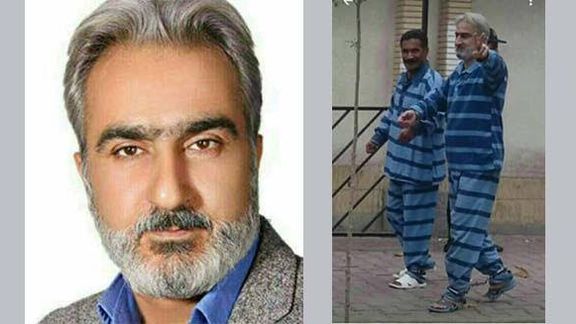
A political prisoner detained in Iran’s Mashhad prison in the northeast, has revealed the extent of his deteriorating health condition during his latest contact.

A political prisoner detained in Iran’s Mashhad prison in the northeast, has revealed the extent of his deteriorating health condition during his latest contact.
Activist Abbas Vahedian Shahroodi released an audio file in which he explains that the palms of his hands and the soles of his feet are suffering from extreme peeling, and he is forced to constantly remove excess skin with a nail clipper.
The condition is currently so dire that due to the skin's peeling, he is suffering constant bleeding but facing medical neglect he is suffering, and his condition remains undiagnosed.
Vahedian, a teacher and writer, is one of 14 civil and political activists inside Iran who, on June 11, 2019, published an open letter demanding the resignation of Iran's ruler Ali Khamenei and fundamental changes to the constitution.
Vahedian, who was also detained and sentenced in 2018 for his civil and political activities, was tried in the Mashhad Revolutionary Court after the publication of the letter. He has been sentenced to a total of 21 years of imprisonment on charges such as "acting against national security" and "collaboration with opposition groups."
Iran’s judiciary says individuals with medical problems cannot be detained. However, this comes in the wake of numerous reports indicating that Iranian authorities have deliberately denied medical care to political prisoners, leading to fatalities and suffering, including Faramarz Javidzad, an Iranian-American citizen, who died in the notorious Evin Prison on Saturday as his physical health deteriorated due to a lack of medical attention.

Iran International has obtained information shedding further light on how several young protesters were killed during anti-regime protests in Iran.
Alireza Hosseini Khoms, a young man born in 1997, was one of more than 500 people killed by security forces in the protests that turned into an uprising in September 2022 and lasted for months.
According to a source close to the family, gunfire from security agents killed Khoms. One of the bullets struck his left thigh, while the other found its mark in the neck near his throat. The circumstances surrounding his transfer to the hospital remain unclear; however, following his admission, regime agents reportedly contacted his family to convey the news of his death.
Hosseini, an employee of Erfan Niayesh Hospital located in Tehran, resided with his parents near the capital Tehran. The incident took place on September 21, when Alireza became the target of two bullets fired by government agents.
Regime's security forces told the family that Alireza's body would be returned to them only if they agreed to hold a quiet burial. Consequently, two days later, Alireza was laid to rest in the Behesht-e Fatemeh Cemetery in Eslamshahr.
Alireza's official death certificate, dated October 4 and registered with the Civil Registry Organization, attributed the cause of death to a "collision with hard or sharp objects."
Furthermore, a report from the criminal investigation unit, a copy of which has been obtained by Iran International, describes the scene as follows: "The body was discovered within a mortuary, displaying signs of gunshot wounds on the left thigh and near the throat."
Despite compelling evidence and several eyewitnesses, the Hosseini family's efforts to seek justice from military and judicial authorities in Tehran Province have been in vain, with the only response being, "We did not kill him; do not come back."

Faramarz Javidzad, an Iranian-American citizen, died in the notorious Evin Prison on Saturday as his physical health deteriorated due to a lack of medical attention.
On Friday night, after several days of declining health, Javidzad was transferred to the prison clinic. However, after a medical examination, he was returned to his cell, as prison authorities prevented his transfer to a hospital, as reported by IranWire.
It remains unclear what he was convicted of, and whether the United States raised his case during recent negotiations for a prisoner exchange with Iran.
On Saturday, despite his blood pressure reaching a critical level, prison authorities continued to prevent his transfer to a hospital.
The 60-year-old had reportedly lived in the United States for two decades before returning to Iran a few years ago.
Since the establishment of the Islamic Republic in 1979, a significant number of prisoners have lost their lives due to a lack of access to proper medical care.

The Friday Prayer Imam of Rask, in Iran's Sistan-Baluchestan Province, has been tortured by intelligence agents during his detention, the family has charged.
The son of Mowlavi Fat’hi Mohammad Naqshbandi made a revelation on Saturday, asserting that his elderly father had endured torture involving the use of an "electroshock weapon" and a hot iron at the Zahedan Intelligence detention center.
Abdolqaffar Naqshbandi, in a post on the X social network, lamented, "I received news about a month after my elderly father's detention that he is once again being subjected to physical and psychological torture in Zahedan, the very same place where both he and I endured four years of torment."
The Sistan-Baluchistan Judiciary, August 20th, officially announced the arrest of Mowlavi Naqshbandi on charges that included "disrupting public opinion through false speeches, slander, and defamation against the Islamic Republic of Iran's regime, engaging in activities against national security, and engaging in the unlawful occupation of national lands."
Simultaneously, the Baluchestan news website, Halvash, reported that Naqshbandi had been detained under circumstances involving "humiliation and insult."
In recent months, the situation in Sistan-Baluchestan has markedly deteriorated, with cities in the region experiencing heightened tension, especially on Fridays when residents voice their grievances against the regime through protests.
There have been numerous reports of attacks targeting military and government forces within the province in the months following the tragic death of Mahsa Amini in custody last year, which triggered nationwide protests.

Hackers claim they gained control over 500 servers of Iran’s Ministry of Science, revealing a trove of classified documents on protests and academia dissidents.
The hacker group Ghiyam ta Sarnegouni (Uprising till Overthrow) which is affiliated to the People's Mojahedin Khalq Organization (MEK) made the announcement Saturday, the first day of the new academic year in Iran and said it had acquired access to over 20,000 documents.
Some of the documents hackers have published on their Instagram and Telegram accounts are related to purging academics who are critical of the government or have supported the Women, Life, Freedom movement.
The purge has opened the way for hiring 15,000 pro-regime professors and other staff in universities. Authorities also plan to adopt new student selection procedures and expelling thousands of students who have been part of the protest movement. They have even greenlighted the acceptance of Iraq’s Shiite Hashd al-Shaabi militias and other proxies in Iranian universities.
The ministry’s public relations in a statement Saturday claimed “vigilant technical experts” had managed to repel the cyber-attack and shut down the ministry’s website temporarily to investigate the incident.
In the past year, MEK-affiliated hackers have targeted the portals of several other government agencies including Tehran Municipality, the state broadcasting corporation (IRIB), the Presidential Office, and the ministries of Foreign Affairs, Agriculture, and Islamic Guidance and published thousands of documents.

A "very confidential” document published by hackers this time reveals the proceedings of a Supreme Council of Cultural Revolution meeting including demographic data about last year’s nationwide protests based on data from intelligence agencies, including the Ministry of Intelligence and the Revolutionary Guards (IRGC) Intelligence Organization (SAS).
Dated October 5, 2022, approximately three weeks after the death of 22-year-old Mahsa Amini in custody sparked nationwide anti-government protests, the document emphasizes that 82 percent of detainees in the first two weeks of the protests were teenagers and young people under the age of thirty, with men comprising the majority at 88 percent of all detainees.
The document also states that authorities had no records related to 93 percent of detainees and that protesters promoted civil disobedience in places such as bazaars, metros and city buses. According to the same document, “hatred towards the Islamic Republic, hostility and civil disobedience” had been observed among protesters.
In a classified letter to President Ebrahim Raisi that hackers claim to have accessed, Higher Education Minister Mohammad-Ali Zolfigol says some university chancellors were reluctant to cooperate with security bodies in suppressing the students and that some academic officials who had signed statements against such measures had been fired.
Zolfigol said in the letter that Sharif University of Technology, one of the top universities in Iran, “had come completely under the control of rioters” and added that the National Security Council (NSC) and Supreme National Security Council (SNSC) officially demanded the chancellor of the university to be sacked.
Sharif University required “fundamental changes” without which it could not be controlled if there was more unrest in the future, the minister said in his letter to the President.
Students in at least 150 universities across Iran held protests during last year’s several-month-long unrest and in many cases were supported by their professors. Documents acquired by hackers from the IRGC-affiliated Fars News Agency in December indicated that at least 51% of the students at state universities had participated in Women, Life, Freedom protests.
The recent purge of academia in Iranian universities dubbed as ‘the second cultural revolution’ has shaken many Iranians who are already grappling with various pressures. The purge comes amid loss of hope in improvement of the country’s circumstances, including its economy, relations with the international community and removal of sanctions, as well as even relative social and political freedoms.

Iran has approved a plan to provide unrestricted SIM cards to foreign tourists, while the internet is severely restricted for its own citizens.
Ali Asghar Shalbafian, the Deputy for Tourism at the Ministry of Cultural Heritage, said tourism is a priority in the plan, and in the first phase, a list of "approved" travel agencies will be provided with uncensored internet.
All international messaging apps and social media platforms, as well as tens of thousands of websites are blocked in Iran and users must deploy VPNs to circumvent the restrictions.
Shalbafian also emphasized that under the plan, unfiltered SIM cards will be provided to foreign tourists visiting Iran. In addition to tourists, hotel staff and tour guides will also have such SIM cards.
The news of providing unrestricted SIM cards to foreign tourists was first published in late February by the government. Strong reactions to the news led the government to delete the tweet a few hours after its publication.
Following that, Issa Zarepour, the Minister of Communications and Information Technology, explained that foreign tourists were facing difficulties due to the blocking of platforms like Instagram and WhatsApp.
Ezzatollah Zarghami, the Minister of Cultural Heritage and Tourism, also emphasized that providing free access to the internet for foreigners is a “necessity.”
With the approval and implementation of the plan, it seems that the Iranian authorities are taking another significant step toward tiered internet access.
Although it's not the first time that certain individuals in the country have had access to the internet without restrictions, the clear distinction between Iranian citizens and non-Iranians is a matter that some have described as digital segregation.
Currently, employees of government ministries, members of parliament, university professors, and members of some associations and guilds, including specific groups, are among those who benefit from tiered and uncensored internet access in Iran.