Iran Sentences Four To Death Over Counterfeit Alcohol Sales
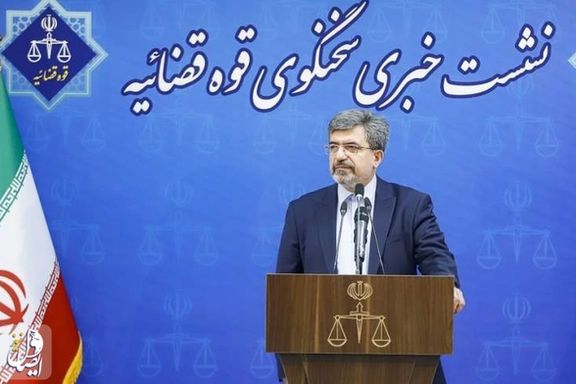
Four men have been sentenced to death convicted of being in a counterfeit alcohol network which led to the deaths of 17 Iranian citizens.
Four men have been sentenced to death convicted of being in a counterfeit alcohol network which led to the deaths of 17 Iranian citizens.
Masoud Setayeshi, Iran's judiciary spokesperson, revealed details of the wide scale operation on Tuesday, the network's distribution having led to the poisoning, blindness, and disability in 191 other Iranians.
Eleven defendants were charged with "corruption on earth" for distributing toxic and hazardous methanol-laced substances, a charge which often carries the death penalty, though only four were sentenced to death. Others in the gang were charged with one to five year prison terms.
For decades, Iran has grappled with alcohol poisoning due to the consumption of counterfeit alcoholic beverages, resulting in fatalities, blindness, and severe injuries. Despite the Iranian regime's strict ban on alcohol, a recent survey by Iran Open Data revealed that half of all adults continue to regularly consume alcohol, often resorting to homemade beverages to evade the prohibition.
In recent months, Iranian cities have witnessed a concerning surge in alcohol poisoning cases, leading to hospitalizations and deaths, as reported by local news outlets.
A 2018 report by the World Health Organization (WHO) ranked Iran ninth out of 189 countries in terms of alcohol consumption per capita, underscoring the persistence of alcohol consumption despite the government's ban.

During an interview with the state broadcaster Monday, IRGC Navy Commander Alireza Tangsiri announced the construction of approximately 900 residential units by his force for the people on the three islands of Greater Tunb, Lesser Tunb, and Abu Musa.
The measures by the IRGC are in line with the Islamic Republic’s policy to encourage people to live in the islands, where living conditions are dire in the absence of basic facilities. The government has also announced it is mulling over a plan to give free plots of land measuring 300sq meters (3,230sq feet) to anyone who commits to living on them. Moreover, it will also offer loans to build a home, as part of a national homeownership scheme, in a bid to incentivise Iranians to populate the contested area.
The three Persian Gulf islands have historically been part of Iran, proof of which can be corroborated by historical and geographical documents. However, the UAE has repeatedly laid claim to the islands, describing the situation as “the continued occupation by the Islamic Republic of Iran.” The three islands fell under British control in 1921 but on November 30, 1971, a day after British forces left the region and just two days before the UAE was to become an official federation, Mohammad Reza Shah – the last monarch of Iran -- sent the Iranian navy to secure all three. Iranian forces remain on the islands, with only Abu Musa having a civilian population which is less than two thousand.
Tangsiri reiterated that Iran’s Supreme Leader Ali Khamenei has personally ordered efforts to increase the islands’ population “as a means to increase their security. We believe that we should settle the people on these islands so that our friends do not fear that we want to establish a military base against them," he stated, referring to Arab countries of the region who have collectively asserted the United Arab Emirates' right to sovereignty over the islands.

The Persian Gulf Cooperation Council (GCC) -- a regional organization bringing together six countries of Bahrain, Qatar, Kuwait, the United Arab Emirates, Oman and Saudi Arabia -- repeatedly expresses support for “the right of the State of the UAE to regain sovereignty over her three islands and over the territorial waters, the airspace, the continental shelf, and the economic zone of the three islands, as they are an integral part of the State of the United Arab Emirates.”
Like China did in December, Russia signed a statement with the Gulf Cooperation Council in early July challenging Iran's ownership of three islands. Last week, the GCC foreign ministers, US Secretary of State Antony Blinken, and GCC Secretary General Jasem Albudaiwi published a joint statement following their meeting in New York expressing “their support for the United Arab Emirates’ call to reach a peaceful solution to the dispute.”
Speaking at the annual United Nations General Assembly earlier this week, UAE’s Minister of State for International Cooperation Reem Al Hashimy also reiterated her country’s demand that Iran stop its “occupation” of the three islands of Greater Tunb, Lesser Tunb, and Abu Musa. She added that the UAE “continues to seek a resolution, either through direct negotiation or through the International Court of Justice. This has been our firm stance for decades.”

On Monday, Iran's permanent mission to the UN rejected the claim as “baseless,” saying, “Iran regards such groundless statements as violation of the sovereignty and territorial integrity of a member of the United Nations and a gross violation of international law and the United Nations Charter.”
Tangsiri's remarks came against the backdrop of a series of maritime incidents involving Iran's seizure and harassment of vessels that prompted the US to strengthen its military presence in the region. This also came as Arab countries have stepped up efforts to claim the three islands leveraging their relations with Russia and China to sideline Iran.
In recent months, Tehran's military forces have hijacked several Western tankers in what is seen as retaliation for previous Western seizures of Iranian oil. Iran's introduction of advanced maritime weaponry prompted Washington to extend armed protection to commercial ships traversing the Strait of Hormuz. In July, the US Defense Department announced the deployment of F-35 jet fighters and a Navy destroyer to the Middle East.
Each day, 85 vessels, primarily oil tankers, pass through the Strait of Hormuz on average. A substantial portion of the world's crude oil is transported through these waters and thus, it has strategic importance.
Highlighting the strategic significance of the Strait of Hormuz, the IRGC Navy commander said that “the island of Greater Tunb, resembling an unsinkable aircraft carrier, is strategically positioned in the middle of the Strait of Hormuz, with full control over the entrance and exit routes of the strait.”
Tangsiri added that the three islands along with Farvar, Sirri, and Lesser Farvar islands provide complete dominance over the entry and exit routes of the region.
The Persian Gulf has numerous small islands with about 20 residential ones under Iran’s rule as well as about 20 without any local residents. Most islands are sparsely populated, with some being barren, and some utilized for communication, military, or as ship docks.
Tangsiri said, “Foreigners have long cast covetous eyes on this region,” noting that the region’s vast oil and gas resources have further grown their eagerness.


According to the latest report from ISC, the point-to-point inflation rate is approximately 40 percent, signifying that Iranian households now spend 40 percent more on purchasing an "identical set of goods and services" compared to September 2022.
In the absence of credible data from the Central Bank of Iran regarding inflation rates, Iran's Statistical Center has become the primary official entity for announcing these figures. Government officials and, at times, the central bank tend to announce lower inflation figures prices for consumer goods. The central bank, along with the Ministry of the Economy, ceased issuing regular economic data in 2019 when US sanctions that pushed an already struggling economy into a deep recession.
Although Iran's Statistics Center is administered and funded by the government and operates under the umbrella of Planning and Budget Organization, it has maintained a veneer of credibility as one of the very scarce sources of data – both economic and social. However, it has recently faced pressure from the regime to release figures in line with the government's propaganda. In July, President Ebrahim Raisi sacked the head of Iran's Statistics Center.
Despite the regime's claims of increased crude oil sales and the positive impact of releasing Iran's revenues from Iraq and South Korea, which were blocked under US sanctions, economic hardships continue to pressure Iranians. The purchasing power of the average household in Iran has significantly decreased in recent years, with the highest price hikes affecting food items. Meat, once the primary source of protein for wage earners in Iran, was initially replaced by chicken, and more recently by eggs.

Approximately a year ago, Iran's rial was trading at around 300,000 per US dollar, but in early May, it dropped to as low as 550,000. Currently, it stands above 490,000. This drastic devaluation of the rial illustrates the severity of inflation in Iran. In July, a lawmaker stated that the annual inflation rate was 120 percent, contradicting the 60 or 70 percent figures cited by various politicians and academics. According to World Bank figures from June, Iran's food inflation rate stood at 78 percent.
The head of Tehran's Supermarkets Union said last week that "people's purchasing power has declined by more than 50% compared to the same period last year, disrupting the supply chain in the market." Davoud Fekouri had to refute his earlier claims in an interview with the state news agency IRNA. In his Monday interview, he was apparently forced to say that supermarket sales have decreased insignificantly and claimed that “it was primarily due to rising prices of certain food items, such as pasta, dairy products, tomato paste, canned fish, and others."
According to data by SCI, over a 10-year period from 2011 to 2021, per capita consumption of rice and red meat decreased by 20.5 percent and 54 percent, respectively. Moreover, per capita consumption of milk and dairy products dropped by 13.4 percent, and per capita consumption of fish and shrimp halved.
Lawmaker Abbas Moghtadaei Khourasgani claimed on Monday that US measures such as sanctions and freezing Iranian funds abroad have “failed miserably,” and people will feel the positive impact of the government’s policies in the near future. “Unfreezing Iran’s assets is among the very positive endeavors of the current administration that will undoubtedly have a positive impact on the people's well-being,” he said, adding that the released funds will help control the market and the devaluation of rial. In the past few days, rial’s exchange rate has fallen against the dollar, albeit insignificantly.
However, the release of Iran’s money from Iraqi banks -- that apparently started in June -- and its $6 billion in oil revenues from South Korea earlier this month as well as a rise in oil exports have so far failed to make a dent in the adversity people face.