Switzerland Slaps Sanctions On Iran Over Drone Supply To Russia

Switzerland has imposed further sanctions in connection with Iran's drone supply for the Russian invasion of Ukraine, the government said in a statement on Friday.

Switzerland has imposed further sanctions in connection with Iran's drone supply for the Russian invasion of Ukraine, the government said in a statement on Friday.
Switzerland's Federal Council added in its statement that the new punitive measures are in line with those of the European Union and include bans on the sale, supply, export and transit of components used for the manufacture and production of drones.
According to the statement, the new package also targets financial and travel sanctions against persons and entities connected with support for Iran's drone program.
“In view of Iran's continued military support for Russia's military aggression against Ukraine, which is contrary to international law, and the fact that Russia is using Iranian-made Unmanned Aerial Vehicles (UAVs) to support the military aggression,” the Federal Council adopted the sanctions imposed by the EU on 20 July as part of its new framework for restrictive measures. “Switzerland is incorporating these new sanctions measures into the Ordinance on Measures against the Islamic Republic of Iran.”
In July, a group of European Union candidate countries -- namely North Macedonia, Montenegro, Albania, Ukraine, Republic of Moldova, and Bosnia and Herzegovina -- aligned themselves with an EU Council decision to introduce a fresh sanctions framework aimed at Iran's support for Russia's war on Ukraine.
Switzerland has been adopting the EU's sanctions listings regarding the supply of Iranian UAVs to Russia since autumn 2022, the last time being on 16 August.
Earlier in the week, as a fresh Ukrainian report outlined the use of Western parts in Iranian-made drones, Washington issued a set of fresh sanctions on a procurement network.
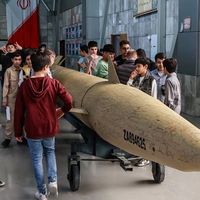
The move is the latest in a series of recent Western sanctions on Iran for supplying hundreds of kamikaze Shahed drones to Russia. Moscow has used the lethal weapon to attack civilian and infrastructure targets, as well as to overwhelm Ukrainian air defenses during large missile attacks.

A top military adviser to Iran’s Supreme Leader has boasted about the attack on US bases in Iraq in January 2020, emphasizing that Ali Khamenei ordered the attack.
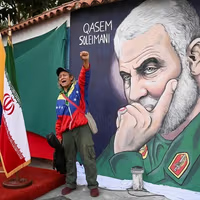
Major General Yahya Rahim-Safavi, who is a former commander-in-chief of the Revolutionary Guard, said Friday that after the targeted killing of IRGC’s Quds force commander Qassem Soleimani, “the Supreme Leader ordered the missile strike on the Ayn al-Asad airbase (in western Iraq) within a short period.”
On January 3, 2020, former US President Donald Trump ordered a drone strike near Baghdad International Airport that killed Soleimani. The US justified the action by saying that Soleimani was actively planning attacks against American diplomats and military personnel in Iraq and the broader region.
Rahim-Safavi also claimed that Trump anticipating Iranian retaliation "had ordered his military commanders to be prepared to retaliate but hey argued that if we respond to Iran, Iran has already prepared its missiles, and all our armed forces in Iraq, Kuwait, and Bahrain will be vulnerable to Iranian missile strikes, and we cannot withstand it.”
“We had really prepared our missiles," he added, perhaps referring to the high alert status of Iran’s military forces that led to the IRGC's downing of a Ukrainian airliner killing all 176 passengers and crew. The airliner was shot down by two air-defense missiles fired by the IRGC as it took off from Tehran’s Imam Khomeini International Airport as the IRGC was anticipating retaliation for its ballistic missile attack that targeted the base.
“Today, we have become so strong that even our enemies like the United States and the Zionists (Israel) do not even think about attacking us,” he said. His sentiment was echoed by Iraj Masjedi, another former senior Quds force commander earlier in the day. Masjedi was also Iran's ambassador to Iraq and a top advisor to Soleimani.

Iran’s security forces opened fire injuring at least 23 people in Zahedan, including four children, who were marking the one-year anniversary of a government massacre.
Amid heavy security presence, the predominantly Sunni population of the city held another demonstration after their Friday prayers, as they had done every single Friday during the past year. This Friday marked the eve of the regime's brutal crackdown on protesters in several cities of Sistan-Baluchestan province on September 30, 2022.
Online videos from the Friday rallies show security forces using live fire and tear gas to disperse the protesters, injuring several people. Several other cities in the province, such as Khash, Rask, and Taftan, have seen people taking to the streets, chanting slogans against the regime. In some of the videos from Zahedan and Khash, security forces are seen retreating as protesters advance towards them.
By nightfall, people in several cities are still out on streets setting up bonfires to disrupt the movements of security forces.
Footage from the clashes and the injured protesters at hospitals were so touching that Iranians on social media have already started condemning the brutal crackdown.
US Representative Claudia Tenney (R-NY) said on X that she is appalled by the attack on Makki Mosque, calling on the IRGC to immediately end this abhorrent assault on the Iranian people.
September 30, 2022 is known as "Bloody Friday" which witnessed a devastating loss of life, with approximately 100 protesters in the Baluch region of Iran, including women and children, falling victim to direct gunfire from military and security forces.
Many of them succumbed to severe head and chest injuries, marking a dark chapter in Iran's history that unfolded amidst the uprising against the regime following the death of Mahsa Amini and the rape of a 15-year-old Baluch girl by the police chief of Chabahar, a city in Sistan-Baluchestan province. The regime has since failed to take any action against the perpetrators or launch a transparent investigation.
In some of the videos from Zahedan and Khash, security forces are seen retreating as protesters advance towards them. Some people on social media commented that Zahedan is fighting on behalf of all Iranians.
The protests began after Friday prayer sermons by Iran's leading Sunni cleric, Mowlavi Abdolhamid, in Zahedan's Makki mosque, where he decried the regime's inaction regarding the perpetrators of the Bloody Friday incident. The mosque was surrounded by a large number of security forces who had set up tents and positioned armed forces in the area during the night in anticipation of protests.
A huge number of people attended the congregation and embarked on a rally, chanting slogans and carrying banners despite the security atmosphere.
Referring to Bloody Friday, Abdolhamid, who has become a dissident cleric, emphasized that such a massacre is a consequence of the discriminatory policies of the regime towards ethnic and religious minorities. The outspoken cleric, who delivered his speech amid an internet shutdown that disrupted the live broadcast of the sermon, noted that "such an attack with over 100 killed and 300 injured does not happen anywhere else in the world."
As Sunni Muslims, Baluch citizens are both an ethnic and religious minority. Estimates of the Iranian Baluch population range from 1.5 to 2 million people. The Baluch community, along with the Kurds, has always been among the most persecuted minorities in Iran and has the largest number of people executed in the country.
Abdolhamid, who described Bloody Friday as a premeditated action against the Baluch minority last year, noted that the prayer ground in the city of Zahedan, where the attacks took place, had always been a place of "unity and security," and no one expected such a massacre to happen there.
He added that while the "judges" handling the case of the Bloody Friday incident are "good people," they lack the independence they should have, and underlined that he is aware of "the pressure from various authorities" exerted on them.

Iran’s industry minister has criticized the “graveyard of grounded airplanes” at Tehran’s Mehrabad Airport, calling on Iranian firms to do something about it.
Abbas Aliabadi, the minister of industry, mines and trade, made the remarks during an event on Thursday, saying that knowledge-based companies must try to make Iran “a hub for technology in the region.”
"At Mehrabad Airport, there is a graveyard of grounded airplanes. When we inquire about the reason, they say these airplanes have technical issues due to sanctions, such as lacking engines,” he said.
He said about 9,000 knowledge-based companies have been registered in the country, but the number of active groups is less than 70 companies. Since Khamenei included the adjective “knowledge-based” in the motto of the previous Iranian year (which ended March 20), the most important thing that occurred is that many companies redesigned or reintroduced themselves as such to take advantage of loans and incentives available from the government.
According to Alireza Barkhor, the deputy chairman of the Association of Iranian Airlines, more than 50 percent of Iran’s passenger planes are grounded due to lack of spare parts, particularly engines. Mohammad Mohammadi-Bakhsh, the Head of the Iranian Civil Aviation Organization, revealed that from Iran's 330 registered passenger planes, 139 are currently out of service.
Decades-long sanctions have inhibited Iran's ability to procure passenger aircraft and related equipment from international markets, leading to an aging national aviation fleet.
Iran has suffered from shortages of civilian airliners since the 1990s and used a variety of ways to lease older planes or buy spare parts through intermediaries, but the technical state of its fleet has been deteriorating.
The 2015 nuclear agreement (JCPOA) suspended sanctions on purchases of Western aircraft and Iran began talks to buy new planes from Boeing and Airbus. A few airbus planes were delivered but the Trump administration never approved sale of US planes until Washington withdrew from the JCPOA in May 2018 and reimposed sanctions.

Saudi Arabia is seeking binding US security guarantees, primarily against Iran, before it agrees to establish relations with Israel, sources have confirmed to Reuters.
Three unnamed regional sources said that the Palestinian issue is not paramount for the Saudis, who are determined to secure a military pact with the United States to defend the kingdom.
Although a pact might fall short of the cast-iron, NATO-style defense guarantees the kingdom initially sought when the issue was first discussed between Crown Prince Mohammed bin Salman and President Joe Biden during his visit to Saudi Arabia in July 2022.
Instead, a US source told Reuters it could look like a US agreement with Bahrain, where the US Navy Fifth Fleet is based. Such an agreement would not need congressional backing, which can be implemented before Biden’s first presidential term ends next year.
Washington could also sweeten any deal by designating Saudi Arabia a Major Non-NATO Ally, a status already given to Israel, the US source said.

Although Iran re-established diplomatic ties with Saudi Arabia earlier this year, top Iranian officials have been criticizing Riyadh’s plans for establishing relations with Israel as a step detrimental for the Palestinians. Tehran supports militant Palestinian groups who have intensified their attacks against Israel and its civilian population this year.
Palestinian groups such as Hamas and the Islamic Jihad are parts of Iran’s militant network of proxy forces from Iraq to Lebanon and in Yemen. They receive financial and military assistance that Tehran is not reluctant to boast about.
Riyadh is well aware of Tehran’s ability to foment unrest across the region or even directly harm Saudi Arabia. Prince Mohammed bin Salman is said to have been “traumatized” by a devastating attack on Saudi oil installations in September 2019, and follow-up missile and drone attacks by Iran-aligned Houthis in Yemen.
Despite close Saudi ties with former President Donald Trump’s administration, the US failed to immediately take any action against Iran for its brazen missile and drone attack, which posed a major risk to global energy supplies. As a result, Reuters’ sources said Saudi Arabia would not settle for less than binding assurances of US protection if it faced attack.
Agreements giving the world's biggest oil exporter US protection in return for normalization with Israel would reshape the Middle East and binding Riyadh to Washington after China's inroads in the region. For Biden, it would be a diplomatic victory to vaunt before the 2024 US election.
In reviving relations with Iran, Riyadh hoped to pacify the Houthis in Yemen and perhaps reach a lasting peace to focus on its grand development plans at home. However, so far there are no major positive developments.
Another Saudi goal could have been to reduce the chances of a harsh reaction by the militant regime in Iran to any agreement with Israel. Riyadh tried to balance its regional policies by improving ties with Tehran before normalizing relations with Israel.
While the Biden administration is insisting on securing some Israeli guarantees regarding concessions to Palestinians, Saudi Arabia seems less interested in tying its goals to their fortunes.
"The normalization will be between Israel and Saudi Arabia. If the Palestinians oppose it the kingdom will continue in its path," said one of the regional sources. "Saudi Arabia supports a peace plan for the Palestinians, but this time it wanted something for Saudi Arabia, not just for the Palestinians."

Retired Revolutionary Guard officers were deployed to suppress protesters in Iran during anti-regime demonstrations, IRGC commander Hossein Salami said on Thursday.
Addressing retired officers during a gathering in Tehran Salami said that the IRGC “organized” retired officers and “deployed” them to the “battlefield” during the Women, Life, Freedom movement. The protests broke out after a 22-year-old woman was killed in the custody of Iran’s notorious hijab police in September last year.
Salami, calling the protests “riots” according to the Iranian regime’s terminology told retired officers, “Even now, you are in the battlefield…and when there are riots, you are present, you show up, get organized and go [to confront the protests].
The Islamic Republic deployed the regular police, riot police, IRGC forces and plainclothes agents in tens of thousands across the country to suppress the protests. They were armed with military weapons, shotguns, clubs and knives. More than 540 civilians were killed by these forces and 22,000 arrested in five months. Scores of you people lost one or both eyes when agents fired at their faces with shotgun ‘birdshots’.
Salami emphasized that retired IRGC officers have always been present in the past in suppressing protests. However, during the protests, Salami had threatened young demonstrators that the regime will “come after them” with its young supporters.
According to past statements by other IRGC commanders, during the 2009 protests to a fraudulent presidential election, thousands of criminals were freed from prisons and ordered to attack demonstrators.