Inmates Start Fire At Prison In Iran’s Southwest, Shots Heard
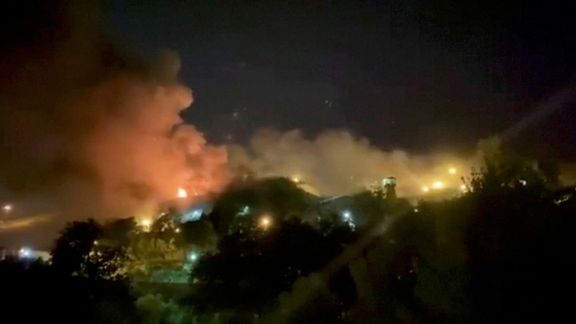
Prisoners at a facility in southwestern Khuzestan province started a fire Friday to protest a death sentence issued against a fellow inmate.

Prisoners at a facility in southwestern Khuzestan province started a fire Friday to protest a death sentence issued against a fellow inmate.
According to Iranian state news agencies, "Following the announcement of the death sentence of a prisoner in Ramhormoz prison, several prisoners started a riot by starting a fire.”
"Gunfire could be heard from outside the prison," Mehr News said.
Gholamreza Roshan, the director-general of Khuzestan’s prisons, told a reporter with IRGC-affiliated Fars news that the unrest occurred after a convict was given a death sentence for murder.
"Some inmates in the same ward as the condemned individual instigated the unrest under the pretext of defending him," he added.
He also claimed that immediate action was taken by prison authorities, and the situation in the prison is under control. However, there was no independent assessment of the situation.
Earlier in the month, another fire was reported in a prison near the capital Tehran on the anniversary of Mahsa Amini, whose death triggered the biggest anti-regime protests in Iran. State media said female convicts on death row set fire to the women's ward at the Qarchak penitentiary by burning their clothes.
Also on that day, detainees in the women's ward of Tehran's Evin Prison gathered in protest to mark the occasion, chanting slogans against the regime, refusing to enter their cells, and setting fire to their headscarves in the prison courtyard.

Media in Germany have been discussing a recent report by Iran International on an influence operation by the Islamic Republic of Iran in the US and Europe.
Iran International and Semafor this week simultaneously published similar versions of the report, shedding light on the Islamic Republic's influence network (IEI) within the United States and Western decision-making circles. The report garnered significant attention in the German media landscape. Notable publications such as Die Welt, Berliner Zeitung, Bild, and Taz have extensively covered this revelation.
Die Welt, in an article titled "A trace of the Iran network also leads to Berlin," emphasized the sensitivity of the publication’s timing and raised questions about the inclusion of a German name within the report. The publication expressed surprise at the lack of coverage by major American newspapers, including The Washington Post and The New York Times, regarding this crucial and sensitive matter.
Die Welt referring to an email sent by Adnan Tabatabai to Iranian former foreign minister Mohammad Javad Zarif, in which Tabatabai offers that members IEI (Iran Experts Initiative) could write articles to be published under the names of current or former Iranian officials potentially using false authorship, to promote Iran’s views in the West.
Die Welt's perspective underscores the uniqueness of this situation, noting that among the experts mentioned in the Iran International report, only Adnan Tabatabai disputes the authenticity of the disclosed documents. Regardless of the material's authenticity, the article raises questions about the boundaries between independent experts and their areas of expertise. It emphasizes that IEI members in this context have openly advocated for a diplomatic approach in negotiations with Iran, while emphasizing the importance of maintaining independence within their respective fields of expertise.

Berliner Zeitung has raised the possibility that one of Germany’s Ministry of Foreign Affairs partners, Adnan Tabatabai, may have acted as a "Ghost writer" for the Iranian authorities within Germany. This revelation has the potential to be a critical situation for FM Analena Baerbock.
There are suspicions that the Ministry of Foreign Affairs may have also provided support to a think tank closely aligned with the Iranian government.
According to Berliner Zeitung, Adnan Tabatabai has made multiple public appearances alongside Analena Baerbock in the past, and his think tank, Carpo, has received significant funding from the Ministry of Foreign Affairs. Over one million euros of public tax funds have been allocated to Carpo as a partner of the Ministry of Foreign Affairs for various dialogue projects. Adnan Tabatabai serves as the CEO of Carpo.
The discussion surrounding this issue has also been extensively covered by Taz and Bild. Bild, published a photo of Adnan Tabatabai alongside German Foreign Minister Baerbock, raising questions about potential ties to Iranian intelligence. The article implies that Tabatabai’s interactions with the federal foreign minister go beyond mere support for Iran's authoritarian regime.
Furthermore, Bild highlights a serious suspicion that Adnan Tabatabai actively engaged with the Iranian regime to promote public relations for Iran’s nuclear program. The leaked emails provide insights into how the Iranian regime utilized initiatives to influence the foreign policies of Western nations, with some experts reportedly obtaining government positions in the United States.
Despite being the sole individual vehemently denying the contents of the Iran International report, Adnan Tabatabai has repeatedly defended and whitewashed the Islamist regime in the media in recent years.
Die Welt claims that the German MFA has not answered its questions about Adnan Tabatabai, raising more questions about the extent of IEI's influence on the relationship between the United States and Iran.
However, the German MFA sent a short reply to the Berliner Zeitung, stating, “Previous project funding never resulted in privileged, exclusive, or advisory access to the Foreign Ministry.” In a recent interview with Die Welt, Tabatabai reported on his "exchange of content with employees of Germany MFA," based on current developments and conducted in person.

A top military adviser to Iran’s Supreme Leader has boasted about the attack on US bases in Iraq in January 2020, emphasizing that Ali Khamenei ordered the attack.
Major General Yahya Rahim-Safavi, who is a former commander-in-chief of the Revolutionary Guard, said Friday that after the targeted killing of IRGC’s Quds force commander Qassem Soleimani, “the Supreme Leader ordered the missile strike on the Ayn al-Asad airbase (in western Iraq) within a short period.”
On January 3, 2020, former US President Donald Trump ordered a drone strike near Baghdad International Airport that killed Soleimani. The US justified the action by saying that Soleimani was actively planning attacks against American diplomats and military personnel in Iraq and the broader region.
Rahim-Safavi also claimed that Trump anticipating Iranian retaliation "had ordered his military commanders to be prepared to retaliate but hey argued that if we respond to Iran, Iran has already prepared its missiles, and all our armed forces in Iraq, Kuwait, and Bahrain will be vulnerable to Iranian missile strikes, and we cannot withstand it.”
“We had really prepared our missiles," he added, perhaps referring to the high alert status of Iran’s military forces that led to the IRGC's downing of a Ukrainian airliner killing all 176 passengers and crew. The airliner was shot down by two air-defense missiles fired by the IRGC as it took off from Tehran’s Imam Khomeini International Airport as the IRGC was anticipating retaliation for its ballistic missile attack that targeted the base.
“Today, we have become so strong that even our enemies like the United States and the Zionists (Israel) do not even think about attacking us,” he said. His sentiment was echoed by Iraj Masjedi, another former senior Quds force commander earlier in the day. Masjedi was also Iran's ambassador to Iraq and a top advisor to Soleimani.

Iran’s security forces opened fire injuring at least 23 people in Zahedan, including four children, who were marking the one-year anniversary of a government massacre.
Amid heavy security presence, the predominantly Sunni population of the city held another demonstration after their Friday prayers, as they had done every single Friday during the past year. This Friday marked the eve of the regime's brutal crackdown on protesters in several cities of Sistan-Baluchestan province on September 30, 2022.
Online videos from the Friday rallies show security forces using live fire and tear gas to disperse the protesters, injuring several people. Several other cities in the province, such as Khash, Rask, and Taftan, have seen people taking to the streets, chanting slogans against the regime. In some of the videos from Zahedan and Khash, security forces are seen retreating as protesters advance towards them.
By nightfall, people in several cities are still out on streets setting up bonfires to disrupt the movements of security forces.
Footage from the clashes and the injured protesters at hospitals were so touching that Iranians on social media have already started condemning the brutal crackdown.
US Representative Claudia Tenney (R-NY) said on X that she is appalled by the attack on Makki Mosque, calling on the IRGC to immediately end this abhorrent assault on the Iranian people.
September 30, 2022 is known as "Bloody Friday" which witnessed a devastating loss of life, with approximately 100 protesters in the Baluch region of Iran, including women and children, falling victim to direct gunfire from military and security forces.
Many of them succumbed to severe head and chest injuries, marking a dark chapter in Iran's history that unfolded amidst the uprising against the regime following the death of Mahsa Amini and the rape of a 15-year-old Baluch girl by the police chief of Chabahar, a city in Sistan-Baluchestan province. The regime has since failed to take any action against the perpetrators or launch a transparent investigation.
In some of the videos from Zahedan and Khash, security forces are seen retreating as protesters advance towards them. Some people on social media commented that Zahedan is fighting on behalf of all Iranians.
The protests began after Friday prayer sermons by Iran's leading Sunni cleric, Mowlavi Abdolhamid, in Zahedan's Makki mosque, where he decried the regime's inaction regarding the perpetrators of the Bloody Friday incident. The mosque was surrounded by a large number of security forces who had set up tents and positioned armed forces in the area during the night in anticipation of protests.
A huge number of people attended the congregation and embarked on a rally, chanting slogans and carrying banners despite the security atmosphere.
Referring to Bloody Friday, Abdolhamid, who has become a dissident cleric, emphasized that such a massacre is a consequence of the discriminatory policies of the regime towards ethnic and religious minorities. The outspoken cleric, who delivered his speech amid an internet shutdown that disrupted the live broadcast of the sermon, noted that "such an attack with over 100 killed and 300 injured does not happen anywhere else in the world."
As Sunni Muslims, Baluch citizens are both an ethnic and religious minority. Estimates of the Iranian Baluch population range from 1.5 to 2 million people. The Baluch community, along with the Kurds, has always been among the most persecuted minorities in Iran and has the largest number of people executed in the country.
Abdolhamid, who described Bloody Friday as a premeditated action against the Baluch minority last year, noted that the prayer ground in the city of Zahedan, where the attacks took place, had always been a place of "unity and security," and no one expected such a massacre to happen there.
He added that while the "judges" handling the case of the Bloody Friday incident are "good people," they lack the independence they should have, and underlined that he is aware of "the pressure from various authorities" exerted on them.

Iran’s industry minister has criticized the “graveyard of grounded airplanes” at Tehran’s Mehrabad Airport, calling on Iranian firms to do something about it.
Abbas Aliabadi, the minister of industry, mines and trade, made the remarks during an event on Thursday, saying that knowledge-based companies must try to make Iran “a hub for technology in the region.”
"At Mehrabad Airport, there is a graveyard of grounded airplanes. When we inquire about the reason, they say these airplanes have technical issues due to sanctions, such as lacking engines,” he said.
He said about 9,000 knowledge-based companies have been registered in the country, but the number of active groups is less than 70 companies. Since Khamenei included the adjective “knowledge-based” in the motto of the previous Iranian year (which ended March 20), the most important thing that occurred is that many companies redesigned or reintroduced themselves as such to take advantage of loans and incentives available from the government.
According to Alireza Barkhor, the deputy chairman of the Association of Iranian Airlines, more than 50 percent of Iran’s passenger planes are grounded due to lack of spare parts, particularly engines. Mohammad Mohammadi-Bakhsh, the Head of the Iranian Civil Aviation Organization, revealed that from Iran's 330 registered passenger planes, 139 are currently out of service.
Decades-long sanctions have inhibited Iran's ability to procure passenger aircraft and related equipment from international markets, leading to an aging national aviation fleet.
Iran has suffered from shortages of civilian airliners since the 1990s and used a variety of ways to lease older planes or buy spare parts through intermediaries, but the technical state of its fleet has been deteriorating.
The 2015 nuclear agreement (JCPOA) suspended sanctions on purchases of Western aircraft and Iran began talks to buy new planes from Boeing and Airbus. A few airbus planes were delivered but the Trump administration never approved sale of US planes until Washington withdrew from the JCPOA in May 2018 and reimposed sanctions.

Iranian political prisoner Fatemeh Sepehri has said she would only consent to her much-needed heart surgery if her two detained brothers are released.
Ali Sepehri, one of Fatemeh Sepehri's brothers, announced in a tweet on Friday that his sister "requires immediate heart surgery," but she has made the "consent for surgery a precondition" for the release of her detained brothers, Hassan Sepehri and Mohammad-Hossein Sepehri.
"My sister's angiography report shows that two out of her three main heart arteries are more than 95 percent blocked," Mohammad-Hossein Sepehri said earlier in the week. Ali Sepehri says two of his brothers -- Hassan and Mohammad-Hossein -- are in detention.
Sepehri and her brother Mohammad-Hossein are among the signatories of a statement requesting Supreme Leader Ali Khamenei's resignation in 2019. In another letter with 13 fellow women rights activists months later, she called for the abolition of Islamic republic and establishment of a democratic secular government.
She has been arrested a number of times during the past several years. Two years ago, Sepehri was released from Mashhad's Vakilabad prison after nine months of detention, but she released a video, saying "I will not remain silent and will stay on this path."
She was arrested again in the early days of the Women, Life, Freedom protests after security agents raided her home. In October, Sepehri's daughter published a video stating that her mother was held in solitary confinement at the Revolutionary Guard’s Intelligence center in the city of Mashhad.
The Mashhad Revolutionary Court sentenced her to 18 years in prison on charges of "collaboration with hostile states," "assembly and collusion," "insulting the leadership," and "propaganda against the regime." The sentence has been upheld by the Court of Appeals. Based on Article 134 of the Islamic Penal Code, she must serve ten years in prison.