Political Prisoner in Iran Demands Release Of Brothers Before Surgery
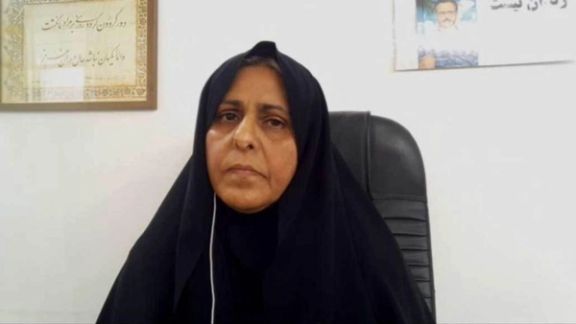
Iranian political prisoner Fatemeh Sepehri has said she would only consent to her much-needed heart surgery if her two detained brothers are released.
Iranian political prisoner Fatemeh Sepehri has said she would only consent to her much-needed heart surgery if her two detained brothers are released.
Ali Sepehri, one of Fatemeh Sepehri's brothers, announced in a tweet on Friday that his sister "requires immediate heart surgery," but she has made the "consent for surgery a precondition" for the release of her detained brothers, Hassan Sepehri and Mohammad-Hossein Sepehri.
"My sister's angiography report shows that two out of her three main heart arteries are more than 95 percent blocked," Mohammad-Hossein Sepehri said earlier in the week. Ali Sepehri says two of his brothers -- Hassan and Mohammad-Hossein -- are in detention.
Sepehri and her brother Mohammad-Hossein are among the signatories of a statement requesting Supreme Leader Ali Khamenei's resignation in 2019. In another letter with 13 fellow women rights activists months later, she called for the abolition of Islamic republic and establishment of a democratic secular government.
She has been arrested a number of times during the past several years. Two years ago, Sepehri was released from Mashhad's Vakilabad prison after nine months of detention, but she released a video, saying "I will not remain silent and will stay on this path."
She was arrested again in the early days of the Women, Life, Freedom protests after security agents raided her home. In October, Sepehri's daughter published a video stating that her mother was held in solitary confinement at the Revolutionary Guard’s Intelligence center in the city of Mashhad.
The Mashhad Revolutionary Court sentenced her to 18 years in prison on charges of "collaboration with hostile states," "assembly and collusion," "insulting the leadership," and "propaganda against the regime." The sentence has been upheld by the Court of Appeals. Based on Article 134 of the Islamic Penal Code, she must serve ten years in prison.


Last week, hardliner Education Minister Reza-Morad Sahrai said "This year [which started in March], nearly 20,000 school principals have been replaced to bring about changes in schools."
Mansour Haghighatdoust, a conservative political activist, criticized the “purification process” that is seen in almost all state organizations, describing it as “worrisome” that now educators and cultural figures are under the scrutiny of hardliners, fearing for how the sudden mass redundancies will affect children. “How can 20,000 school principals be replaced in a short period?"
Mohsen Borhani, a professor of criminal law at Tehran university, who was recently sacked for criticizing the regime on social media after the execution of four young protesters, told reformist daily Etemad that the order to remove professors critical of the regime was issued about a month after Ebrahim Raisi took office.

By protocol, the President of Iran is ex officio the chairman of the Supreme Council of the Cultural Revolution, a hardliner-dominated body with a declared goal of ensuring that the education and culture of Iran remains "100% Islamic." Its duties include working against outside "cultural influences" and ideologies, a pretext that is used to sack academics who do not abide by regime dogma. It is also the body responsible for depriving the Baha'i religious minority of education, forcing university professors into retirement and gender segregation of educational centers.
Teaching restrictions on Mohammad Soroush Mahallati, a professor of Islamic jurisprudence at Qom seminary, may be a sign that the purge has reached Iran’s seminaries, showing that Iran’s hardliners seek to sideline critics who once were members of their own circles. "These restrictions are clearly because of my critical remarks in speeches and articles, and they intend to dissuade students from engaging with me so that no one has any contact with me," Mahallati said about removing official credits from the courses he teaches at the seminary.
Although the purge of academics has accelerated since last year’s protests ignited by the death in custody of 22-year-old Mahsa Amini, Borhani said that “based on undeniable documents, the process of purging academics had been planned long before the protests and is now being implemented.”

Raisi embarked on his ‘purification’ in the first month of his tenure, expelling Bijan Abdolkarimi, an associate professor in the Department of Philosophy at the Islamic Azad University. However, Borhani claims that the firing of professors is based on the systematic plan that was started in former hardliner governments, and Raisi just made the best use of Women, Life, Freedom protests as a momentum to expedite the process.
Since the uprising began in September last year, a large number of academics voiced solidarity with protesters and once the unrest was quelled, the Raisi administration intensified the crackdown, pushing professors into early retirement, not renewing teaching contracts, cancelling classes without prior notice, removing and suspending professors, and reducing monthly salaries. Tens of professors have also been summoned or temporarily detained.
In August, Etemad published a list of 157 tenured professors who were dismissed, forced into retirement, or banned from teaching for their criticism and dissenting views from 2006 to the end of August 2023. Of the 157 previously announced names, 58 were removed during Ebrahim Raisi's administration. The daily published another article to add 52 more names, illustrating the continuing effort by hardliners to eliminate dissenting voices from academia.
The purge of university professors in the past 17 years went beyond that, when non-tenured lecturers were replaced by "religious" and "revolutionary" professors. The trend started after Mahmoud Ahmadinejad took office and continued in Hassan Rouhani’s administration. Continuing into the Raisi era, it has seen successive governments in the Islamic Republic systematically expelling seasoned professors for their "secular views," among other political reasons.
According to a report from the Ministry of Science, Research, and Technology in 2013, during Ahmadinejad's presidency, approximately 17,000 new faculty members were added to universities payroll. Such a move is speculated to be repeated as President Raisi plans to add 15,000 "revolutionary" professors to the academic faculty of universities nationwide.