IRGC Commander Praises Retired Officers For Suppressing Protests

Retired Revolutionary Guard officers were deployed to suppress protesters in Iran during anti-regime demonstrations, IRGC commander Hossein Salami said on Thursday.

Retired Revolutionary Guard officers were deployed to suppress protesters in Iran during anti-regime demonstrations, IRGC commander Hossein Salami said on Thursday.
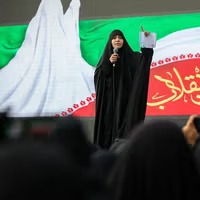
Addressing retired officers during a gathering in Tehran Salami said that the IRGC “organized” retired officers and “deployed” them to the “battlefield” during the Women, Life, Freedom movement. The protests broke out after a 22-year-old woman was killed in the custody of Iran’s notorious hijab police in September last year.
Salami, calling the protests “riots” according to the Iranian regime’s terminology told retired officers, “Even now, you are in the battlefield…and when there are riots, you are present, you show up, get organized and go [to confront the protests].
The Islamic Republic deployed the regular police, riot police, IRGC forces and plainclothes agents in tens of thousands across the country to suppress the protests. They were armed with military weapons, shotguns, clubs and knives. More than 540 civilians were killed by these forces and 22,000 arrested in five months. Scores of you people lost one or both eyes when agents fired at their faces with shotgun ‘birdshots’.
Salami emphasized that retired IRGC officers have always been present in the past in suppressing protests. However, during the protests, Salami had threatened young demonstrators that the regime will “come after them” with its young supporters.
According to past statements by other IRGC commanders, during the 2009 protests to a fraudulent presidential election, thousands of criminals were freed from prisons and ordered to attack demonstrators.

US State Department expressed concern Thursday about a recent Iranian space launch, saying that the program offers a pathway to more advanced ballistic missiles.
“We have long made clear our concerns about Iran’s space launch vehicle programs, that they provide a pathway to expand its longer-range missile systems. Space launch vehicles incorporate technologies virtually identical and interchangeable to – with those used in ballistic missiles,” State Department’s spokesperson Matthew Miller said during a press briefing.
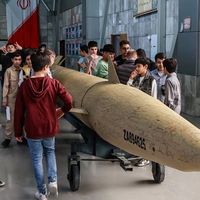
On Wednesday, Iran announced the successful placement of its Nour 3 satellite with an imaging satellite into orbit, positioned in an orbit approximately 450 kilometers above the Earth's surface. Nour belongs to a class of Iranian military Earth-imaging CubeSats. To date, two Nour satellites have been launched from Iran's Shahrud Desert, using three-stage Qased space-launch vehicles.
The announcement came amidst escalating tensions between Iran and Western nations, as Tehran continues to expand it nuclear program, accumulating enough enriched uranium for five nuclear warheads..
When the United States and other world powers concluded the 2015 JCPOA nuclear accord with Iran, a UN resolution put vague limitations on Iran’s ballistic missile program, forbidding the development of weapons systems that could deliver nuclear warheads. The United States has previously accused Iran of violating a UN Security Council resolution by conducting satellite launches. However, Iran argues that its space launch vehicles are not developed for that purpose.
“Iran’s continued advancement of its ballistic missile capabilities poses a serious threat to regional and international security and remains a significant nonproliferation concern,” Miller added.

The United States Navy has condemned Iran’s Revolutionary Guard's Navy for pointing lasers against a US attack helicopter operating in the Persian Gulf.
According to a statement by US Naval Forces Central Command Spokesman Cmdr. Rick Chernitzer on Thursday, personnel aboard vessels belonging to the IRGC’s Navy pointed lasers at a US Marine Corps AH-1Z Viper attack helicopter while in flight, calling it “unsafe, unprofessional and irresponsible.”
The chopper, assigned to the 26th Marine Expeditionary Unit (Special Operations Capable), was conducting routine operations in the international airspace of the Persian Gulf when the interaction took place on Wednesday, the US Navy said, explaining that “The aircraft is attached to Marine Medium Tiltrotor Squadron (VMM) 162 (Reinforced), deployed aboard the Wasp-class amphibious assault ship USS Bataan (LHD 5), on a scheduled deployment to the Middle East Region.”
“Iran’s Islamic Revolutionary Guard Corps Navy (IRGCN) vessels shone a laser multiple times at the aircraft while in flight," the Navy statement said. No one aboard was injured, and the helicopter was not damaged.

Warning about such acts by the Iranian military, Cmdr. Chernitzer said, “These are not the actions of a professional maritime force. This unsafe, unprofessional, and irresponsible behavior by the Iranian Revolutionary Guard Corps Navy risks US and partner nation lives and needs to cease immediately.”
Chernitzer noted that naval forces will “remain vigilant and will continue to fly, sail and operate anywhere international law allows while promoting regional maritime security.”
This is the second time in six years that Iranian units have targeted a helicopter associated with the USS Bataan with lasers. In 2017, an Iranian naval patrol boat used lasers against a Marine helicopter moving through the Strait of Hormuz with three US vessels.
Iranian state media also reported in 2022 that the Iranian military was developing a laser cannon to shoot down aerial targets. In September 2019, Electronic Industries Organization of Iran announced it has succeeded to acquire the knowledge for the laser weapons technology, saying its laser weapons can destroy radar evading UAVs that are made up of composite layers.
Although Iran wants to highlight its laser weapon capabilities to target drones and cruise missiles, the directed-energy weapons including lasers are still at their experimental stage, and are not seen as practical, high-performance military weapons, because a laser generates a beam of light which needs clear air, or a vacuum, to work. The US-Israeli project for such a weapon was canceled in 2005 because of "its bulkiness, high costs and poor anticipated results on the battlefield".
Tensions in the Persian Gulf region have intensified following a series of maritime incidents involving Iran's seizure and harassment of vessels that prompted the US to strengthen its military presence in the region.
In recent months, Tehran's military forces have tried to hijack several Western tankers in what is seen as retaliation for previous Western seizures of Iranian oil. In early-July, Iran tried to seize two oil tankers near the Strait of Hormuz, opening fire on one of them, the US Navy said, adding that the Iranian naval vessels backed off after the US Navy dispatched a guided missile destroyer to the scene.
Iran's introduction of advanced maritime weaponry prompted Washington to extend armed protection to commercial ships traversing the Strait of Hormuz. Later in July, the US Defense Department announced the deployment of additional F-35 and F-16 fighter jets along with a warship to the Middle East in a bid to monitor key waterways in the region following Iran's seizure and harassment of commercial vessels.
Having found itself under US pressure in the Persian Gulf, Iran unveiled a series of what it called new maritime weapons in August. The IRGC held drills around three Iranian islands in the Persian Gulf contested by the United Arab Emirates and claimed that it has added a 600-kilometer-range new missile to its arsenal “for defending the islands’ territory.”

Reza Pahlavi, the exiled prince of Iran, has blamed Supreme Leader Ali Khamenei for the Zahedan Massacre last September.
Pahlavi's statement was made on social media platform X, where he described the incident as an act against the Iranian people.
The day, known as Bloody Friday, witnessed a devastating loss of life as approximately 100 protesters in the Baluch region of Iran, including women and children who were victims of direct gunfire from military and security forces.
"Each and every bullet that was fired at the heads and bodies of the most helpless children of Iran were bullets that targeted the whole of Iran," he said. "Undoubtedly, the main person responsible for this massacre is Ali Khamenei," Pahlavi added.
Many of them succumbed to severe head and chest injuries, marking a dark chapter in Iran's history unfolding amidst the uprising against the regime in the wake of the death of Mahsa Amini and the rape of a 15-year-old Baluch girl by the police chief of Chabahar.
Over 300 more were injured and the regime has since failed to take any action against the perpetrators or launch a transparent investigation. In March, an Iranian lawmaker called for justice for the victims of the massacre.
Moineddin Saeedi, representative of Chabahar city, warned President Ebrahim Raisi that the issue should be handled “with special attention” given the level of anti-regime sentiment and the animosity stirring in the Baluch dominant province.

Another mysterious explosion has hit a facility belonging to Iran's sanctioned Ministry of Defense and Armed Forces Logistics (MODAFL) in Tehran.
It marks the third such incident in just a matter of days, with a particular focus on MODAFL installations across Iran. According to the Iranian Ministry of Defense, the incident was played down, described as a fire that was extinguished within one of its battery storage warehouses, causing no casualties.
The ministry released a statement on Thursday, stating, "Following last week's fire in a storage facility linked to our organization, the area was undergoing cleaning procedures when the remaining debris and waste unexpectedly ignited."
Last week, another explosion was contained at the battery warehouse belonging to Iran's Ministry of Defense.
Since July 2020, a series of sabotage acts and drone attacks have targeted sensitive military and industrial installations within Iran. These incidents have included at least three major operations resulting in substantial damage to nuclear facilities.
Iran has attributed these attacks to Israel, while successive Israeli administrations have refrained from publicly acknowledging or accepting responsibility. However, they have consistently issued warnings that Israel would employ all available means, including military actions, to thwart Iran's progress in its nuclear weapons program and the acquisition of such capabilities.
Back in March, the US Department of the Treasury's Office of Foreign Assets Control (OFAC), in cooperation with the Federal Bureau of Investigation (FBI), designated four entities and three individuals in Iran and Turkey for their role in procuring equipment, including European-origin unmanned aerial vehicle (UAV) engines, in support of Iran's UAV and weapons initiatives. The procurement network operates on behalf of MODAFL, overseeing several firms engaged in UAV and ballistic missile development.

Handwritten notes from Javad Rouhi, who died in Nowshahr prison due to medical neglect, show the brutal torture he endured in the hands of state security.
Atena Daemi, a human rights activist, has since his recent death, made the notes public, drawing attention to the dire plight of inmates in Iran's penitentiaries.
Rouhi, who was apprehended during the nationwide protests, died under suspicious circumstances while in custody on August 31. He had been sentenced to death alongside two other teenagers, on charges of allegedly setting fire to a police station.
The notes written by Rouhi reveal that during his 44 days of incarceration at the Intelligence Department of Mazandaran Province facility, he was subjected to repeated instances of interrogation torture including electric shock and beatings. In one incident, his feet were beaten for three consecutive nights, leading to paralysis and numbness in his right foot.
Rouhi emphasized that all his confessions regarding allegations such as "burning the Quran, insulting sanctities, and damaging government properties" were extracted under duress and the looming threat to his life.
On August 31, the Mizan News Agency, the judiciary's official media outlet, reported his transfer to a hospital due to a "seizure" within Nowshahr Prison, where he ultimately died.
In response to the tragic event, a multitude of users have labeled his suspicious death as a "state murder."