Iranian Lawmaker Claims No Protester Died In 2022 Unrest
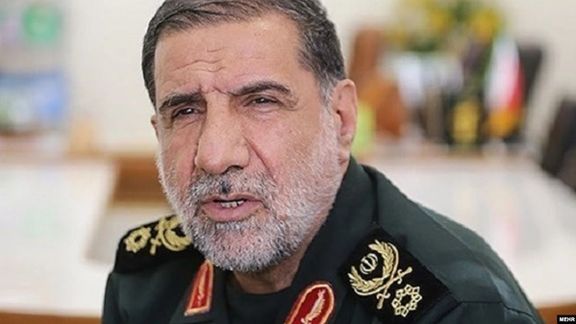
Esmail Kowsari, an ultraconservative lawmaker and former IRGC general, has asserted that no protesters were killed during the 2022 anti-regime demonstrations.

Esmail Kowsari, an ultraconservative lawmaker and former IRGC general, has asserted that no protesters were killed during the 2022 anti-regime demonstrations.
The statement comes in stark contrast to video and photo evidence, as well as reports from rights groups, which indicate that over 500 people, including 71 minors, were killed, thousands were injured, and 22,000 were arrested in the wake of the protests sparked by the death of Mahsa Amini while in custody.
Kowsari also said that "Mahsa Amini was a code name used to prolong the protests for up to three months," though, like other regime officials, he did not provide any evidence to support this claim.
He added, "The events of the previous year were a deliberate plan to undermine the stability of the regime."
To date, the judicial and security authorities in the Islamic Republic have refrained from offering any explanation to the families of the slain protesters regarding their role in the shootings during the Women, Life, Freedom protests.
Kowsari alleged that, in order “to minimize casualties, forces were instructed not to open fire.” However, online videos during and after the protests clearly show that regime forces directly fired at demonstrators, resulting in fatalities and injuries.
The Islamic Republic has also imposed several death sentences on protesters arrested during the demonstrations, with seven of them executed. The Iranian judiciary claims that the verdicts were issued by a "court of first instance," but details regarding the location and fairness of the trials remain undisclosed. In most similar cases, the government does not permit defendants to choose their own legal representation, and due process of law is often absent.
Numerous countries and international organizations, including Canada, Germany, and the United Nations, have called on the Iranian government to refrain from imposing death sentences on protesters.

The Peace Research Institute Oslo (PRIO) has unveiled his shortlist for the 2023 Nobel Peace Prize, which includes an Iranian and an Afghan rights activists.
The 2023 shortlist features the names of Narges Mohammadi and an Afghan activist Mahbouba Seraj.
Narges Mohammadi is a prominent Iranian human rights activist and journalist who has been a fervent advocate for women's rights and the abolition of the death penalty. She has faced multiple incarcerations in Iran and is currently serving a lengthy prison sentence on charges that include disseminating “propaganda against the state.” Her imprisonment has garnered international condemnation.
Henrik Urdal, the director of the Peace Research Institute Oslo (PRIO, remarked, "History has shown us that respect for human rights is intrinsically linked to peaceful societies. The non-violent struggle for human rights is therefore a valuable contribution to peace and stability, and an advancement of the 'fellowship among nations' as stipulated by Alfred Nobel in his will. As this year marks the 75th anniversary of the Universal Declaration of Human Rights, my Nobel shortlist reflects a timely and worthy focus on human rights defenders and activists."
Mahbouba Seraj is a prominent Afghan journalist and women's rights activist. After spending 26 years in exile, she returned to Afghanistan in 2003 and is currently based in Kabul. Seraj is a staunch advocate for children's health and education, anti-corruption efforts, and the empowerment of survivors of domestic abuse.
The Nobel Peace Prize is awarded annually by the Norwegian Nobel Committee to individuals or organizations for their exceptional contributions to the promotion of peace.

An Iranian lawmaker has joined other politicians and analysts in warning the government that prolonged economic crisis could lead to a fresh wave of protests.
Mohammad Hassan Asafari Conveyed his concerns to the Didban Iran [Iran Monitor] website in Tehran that the government should not assume that the people will remain silent in the face of rising prices and other economic problems. He emphasized that there is no guaranty Iranians would always remain quiet regardless of the government’s performance.
Didban Iran noted that previous protests in 2018 and 2019 were driven by economic motives. Even last year's protests, which primarily revolved around political and cultural issues, at times revealed underlying economic grievances among the population. Iranian sociologists have repeatedly warned that economic problems have the potential to spark further protests in Iran.
Asafari pointed out the government's weak track record in addressing the country's economic problems, which could potentially trigger another round of protests due to increasing prices.
The lawmaker also drew attention to the fact that foreign sanctions disproportionately impact the lower and middle classes, as inflation hovers around 50 percent and the income gap widens.

Regime insiders holding lucrative posts in the government and the state-controlled economy, getting a much bigger share of the wealth, has been a growing problem in Iran for the past decade.
Didban Iran reiterated that the protests in 2018 and 2019 had economic motivations and even last year's protests which were mainly about political and cultural issues at times reflected the people's economic concerns. The website added that Iranian sociologists have repeatedly warned that economic problems can potentially trigger a new round of protests in Iran.
Asafari argued that the people's grievances are genuine, and they have every right to protest. There are economic concerns in the Iranian society to which the government should attend. He added that while the whole country is under the pressure of sanctions, the underprivileged groups feel those pressures more than others. Pensioners and low-paid workers are under redoubled pressures and that is not fair, the lawmaker said.
Because Iran’s currency has fallen by another 50-percent since mid-2022 and 12-fold since 2018, the minimum wage that many workers earn has dropped to less than $150 a month, while a family of three needs at least three times as much to afford the bare minimum of daily needs.
Meanwhile, Iranian Hossein Bayat, an attorney, emphasized the economic implications of the cultural limitations the government imposes on Iranians. He said the new hijab enforcement law is telling the people that the government can force you to pay fines for what you wear only because it can.
The new law forces women who remove their headscarves to pay hefty fines. If they are in a car, the driver could also be forced to pay a penalty while his car can be held at a police pound for several weeks.
Some critics argue that while the law was meant to protect the government's official ideology, it is now a means of getting money from the people to make up for the government's budget deficit.
Bayat explained: "This new law say to women: You are not even safe at your own home or in your car. We can always charge you with some accusation and bring you face to face with the government."
The 70-article legislation has already been approved by the Iranian parliament, with its final ratification pending approval by the Guardian Council, a non-elected body that operates under the supervision of Supreme Leader Ali Khamenei.
In another development, former lawmaker Ali Motahari warned that the intervention of hardline clerics in state affairs has alienated them from the people. He argued that hardline clerics who align themselves with the government have sacrificed their independence.
Motahari asserted that if clerics refrained from participating in the government, they could have acted as independent observers to criticize the government's performance and prevent deviations.

Prisoners at a facility in southwestern Khuzestan province started a fire Friday to protest a death sentence issued against a fellow inmate.
According to Iranian state news agencies, "Following the announcement of the death sentence of a prisoner in Ramhormoz prison, several prisoners started a riot by starting a fire.”
"Gunfire could be heard from outside the prison," Mehr News said.
Gholamreza Roshan, the director-general of Khuzestan’s prisons, told a reporter with IRGC-affiliated Fars news that the unrest occurred after a convict was given a death sentence for murder.
"Some inmates in the same ward as the condemned individual instigated the unrest under the pretext of defending him," he added.
He also claimed that immediate action was taken by prison authorities, and the situation in the prison is under control. However, there was no independent assessment of the situation.
Earlier in the month, another fire was reported in a prison near the capital Tehran on the anniversary of Mahsa Amini, whose death triggered the biggest anti-regime protests in Iran. State media said female convicts on death row set fire to the women's ward at the Qarchak penitentiary by burning their clothes.
Also on that day, detainees in the women's ward of Tehran's Evin Prison gathered in protest to mark the occasion, chanting slogans against the regime, refusing to enter their cells, and setting fire to their headscarves in the prison courtyard.

Iran’s security forces opened fire injuring at least 23 people in Zahedan, including four children, who were marking the one-year anniversary of a government massacre.
Amid heavy security presence, the predominantly Sunni population of the city held another demonstration after their Friday prayers, as they had done every single Friday during the past year. This Friday marked the eve of the regime's brutal crackdown on protesters in several cities of Sistan-Baluchestan province on September 30, 2022.
Online videos from the Friday rallies show security forces using live fire and tear gas to disperse the protesters, injuring several people. Several other cities in the province, such as Khash, Rask, and Taftan, have seen people taking to the streets, chanting slogans against the regime. In some of the videos from Zahedan and Khash, security forces are seen retreating as protesters advance towards them.
By nightfall, people in several cities are still out on streets setting up bonfires to disrupt the movements of security forces.
Footage from the clashes and the injured protesters at hospitals were so touching that Iranians on social media have already started condemning the brutal crackdown.
US Representative Claudia Tenney (R-NY) said on X that she is appalled by the attack on Makki Mosque, calling on the IRGC to immediately end this abhorrent assault on the Iranian people.
September 30, 2022 is known as "Bloody Friday" which witnessed a devastating loss of life, with approximately 100 protesters in the Baluch region of Iran, including women and children, falling victim to direct gunfire from military and security forces.
Many of them succumbed to severe head and chest injuries, marking a dark chapter in Iran's history that unfolded amidst the uprising against the regime following the death of Mahsa Amini and the rape of a 15-year-old Baluch girl by the police chief of Chabahar, a city in Sistan-Baluchestan province. The regime has since failed to take any action against the perpetrators or launch a transparent investigation.
In some of the videos from Zahedan and Khash, security forces are seen retreating as protesters advance towards them. Some people on social media commented that Zahedan is fighting on behalf of all Iranians.
The protests began after Friday prayer sermons by Iran's leading Sunni cleric, Mowlavi Abdolhamid, in Zahedan's Makki mosque, where he decried the regime's inaction regarding the perpetrators of the Bloody Friday incident. The mosque was surrounded by a large number of security forces who had set up tents and positioned armed forces in the area during the night in anticipation of protests.
A huge number of people attended the congregation and embarked on a rally, chanting slogans and carrying banners despite the security atmosphere.
Referring to Bloody Friday, Abdolhamid, who has become a dissident cleric, emphasized that such a massacre is a consequence of the discriminatory policies of the regime towards ethnic and religious minorities. The outspoken cleric, who delivered his speech amid an internet shutdown that disrupted the live broadcast of the sermon, noted that "such an attack with over 100 killed and 300 injured does not happen anywhere else in the world."
As Sunni Muslims, Baluch citizens are both an ethnic and religious minority. Estimates of the Iranian Baluch population range from 1.5 to 2 million people. The Baluch community, along with the Kurds, has always been among the most persecuted minorities in Iran and has the largest number of people executed in the country.
Abdolhamid, who described Bloody Friday as a premeditated action against the Baluch minority last year, noted that the prayer ground in the city of Zahedan, where the attacks took place, had always been a place of "unity and security," and no one expected such a massacre to happen there.
He added that while the "judges" handling the case of the Bloody Friday incident are "good people," they lack the independence they should have, and underlined that he is aware of "the pressure from various authorities" exerted on them.

Iranian political prisoner Fatemeh Sepehri has said she would only consent to her much-needed heart surgery if her two detained brothers are released.
Ali Sepehri, one of Fatemeh Sepehri's brothers, announced in a tweet on Friday that his sister "requires immediate heart surgery," but she has made the "consent for surgery a precondition" for the release of her detained brothers, Hassan Sepehri and Mohammad-Hossein Sepehri.
"My sister's angiography report shows that two out of her three main heart arteries are more than 95 percent blocked," Mohammad-Hossein Sepehri said earlier in the week. Ali Sepehri says two of his brothers -- Hassan and Mohammad-Hossein -- are in detention.
Sepehri and her brother Mohammad-Hossein are among the signatories of a statement requesting Supreme Leader Ali Khamenei's resignation in 2019. In another letter with 13 fellow women rights activists months later, she called for the abolition of Islamic republic and establishment of a democratic secular government.
She has been arrested a number of times during the past several years. Two years ago, Sepehri was released from Mashhad's Vakilabad prison after nine months of detention, but she released a video, saying "I will not remain silent and will stay on this path."
She was arrested again in the early days of the Women, Life, Freedom protests after security agents raided her home. In October, Sepehri's daughter published a video stating that her mother was held in solitary confinement at the Revolutionary Guard’s Intelligence center in the city of Mashhad.
The Mashhad Revolutionary Court sentenced her to 18 years in prison on charges of "collaboration with hostile states," "assembly and collusion," "insulting the leadership," and "propaganda against the regime." The sentence has been upheld by the Court of Appeals. Based on Article 134 of the Islamic Penal Code, she must serve ten years in prison.