Iran To Deduct Fines From Bank Accounts Of Women Defying Hijab
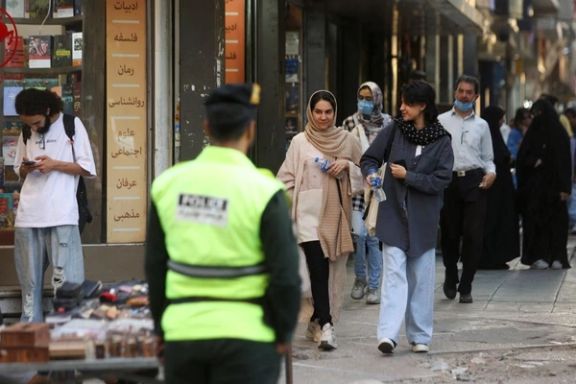
An Iranian newspaper said Monday that the parliament has approved a law allowing for the deduction of money from the accounts of women who do not adhere to mandatory hijab.
An Iranian newspaper said Monday that the parliament has approved a law allowing for the deduction of money from the accounts of women who do not adhere to mandatory hijab.
The report by Farhikhtegan newspaper confirms recent remarks by lawmaker Amir-Hossein Bankipour, who said fines for women who do not comply with hijab laws will be directly deducted from their bank accounts, without the need for their permission.
The move is based on Iran’s new hijab bill, pending approval by the Guardian Council, that aims to enforce stricter penalties for hijab refuseniks.
The bill, officially titled "Protection of Family Through Promotion of Hijab and Chastity Culture," initially secured parliamentary approval in September. However, it encountered an unexpected setback when the Guardian Council, holding ultimate legislative authority, rejected it. The rejection cited formal deficiencies and called for revisions to clarify ambiguous terms.
The enforcement strategy includes surveillance measures such as facial recognition technology and scrutiny of online content to identify violators. Bankipour emphasized that “the measures aim to deter repeat offenses,” with fines escalating to 240 million rials ($400) for those who remove hijab for the second time.
Farhikhtegan wrote that enforcing penalties for hijab violations falls outside the judiciary's jurisdiction; the police will handle enforcement.
The announcement comes against the backdrop of heightened tensions surrounding hijab enforcement, fueled by widespread protests following the death of Mahsa Amini in 2022. Amini's death after her arrest for violating hijab regulations ignited the boldest wave of protests against the Islamic Republic.

Iran's crude oil production stood at an estimated 3,163,000 barrels per day as of January 2024, showing a slight decrease from December 2023's output of 3,168,000 barrels per day. This is notably lower than the 4,376,194 barrels per day Iran was producing in 2016.
Data from the US Energy Information Administration (EIA) indicates that Iran produced 2.93 million barrels of crude oil per day in the third quarter of 2023, excluding condensates. However, in November 2023, Iran's oil minister, Javad Owji, stated that the country was producing 3.4 million barrels of oil per day, suggesting potential for increased production capacity.
Bijan Zanganeh has expressed optimism about Iran's ability to raise its output to 7 million barrels per day within five to six years, at a cost of less than $70 billion. He argues that the projected revenues from expanded oil sales justify the relatively modest investment.
Despite Zanganeh's positive outlook, significant challenges confront Iran's petroleum sector, including the impact of global sanctions. Sanctions have severely curtailed Iran's oil output and hindered international investment in the industry, with production expected to hit a 30-year low in 2020. Additionally, geopolitical tensions and proposed legislation in the United Statestightening sanctions on Iranian oil further complicate Iran's prospects for oil exports.
The World Bank has noted that Iran's heavy reliance on oil revenues makes it vulnerable to external shocks and sanctions. While Iran has sought to enhance domestic crude oil processing and diversify its trading partners, sanctions continue to hinder access to foreign capital and technology necessary for increasing production capacity.
Consequently, even while Zanganeh's projections show potential for Iran's oil sector, they fail to consider the major obstacles provided by geopolitical dynamics and sanctions, which make it more difficult for the nation to meet its output targets.

Iran faces significant challenges in increasing its oil production capacity
Iran's efforts to boost its oil production face serious obstacles, including international sanctions that severely limit its capacity to export oil. This has led to a decline in revenue and deterred foreign investment and technological transfer necessary for expanding production.
Budgetary constraints and limited access to advanced foreign technologies further impede progress. Additionally, Iran's lack of natural gas needed for oil production poses a challenge to sustaining and increasing production levels.
Geopolitical issues such as market competitiveness and escalating sanctions complicate Iran's export prospects. Balancing domestic energy consumption with export requirements requires effective resource management to meet both objectives.
Obtaining funding, strategic resource management, and navigating global dynamics are crucial for overcoming these challenges and expanding Iran's oil production capacity.
While recent trends suggest room for growth, future production levels depend on efficient resource management and domestic economic policies. Economist Masoud Nili warns of a possible economic downturn and loss of competitiveness without significant reforms to the financial framework and investment incentives.
Despite Zanganeh's optimism, Iran's oil potential is constrained by sanctions, limiting exports and access to vital resources. However, technical advancements, administrative reforms, and strategic positioning offer hope for resilience and growth in Iran's oil sector amid challenging conditions.
Iran's efforts to boost its oil production capability is beset with serious obstacles. Iran's capacity to export oil internationally has been severely limited by international sanctions, especially those imposed by the US. This has resulted in a steep fall in revenues and deterred foreign investment and knowledge transfer, which are essential for expanding production.
Further impeding advancement are budgetary limitations and restricted access to cutting-edge foreign technologies. Iran has plenty of natural gas reserves, but it is unable to extract the natural gas needed to produce oil.
Another problem is balancing domestic energy consumption with export requirements, which requires effective resource management to satisfy both objectives. In general, obtaining funding, strategically managing resources, and skillfully navigating global dynamics are necessary to overcome these challenges.
Although recent patterns suggest room for expansion, it is unclear how much oil Iran will be able to produce over the next five years. Even though exports, mostly to China, reached a record level of 1.29 million barrels per day, efficient resource management and domestic economic policies will have a significant impact on future output.

The video went viral in Iran on Saturday depicting a tense encounter between a young woman and a cleric who is filming her holding her baby while her hijab is loose in a clinic in the religious city of Qom.
Iran’s clerical rulers encourage everyone to confront women with insufficient hijab and urge them to abide by the law. Reporting on others is also encouraged and there have been instances of people filming women to send it to the authorities for legal action.
The incident escalated into a brawl when the young woman noticed the cleric filming her. Other women in the hospital intervened and asked the cleric to delete his video in fear that it would lead to further problems for the mother.
The footage captured the young mother in the clinic with her sick infant. Shortly after entering, her headscarf slips off.
Hassan Gharib, the prosecutor of the religious city of Qom, said Sunday that an order to identify and prosecute the person who leaked the CCTV footage to Iran International has been issued. However, he clarified that no arrests have been made in connection with the incident.

Gharib emphasized the importance of adhering to the religious duty of urging others to abstain from forbidden acts and uphold religious principles. “In any case, we will decisively, fairly, and speedily investigate the matter.”
Typically, rather than prosecuting people who bother others over hijab, authorities often target and punish victims, as well as individuals who share photos and videos with foreign-based Persian media outlets that tarnish the image of the regime, its officials, or clerics.
In September, 29-year-old Elham Farshad who had a verbal encounter with a cleric harassing her over hijab was sentenced to three years and eight months in prison after a video of the incident was leaked on social media.
“It is necessary to point out that the error of the person who sent the video to anti-revolutionary media should not be overlooked. This calls for intelligence work and action that will teach [such people] a lesson,” the Revolutionary Guards (IRGC) linked Fars News Agency wrote Sunday.
At a press briefing Sunday most of which was related to the controversies over legislation and enforcement of hijab, President Ebrahim Raisi’s aide, Sakineh-Sadat Pad, said she had seen the video and would follow up on the matter.
Pad characterized the actions of both the woman and the cleric as "aggressive" and their behavior as "disagreeable." While acknowledging the understandable concern of the young mother for her sick child, Pad did not explicitly condemn the cleric's infringement upon the woman's privacy and rights. She emphasized the need for further investigation into the matter.
The footage obtained by Iran International (IITV) from the clinic's CCTV captures the young woman seated against the wall in a secluded area, cradling her sick baby in her arms. Her hijab has slipped down over her shoulders. In the background, the cleric covertly uses his mobile device to capture pictures or video of the woman, presumably to document her violation of hijab regulations.
Upon realizing the cleric's actions, the woman swiftly passes her baby to someone nearby and confronts the cleric, demanding to inspect his phone to delete the recorded footage. The cleric refuses, escalating the situation into a physical altercation as bystanders intervene.
The cleric flees the scene, and the woman is taken away from by the clinic staff after having a nervous fit. The identities of the cleric and the woman are not known.
Some Twitterati have commented that the incident is evidence of the opposition to compulsory hijab and shows that the Islamic Republic has failed in enforcing it even in Qom, Iran's second religious city and the seat of most of its seminaries.
Most hardliner social media users have blamed the woman for failing to comply with hijab rules and then arguing with the cleric and charging to attack him. They justify the cleric’s actions by arguing that his intention was pure, and he only wanted to carry out his religious duty.
Some hardline, pro-government social media users have called the young mother “rowdy” or “a shrew”. Those against the compulsory hijab, however, have created several hashtags in support of the young mother such as “We Are All Rowdy/Shrews”.


The passage of time, however, proved that I was mistaken. His intention was to continue serving a regime that had afforded him ample opportunities, enabling him to exert influence over two major newspapers, rise from a street activist to Iran’s ambassador in Germany, and subsequently become a chief negotiator in nuclear talks with the West.
Throughout his career, Mousavian has demonstrated unwavering loyalty to the Islamic Republic. From his tenure as a member of the Resalat Daily editorial board and his leadership role at Tehran Times to his diplomatic endeavors in Europe as Iran's top diplomat, he has consistently upheld the regime's interests. Even upon relocating to the US, his advocacy for the controversial JCPOA nuclear deal and defense of Iran's nuclear program as peaceful persisted.
Mohammad Javad Zarif attests to Mousavian's commitment to the regime, having entrusted him with representation at various European events during Zarif's tenure at the Ministry of Foreign Affairs. Zarif lauds Mousavian's adept defense of the regime's positions, acknowledging his efforts in international forums across America and Europe.
However, Mousavian has crafted various narratives portraying himself as a regime critic. One such claim involves being listed as a target for internal assassination in the 1990s, an assertion lacking substantiation or evidence. Lists of assassination targets from the 1990s, provided by reputable sources, notably exclude Mousavian's name, indicating a discrepancy in his narrative. I have personally seen two lists for assassinations in the 1990s (one list provided to me by Saeed Hajjarian, a high-ranking security official) and Mousavian was not on those lists. The internal terror project in that period was planned to be carried out inside the country and not in Europe.

Terror-oriented ideology and discourse
During the 1980s, the regime's ideological priorities differed from its current agenda. Anti-semitism, nuclear armament, and Shia imperialism were not prominent; instead, the focus was on the Iran-Iraq war, domestic stability through terror tactics, and ideological rivalries within Islamist factions. Amidst escalating tensions and internal dissent, internal targeted killings emerged as a pivotal tool to safeguard the regime's survival.
Islamist terrorism, characterized by fatwas and militant recruitment, was instrumentalized by the regime to suppress dissent and eliminate opposition voices. This was a time when the war with Iraq was not going well and numerous opposition figures abroad were plotting the regime’s overthrow. Survival of the clerical rulers was the top priority. Mousavian, along with his counterparts at Resalat, played a pivotal role in legitimizing and normalizing this terror narrative, perpetuating a culture of fear and coercion within Iranian society.
Ali Khamenei had the same feeling of fragility in his first years in office and began killing intellectuals and political dissidents in the 1990s. Resalat did the same job to promote and normalize terror in this decade even when Mousavian was out. It was in its DNA.
Mousavian played a key role in the covering up of the Mykonos terror attack and denying Iran's role in this terror attack: "Personally I had more than 300 meetings with the [people in] the [German] Ministry of Foreign Affairs, the judiciary, the German Parliament, the Chancellor's office and even with the heads of the German media to show that the [Iranian] government had no role in the event.”
According to Parviz Dastmalchi, who witnessed the assassinations, Abolghasem Mesbahi, known as 'Witness C,' one of the founders of the IRI’s Ministry of Intelligence and Security, testified in February 1997 under oath before the German court regarding the role of Hossein Mousavian in the assassination of Kurdish leaders at the Mykonos restaurant: "Mr. Mousavian has participated in most of the assassinations committed in Europe."
Terrorism, as exemplified by Mousavian's actions, is a grave matter not to be trivialized. His cavalier attitude towards terrorizing American authorities, as evidenced by his gleeful recollection of Bryan Hook's wife's distress, underscores the severity of his involvement in Iran's state-sponsored terrorism. Such callous disregard for human life is reprehensible and underscores the urgent need for accountability.
Opinions expressed by the author are not necessarily the views of Iran International - The author signed a petition to oust Mousavian from his Princeton position.