Iranian MP Warns Of Impact Of Low Voter Turnout On Future Elections
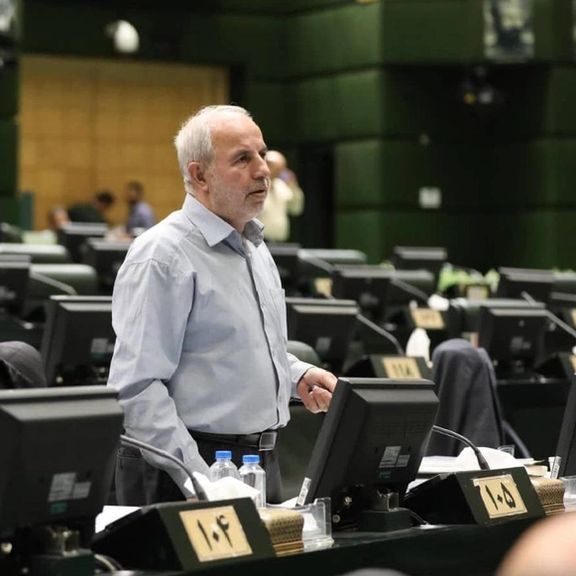
MP Jabar Kouchakinejad warned that the latest boycott of Iran’s elections will impact future polls as the government struggles to retain credibility.

MP Jabar Kouchakinejad warned that the latest boycott of Iran’s elections will impact future polls as the government struggles to retain credibility.
Kouchakinejad, who was elected as the MP of the northern city of Rasht, attributed the decline in voter turnout to the perceived misconduct of government officials and parliamentarians.
“If not addressed promptly, the trend could pose significant challenges in the forthcoming 2025 presidential elections,” he cautioned in his Monday interview with Rouydad 24.
Rasht, Kuchakinejad's electoral district, recorded the lowest voter turnout nationwide on March 1, standing at a mere 22%.
“The lack of public participation, coupled with instances of casting blank or invalid votes, reflects a broader discontent with the performance of government officials,” he added.
He further expressed disappointment in the failure of officials to address public concerns adequately.
"We officials neither behaved well with the people nor solved their problems; we should have at least done one of these properly to prevent the bitter incident of people's non-participation," Kuchakinejad stated.
Echoing his concerns, Emad al-Din Baghi, a prominent reformist activist, estimated that only about 20% of voters were happy with the current situation and took part in March 1 elections. Baqi urged authorities to heed the significance of the figures and undertake necessary reforms to restore public trust in the electoral process.
Furthermore, Baqi raised doubts about the accuracy of the government's official turnout figures, suggesting that “closer examination reveals a truer participation rate of around 34%, taking into account invalid votes.”

Anisa Fanaiyan, an Iranian Baha'i has been sentenced to 16 years in prison and fined 500 million rials (approximately $850) by the Semnan Revolutionary Court.
Additionally, Fanaiyan has been deprived of social rights for 15 years and faces a two-year prohibition from joining political and social groups.
The court verdict states that Fanaiyan has been sentenced to 10 years in prison for "establishing and managing a group with the intention of undermining national security," five years for "deviant educational and propagandistic activities contrary to Islamic law," and one year of probation for "propaganda against the Islamic Republic system."
Furthermore, the court has ordered the confiscation of $4,350 of personal assets belonging to Fanaiyan's family members, seized during a residence inspection, in favor of the government.
Three other Baha'i citizens have been summoned to the Second Branch of the Sari Revolutionary Court on charges including "deviant educational and propagandistic activities contrary to Islamic law in Baha'i groups" amid crackdowns on the minority group.
The legal case for two other Baha'i citizens has been referred to the First Branch of the Babol Revolutionary Court on similar charges.
In recent months, pressures from security and judicial authorities on Bahai citizens have escalated. Unofficial sources estimate that over 300,000 Bahai citizens reside in Iran. However, the Constitution of the Islamic Republic only recognizes Islam, Christianity, Judaism, and Zoroastrianism as official religions.
Bahais constitute the largest religious minority in Iran and have faced systematic harassment and persecution since the Islamic Revolution of 1979.

A year after the detente restoring diplomatic ties between Saudi Arabia and Iran, relations between the regional rivals remain tense.
On March 10, the two nations agreed to reopen embassies and exchange ambassadors, ending a seven-year diplomatic freeze. However, progress has been slow, and ties between the countries remain at a minimal level.
Despite efforts to mend ties, including meetings between top security officials in Beijing and the signing of diplomatic and security cooperation agreements, Saudi Arabia and Iran have yet to translate diplomatic gestures into substantial agreements. The ongoing conflict in Yemen continues to hamper progress with the Iran-backed Houthi militia in Yemen still at work with Saudi-backed coalition forces.
The Israel-Hamas conflict has heightened the need for peacemaking efforts in the region, with concerns over Iran's support for proxies destabilizing the area. While there have been discussions regarding potential areas of cooperation, including Saudi investment in Iran's economy, disagreements persist over regional issues.
Saudi Arabia has discussed economic measures to incentivise Iran to reign in its proxies, but as the Houthis' blockade of the Red Sea continues to hamper global trade, the Saudi influence remains in question.
A major obstacle between the two remains to be claims over the Arash/Dorra oil and gas fields in the northern Persian Gulf, with Saudi Arabia and its allies refusing to recognize Iranian claims.
Saudi Arabia severed ties with Iran in 2016 following the storming of its embassy in Tehran during a dispute over Riyadh's execution of a Shiite Muslim cleric. Subsequent conflicts, including missile and drone attacks on Saudi oil facilities and tankers in the Persian Gulf from Iran's Houthi militia further strained relations amid an almost decade-long war.

The dust has settled on the highly engineered 2024 parliamentary election polls in Iran, prompting an evaluation of the management mechanisms and outcomes for the regime.
Following each manipulated election in Iran, where the precise level of participation remains undisclosed, and the resulting parliament remains loyal to the Supreme Leader, it becomes feasible to discern the impact on the regime's stability.
In brief, the fraudulent elections of 2024 not only failed to alleviate doubts regarding Iran's electoral procedures but exacerbated them. While such elections carry certain advantages, including a facade of democracy, temporary regime propaganda, and the stirring of dissent among opposition factions regarding participation, these benefits come at a cost. With the increasing challenges of manipulating votes, deceiving the public, and clandestinely tampering with ballots in the digital era, the feasibility of sustaining these manipulations is dwindling.
The lowest turnout ever delegitimized the next Majles (parliament) and Experts Assembly when the government desperately needed more legitimacy after its image became badly damaged in 2022-2023 repressions against the Mahsa Movement. The figures provided by the Ministry of the Interior and government propaganda channels regarding eligible voters (61 million instead of 65 million), disqualification of hundreds of candidates, and total turnout (40 or 41 percent compared to a more realistic 16-34 percent) have raised considerable doubts among the populace.
Materials related to these doubts are still being published in Iran, although the IRGC spokesman ordered news websites to stop discussing the elections three days after the vote and even before announcement of the official results.

Continued skepticism about statistics
Not only the opposition and the people in the streets and bazaars, but also former officials who are still in contact with government personnel, do not believe the official results. "Based on the calculations of the voting in Tehran and the most votes obtained, it seems that there were more than 500,000 invalid votes in Tehran," says Ali Rabi’i, a former high-ranking member of the Ministry of Intelligence in three administrations, and Minister of Labor. He is aware that he will be prosecuted if he does not have reliable sources. The government claims that well over 1.5 million votes were cast in Tehran without announcing the exact number, so blank or invalid protest votes were at least 25-30 percent of the total.
Glorious elections
Iranian officials called the election a miracle and epic. However, the candidates with the highest votes in 31 provinces won an average of 5% (from 2% to 17%) of votes according to the manipulated statistics of the Ministry of Interior from the 18-year-old and above population. Despite the non-participation of 59%, according to the official statistics, the many Reformists are still trying to prove their loyalty to the regime and their followers despite the fact that the regime barred them from the elections. Former President Mohammad Khatami did not even mention that he was not going to vote before the election day, which could have reduced participation even more.
The hardliners who engineered and carried out the now failed elections try to justify the low turnout by an inverted logic and strange excuses, while at the same time boasting about “good elections.” One of the excuses is the impact of US sanctions on voters, while according to their own logic of popular anti-American support, participation should have been higher. They also argue that if Supreme Leader Ali Khamenei’s guidelines and policies were fully implemented, more people would have voted. In fact, the current economic crises and the harsh repressive policies that drove away the voters are the direct results of Khamenei’s policies. His foreign policy, for example, has brought on the economic sanctions and lack of normalcy in Iran’s international ties that have impoverished the voters.

Iran's foreign ministry spokesman pointed fingers at the United States, citing its support for Israel as the root cause of its Houthi milita's blockade of the Red Sea.
In a press briefing on Monday, Nasser Kanaani said that amid the war in Gaza, "warmongering policies" from Israel and “insufficient action” from the US to resolve it, has contributed to regional instability.
The spokesperson alleged that “the actions of Yemen's Houthis were in response to Zionist presence in the Red Sea.”
Iran's Houthis in Yemen began a blockade in the Red Sea region, instigated by the Supreme Leader in support of Hamas in Gaza in the wake of Israel's retaliation to the invasion of October 7.
The Houthis have since carried out dozens of attacks on international vessels. Initially aimed at Israel-linked ships to force the country into a ceasefire, it has expanded to US and UK-linked vessels in retaliation to their support of Israel's right to defend itself in the wake of the Hamas invasion of Israel on October 7.
However, it has also affected ships not linked to any of the three targets and has caused massive diversions and price hikes to global shipping on the route responsible for around 12 percent of global trade.
In response, a coalition of more than 20 nations, led by the US, has formed to counter the Iran-backed blockade, aiming to safeguard vital trade routes responsible for a significant portion of global trade.
Kanaani urged the US to focus on addressing the core crisis in Gaza and to cease support for what he referred to as the "mass killing machine of the Israeli regime", still failing to acknowledge the fact that the Gaza war was triggered by Iran's proxy militia, Hamas, which killed 1,200 mostly civilians and kidnapped at least 250 more, in the single most deadly day for Jews since the Holocaust.
In the wake of the war, Iran's proxies in Lebanon, Syria and Iraq have also targeted Israel and US facilities in the region spurring a wider conflict beyond the confines of Gaza.

Iran, China, and Russia are to commence a joint naval exercise in the Indian Ocean on Tuesday as the three nations further military ties.
According to reports from the ISNA semi-official news agency, the exercise will see the participation of surface and aerial units from the Iranian navy, alongside naval units from China and Russia.
Additionally, representatives from Oman, Azerbaijan, Kazakhstan, Pakistan, and South Africa will also be involved.
The primary objective of the exercise, as outlined by ISNA, is to “bolster security measures and fortify the foundations of stability in the region.”
The development comes amidst growing concerns raised by US Senator Tom Cotton regarding Iran's escalating aggression against US forces across the Middle East.
Senator Cotton on Friday highlighted Iran-backed militants' repeated attacks on Americans in Iraq and Syria, emphasizing what he perceives as a lack of robust response from the current US administration.
In 2022, Iran, China, and Russia conducted a joint naval maneuver in the Gulf of Oman. Iran, in particular, finds itself embroiled in a proxy war, with its militias openly supporting various factions involved in regional conflicts, such as the attack on Israel on October 7, which drew in international players including the US and UK.
Of particular concern are the actions of Yemen's militants, armed and supported by Tehran, who have carried out deadly drone and missile attacks against commercial vessels in the Red Sea, escalating tensions in the region.
In February, the United States, in collaboration with Britain, initiated numerous strikes against Iran-backed groups in Iraq and Syria, as well as targeting Iran's Yemeni proxy, the Houthis.