Naval Exercise Between Iran, China, Russia To Begin In Indian Ocean
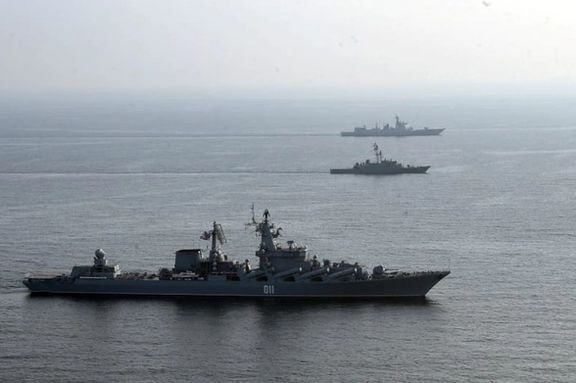
Iran, China, and Russia are to commence a joint naval exercise in the Indian Ocean on Tuesday as the three nations further military ties.
Iran, China, and Russia are to commence a joint naval exercise in the Indian Ocean on Tuesday as the three nations further military ties.
According to reports from the ISNA semi-official news agency, the exercise will see the participation of surface and aerial units from the Iranian navy, alongside naval units from China and Russia.
Additionally, representatives from Oman, Azerbaijan, Kazakhstan, Pakistan, and South Africa will also be involved.
The primary objective of the exercise, as outlined by ISNA, is to “bolster security measures and fortify the foundations of stability in the region.”
The development comes amidst growing concerns raised by US Senator Tom Cotton regarding Iran's escalating aggression against US forces across the Middle East.
Senator Cotton on Friday highlighted Iran-backed militants' repeated attacks on Americans in Iraq and Syria, emphasizing what he perceives as a lack of robust response from the current US administration.
In 2022, Iran, China, and Russia conducted a joint naval maneuver in the Gulf of Oman. Iran, in particular, finds itself embroiled in a proxy war, with its militias openly supporting various factions involved in regional conflicts, such as the attack on Israel on October 7, which drew in international players including the US and UK.
Of particular concern are the actions of Yemen's militants, armed and supported by Tehran, who have carried out deadly drone and missile attacks against commercial vessels in the Red Sea, escalating tensions in the region.
In February, the United States, in collaboration with Britain, initiated numerous strikes against Iran-backed groups in Iraq and Syria, as well as targeting Iran's Yemeni proxy, the Houthis.

A court in Tehran ruled Monday that German-Iranian Sharmahd and the United States government should pay the amount as compensation for the families of the victims of a terrorist attack in Iran, of which Sharmahd is accused.
Sharmahd, a 68-year-old software developer and California resident, was abducted by Iranian agents during a visit to the United Arab Emirates in 2020 and forcibly taken to Iran. In February 2023, the Iranian judiciary sentenced him to death on charges of endangering national security a verdict upheld by Iran's Supreme Court. Sharmahd was convicted of heading a pro-monarchist group named Tondar accused of a deadly bombing incident that occurred in 2008 at a religious center in Shiraz, killing 14 and injuring 215 more. However, many years ago other people were already arrested and convicted for the bombing.
However, Sharmahd along with his family and lawyers have denied the charges and Iran has provided no evidence to support its allegations. Amnesty International has condemned the trial as a sham.

The US-based activist whose group Tondar purportedly aims to restore the overthrown monarchy, toppled in the 1979 revolution, is believed to have been forced to confess to the charges against him, in a typical fashion of forced confessions.
Iran’s change of approach towards the case seemed like a detour to gain concessions from the US in exchange for reducing Sharmad's death sentence. The Biden administration last year agreed to release at least $6 billion in frozen Iranian funds for the release of five hostages similarly convicted in sham trials. The Qatar-brokered deal to free up frozen Iranian funds in South Korea in exchange for five US citizens, led to allegations that the Biden administration is playing a dangerous game encouraging the hostage-taking of yet more dual nationals abroad.
The recent ruling by the Islamic Republic's judiciary is seen as a way to pressure the United States and Germany to pay what amounts to a ransom for Sharmad's release. The Islamic Republic has a history of taking hostages and using them as bargaining chips in negotiations.
Many former officials and experts from the US and other countries, as well as Iranian dissidents, had warned that the prisoner release deal with Iran would set a “dangerous precedent” and would only encourage the regime for taking more hostages. "This will only encourage more hostage taking by the Iranian terrorists” the former US Secretary of State, Mike Pompeo, said.
Richard Goldberg, a senior adviser at the Foundation for Defense of Democracies and former White House National Security Council director for countering Iranian weapons of mass destruction, had echoed such fears. “President Joe Biden’s decision to trade $6 billion for five American citizens unlawfully detained in Tehran isn’t just the largest hostage ransom payment in American history—it’s also the second phase of an unacknowledged agreement with Tehran that strengthens the ayatollah’s position in the Middle East and frees the regime to cross the nuclear weapons threshold at a time of its choosing. Americans need to brace themselves for the consequences of both realities.”
It is not the first time Iran has won in the hostage diplomacy stakes. In 2015, President Barack Obama agreed to pay Tehran $1.7bn for the release of four Americans as part of the broader negotiations over the Iran nuclear deal.
Iran took more hostages in the months and years thereafter, believing it could get an even better price from a future US president. While the Trump administration turned to pressure instead of ransoms and won the release of two hostages without paying any money, under President Biden, ransom payments have returned at multiple times the cost. While the Obama administration paid $425 million per American in 2015, the Biden administration agreed to pay $1.2 billion.


Iran's crude oil production stood at an estimated 3,163,000 barrels per day as of January 2024, showing a slight decrease from December 2023's output of 3,168,000 barrels per day. This is notably lower than the 4,376,194 barrels per day Iran was producing in 2016.
Data from the US Energy Information Administration (EIA) indicates that Iran produced 2.93 million barrels of crude oil per day in the third quarter of 2023, excluding condensates. However, in November 2023, Iran's oil minister, Javad Owji, stated that the country was producing 3.4 million barrels of oil per day, suggesting potential for increased production capacity.
Bijan Zanganeh has expressed optimism about Iran's ability to raise its output to 7 million barrels per day within five to six years, at a cost of less than $70 billion. He argues that the projected revenues from expanded oil sales justify the relatively modest investment.
Despite Zanganeh's positive outlook, significant challenges confront Iran's petroleum sector, including the impact of global sanctions. Sanctions have severely curtailed Iran's oil output and hindered international investment in the industry, with production expected to hit a 30-year low in 2020. Additionally, geopolitical tensions and proposed legislation in the United Statestightening sanctions on Iranian oil further complicate Iran's prospects for oil exports.
The World Bank has noted that Iran's heavy reliance on oil revenues makes it vulnerable to external shocks and sanctions. While Iran has sought to enhance domestic crude oil processing and diversify its trading partners, sanctions continue to hinder access to foreign capital and technology necessary for increasing production capacity.
Consequently, even while Zanganeh's projections show potential for Iran's oil sector, they fail to consider the major obstacles provided by geopolitical dynamics and sanctions, which make it more difficult for the nation to meet its output targets.

Iran faces significant challenges in increasing its oil production capacity
Iran's efforts to boost its oil production face serious obstacles, including international sanctions that severely limit its capacity to export oil. This has led to a decline in revenue and deterred foreign investment and technological transfer necessary for expanding production.
Budgetary constraints and limited access to advanced foreign technologies further impede progress. Additionally, Iran's lack of natural gas needed for oil production poses a challenge to sustaining and increasing production levels.
Geopolitical issues such as market competitiveness and escalating sanctions complicate Iran's export prospects. Balancing domestic energy consumption with export requirements requires effective resource management to meet both objectives.
Obtaining funding, strategic resource management, and navigating global dynamics are crucial for overcoming these challenges and expanding Iran's oil production capacity.
While recent trends suggest room for growth, future production levels depend on efficient resource management and domestic economic policies. Economist Masoud Nili warns of a possible economic downturn and loss of competitiveness without significant reforms to the financial framework and investment incentives.
Despite Zanganeh's optimism, Iran's oil potential is constrained by sanctions, limiting exports and access to vital resources. However, technical advancements, administrative reforms, and strategic positioning offer hope for resilience and growth in Iran's oil sector amid challenging conditions.
Iran's efforts to boost its oil production capability is beset with serious obstacles. Iran's capacity to export oil internationally has been severely limited by international sanctions, especially those imposed by the US. This has resulted in a steep fall in revenues and deterred foreign investment and knowledge transfer, which are essential for expanding production.
Further impeding advancement are budgetary limitations and restricted access to cutting-edge foreign technologies. Iran has plenty of natural gas reserves, but it is unable to extract the natural gas needed to produce oil.
Another problem is balancing domestic energy consumption with export requirements, which requires effective resource management to satisfy both objectives. In general, obtaining funding, strategically managing resources, and skillfully navigating global dynamics are necessary to overcome these challenges.
Although recent patterns suggest room for expansion, it is unclear how much oil Iran will be able to produce over the next five years. Even though exports, mostly to China, reached a record level of 1.29 million barrels per day, efficient resource management and domestic economic policies will have a significant impact on future output.

The video went viral in Iran on Saturday depicting a tense encounter between a young woman and a cleric who is filming her holding her baby while her hijab is loose in a clinic in the religious city of Qom.
Iran’s clerical rulers encourage everyone to confront women with insufficient hijab and urge them to abide by the law. Reporting on others is also encouraged and there have been instances of people filming women to send it to the authorities for legal action.
The incident escalated into a brawl when the young woman noticed the cleric filming her. Other women in the hospital intervened and asked the cleric to delete his video in fear that it would lead to further problems for the mother.
The footage captured the young mother in the clinic with her sick infant. Shortly after entering, her headscarf slips off.
Hassan Gharib, the prosecutor of the religious city of Qom, said Sunday that an order to identify and prosecute the person who leaked the CCTV footage to Iran International has been issued. However, he clarified that no arrests have been made in connection with the incident.

Gharib emphasized the importance of adhering to the religious duty of urging others to abstain from forbidden acts and uphold religious principles. “In any case, we will decisively, fairly, and speedily investigate the matter.”
Typically, rather than prosecuting people who bother others over hijab, authorities often target and punish victims, as well as individuals who share photos and videos with foreign-based Persian media outlets that tarnish the image of the regime, its officials, or clerics.
In September, 29-year-old Elham Farshad who had a verbal encounter with a cleric harassing her over hijab was sentenced to three years and eight months in prison after a video of the incident was leaked on social media.
“It is necessary to point out that the error of the person who sent the video to anti-revolutionary media should not be overlooked. This calls for intelligence work and action that will teach [such people] a lesson,” the Revolutionary Guards (IRGC) linked Fars News Agency wrote Sunday.
At a press briefing Sunday most of which was related to the controversies over legislation and enforcement of hijab, President Ebrahim Raisi’s aide, Sakineh-Sadat Pad, said she had seen the video and would follow up on the matter.
Pad characterized the actions of both the woman and the cleric as "aggressive" and their behavior as "disagreeable." While acknowledging the understandable concern of the young mother for her sick child, Pad did not explicitly condemn the cleric's infringement upon the woman's privacy and rights. She emphasized the need for further investigation into the matter.
The footage obtained by Iran International (IITV) from the clinic's CCTV captures the young woman seated against the wall in a secluded area, cradling her sick baby in her arms. Her hijab has slipped down over her shoulders. In the background, the cleric covertly uses his mobile device to capture pictures or video of the woman, presumably to document her violation of hijab regulations.
Upon realizing the cleric's actions, the woman swiftly passes her baby to someone nearby and confronts the cleric, demanding to inspect his phone to delete the recorded footage. The cleric refuses, escalating the situation into a physical altercation as bystanders intervene.
The cleric flees the scene, and the woman is taken away from by the clinic staff after having a nervous fit. The identities of the cleric and the woman are not known.
Some Twitterati have commented that the incident is evidence of the opposition to compulsory hijab and shows that the Islamic Republic has failed in enforcing it even in Qom, Iran's second religious city and the seat of most of its seminaries.
Most hardliner social media users have blamed the woman for failing to comply with hijab rules and then arguing with the cleric and charging to attack him. They justify the cleric’s actions by arguing that his intention was pure, and he only wanted to carry out his religious duty.
Some hardline, pro-government social media users have called the young mother “rowdy” or “a shrew”. Those against the compulsory hijab, however, have created several hashtags in support of the young mother such as “We Are All Rowdy/Shrews”.