US, UK Sanction Opeatives Of Iran-Backed Al-Ashtar Brigades
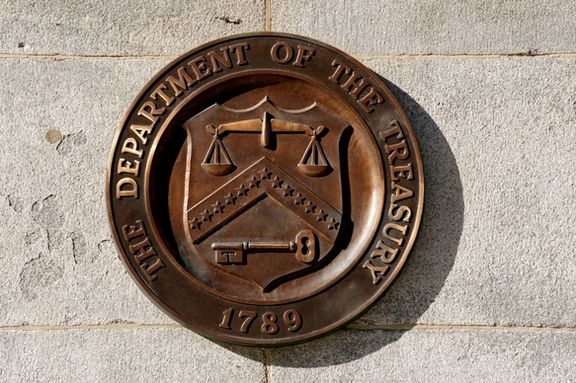
A bronze seal for the Department of the Treasury is shown at the US Treasury building in Washington, January 20, 2023.
The United States, in coordination with the UK, imposed sanctions on four individuals in Iran for aiding the Bahrain-based, US-designated terrorist group al-Ashtar Brigades, the Treasury Department said in a statement on Tuesday.
The sanctions were imposed in coordination with Bahrain's government and allege that the targeted individuals "materially assisted, sponsored, or provided financial, material, or technological support for, or goods or services to or in support of" al-Ashtar Brigades.
The US action, taken in coordination with the Kingdom of Bahrain, underscores our collective commitment to disrupting Iran’s destabilizing forces and threats, particularly those which threaten our partners in the region and around the world,” Brian Nelson, US under secretary of the Treasury for terrorism and financial intelligence, said in a statement.
The United States has been taking action against Iran-backed groups in the Middle East to reduce Tehran's influence in the region and to isolate its affiliates. It designated al-Ashtar Brigades a foreign terrorist organization in 2018.
In 2018, the government of Bahrain charged numerous individuals due to terrorism-related activities. A number of these individuals fled Bahrain to evade prison sentences and settled in Iran, which has long supported and continues to serve as a safe haven for terrorist groups.
In recent weeks, Washington and Tehran have also been at odds over the conflict in Gazaand its implications in the region with Iran-backed Houthi rebels in Yemen disrupting commercial shipping in the Red Sea and the US carrying out strikes against them.
European security agencies have thwarted multiple terror plots by Iran-backed extremists, spurred on by the war in Gaza, the latest of which in Italy.
Italian authorities have detained three Palestinians believed to be affiliated with the Al Aqsa Martyrs’ Brigade, a designated terror group by the US and EU, for allegedly planning assaults on civilian and military targets in Europe.
In October, Israeli intelligence chief David Barnea revealed that Mossad and intelligence agencies abroad had foiled 27 attacks on Jewish and Israeli figures over the last year.
In an undisclosed investigation last December, authorities in Austria and Bosnia apprehended two groups of Afghan and Syrian refugees in possession of weapons, including Kalashnikov assault rifles and pistols. Investigators found images of Jewish and Israeli targets in Europe on the suspects’ phones, the latest in a series of Iran-backed plots against Jewish and Israeli targets abroad.
In a recent case uncovered by Swedish authorities, Iranian agents posing as refugees planned the assassination of prominent Jewish leaders in Sweden, leading to their arrest and subsequent deportation.
German intelligence has warned of heightened risks, particularly regarding threats against Jewish and Israeli targets, with extremist groups exploiting the conflict in Gaza for propaganda, recruitment, and fundraising.
Recent raids in Germany and the Netherlands reveal a shift towards plotting attacks within Europe, with concerns raised about the potential exploitation of refugee flows by terror organizations.
Russia, China, and Iran have launched joint navy drills aimed at what they term as bolstering maritime security in the Gulf of Oman and the Indian Ocean.
Dubbed "Maritime Security Belt – 2024," the joint exercise is scheduled to take place from March 11 to 15 in the waters near the Gulf of Oman.
China deployed its 45th escort task force, comprising the guided-missile destroyer Urumqi, guided-missile frigate Linyi, and comprehensive supply ship Dongpinghu.
While the US-led coalition has responded with counterstrikes against the militant group on one of the world’s most critical trade routes, China, stationed near the Red Sea in Djibouti, has refrained from officially condemning the attacks.
Meanwhile, Russia's Pacific fleet, led by the Varyag guided missile cruiser and Marshal Shaposhnikov frigate, has arrived at Iran’s Chabahar port to participate in the joint drill.
The Russian defense ministry stated that the exercise will involve ships, boats, and naval aviation from Iran and China, with representatives from several other countries acting as observers.
Reports indicate the participation of more than 10 Iranian Navy vessels and three helicopters in the trilateral naval drill. The joint exercise follows the Maritime Security Belt of last year which featured a similar five-day drill between China, Russia, and Iran in the Arabian Sea.
European Union leaders are ready to respond with new and significant measures against Iran amid reports that Tehran may transfer ballistic missiles to Russia for use against Ukraine.
"The European Council calls on third parties to immediately cease providing material support to Russia's war of aggression against Ukraine," said the draft conclusions of a summit to be held next week, seen by Reuters.
Iran has provided Russia with a large number of powerful surface-to-surface ballistic missiles, six sources told Reuters, deepening the military cooperation between the two countries, which are both under US sanctions.
Since mid-2022, Iran has provided hundreds of Shahed Kamikaze drones to Russia that have been used against civilian targets and infrastructure in Ukraine. The drones have also helped swarm Ukrainian air defenses during large-scale Russian missile attacks on cities. Iran still denies supplying the drones, although many parts and downed UAVs have been recovered.
"Reports that Iran may transfer ballistic missiles and related technology to Russia for use against Ukraine are very concerning," the draft conclusions of the March 21-22 summit said.
The engine of an Iranian drone shot down over Ukraine in May 2023
"The European Union is prepared to respond swiftly and in coordination with international partners, including with new and significant measures against Iran."
The conclusions also said the leaders would call on High Representative Josep Borrell and the Commission to prepare further sanctions against Belarus, North Korea and Iran.
France, Germany and Britain last September retained ballistic missile and nuclear proliferation-related sanctions on Iran that were set to expire in October under the 2015 Iran nuclear deal.
Officials at the time said that decision had been made in large part due to Russia's use of Iranian drones against Ukraine and the possibility Iran might transfer ballistic missiles to Russia.
British Defence Minister Grant Shapps said in an interview with House Magazine earlier this month that London had information concerning Iran's provision of ballistic missiles to Russia.
"I do. I can't go into it," Schapps was quoted as saying. "Whether it's ballistic missiles, or the Shahed drones that they supplied Russia with, we've seen that if there's struggle in the world, often Iran are egging it on, or helping to supply the food chain in this case."
The Biden administration tried to reverse former President Donald Trump’s policy of pressuring Iran and re-launched nuclear talks in April 2021. After nearly a year of negotiations in Vienna the effort failed when Russia’s attack on Ukraine began. Soon after, Tehran started supplying drones to Moscow.
A US State Department nominee is being blocked by a GOP member of the Senate Foreign Relations Committee, who demanded transparency on the suspension of former envoy to Iran, Robert Malley.
"I’ve been asking for 8 months for information regarding the suspension of Special Envoy Robert Malley’s security clearance,” Senator Jim Risch (R-ID), ranking member of the Foreign Relations Committee, stated during the hearing.
President Biden’s special envoy on Iran, Robert Malley, was placed under administrative leave in 2023 and is currently under investigation by the FBI for possible “mishandling of classified documents.”
Since then, several Republican members of Congress have tried to obtain information on the circumstances of his suspension – and the reasons his security clearance was suspended.
“The department’s defiance left me no choice but to hold this nomination until the [Department of] State responded,” Risch said.
Margaret Taylor's nomination as Legal Advisor for the Department of State by the Biden administration appeared unrelated to Robert Malley's case – though the confirmation hearing itself provided Senate Republicans with a chance to pressure the Department.
“I’m going to continue to hold her,” Risch said. “She’s the highest ranking and the one State Department wants the most to be confirmed. And I’m going to continue to do that until the State Department gives us some basic information that we really want.”
US Senator James Risch (R-ID) during a Senate Foreign Relations Committee hearing on Capitol Hill in Washington, District of Columbia, September 14, 2021
It’s still unclear why the State Department is refusing to divulge the information that the US lawmakers seek, even in a classified setting. The refusal has raised suspicions among many that there may be serious wrongdoing with repercussions beyond Malley himself.
“Certainly, it’s classified information,” Senator Risch said. “But I’m the most senior member of the intelligence committee. I hear this stuff every day…We cannot do our oversight work without getting this information.”
Another Republican Senator, Pete Ricketts of Nebraska, recapped the story of Malley’s career and suspension, pointing out that it was through “press reports” - not the State Department - that Congress was informed of the envoy’s suspension.
“Malley wasn’t some low level official,” Ricketts said. “He was special envoy for Iran who played a critical role in this administration's Iran policy… In September a press report revealed that Iran had orchestrated an influence operation that involved Malley’s close associates. And yet we’ve not heard from SD on whether this revelation was related to Malley’s suspension and investigation.”
Last September,Iran Internationaland Semafor obtained leaked emails from an Iranian foreign ministry official revealing the establishment of an influence network by the Iranian government to promote its agenda in the West. Known as the Iran Expert Initiative (IEI), this network consisted of at least four associates of Malley with Iranian backgrounds, who held a particular interest in Iran's nuclear program.
“We all listened to Mr. Malley for a long time,” Senator Risch said, “he told us things. We acted and formed beliefs based on those. And they won’t tell us why his clearance was suspended… This is not right... They act like we work for them instead of them working for us. And so until that happens I’m gonna continue to hold Ms. Taylor’s nomination.”
The Chairman of the Foreign Relations Committee, Senator Ben Cardin, does have the authority to bring the nomination to the floor, where Democrats, holding a narrow majority, may have the opportunity to secure Taylor's approval.
“I cannot be a stronger proponent of her nomination,” Cardin said of Taylor. “I’m convinced that she is likely the most qualified individual ever nominated to be legal advisor.”
He also explained that the information sought by the Congress is not held by the State Department. “It’s the FBI that has that information.”
Senator Ricketts, instead suggested subpoenaing the State Department. He argued that if the department lacks records, it would corroborate their claim. However, if they have basic HR documents concerning Malley's suspension, it could provide crucial insights into the reasons behind it.
The State Department, Senator Ricketts added, “has chosen to hide behind the Privacy Act despite the law providing a clear exception for oversight committees.”
President Biden and his Secretary of State, Antony Blinken, have come under intense pressure over Robert Malley’s appointment, role and suspension. Many critics see the Malley case (and the IEI saga) as the clearest signs of the Biden administration’s “appeasement” towards Iran.
Notably, near the end of the session, Senator Ricketts asked Taylor’s legal opinion on the Privacy Act and the State Department’s recourse to it: “based on your legal understanding,” he said, “do you believe that the Privacy Act would prevent disclosure to this committee information pertaining to the suspension of Robert Malley’s security clearance?”
“I don’t believe the privacy act would have that effect,” responded Taylor.
This week, US President Joe Biden is confronted with a critical decision regarding a $10 billion sanctions waiver for Iran – and whether to renew it, or not.
With the ongoing war in Gaza and continued attacks by the Iran-backed Houthis in the Red Sea, the deadline could not come at a worse moment for the administration.
Last year, the US extended the sanctions waiver by four months, allowing Iraq to continue purchasing electricity from Iran.
Additionally, the waiver granted Iran limited access to approximately $10 billion in Iraqi payments held in escrow accounts, ostensibly for purchasing "humanitarian goods" without facing US sanctions.
However, both Republicans and Democrats swiftly challenged this decision, contending that the fungibility of money would effectively empower the Tehran regime to divert these funds towards arming its proxies, despite the humanitarian guise.
As of today, details of Iran's utilization of the sanctions-waived funds remain largely unclear.
During a December 2023 hearing of the House Financial Services Committee, Elizabeth Rosenberg, the assistant secretary of the US Treasury Department, acknowledged the existence of "two transactions” by Iran.
She added that she would only provide additional detail about those transactions in a classified setting.
If the administration’s plan was to keep the region – and Iran – quiet until after the 2024 US election – the recent developments have proven that plan to have backfired.
Packages fall towards northern Gaza, after being dropped from a military aircraft, amid the ongoing conflict between Israel and the Palestinian group Hamas, as seen from Israel's border with Gaza, in southern Israel, March 11, 2024.
Middle East Unrest Intensifies After Waiver Decision
Since the US extended the sanctions waiver four months ago, the situation in the Middle East has deteriorated further, amplifying an already tense crisis.
In January, an Iran-backed militia's drone attack in Jordan claimed the lives of three US service members, marking the first American military fatalities from hostile fire amid escalating tensions from Israel's conflict with Hamas.
Increased attacks on vessels in the Red Sea by Iran-backed Houthi rebels have intensified criticism of the administration's handling of Iran. Last week, CENTCOM Commander Gen. Erik Kurilla told the Senate Armed Services Committee that Iran remains undeterred in its support for Hamas, Hezbollah and the Houthis – and is not paying a price for its nefarious activities in the region.
“In light of these things, it is shocking that the US would then permit tyrants and extremists in Tehran access to billions of dollars which will undoubtedly be used to wreak havoc on America and its allies - including Israel,” Dr. Casey Babb, International Fellow with the Institute for National Security Studies in Tel Aviv, told Iran International.
The international security and affairs expert maintains that Iran is to blame for much of the region’s turmoil – and the Biden administration, along with most Western governments “don't seem to have any idea what they're doing…the lack of foresight and strategic decision-making in the region is astounding, and the potential unfreezing of additional money for Iran speaks to this”.