Zahedan Leader Warns Bloody Friday Perpetrators Will Evade Justice
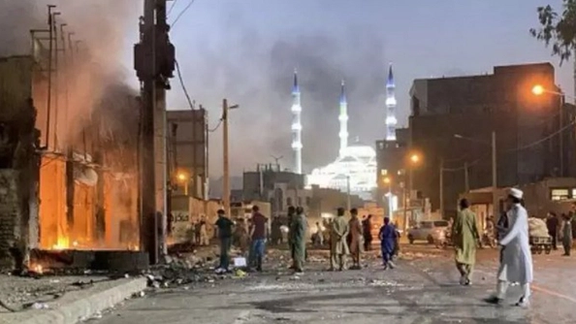
Zahedan's Friday prayer leader fears that even with an upcoming court session regarding the Bloody Friday massacre of 2022, the main perpetrators will evade justice.
Zahedan's Friday prayer leader fears that even with an upcoming court session regarding the Bloody Friday massacre of 2022, the main perpetrators will evade justice.
Mowlavi Abdolhamid said the upcoming session is a crucial step towards justice, a development awaited by the community, but amidst Iran's corrupt legal system, feared justice would not be done, the country's security forces protected from the repercussions of their brutal suppression.
On Monday, he said, "The perpetrators of the crime and those affiliated with the Revolutionary Guards and Basij will never face justice", revealing that the court session has been finally summoned with a limited presence of law enforcement personnel.
Bloody Friday, which took place on September 30, 2022, amidst nationwide protests for the Women, Life, and Freedom movement in Iran, marked a tragic chapter in Zahedan's history.
Following Friday prayers at the Makki Mosque, Zahedan residents gathered to protest the alleged assault by a police commander on a teenage Baluch girl in Chabahar. The peaceful demonstration turned deadly when law enforcement personnel opened fire from inside a police station, resulting in the loss of at least 100 lives.
Previous attempts at seeking justice were met with controversy, with reports indicating that the presiding judge attempted to resolve the matter through blood money settlements without adequately considering the statements of the victims' families.
In November, Abdolhamid questioned why the perpetrators had so far not been brought to justice in spite of orders from the country's Supreme Leader. “It is surprising that despite the leader's order to punish the perpetrators and leaders of this crime, it has not been followed. Our belief until now was that the leader's orders are valid, and at least those who eat the bread of sovereignty and government will follow it," he said.
Zahedan, in the southeastern province of Sistan-Baluchistan, is among the most economically deprived parts of Iran. The province has a large Baluch population, mostly Sunnis. They have historically been among Iran's most persecuted minorities, with the rate.

Reformist lawmaker Mohammad-Sadegh Javadihesar strongly criticizes members of parliament for introducing the plan to deduct hijab fines only after the elections, labeling their behavior as "most heinous and despicable." He asserts that such decisions have the potential to "ignite chaos in society."
Javadihesar condemns the timing of the proposal when most people are angry because of runaway inflation, suggesting that it reflects a lack of rationality within the system. He warns that failure to address such actions may deepen the rift between the government and the people, increasing the likelihood of social unrest.
Drawing parallels, Javadihesar likens the lawmakers' proposed measure to the fuel price hikes in 2019, which triggered widespread protests across the country. He emphasizes that the government's harsh crackdown on protesters resulted in numerous casualties, highlighting the potential consequences of implementing similar controversial policies.
In November 2019, security forces killed at least 1,500 citizens after nationwide protests broke out when the government suddenly doubled the gasoline price.
“If there is still any rationality left in the system, it will deal with such behavior, otherwise, the conflict between the government and the nation will deepen and the possibility of certain social conflicts will not be small,” Javadihesar, spokesman of Etemad Melli Party, told Rouydad 24 news website on Monday.

Amir-Hossein Bankipour, a member of the Supreme Council of Cultural Revolution and re-elected lawmaker, said in an interview broadcast by the state-run television (IRIB) last week that a cash fine of 30 million rials (around $50) is to be deducted from the accounts of those who fail to observe the mandatory hijab.
Bankipour clarified that the deduction of funds would proceed without the account holders' consent, potentially resulting in overdrafts if insufficient funds are available. He noted that under the proposed legislation, repeat offenders would face legal action through the courts.
Negahdari echoed Bankipour's remarks on Sunday, affirming that the Parliament has opted to replace direct cash fines for moral policing incidents related to hijab. This decision aims to prevent social conflicts stemming from confrontations with morality police, which have led to the circulation of "disparaging images" in society.
Since March 2023, hardliners have attempted to end women's increasing defiance of compulsory hijab and reclaim lost ground through various instructions to government bodies, but their efforts seem to have hugely backfired as the number of women who refuse to abide by the current rules has very noticeably increased since the Woman, Life, Freedom protests of 2022-2023.
In a recent speech to a group of self-styled protectors of public morality, a top Revolutionary Guards (IRGC) commander, Aziz Jafari, told them the municipality of Tehran is to cooperate with them in resuming their operations at metro stations. “By expanding our activities, we want to put an end to the unveiling sedition,” he told the organized vigilantes.
Jafari delivered his speech a week after the elections of parliament and Assembly of Experts before and during which authorities had put the activities of organized vigilantes on hold, presumably not to anger potential voters who were already inclined to boycott the elections. Some officials even assured women that they could turn up at polling stations without fear of getting into trouble for hijab.
The proposed measure against hijab offenders is an amendment to a controversial bill, generally referred to as the “Hijab and chastity bill”, that the parliament approved in June 2023.
The constitutional watchdog, the Guardian Council, however, rejected the bill in October and sent it back to parliament for amendment and removal of verbal ambiguities.
Experts said at the time, that rejection of the bill was mainly for formal issues and had nothing to do with people’s objection to its provisions.
Hardliners in the parliament are confident that the bill will be endorsed by the Council soon and can be implemented by early April.


With the ongoing war in Gaza and continued attacks by the Iran-backed Houthis in the Red Sea, the deadline could not come at a worse moment for the administration.
Last year, the US extended the sanctions waiver by four months, allowing Iraq to continue purchasing electricity from Iran.
Additionally, the waiver granted Iran limited access to approximately $10 billion in Iraqi payments held in escrow accounts, ostensibly for purchasing "humanitarian goods" without facing US sanctions.
However, both Republicans and Democrats swiftly challenged this decision, contending that the fungibility of money would effectively empower the Tehran regime to divert these funds towards arming its proxies, despite the humanitarian guise.
As of today, details of Iran's utilization of the sanctions-waived funds remain largely unclear.
During a December 2023 hearing of the House Financial Services Committee, Elizabeth Rosenberg, the assistant secretary of the US Treasury Department, acknowledged the existence of "two transactions” by Iran.
She added that she would only provide additional detail about those transactions in a classified setting.
If the administration’s plan was to keep the region – and Iran – quiet until after the 2024 US election – the recent developments have proven that plan to have backfired.

Middle East Unrest Intensifies After Waiver Decision
Since the US extended the sanctions waiver four months ago, the situation in the Middle East has deteriorated further, amplifying an already tense crisis.
In January, an Iran-backed militia's drone attack in Jordan claimed the lives of three US service members, marking the first American military fatalities from hostile fire amid escalating tensions from Israel's conflict with Hamas.
Increased attacks on vessels in the Red Sea by Iran-backed Houthi rebels have intensified criticism of the administration's handling of Iran. Last week, CENTCOM Commander Gen. Erik Kurilla told the Senate Armed Services Committee that Iran remains undeterred in its support for Hamas, Hezbollah and the Houthis – and is not paying a price for its nefarious activities in the region.
“In light of these things, it is shocking that the US would then permit tyrants and extremists in Tehran access to billions of dollars which will undoubtedly be used to wreak havoc on America and its allies - including Israel,” Dr. Casey Babb, International Fellow with the Institute for National Security Studies in Tel Aviv, told Iran International.
The international security and affairs expert maintains that Iran is to blame for much of the region’s turmoil – and the Biden administration, along with most Western governments “don't seem to have any idea what they're doing…the lack of foresight and strategic decision-making in the region is astounding, and the potential unfreezing of additional money for Iran speaks to this”.