Iran Extends Hijab Enforcement To Airports
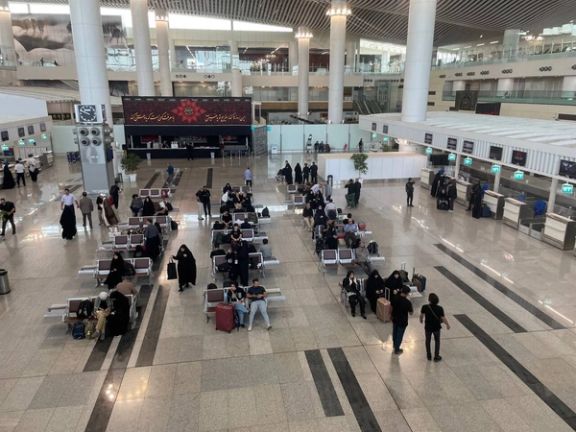
After being implemented in metro stations, university campuses and a raft of public spaces, hijab enforcement by special agents has now been extended to Iran's airports.
After being implemented in metro stations, university campuses and a raft of public spaces, hijab enforcement by special agents has now been extended to Iran's airports.
Amid concerns about potential altercations between women and hijab enforcers, Reza Nakhjavani, Iran’s Deputy Minister of Roads and Urban Development, claims that hijab enforcement at airports is conducted in accordance with the laws of the country.
“Currently there is no law regarding the prohibition of entry for passengers without hijab onto airplanes, but order and discipline must prevail at airports," said Nakhjavani on Wednesday.
His remarks come amid heightened tensions surrounding the deployment of government-affiliated forces, commonly known as 'hijab enforcers,' particularly in the Tehran metro.
The controversy surrounding hijab enforcement in Iran gained international attention following the death of Mahsa Amini while in morality police custody. Amini's arrest in September 2022, on charges related to 'improper hijab,' sparked nationwide protests and catalyzed the Woman, Life, Freedom movement.
Amini's death was followed last year by another incident involving Armita Geravand, a teenage student, who was assaulted by hijab enforcers in the metro, leading to her eventual death after spending 28 days in a coma.
The situation has further escalated with reports of hijab enforcement forces extending their activities to university campuses, including the University of Tehran. Student councils have reported instances of harassment and intimidation by these forces, who claim to be enforcing dress codes on campus.
The crackdown on mandatory hijab defiance continues despite widespread condemnation, both domestically and internationally, rights groups branding the laws discriminatory and oppressive. The UN said the latest round of hijab laws are nothing less than gender apartheid.

On one front, the government aims to increase the population by two-fold – and as soon as possible. To achieve this, it has severely restricted abortion and contraception, and simultaneously promotes pregnancy and childbearing.
But, year after year, individuals are instead opting to have fewer children, standing in opposition to the government's ambitious population policy. In essence, Iranians have effectively countered Khamenei's population policy – and defeated its goals.
Abortion rate undermine Khamenei’s goals
One of the ways Khamenei’s policy has been thwarted is by Iranian women opting for abortion.
Estimating the precise number of abortions in Iran proves challenging. Nonetheless, a senior health expert with the Expediency Council suggests that both legal and illegal abortions total approximately 1.3 million annually, with intentional abortions accounting for around 530,000 cases. Other authorities offer estimates ranging from 250,000 to 650,000 cases per year.
These abortions are carried out either by private clinics or through the use of illegal pills available in the market. While today's younger generation is knowledgeable about contraception methods, the government has eliminated their accessibility from all public facilities in this field.

A policy driven by nefarious motives
The abortion policy of the Islamic Republic has been quite stringent, though not driven by Islamic Sharia prohibition or a culture of valuing human life. Instead, it has been driven by the aim to boost the population for the establishment of an Islamic empire – despite causing impoverishment and exacerbating the populace's hardships with annual inflation rates ranging around 50%.
Until the fetus reaches 4.5 months of gestation, there are typically no Shariah restrictions according to the fatwas issued by most Shia sources of emulation. In such cases, the mother isn't required to obtain a license and is obligated to pay an atonement. The new population law of the Islamic Republic of Iran, akin to its regulations on loan interests, contradicts fatwas.
Unlike many American conservatives, the authorities of the Islamic Republic do not take a moral stance against abortion nor emphasize the inherent right to life. Over the past 45 years, their focus has primarily revolved around execution, genocide, warfare, and bloodshed.
Their opposition to abortion stems from two primary motives: firstly, they view a large population as essential for achieving superpower status, which aligns with their overarching agenda, and secondly, they seek to maintain a vast army comprised of impoverished, uneducated, and vulnerable individuals for the perpetuation of their oppressive regime and involvement in endless regional conflicts. But, compared to their government, the general populace is more acutely aware of the country's resource constraints, such as limited access to safe water, education, and healthcare.
Khamenei battles ongoing population decline
In the last two decades, Ali Khamenei has expressed dissatisfaction with Iran's population control policies from the 1990s, aiming to counteract the ongoing decline in growth rates since the 1980s, where it stood at 3.91%, by striving to increase the rate from the 1.2% observed in the 2000s.
Consequently, following the enactment of the Family Protection and Youth Population Law in 2020, abortion can only be conducted legally with official permits.
Law vs. Reality
According to Article 56 of the Family Protection and Youth Population Law, an abortion without a license is punishable by fine, imprisonment, and revocation of the medical license, and the coroner’s office is responsible for filing the case for the applicants. The doctor of this office is in charge of reviewing the documents and completing the details of the case. In addition to the punishments stipulated in the Islamic Penal Code, the work license of a doctor, midwife, or pharmacist involved in abortion and their stewards will be revoked and they must pay a fine. But despite these punishments, underground and illegal abortions continue, with the government struggling to enforce its law. Easy access to abortion drugs has also contributed to high abortion rates.
However, societal trends have consistently shifted in the opposite direction. Iran's population growth rate has declined from 1.62% in 2006 to 1.24% in 2016, and approximately 0.7% in 2021. Certainly, around half a million individuals—comprising roughly one million births and half a million deaths—are added to the population annually. But, if current trends persist, the growth rate is projected to reach zero within the next seven years, thereafter turning negative.
The Family Protection and Youth Population Law and its various rewards and punishments for having children and infertility have not been able to change this trajectory. Paradoxically, even the prohibition of prenatal screening has not aided in decreasing abortion rates. The pervasive sense of economic hardship and despair regarding the future weighs heavily on the minds of mothers across all 31 provinces – with this overwhelming burden prompting them to undergo abortions despite the associated risks and financial strain, all of which are borne out of their own pockets.
Thus, Ali Khamenei and the Islamic Revolutionary Guards (IRGC) cannot rely on population growth to bolster their influence. To sustain their oppressive regime, they depend on maintaining a populace mired in poverty and unemployment. Their aspirations for empire-building hinge on depleting the resources of the people, impoverishing them for conflicts with Israel and America, and funneling billions annually to proxy groups and sympathetic governments in Syria and Yemen. Additionally, to support the Quds Force, they must rely on Shiite populations in Afghanistan, Pakistan, Iraq, and Lebanon. Ultimately, their pursuit of power relies on a strategy of impoverishment and manipulation that will also extend beyond Iran's borders.


“Certainly, in the future, these exports will increase even more, considering the innovations being made and the new armaments we are pursuing and unveiling,” Ashtiani was quoted as saying by ILNA news website.
A UN Security Council embargo on Iran’s conventional arms trade expired in October 2020, when the United States failed to garner support to extend the restrictions, amid the Trump administration’s “maximum pressure” campaign against Tehran. European allies were not supportive of the administration’s Iran policies, while Russia and China were firmly siding with their ally.
Having been under various Western and UN sanctions for 45 years, the Islamic Republic has developed a domestic arms industry, which has achieved relatively low-tech successes, particularly in the realm of missiles and drones.

Ashtiani boasted that “In the realm of defense capability worldwide, we hold a special position due to reaching a stage in indigenous production where we have manufactured the necessary equipment for our armed forces internally. This has led to our defense capability and the result of which is the national security of our country, with the format of this equipment being in the stage of exports.”
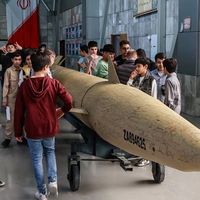
Since mid-2022, Iran has provided hundreds of Shahed Kamikaze drones to Russia that have been used against civilian targets and infrastructure in Ukraine. The drones have also helped swarm Ukrainian air defenses during large-scale Russian missile attacks on cities. Iran still denies supplying the drones, although many parts and downed UAVs have been recovered.
The West is now concerned over emerging signs that Tehran might supply long-range missiles to Russia, which is running low on its own stocks after more than two years of large-scale attacks on targets in Ukraine. European Union leaders are ready to respond with new and significant measures against Iran amid reports that Tehran may transfer ballistic missiles to Russia for use against Ukraine.
"The European Council calls on third parties to immediately cease providing material support to Russia's war of aggression against Ukraine," said the draft conclusions of a summit to be held next week, Reuters reported this week.

It is not clear to what extent the Biden administration is concerned about the latest reports of Iran’s missile supplies to Ukraine, as it stands to renew billions of dollars’ worth of sanctions waivers for Iran, which can partly alleviate Tehran’s lack of financial resources to boost its weapons development.
The danger Iranian weapons pose is not limited to supplying Russia, but most of its production ends up in the hands of rogue forces, such as the Houthi rebels in Yemen. Since November, using an array of Iranian missiles and drones the Houthis have wreaked havoc on international shipping in the Red Sea region, prompting the US and the UK to launch air strikes against targets in Yemen.
Multilateral arms embargos against Iran began in 2006, when the UN Security Council restricted on the export of technology related to nuclear delivery systems to Iran. In 2007, the Council added an embargo on arms exports to Iran, followed by a UN embargo on the sales of major conventional weapons.
These embargos were later wrapped into UNSC Resolution2231 that formalized the 2015 JCPOA nuclear deal with Iran. The agreement set October 2020 for the sunset clause to the conventional weapons embargo, and October 2023 for restrictions to the transfer of goods and technology that could contribute to the development of nuclear weapons delivery systems.