Chinese Envoy Calls For Boosting Political Ties With Iran
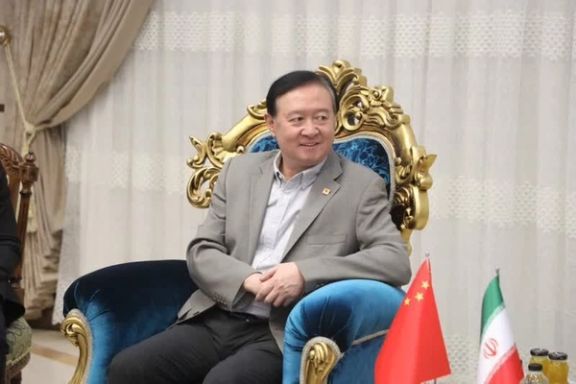
The Chinese Ambassador to Iran, Chang Hua, has called for closer relations with relevant political parties and organizations in Iran to enhance bilateral cooperation.

The Chinese Ambassador to Iran, Chang Hua, has called for closer relations with relevant political parties and organizations in Iran to enhance bilateral cooperation.
The statement followed his meeting with members of Iran’s Islamic Coalition Party in Tehran on Wednesday.
The Chinese envoy's assertion to bolster ties is a result of Iran's limited participation in China's Belt and Road Initiative (BRI) and other regional investments, primarily due to enduring US sanctions. Despite close political relations, Iran's involvement in the BRI remains minimal, raising concerns about the depth of their strategic partnership.
Initiated in 2013 with investments totaling $1 trillion across approximately 150 countries, the BRI aims to enhance regional integration, trade expansion, and economic growth. However, Iran has received relatively few investments compared to other nations, casting doubts on the sustainability of their alliance.
Chinese investments in Iran have been modest, with only two agreements signed between 2013 and 2023. Challenges such as the US withdrawal from the JCPOA nuclear accord in 2018 have hindered projects like the South Pars gas field's phase 11 and the Gohardasht Steel project.
Now, the focus is turning towards the Islamic Coalition Party, a conservative political entity in Iran which advocates for economic liberalism and holds influence among older generations of conservatives, particularly among retailers and traditionalist clerics.
Among the Chinese leadership there is a perception that as the dominant ruling force within the Islamic Republic, the party is a critical gateway to economic development.
In addition to ongoing military ties, China is already making headway into Iran's construction market, perceived by the Iranian government as critical foreign investment for the country strangled by global sanctions.

Iran’s exiled prince Reza Pahlavi warned against threatening the Iranian armed forces with revenge and reprisals in the process of overthrowing the regime.
During an online meeting, Pahlavi said that the armed forces will act to ensure the survival of the regime if dissidents and activists employ vindictive rhetoric against them during the campaigns to topple the Islamic Republic.
“We are not seeking revenge. We want hatred and revenge to be replaced by coexistence and reconciliation. If the regime changes and our culture is still to take revenge, we have done nothing,” he stressed.
According to the exiled prince, if as little as 3.5% of the Iranian population can act in concert in an organized manner, it can lead to a regime change based on the principles of non-violent struggle.
“However, at the end of the day, it all comes down to whether the armed forces, who protect the regime, will stand in front of the people or not,” he went on to say.
Pahlavi further remarked that the most important thing at the moment is to save Iran from an inhuman regime for the sake of the future secular democracy in the country.
The armed forces have been at the front lines of the regime's oppression against the uprising. At least 500 civilians have been murdered by brutal crackdowns around Iran since the uprising of 2022 as the country's state security imposes harsh punishment for protesters and dissidents.

Republican lawmakers are outraged by President Joe Biden’s decision to renew a US sanctions waiver that benefits Iran, despite the regime’s continued attacks on US interests.
The waiver, signed and transmitted to the US Congress late Wednesday, allows Iraq to purchase electricity from Iran for billions of dollars and pay for it by transferring hard currencies to accounts in third countries such as Oman and Qatar.
While exempting Iraq from Iran sanctions for importing energy is not a new policy, the permission for Baghdad to pay in hard currency is part of the waiver. This was allowed for the first time by the Biden administration last year.
Iran International has information confirming that the waiver will allow Iraq once again to pay for its energy imports with hard currencies via accounts in third countries. The Biden administration claims that money going into these accounts can only be used to purchase non-sanctionable good, but so far there has been no accounting for the $10 billion that Iraq transferred to Oman last year.
Critics say the waiver should not have been renewed, not least because Iran continues to fund armed groups that are hellbent on harming Americans and forcing the United States to pull out from the region.
“Why is Biden granting sanctions relief to Iran while its proxies aim to kill US personnel,” asked Rep. Pat Fallon on his X account. “Does Biden want to fund terrorism or does it want to protect our troops abroad? Another chapter in the Biden foreign policy legacy of disgrace!”
Such strong feelings towards Joe Biden’s Iran policy are not new. The difference this time is that many in Washington see the regime in Tehran as not just an adversary but an enemy in a proxy war that has killed and wounded Americans.
“President Biden just renewed a sanctions waiver to allow Iran access to $10 billion,” Rep. Bryan Steil posted on X. “Meanwhile, Iran is enriching uranium closer to nuclear level and its proxies are shooting missiles at our service-members, killing 3.”
The Biden administration maintains that the waiver is not what many suggest –that it will not enrich the Iranian regime or its proxies, and it’s not a Biden initiative at any rate.
“The waiver has been regularly renewed since 2018, continuing a practice from the prior administration,” a State Department spokesperson said in response to questions submitted by Iran International. “Since 2018, the waiver has remained necessary as Iraq weans itself off Iranian energy imports, which cannot happen overnight.”
It’s unclear if (or to what extent) the new waiver differs from the original that was granted in 2018. Some experts have suggested that this one offers Iran way more freedom on how to use the money.
The State Department has only gone as far as to say “under these waivers, no money has been permitted to enter Iran.” And that the funds “can only be used for transactions for the purchase of food, agricultural commodities, medicine, medical devices, and other non-sanctionable transactions.”
“The money never touches Iran,” the department’s spokesperson said Wednesday.
But his argument has never satisfied Biden’s critics –and it’s unlikely to do so this time. The critics say that money is fungible and does not need to ever “touch” Iran to benefit the regime. That it exists and is accessible, they say, means that it can free up funds of corresponding figures inside Iran, which can then be used for ‘malign activities.’
“The Biden Administration should be combatting Iran’s ability to finance terror at every level,” Rep. Bill Huizenga posted on X shortly after the sanction waiver was signed and transmitted to the US Congress. “ It is no secret Iranian funded proxies are attacking American troops and our allies. President Biden should apply maximum pressure and tighten restrictions on the Iranian regime.
President Biden has not lifted any sanctions since he took office, but he has relaxed the sanctions’ enforcement, allowing China to buy from Iran millions of barrels of oil and replenish its empty coffers with an estimated $80 billion.

Once again, the hardline chancellor of Tehran University has denied allegations of purging academics based on their political beliefs, instead accusing those dismissed of "moral issues."
In an interview with the semi-official Mehr News Agency on Tuesday, Mohammad Moghimi asserted that not a single academic has been dismissed from Iran’s top state university on political grounds.
“The ethical problems of some professors who make a lot of noise on social media, by the way, has been proven,” Moghimi claimed.
In September 2023, Moghimi asserted that he had “full knowledge” that some academics who had been dismissed had faced lawsuits from students regarding "ethical matters."
The latest wave of academic purges in Iran began during President Ebrahim Raisi's administration. It gained momentum shortly after nationwide protests under the banner of "Woman, Life, Freedom" erupted following the death of Mahsa (Jina) Amini in the custody of the so-called morality police on September 16, 2022. Following Amini’s death, many universities became centers of extensive months-long student protests.
While the law prohibits the military from entering academic institutions, plainclothes security forces and organized militia were extensively deployed to suppress the student protests. Armed plainclothes agents and vigilantes went so far as to attack students inside Tehran’s Sharif University of Technology on October 3, 2022, resulting in the arrest of dozens of students.

Academics Fired Over Protest Support
Ali Sharifi-Zarchi, a prominent member of the bioinformatics and AI Faculty within the prestigious computer engineering department of Sharif University of Technology, was among the first to be dismissed for his support of dissident students.
Zarchi's revelation of the actions taken against him prompted several other academics, such as Somayyeh Sima, a faculty member in the water engineering department at Tarbiat Modares University, to come forward and share their own experiences.
Numerous academics who were dismissed, terminated, suspended, or demoted for supporting protesting students faced arbitrary accusations. They were accused of “academic sluggishness”, “political immorality and media show-off”, and "defiling" the academic arena with their "factional and even anti-national views" by the ministry of higher education.
The purge has been widely attributed to ultra-hardliners allied with President Ebrahim Raisi, aiming to assert dominance in the political arena by ousting other politicians, officials, and academics. Former moderate conservative Speaker Ali Larijani coined the term "purification" to characterize these plans.
Academic Purges: From 1980 To Today
The history of academic purges in the Islamic Republic dates back to 1980, shortly after the victory of the Islamic Revolution. The newly established government's Cultural Revolutionary Headquarters shut down universities across Iran for three years, aiming to eliminate dissenting voices and impose its Islamic revolutionary ideology on higher education institutions.
During that period, thousands of professors and students were purged for a variety of reasons, including their political affiliations and perceived Western influences, in what became known as the "Cultural Revolution".
Throughout Mahmoud Ahmadinejad's presidency (2005-2013), closely aligned with hardliners, the regime sought to recruit academics who shared the ideological stance of the hardline and religious establishment. Concurrently, it endeavored to eradicate its political adversaries, namely reformists, from academia.
Supreme Leader Ali Khamenei has also repeatedly emphasized that universities must adhere to Islamic principles, asserting that those not aligned with the regime should be barred from teaching. In a speech delivered in July 2015, he stated, "Do not employ unreliable individuals in universities at any cost." He urged, "There are good professors; employ them."

The office of Iran's Supreme Leader Ali Khamenei announced Tuesday the launch of his new Instagram page following the closure of his previous account on the platform.
The office of Khamenei said they “officially expressed their protest to Meta company, and the company has so far refrained from responding to the action."
Last month, Meta, which owns Instagram and Facebook, removed Ali Khamenei's accounts from Instagram and Facebook citing repeated violations of their “Dangerous Organizations & Individuals policy.”
The move was reportedly in response to its explicit support for Iran’s proxy groups in the region, including Hamas and Hezbollah, both designated as terrorist groups by several countries.
A large number of Iranian activists have been calling for the removal of Khamenei's accounts on various platforms.
Platforms like Instagram, Facebook, Telegram, and others remain inaccessible in Iran due to government filtering policies.
Tensions in the region have intensified since Iran-backed Hamas militia in Gaza launched attacks on Israel, with Iran's proxies in Iraq, Syria, Lebanon, and Yemen showing support for the group with attacks against both Israel and US targets.

The head of Iran's parliamentary construction commission has announced that Chinese companies are set to enter the Iranian housing market starting from April, raising fears of a resulting financial crisis.
The deal to bring in Chinese companies comes as the Iranian government seeks to gain access to Chinese technologies, but despite potential benefits, concerns arise regarding the substantial debt Chinese construction companies carry, totaling over $390 billion as reported by The New York Times in 2023.
The possibility of bankruptcy post-project launch could lead to heavy legal complications for Iran but amid global sanctions, the desire for foreign investment outweighs the potential risks.
According to Mohammad-Reza Rezaei Kouchi, “Chinese investment in Iran's construction industry will grant them a share in building projects and unit sales.” However, he added that the cooperation model solely involves investment, with Chinese funds entering the market and no plans for utilizing Chinese labor.
Experts say the Chinese housing initiative aligns with the 25-year cooperation agreement between Tehran and Beijing. Signed in 2021, a leaked version of the agreement's final text is quite broad, yet Tehran officials, grappling with an unsolved economic crisis, anticipate it will attract $400 billion in investment.
The Iranian housing sector already faces challenges, with many local companies struggling due to rising costs, inflation, and reduced demand. President Ebrahim Raisi's pledge to build one million housing units annually has failed, especially considering the high average housing prices in Tehran compared to the minimum wage.
The average cost for one square meter of housing in Tehran is roughly 600 million rials ($1,000), far exceeding the monthly minimum wage of about $100.