US Throws Weight Behind UN Report On Iran’s Abuses In 2022 Crackdown
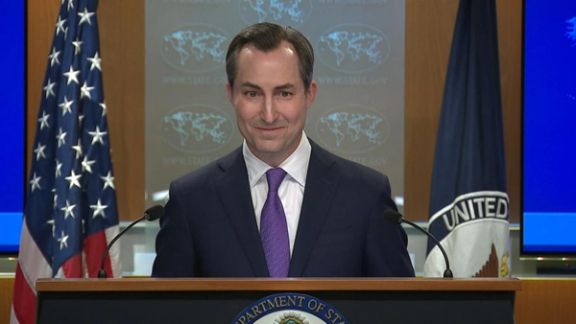
US State Department Spokesperson Matthew Miller
The United States has backed a report by the UN Fact-Finding Mission on Iran that confirmed a wide array of “crimes against humanity” committed during the Iranian regime's crackdown on the 2022 protests.
In his press briefing on Thursday, US State Department Spokesperson Matthew Miller highlighted the “extremely concerning human rights abuses” that the reports documented, including killings, imprisonment, torture, and sexual violence.
“We strongly support the resolution under consideration at the UN Human Rights Council that renews mandate – renews mandates for the fact-finding mission and the special rapporteur on human rights in Iran for another year,” Miller added.
Tehran has dismissed the report, reiterating that it does not recognize the UN group. The Fact-Finding Mission (FFM) was established by the United Nations’ Human Rights Council in November 2022, two months after the Woman, Life, Freedom protests swept Iran in response to the death in morality-police custody of 22-year-old Mahsa Amini.
Miller further condemned the “illegitimate activities by the Iranian Government,” noting that the Biden administration has imposed sanctions on more than 500 Iranian entities.
However, he defended a recent waiver signed by the White House that will allow Iran to continue selling electricity to Iraq, emphasizing that no money is permitted to enter Iran under the terms of this waiver. “All of these funds are held in restricted accounts and they can only be used for transactions for the purchase of food, medicine, medical devices, agricultural products, and other non-sanctionable transactions.”
He also reiterated that Iran is always going to fund terrorism and it is always going to fund destabilizing activities. “We have held Iran accountable for its support of terrorism and its funding of dangerous proxy groups around the region, and we’ll continue to do so.”
The head of Iran’s Quds Force held talks with Hezbollah in Lebanon in February to assess risks of an Israeli attack that would endanger Tehran’s main proxy ally in the region, Reuters reported.
In Beirut, Quds chief Esmail Ghaani (Qaani) met Hezbollah leader Hassan Nasrallah, multiple sources told Reuters, for at least the third time since Hamas' deadly October 7 attacks on southern Israel and Israel's devastating retaliatory assault on Gaza.
The conversation turned to the possibility of a full Israeli offensive against Hezbollah on its northern border. As well as damaging the Shiite Islamist group, such an escalation could pressure Iran to react more forcefully than it has so far since October, three of the sources, Iranians within the inner circle of power, said.
Over the past five months, Hezbollah, a sworn enemy of Israel, has shown support for Hamas in the form of limited volleys of rockets fired across Israel's northern border.
At the previously unreported meeting, Nasrallah reassured Ghaani he didn't want Iran to get sucked into a war with Israel or the United States and that Hezbollah would fight on its own, all the sources said.
"This is our fight," Nasrallah told Ghaani, said one Iranian source with knowledge of the discussions. It is not clear why Iranian sources would share this information with Western media at this juncture, as Israel continues to hit selected Hezbollah targets in Lebanon.
Calibrated to avoid a major escalation, the skirmishes in Lebanon have nonetheless pushed tens of thousands of people from their homes either side of the border. Israeli strikes have killed more than 200 Hezbollah fighters and some 50 civilians in Lebanon, while attacks from Lebanon into Israel have killed a dozen Israeli soldiers and six civilians.
In recent days, Israel's counter-strikes have increased in intensity and reach, fuelling fears the violence could spin out of control.
Israeli Defence Minister Yoav Gallant indicated in February that Israel planned to increase attacks to decisively remove Hezbollah fighters from the border in the event of a Gaza ceasefire, although he left the door open for diplomacy.
In 2006, Israel fought a short but intense air and ground war with Hezbollah that was devastating for Lebanon.
Israeli security sources have said previously that Israel did not seek any spread of hostilities but added that the country was prepared to fight on new fronts if needed. An all-our war on its northern border would stretch Israel’s military resources.
Iran and Hezbollah are mindful of the grave perils of a wider war in Lebanon, two of the sources aligned with the views of the government in Tehran told Reuters, including the danger it could spread and lead to strikes on Iran's nuclear installations.
The Beirut meeting highlights strain on Iran's strategy of avoiding major escalation in the region while projecting strength and support for Gaza across the Middle East through allied armed groups in Iraq, Syria and Yemen, analysts said.
Yemen’s Houthis have so far done more damage in support of Hamas by launching dozens of missile and drone attacks against international shipping in the Red Sea region. The attacks began in November after Iran’s Ali Khamenei called on Muslims to blockade Israel.
Ghaani and Nasrallah "want to further insulate Iran from the consequences of supporting an array of proxy actors throughout the Middle East." Jon Alterman of Washington's Center for Strategic and International Studies think tank told Reuters.
"Probably because they assess that the possibility of military action in Lebanon is increasing and not decreasing."
IN ISRAEL'S SIGHTS
Ghaani and Nasrallah between them hold sway over tens of thousands of fighters and a vast arsenal of rockets and missiles. They are main protagonists in Tehran's network of allies and proxy militias, with Ghaani's elite Quds Force acting as the foreign legion of Iran's Revolutionary Guards.
While Hezbollah has publicly indicated it would halt attacks on Israel when the Israeli offensive in Gaza stops, US Special Envoy Amos Hochstein said last week a Gaza truce would not automatically trigger calm in southern Lebanon.
Arab and Western diplomats report that Israel has expressed strong determination to no longer allow the presence of Hezbollah's main fighters along the border, fearing an attack similar to Hamas' incursion that killed 1,200 people and took 253 hostages.
"If there is a ceasefire in (Gaza), there are two schools of thought in Israel and my impression is that the one that would recommend continuing the war on the border with Hezbollah is the stronger one," Sima Shine, a former Israeli intelligence official who is currently head of the Iran program at the Institute for National Security Studies, told Reuters.
A senior Israeli official agreed that Iran was not seeking a full-blown war, noting Tehran's restrained response to Israel's offensive on Hamas.
"It seems that they feel they face a credible military threat. But that threat may need to become more credible," the official said.
"FIRST LINE OF DEFENCE"
A war in Lebanon that seriously degrades Hezbollah would be a major blow for Iran, which relies on the group founded with its support in 1982 as a bulwark against Israel and to buttress its interests in the broader region, two regional sources said.
An Iranian security official speaking to Reuters acknowledged however that the costs of such an escalation could be prohibitively high for Iran's allied groups. Direct involvement by Iran, he added, could serve Israel's interests, and provide justification for the continued presence of US troops in the region.
Given Tehran's extensive, decades-long ties with Hezbollah, it would be difficult, if not impossible, to put distance between them, one US official said.
Since the Hamas attack on Israel, Iran has given its blessing to actions in support of its ally in Gaza, but it has stopped well short of an unfettered multi-front war on Israel that Hamas had likely expected Iran to support after October 7.
Before the Beirut encounter with Nasrallah, Qaani chaired a two-day meeting in Iran in early February along with militia commanders of operations in Yemen, Iraq and Syria, three Hezbollah representatives and a Houthi delegation, one Iranian official told Reuters.
Revolutionary Guard's Commander-in-Chief Major General Hossein Salami was also present, the official said. Hamas did not attend.
"At the end, all the participants agreed that Israel wanted to expand the war and falling in that trap should be avoided as it will justify the presence of more US troops in the region,” the official said.
Shortly after, Qaani engineered a pause in attacks by the Iraqi groups. So far, Hezbollah has kept its tit-for-tat responses within what observers have called unwritten rules of engagement with Israel.
According to the Iranian insider, Supreme Leader Ayatollah Ali Khamenei is not inclined to see a war unfold on Iran, where domestic discontent with the ruling system last year spilled over into mass protests.
A new report by the Turkish Statistical Institute (TÜİK) shows that the country remains a top destination for Iranians and Russian to buy residential properties.
Russians, Iranians, Iraqis, and Ukrainians were the top buyers of Turkish real estate in February, according to TÜİK data.
Foreign nationals purchased 2% of all homes sold in Turkey in February, with Iranians accounting for 200 units, second to Russians with 395. Iranians used to be on top of the list before the Russian invasion of Ukraine in 2022 that led to many Russians leaving the country.
Overall, home sales to foreigners decreased by 44.9% in February compared to the same month of the previous year, reaching 1,846 units. Istanbul was the most popular destination for foreign buyers, followed by Antalya.
The decline in home sales to foreigners is likely due to a number of factors, including the ongoing economic crisis in Turkey and rising inflation. The Turkish lira has lost a significant amount of value against the US dollar in recent years with the currency hitting a historic low in March, with real prices rising faster.
Despite the decline, Turkey remains a popular destination for foreign buyers, attracted by its mild climate, and strategic location.
A senior member of Iran’s parliament said in October 2021 thatIranians bought $7 billion of real estate in Turkey in about three years from 2018 to 2020, with estimates of 3,000 residential units every year.
Iran's Real Estate Consultants Association said in June 2023 that a significant number of housing developers have migrated to Turkey and Georgia, warning of the impact on the local economy.
By buying property in Turkey, Iranians try to protect their capital as the country’s currency keeps falling and hope. They also hope to gain Turkish citizenship and be able to do business without being restricted by US sanctions, which make it hard for Iranians to even open bank accounts in other countries.
Iran-backed Houthis vowed on Thursday to expand their operations beyond the Red Sea to block “Israel-linked ships” sailing through the Indian Ocean towards the Cape of Good Hope.
This is the route many commercial vessels have been forced to take in the past few months, since the Houthis, armed by Iranian missiles and drones, have effectively closed the more common, far shorter path between Asia and Europe through the Red Sea and the Suez Canal.
But now the Houthis seem to have decided to threaten the alternative route too, potentially wreaking havoc to logistics and shipping industries, and causing more price hikes in consumer goods. The idea, they claim, is to stop all ships from or headed to Israel.
Following the announcement, a merchant vessel reported it had been hit by a missile and sustained damage 76 nautical miles west of Yemen's Hodeidah, the United Kingdom Maritime Trade Operations (UKMTO) and the British security firm Ambrey said on Friday.
"The vessel has sustained some damage. The crew are reported safe and the vessel is proceeding to its next port of call," the UKMTO said in an advisory note. The US military reported other attacks that failed.
The Houthi announcement coincides with reports that the Biden administration held secret, indirect talks with Iranian officials in the hope that Tehran would use its influence to persuade the Houthis to stop their attacks. Iran has denied this report, however, claiming that talks had been focused only on the nuclear issue.
Whatever the content of the talks, the Houthis don’t seem to be in the mood for de-escalation. More missiles were fired from Houthi-controlled areas of Yemen towards the Red Sea and the Gulf of Aden, according to the United States Central Command.
“There were no injuries or damage reported to U.S. or coalition ships,” CENTCOM announced on X, confirming that it had “successfully engaged and destroyed nine anti-ship missiles and two unmanned aerial vehicles in Houthi-controlled areas of Yemen.”
The US military –sometimes alongside the UK and others– has launched near-daily airstrikes on Houthi sites in Yemen. But the attacks, instructed by President Biden to “degrade” the Houthis’ capabilities, does not seem to have accomplished its objective, as the disruption of maritime trade continues and Houthi leaders sound as undeterred as they have ever been.
The Houthis have been targeting ships in the Red Sea since November, citing solidarity with Palestinians faced with Israel’s attack on Gaza. They are armed and trained by Iran and began attacking vessels when in November Supreme Leader Ali Khamenei called on Arabs to blockade Israel.
The key, therefore, is to make Iran think twice, many in Washington maintain. But not President Joe Biden and his team, who have already made it clear several times that they have no intention to get into a war with, or even confront, Iran.
But Biden critics say airstrikes on Houthis can only work if it’s coupled with targeting Iranian interests. They point to the sanctions waiver that President Biden renewed this week –which allows Iraq to purchase gas from Iran– as a sign of a “failed” Iran policy that has “emboldened” the regime and its proxies.
“The Biden admin has renewed a sanctions waiver that unlocks $10 BILLION for the Iranian regime,” Senator Marsha Blackburn posted on her X Thursday. “After all Iran has done to fund Hamas’ terrorist attacks on Israel, we should not be giving them one more cent. Shame on Biden.”
A top judiciary official in Iran has resigned several months after a Telegram channel revealed that his two sons were arrested for massive corruption and money laundering.
Confirming the resignation, the official news agency of the Iranian judiciary, Mizan, reported on Wednesday that Chief Justice Gholam-Hossein Mohseni Ejei accepted the resignation of First Deputy Mohammad Mosaddegh.
Mizan claimed that Mosaddegh resigned to eliminate any suspicion of influencing the judicial process and to prevent potential abuse of the issue by opponents and detractors. In his resignation, he affirmed that he had not engaged in any communication with other judiciary officials overseeing the case.
Iran ranks 149 out of 180 countries in the 2023 Corruption Perceptions Index (CPI) by Transparency International, scoring 24 out of 100, indicating a very clean state.
A Telegram channel, allegedly linked to security bodies, disclosed in late August that the judiciary deputy’s sons, Mohammad-Sadegh and Amir-Hossein Mosaddegh, were arrested for leveraging their connections to influence significant corruption cases. However, the channel, Oyun, was deactivated or blocked shortly after.
On September 26, judiciary spokesman Masoud Setayeshi confirmed during a briefing that the children of a high-ranking judiciary official had indeed been apprehended for corruption and abuse of influence.
Iran's first deputy head of the Judiciary Mohammad Mosaddegh and his two sons
Prosecutors allege that Mosaddegh’s sons laundered substantial sums of money, received through illicit means, to manipulate justice in other cases. These funds were purportedly invested in construction, gold, foreign currency, and luxury cars.
Apart from Mosaddegh’s sons, the case involves twenty-one other individuals. Despite three hearings held thus far, the judiciary has provided limited information to the public, and the prosecution’s sought sentences remain undisclosed.
Pundits say Iran’s biggest cases of corruption, such as businessman Babak Zanjani’s embezzlement of $6 billion of the proceeds from clandestine oil sales in international markets to avoid sanctions, have taken place since 2005 when the populist Mahmoud Ahmadinejad was first elected to presidency.
In December, revelations regarding the Debsh Tea corruption case, involving nearly $3.5 billion, sent shockwaves across the nation. This case implicates key figures from both current and previous presidential administrations, including ministers of agriculture and industry, as well as the governors of the Central Bank of Iran and the chiefs of Iranian customs administration.
The case involves key figures from both the current and previous presidential administrations, including ministers of agriculture, industry as well as the governors of the Central Bank of Iran and the chiefs of Iranian customs administration.
The company which handled most of the country’s tea imports, sold $1.4 billion of the more than $3.3 billion cheap foreign currency allocated by the government at much higher rates in the black market between 2019 and 2022. This substantial amount of foreign currency was claimed to have been spent on importing tea and tea factory machinery.
Some reports said that until 2020 the annual budget allocated for importing tea was around $300 million, but the budget was suddenly tripled in 2021 without any justification.
Since 1992, there have been at least eleven major corruption cases involving government and state officials - including in petrochemical, steel, insurance, and oil industries, and a major bank. Iranian media say the total value only in these cases amounts to over $90 billion.
Supreme Leader Ali Khamenei and other officials are always vehement that corruption in Iran is not systematic.
Fired faculty members from the University of Tehran are challenging the chancellor who recently claimed no professors have been expelled amid mass crackdowns on dissent.
Prominent sociologist, Ebrahim Bay Salami, himself fired in January last year, remarked, "My colleagues and I are prepared to engage in a debate with the chancellor of the University of Tehran," after thousands of academics around Iran have been forced to retire or had contracts terminated in the wake of the 2022 uprising.
The controversy arose when Mohammad Moghimi, the university's chancellor, declared in an interview, "We have not expelled any professors at the University of Tehran. When allegations of expulsion are raised concerning a professor, it signifies the unilateral termination of the professor's contract with the university due to various reasons. If any cases of expulsion are identified, please introduce them to me. I am fully prepared to hold a session with the media present and debate with any professor claiming to have been expelled."
Salami, speaking in an interview with Khabar Online, urged Chancellor Moghimi to release his complete academic dossier and disclose any issues that led to his expulsion.
Azin Movahed, another university faculty member, said he and his colleagues had also received notices of dismissal, expressing willingness to debate with Moghimi on the matter.
Recent reports reveal the extent of academic pressure in Iran. Etemad, a prominent reformist daily, published a list documenting the dismissal, forced retirement, or banning from teaching of 157 tenured professors between 2006 and August 2023. The trend extended to non-tenured lecturers, purportedly replaced by individuals aligned with the government's ideological stance.
A further 32,000 associate professors have been removed from their positions at various branches of the Islamic Azad University in Iran, it was revealed last year, amidst a major reshuffling of academic roles in the country's higher education system.
The situation escalated amid protests triggered by the death of Mahsa Amini in morality police custody in September 2022, prompting a crackdown by the Raisi administration, including summoning, detaining, and suspending professors aligned with the demonstrators.