Iranian Security Blocks Families Of Executed Prisoners From Gravesite
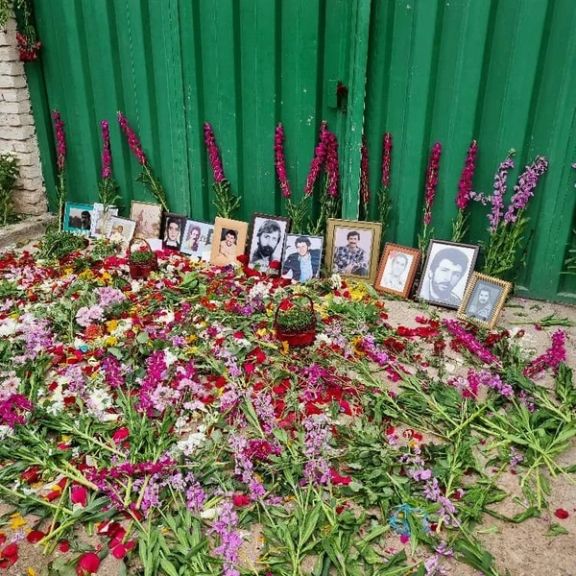
Iranian security forces have prevented families of prisoners executed in the 1980s from visiting the Khavaran cemetery, the resting place of their loved ones.

Iranian security forces have prevented families of prisoners executed in the 1980s from visiting the Khavaran cemetery, the resting place of their loved ones.
The families, who are known as the "Mothers of Khavaran," had planned to visit the graves of the victims of Iran's 1988 mass executions on the last Friday of the year before Norouz, but they were met with locked gates. Visiting the graves of loved ones on the last Friday of the year is a popular tradition in Iran.
Images shared on social media showed the families placing flowers on the iron gate of Khavaran cemetery and holding photos of their executed loved ones.
Mansoureh Behkish, a human rights activist and member of the Mothers of Khavaran, wrote on social media that the families were once again faced with closed doors on the eve of the Iranian New Year.
Behkish, who lost four brothers and a sister in the 1980s, added, "The agents assigned to the entrance of Khavaran asked for national ID cards, which was met with resistance from the families."
The Mothers of Khavaran have been holding a weekly gathering at the cemetery since 1988 to mourn their loved ones and demand justice. The cemetery is believed to be the mass grave of thousands of political prisoners who were executed while serving their sentences.
The exact number of prisoners executed during the purge is not known but according to Amnesty International, Iranian authorities "forcibly disappeared" and "extrajudicially executed" around 5,000 between July and September 1988. Most of victims were linked to the MEK but there were also others with links to leftist and secular groups such as Fadaiyan Khalq Organization (FKO) and Tudeh Party as well as some Kurdish groups, such as Komala and the Kurdish Democratic Party of Iran.

The former chairman of Iran’s central bank has harshly criticized the hardliner government of President Ebrahim Raisi for the worsening economic crisis in the country.
Abdolnasser Hemmati accused the government of creating three-digit inflation of food prices and the impoverishment of tens of millions of people “while Iran has the biggest combined oil and gas reserves in the world.”
President Ebrahim Raisi and his hardliner allies promised a quick fix for the economy during the 2021 presidential campaign, arguing that they can de-couple the economy form US sanctions. However, most economic indicators have worsened in the ensuing 30 months, with the national currency halving in value.
Hemmati was responding to Raisi’s remarks on Friday when the president said that “enemies try to spread despair” among Iranians by highlighting negative news. Hemmati said that Raisi’s policies have led to higher inflation and more corruption, by offering economic privileges to insiders. He was referring to preferential government rates for foreign currencies provided to some importers of essential goods, including foodstuff and animal feed.
Since the United States imposed sanctions on Iran in 2018, the national currency has lost value 15-fold, dropping from 40,000 to 600,000 rials per US dollar. The US withdrew from the 2015 JCPOA nuclear agreement demanding a stronger deal, while Tehran has refused a new deal proposed by the Biden administration in 2022.
Hemmati, referring to the hardliner slogan of a strong government said, “The decline in people's purchasing power despite having the world's first rank in oil and gas resources, over 30 percent of the population falling below the poverty line, a significant gap with regional rivals in terms of gross domestic product," are not signs of strength.

Negotiations to determine the minimum wage have stalled, leaving workers dangling about their future just five days before the Iranian New Year.
Mehdi Bagheri, the workers’ representative in Iran’s Supreme Council of Labor, said the council’s meeting on Wednesday failed to reach a final decision regarding the minimum wage as both the representatives of employers and the government do not “appreciate” workers and their efforts.
“We do not have much time to decide on the most important issue for workers and we are not the plaything of any group,” Bagheri stressed, further accusing the government and employers of manipulating statistics in an attempt to lower the worker’s minimum wage.
“I’ll make it clear that our job in the Supreme Council is to raise the living standards of the workers, not playing mathematical games,” he went on to say.
According to Bagheri, the other sides of negotiations try to avoid discussing the monthly livelihood basket for working families as they are aware that any accurate calculation of this component will result in a significant increase in workers’ wages.

Meanwhile, Nader Moradi, workers and retirees’ union activist, took the government to task for resisting even the minimal demands of the workers for wage determination.
The workers proposed a minimal rate of 195 million rials ($325) but the government keeps rejecting it, Moradi said, further adding, “If we take into account such items as housing and education, the minimum livelihood basket [base salary] for working families stands at 300 million rials (around $500).”
According to the activist, the government’s stance on the issue is shocking and unfathomable as just renting a house in the capital Tehran costs 100 to 120 million rials (165 to 200$).
Moradi also revealed that Iran’s Ministry of Health has backed the government’s position during the wage determination talks by proposing “a food basket” package which has significantly decreased the calorie needs of each person.
“With the government’s proposed calories, workers can’t live and breathe, let alone going to work or doing manual or intellectual labor for at least eight hours a day,” he pointed out.
On Tuesday, Ali Babaei, the spokesperson for the Labor Faction in the Iranian parliament, emphasized the need for fair wages for workers amidst dire economic challenges. He noted that workers are oppressed, their rights are often denied, and their job security remains uncertain.
In recent years, Iranian society has been grappling with severe economic problems. The continuous devaluation of the rial, particularly since the US withdrawal from the JCPOA nuclear deal in 2018, has fueled inflation and plunged millions into poverty. Over the past six years, the rial has fallen 15-fold.
Official annual inflation hovers near 50 percent, much higher than the government’s average salary increase of 20 percent. Earlier in the month, Eqtesad 24 daily warned that nearly one-third of Iranians struggle below the poverty line. The report projected a concerning escalation in poverty rates, foreseeing that by the end of the year 1402 [March 20], the proportion of individuals below the poverty line could soar to as much as 40 percent.
An analysis of posts on Persian social media indicate that Iranians voice deep concern on a daily basis on social media about inflation and rising rents, mainly struggling to pay rent, especially in the capital, Tehran.

US Republican Senator Dan Sullivan has called on the Biden administration to threaten Iran with sinking its ships if its Yemeni proxy continues attacks against American vessels in the Red Sea.
“Tell Iran that the next Houthi missile or drone launched at an American ship will result in the sinking of Iran’s spy ships that target our Navy,” Senator Sullivan (R-AK) wrote in a letter to President Joe Biden on Friday.
Pointing out that US attacks on Houthi targets have not deterred the Iran-backed US-designated group against attacking commercial ships, he argued that the only way to stop the Houthis’ assaults is letting Iran know that it would face direct consequences.
He referred to a hearing before the Senate Armed Services Committee last week, citing General Eric Kurilla, the Commander of US Central Command, as saying that that recent US strikes on Iranian proxies in the region “sent a very strong deterrent message.”
Kurilla, however, said Iran was not deterred from assisting Houthi strikes on US military and civilian targets, emphasizing that “Iranian spy ships are providing the Houthis with targeting information to sink American ships and kill US sailors and Marines.”
“Yet, Iran is facing zero consequences for this collusion... They are not paying the cost,” he said.
“As General Kurilla also noted, however, 'deterrence is always temporary’ and Houthi terrorists in Yemen have not been as effectively deterred,” Sullivan said in his letter. “If we ever expect Tehran to call off its terrorist proxies and make deterrence more than a temporary respite, Iran must be made to pay a price.”
Last week, the Houthis struck a commercial vessel, killing three of its crew members. In a separate attack two days later, American forces also shot down 28 drones and missiles.
During the hearing, Sullivan suggested Kurilla could order attacks to sink Iranian vessels after such an event, even thoughno US or allied vessels were damaged. Kurilla said that Biden would have to issue an order for such an operation.
Sullivan asked the CENTCOM commander if he had recommended sinking Iranian ships to Biden. Kurilla answered, “I provide options ranging everything from cyber to kinetic and I also identify the risk of escalation and all of those options.”
“In fact, the Houthis grow bolder by the day,” Sullivan said in his letter.
On Thursday, Iran-backed Houthis vowed to expand their operations beyond the Red Sea to block “Israel-linked ships” sailing through the Indian Ocean towards the Cape of Good Hope. This is the route many commercial vessels have been forced to take in the past few months, since the Houthis, armed by Iranian missiles and drones, have effectively closed the more common, far shorter path between Asia and Europe through the Red Sea and the Suez Canal.

The Group of Seven (G7) industrialised powers told Iran on Friday not to transfer ballistic missiles to Russia to use in its conflict with Ukraine, warning that they would take action against Tehran if it did so.
"Were Iran to proceed with providing ballistic missiles or related technology to Russia, we are prepared to respond swiftly and in a coordinated manner including with new and significant measures against Iran," the G7 leaders said in a statement.
Iran has provided Russia with a large number of powerful surface-to-surface ballistic missiles, sources told Reuters last month, deepening the military cooperation between the two countries, which are both under US sanctions.
A senior US official told a small group of reporters on Friday that G7 nations are prepared to respond with severe new penalties that could include a ban on Iran Air flights to Europe if Iran proceeds with the transfer of close-range ballistic missiles to Russia. "Our message today is, if Iran proceeds with providing Russia with ballistic missiles, the response from the international community will be swift and severe," the official said.
The official, speaking on condition of anonymity, said one option under consideration "would have the effect of ending flights from Iran Air, its flagship state-owned carrier, into Europe -- point being, this is not business as usual."
The G7 group of major Western democracies is currently chaired by Italy and also includes the United States, Japan, Germany, Britain, France and Canada.
The statement came as the European Union is also considering measures against Iran for arming Russia, Reuters reported this week.
UN Security Council restrictions on Iran's export of some missiles, drones and other technologies expired in October. However, the United States and European Union retained sanctions on Iran's ballistic missile program amid concerns over exports of weapons to its proxies in the Middle East and to Russia.
The United States has said Iran has already provided Russia with drones, guided aerial bombs and artillery ammunition that Moscow has used to attack Ukrainian targets.
(With reporting by Reuters)

US Secretary of State Antony Blinken and the head of the UN nuclear watchdog, Rafael Grossi, discussed Iran’s nuclear program during a meeting in Vienna on Friday.
According to a readout of the meeting by the US State Department, they discussed nuclear safety, security, and safeguards issues, including “outstanding verification issues in Iran.”
The International Atomic Energy Agency has regularly stressed the need for Iran to provide technically credible explanations for the presence of uranium particles of anthropogenic origin at Varamin and Turquzabad and to inform the Agency of the current location(s) of the nuclear material and/or of contaminated equipment.
“These outstanding safeguards issues stem from Iran’s obligations under its Comprehensive Safeguards Agreement and need to be resolved for the Agency to be in a position to provide assurance that Iran’s nuclear program is exclusively peaceful,” Grossi said last year.
Last week, Grossi said, “The Agency has lost continuity of knowledge in relation to [Iran’s] production and inventory of centrifuges, rotors and bellows, heavy water and uranium ore concentrate.”
Iran has enough uranium enriched to up to 60% for three atom bombs and is still stonewalling the agency on key issues, IAEA reports showed in November 2023. Iran's stock of uranium enriched to up to 60% grew by 6.7 kg (14.8 pounds) to 128.3 kg (282.9 pounds) since the last report on September 4, one of the two reports to member states seen by Reuters said. That is more than three times the roughly 42 kg (92.6 pounds) that by the IAEA's definition is theoretically enough, if enriched further, for a nuclear bomb. Weapons-grade is around 90% purity.
Earlier in March, France, Germany and the UK (E3) warned that Iran has "pushed its nuclear activities to new heights" in spite of global sanctions. The trio said that over the past five years, the levels of the country's enrichment “are unprecedented for a state without a nuclear weapons program". The observations were made to the IAEA Board of Governors on March 7.
In September 2023, Tehran withdrew the designation of several inspectors assigned to conduct verification activities in Iran under the Non-Proliferation Treaty Safeguards Agreement.
In December, Ali-Akbar Salehi, the former head of Iran's nuclear agency, implied that Iran has everything it needs for an A-bomb.