Iran’s Ex-Chief Banker Harshly Attacks Government’s Economic Record
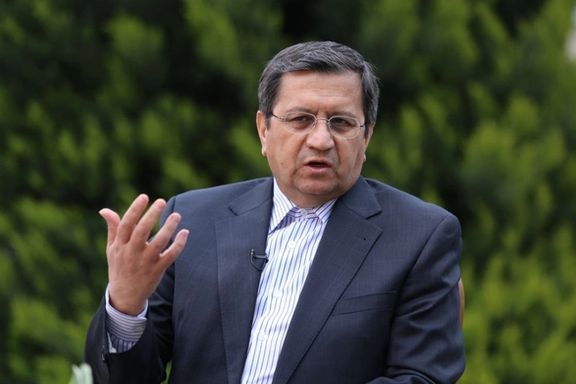
The former chairman of Iran’s central bank has harshly criticized the hardliner government of President Ebrahim Raisi for the worsening economic crisis in the country.
The former chairman of Iran’s central bank has harshly criticized the hardliner government of President Ebrahim Raisi for the worsening economic crisis in the country.
Abdolnasser Hemmati accused the government of creating three-digit inflation of food prices and the impoverishment of tens of millions of people “while Iran has the biggest combined oil and gas reserves in the world.”
President Ebrahim Raisi and his hardliner allies promised a quick fix for the economy during the 2021 presidential campaign, arguing that they can de-couple the economy form US sanctions. However, most economic indicators have worsened in the ensuing 30 months, with the national currency halving in value.
Hemmati was responding to Raisi’s remarks on Friday when the president said that “enemies try to spread despair” among Iranians by highlighting negative news. Hemmati said that Raisi’s policies have led to higher inflation and more corruption, by offering economic privileges to insiders. He was referring to preferential government rates for foreign currencies provided to some importers of essential goods, including foodstuff and animal feed.
Since the United States imposed sanctions on Iran in 2018, the national currency has lost value 15-fold, dropping from 40,000 to 600,000 rials per US dollar. The US withdrew from the 2015 JCPOA nuclear agreement demanding a stronger deal, while Tehran has refused a new deal proposed by the Biden administration in 2022.
Hemmati, referring to the hardliner slogan of a strong government said, “The decline in people's purchasing power despite having the world's first rank in oil and gas resources, over 30 percent of the population falling below the poverty line, a significant gap with regional rivals in terms of gross domestic product," are not signs of strength.

Mehdi Bagheri, the workers’ representative in Iran’s Supreme Council of Labor, said the council’s meeting on Wednesday failed to reach a final decision regarding the minimum wage as both the representatives of employers and the government do not “appreciate” workers and their efforts.
“We do not have much time to decide on the most important issue for workers and we are not the plaything of any group,” Bagheri stressed, further accusing the government and employers of manipulating statistics in an attempt to lower the worker’s minimum wage.
“I’ll make it clear that our job in the Supreme Council is to raise the living standards of the workers, not playing mathematical games,” he went on to say.
According to Bagheri, the other sides of negotiations try to avoid discussing the monthly livelihood basket for working families as they are aware that any accurate calculation of this component will result in a significant increase in workers’ wages.

Meanwhile, Nader Moradi, workers and retirees’ union activist, took the government to task for resisting even the minimal demands of the workers for wage determination.
The workers proposed a minimal rate of 195 million rials ($325) but the government keeps rejecting it, Moradi said, further adding, “If we take into account such items as housing and education, the minimum livelihood basket [base salary] for working families stands at 300 million rials (around $500).”
According to the activist, the government’s stance on the issue is shocking and unfathomable as just renting a house in the capital Tehran costs 100 to 120 million rials (165 to 200$).
Moradi also revealed that Iran’s Ministry of Health has backed the government’s position during the wage determination talks by proposing “a food basket” package which has significantly decreased the calorie needs of each person.
“With the government’s proposed calories, workers can’t live and breathe, let alone going to work or doing manual or intellectual labor for at least eight hours a day,” he pointed out.
On Tuesday, Ali Babaei, the spokesperson for the Labor Faction in the Iranian parliament, emphasized the need for fair wages for workers amidst dire economic challenges. He noted that workers are oppressed, their rights are often denied, and their job security remains uncertain.
In recent years, Iranian society has been grappling with severe economic problems. The continuous devaluation of the rial, particularly since the US withdrawal from the JCPOA nuclear deal in 2018, has fueled inflation and plunged millions into poverty. Over the past six years, the rial has fallen 15-fold.
Official annual inflation hovers near 50 percent, much higher than the government’s average salary increase of 20 percent. Earlier in the month, Eqtesad 24 daily warned that nearly one-third of Iranians struggle below the poverty line. The report projected a concerning escalation in poverty rates, foreseeing that by the end of the year 1402 [March 20], the proportion of individuals below the poverty line could soar to as much as 40 percent.
An analysis of posts on Persian social media indicate that Iranians voice deep concern on a daily basis on social media about inflation and rising rents, mainly struggling to pay rent, especially in the capital, Tehran.


The Secretary of Iran's High Council for Human Rights, Kazem Gharibabadi, accused Western countries of influencing the decisions of the United Nations’ Human Rights Council – and reiterated that the Council does not recognize the Council’s fact-finding mission.
The Iranian regime uses its High Council to defend itself against international criticism for human rights abuses.
“By complying with the political and mostly illegitimate demands of Western countries in 2023, the United Nations Human Rights Council has caused more suffering to the victims of human rights violations and become a tool for political interference [in other countries’ affairs,” Gharibabadi said in response to the UN fact-finding mission’s preliminary report published on March 8.
Established by the UN human rights council in November 2022, in response to the widespread Woman, Life, Freedom protests that engulfed the nation, the fact-finding mission primarily centers on Iran's nationwide 2022-2023 protests. Its experts have expressed regrets over the Iranian authorities' lack of meaningful cooperation, despite repeated requests for information, including details regarding the killing and injury of security forces, as well as their denial of access to the country and its people.
In contrast, Gharibabadi referred to the mandate of the fact-finding mission, claiming that Iran “deals responsibly” with matters related to “riots in the country” while underlining that President Ebrahim Raisi appointed a national committee to investigate the “riots.”
The country’s Supreme Leader Ali Khamenei, along with Iranian officials, have consistently dismissed the characterization of the uprising as peaceful, instead arbitrarily labeling protesters as "rioters" and accusing them of engaging in "terrorist acts."

Regime denies deliberately shooting protesters' faces
In November 2022, more than 370 ophthalmologists reported that numerous protesters struck by rubber bullets, metal pellets, and paintball bullets fired at close range during the protests were treated at medical centers. Many suffered permanent loss of eyesight in one or both eyes.
Backing up those reports, the fact-finding mission’s investigation found that “security forces used unnecessary and disproportionate force which resulted in the unlawful killing and injuries of protestors. A pattern of extensive injuries to protesters’ eyes caused the blinding of scores of women, men and children, branding them for life. The Mission also found evidence of extrajudicial killings.”
Moreover, the report highlighted that female protesters had been deliberately singled out due to their gender. They were subjected to close-range shootings aimed at their faces and genitals.
“A witness, who lost the sight in one eye, recalled a member of the security forces directing a paintball gun loaded with rubber bullets to the head from 1 m away. The mission notes the deterrent and chilling effect of such injuries, as they permanently marked the victims, essentially “branding” them as protesters. In a context where protests are effectively criminalized, the mission is satisfied that such an effect was intended,” the report read.
“These acts form part of a widespread and systematic attack directed against the civilian population in Iran, namely against women, girls, boys and men who have demanded freedom, equality, dignity and accountability,” said Sara Hossain, chair of the UN fact-finding mission.
Human rights organizations have compiled the names of at least 550 protesters, including 68 children, who were killed by security forces.
The full 400-page report is scheduled to be published on March 18th.