Sink Iranian Ships If Houthis Continue Red Sea Attacks, Senator Asks Biden
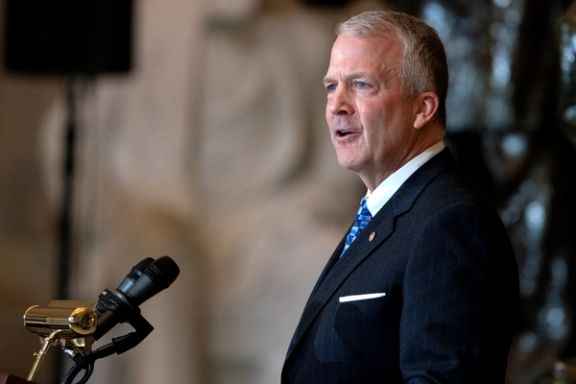
US Senator Dan Sullivan (R-AK) at the Capitol in Washington, DC, March 29, 2022
US Republican Senator Dan Sullivan has called on the Biden administration to threaten Iran with sinking its ships if its Yemeni proxy continues attacks against American vessels in the Red Sea.
“Tell Iran that the next Houthi missile or drone launched at an American ship will result in the sinking of Iran’s spy ships that target our Navy,” Senator Sullivan (R-AK) wrote in a letter to President Joe Biden on Friday.
Pointing out that US attacks on Houthi targets have not deterred the Iran-backed US-designated group against attacking commercial ships, he argued that the only way to stop the Houthis’ assaults is letting Iran know that it would face direct consequences.
He referred to a hearing before the Senate Armed Services Committee last week, citing General Eric Kurilla, the Commander of US Central Command, as saying that that recent US strikes on Iranian proxies in the region “sent a very strong deterrent message.”
Kurilla, however, said Iran was not deterred from assisting Houthi strikes on US military and civilian targets, emphasizing that “Iranian spy ships are providing the Houthis with targeting information to sink American ships and kill US sailors and Marines.”
“Yet, Iran is facing zero consequences for this collusion... They are not paying the cost,” he said.
“As General Kurilla also noted, however, 'deterrence is always temporary’ and Houthi terrorists in Yemen have not been as effectively deterred,” Sullivan said in his letter. “If we ever expect Tehran to call off its terrorist proxies and make deterrence more than a temporary respite, Iran must be made to pay a price.”
Last week, the Houthis struck a commercial vessel, killing three of its crew members. In a separate attack two days later, American forces also shot down 28 drones and missiles.
During the hearing, Sullivan suggested Kurilla could order attacks to sink Iranian vessels after such an event, even thoughno US or allied vessels were damaged. Kurilla said that Biden would have to issue an order for such an operation.
Sullivan asked the CENTCOM commander if he had recommended sinking Iranian ships to Biden. Kurilla answered, “I provide options ranging everything from cyber to kinetic and I also identify the risk of escalation and all of those options.”
The Group of Seven (G7) industrialised powers told Iran on Friday not to transfer ballistic missiles to Russia to use in its conflict with Ukraine, warning that they would take action against Tehran if it did so.
"Were Iran to proceed with providing ballistic missiles or related technology to Russia, we are prepared to respond swiftly and in a coordinated manner including with new and significant measures against Iran," the G7 leaders said in a statement.
Iran has provided Russia with a large numberof powerful surface-to-surface ballistic missiles, sources told Reuters last month, deepening the military cooperation between the two countries, which are both under US sanctions.
A senior US official told a small group of reporters on Friday that G7 nations are prepared to respond with severe new penalties that could include a ban on Iran Air flights to Europe if Iran proceeds with the transfer of close-range ballistic missiles to Russia. "Our message today is, if Iran proceeds with providing Russia with ballistic missiles, the response from the international community will be swift and severe," the official said.
The official, speaking on condition of anonymity, said one option under consideration "would have the effect of ending flights from Iran Air, its flagship state-owned carrier, into Europe -- point being, this is not business as usual."
The G7 group of major Western democracies is currently chaired by Italy and also includes the United States, Japan, Germany, Britain, France and Canada.
The statement came as the European Union is also considering measures against Iran for arming Russia, Reuters reported this week.
UN Security Council restrictions on Iran's export of some missiles, drones and other technologies expired in October. However, the United States and European Union retained sanctions on Iran's ballistic missile program amid concerns over exports of weapons to its proxies in the Middle East and to Russia.
US Secretary of State Antony Blinken and the head of the UN nuclear watchdog, Rafael Grossi, discussed Iran’s nuclear program during a meeting in Vienna on Friday.
The International Atomic Energy Agency has regularly stressed the need for Iran to provide technically credible explanations for the presence of uranium particles of anthropogenic origin at Varamin and Turquzabad and to inform the Agency of the current location(s) of the nuclear material and/or of contaminated equipment.
“These outstanding safeguards issues stem from Iran’s obligations under its Comprehensive Safeguards Agreement and need to be resolved for the Agency to be in a position to provide assurance that Iran’s nuclear program is exclusively peaceful,” Grossi said last year.
Last week, Grossi said, “The Agency has lost continuity of knowledge in relation to [Iran’s] production and inventory of centrifuges, rotors and bellows, heavy water and uranium ore concentrate.”
Iran has enough uranium enriched to up to 60% for three atom bombs and is still stonewalling the agency on key issues, IAEA reports showed in November 2023. Iran's stock of uranium enriched to up to 60% grew by 6.7 kg (14.8 pounds) to 128.3 kg (282.9 pounds) since the last report on September 4, one of the two reports to member states seen by Reuters said. That is more than three times the roughly 42 kg (92.6 pounds) that by the IAEA's definition is theoretically enough, if enriched further, for a nuclear bomb. Weapons-grade is around 90% purity.
Earlier in March, France, Germany and the UK (E3) warned that Iran has "pushed its nuclear activities to new heights" in spite of global sanctions. The trio saidthat over the past five years, the levels of the country's enrichment “are unprecedented for a state without a nuclear weapons program". The observations were made to the IAEA Board of Governors on March 7.
In September 2023, Tehran withdrew the designation of several inspectors assigned to conduct verification activities in Iran under the Non-Proliferation Treaty Safeguards Agreement.
Tehran is doubling down on its rejection of a UN report that found the regime committed crimes against humanity during its crackdown on nationwide protests.
The Secretary of Iran's High Council for Human Rights, Kazem Gharibabadi, accused Western countries of influencing the decisions of the United Nations’ Human Rights Council – and reiterated that the Council does not recognize the Council’s fact-finding mission.
The Iranian regime uses its High Councilto defend itself against international criticism for human rights abuses.
“By complying with the political and mostly illegitimate demands of Western countries in 2023, the United Nations Human Rights Council has caused more suffering to the victims of human rights violations and become a tool for political interference [in other countries’ affairs,” Gharibabadi said in response to the UN fact-finding mission’s preliminary report published on March 8.
Established by the UN human rights council in November 2022, in response to the widespread Woman, Life, Freedom protests that engulfed the nation, the fact-finding mission primarily centers on Iran's nationwide 2022-2023 protests. Its experts have expressed regrets over the Iranian authorities' lack of meaningful cooperation, despite repeated requests for information, including details regarding the killing and injury of security forces, as well as their denial of access to the country and its people.
In contrast, Gharibabadi referred to the mandate of the fact-finding mission, claiming that Iran “deals responsibly” with matters related to “riots in the country” while underlining that President Ebrahim Raisi appointed a national committee to investigate the “riots.”
The country’s Supreme Leader Ali Khamenei, along with Iranian officials, have consistently dismissed the characterization of the uprising as peaceful, instead arbitrarily labeling protesters as "rioters" and accusing them of engaging in "terrorist acts."
A scene of Women, Life, Freedom protests in Tehran (September 21, 2022)
In November 2022, more than 370 ophthalmologists reported that numerous protesters struckby rubber bullets, metal pellets, and paintball bullets fired at close range during the protests were treated at medical centers. Many suffered permanent loss of eyesight in one or both eyes.
Backing up those reports, the fact-finding mission’s investigation found that “security forces used unnecessary and disproportionate force which resulted in the unlawful killing and injuries of protestors. A pattern of extensive injuries to protesters’ eyes caused the blinding of scores of women, men and children, branding them for life. The Mission also found evidence of extrajudicial killings.”
Moreover, the report highlighted that female protesters had been deliberately singled out due to their gender. They were subjected to close-range shootings aimed at their faces and genitals.
“A witness, who lost the sight in one eye, recalled a member of the security forces directing a paintball gun loaded with rubber bullets to the head from 1 m away. The mission notes the deterrent and chilling effect of such injuries, as they permanently marked the victims, essentially “branding” them as protesters. In a context where protests are effectively criminalized, the mission is satisfied that such an effect was intended,” the report read.
“These acts form part of a widespread and systematic attack directed against the civilian population in Iran, namely against women, girls, boys and men who have demanded freedom, equality, dignity and accountability,” said Sara Hossain, chair of the UN fact-finding mission.
Human rights organizations have compiled the names of at least 550 protesters, including 68 children, who were killed by security forces.
The full 400-page report is scheduled to be published on March 18th.
Amid a deteriorating aviation fleet and a bleak outlook for acquiring modern aircraft, Iran has purchased a 29-year-old plane from the Taliban, Iranian daily Aftab-e Yazd has reported.
The plane, most likely a McDonnell Douglas MD-82, was originally built in 1995 for Italy. It was later used by Ukraine for 19 years and then by Kam Air, an Afghan airline. It has been acquired by Iranian airline Kish Air, the paper claimed.
The article by Aftab-e Yazd also criticized the Raisi administration which has claimed it has added 90 planes to the country's fleet, saying that 50 of them were old planes that have been repaired in Iran.
The article quipped, "Let's just pray” that Iran only bought one 29-year-old Kam Air aircraft and the remaining 49 are procured from other sources.
The purchase of the plane comes just two months after Airbus, the European aerospace giant, officially canceled a major deal to sell Iran 100 planes. The deal was worth an estimated $30 billion and was seen as a key part of Iran's efforts to modernize its fleet after the lifting of sanctions as part of the 2015 nuclear agreement (JCPOA). A few airbus planes were delivered but the Trump administration never approved sale of US planes until Washington withdrew from the JCPOA in May 2018 and reimposed sanctions.
Iran has suffered from shortages of civilian airliners since the 1990s. The sanctions have made it almost impossible for Iran to purchase new aircraft or spare parts from Western companies. To compensate, Iran resorted to leasing older planes or procuring spare parts through intermediaries. However, the technical state of their fleet has steadily deteriorated over time.
As a result, Iran's fleet has become increasingly old and unreliable. The average age of Iran's planes is now over 25 years, and many of them are in need of major repairs.
In July 2023, Mohammad Mohammadi-Bakhsh, the head of the Iranian Civil Aviation Organization, said that Iran currently needs 550 planes, but only has 180.
The United States has backed a report by the UN Fact-Finding Mission on Iran that confirmed a wide array of “crimes against humanity” committed during the Iranian regime's crackdown on the 2022 protests.
In his press briefing on Thursday, US State Department Spokesperson Matthew Miller highlighted the “extremely concerning human rights abuses” that the reports documented, including killings, imprisonment, torture, and sexual violence.
“We strongly support the resolution under consideration at the UN Human Rights Council that renews mandate – renews mandates for the fact-finding mission and the special rapporteur on human rights in Iran for another year,” Miller added.
Tehran has dismissed the report, reiterating that it does not recognize the UN group. The Fact-Finding Mission (FFM) was established by the United Nations’ Human Rights Council in November 2022, two months after the Woman, Life, Freedom protests swept Iran in response to the death in morality-police custody of 22-year-old Mahsa Amini.
Miller further condemned the “illegitimate activities by the Iranian Government,” noting that the Biden administration has imposed sanctions on more than 500 Iranian entities.
However, he defended a recent waiver signed by the White House that will allow Iran to continue selling electricity to Iraq, emphasizing that no money is permitted to enter Iran under the terms of this waiver. “All of these funds are held in restricted accounts and they can only be used for transactions for the purchase of food, medicine, medical devices, agricultural products, and other non-sanctionable transactions.”
He also reiterated that Iran is always going to fund terrorism and it is always going to fund destabilizing activities. “We have held Iran accountable for its support of terrorism and its funding of dangerous proxy groups around the region, and we’ll continue to do so.”
“In fact, the Houthis grow bolder by the day,” Sullivan said in his letter.
On Thursday, Iran-backed Houthis vowed to expand their operations beyond the Red Sea to block “Israel-linked ships” sailing through the Indian Ocean towards the Cape of Good Hope. This is the route many commercial vessels have been forced to take in the past few months, since the Houthis, armed by Iranian missiles and drones, have effectively closed the more common, far shorter path between Asia and Europe through the Red Sea and the Suez Canal.