Wages In Iran Lag One Year Behind 50% Inflation
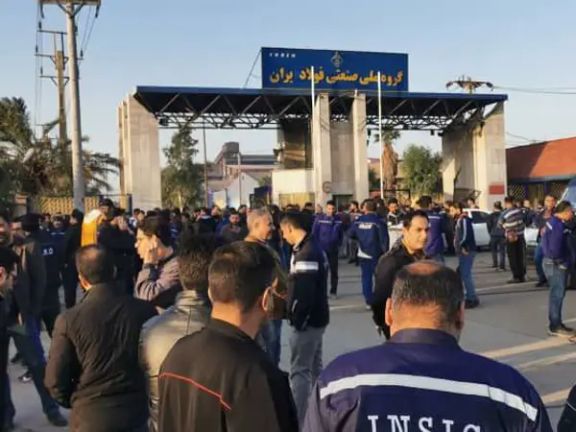
Mohammad Reza Tajik, the head of the Workers' Assembly of Tehran Province, has warned that wages lag behind inflation, leaving millions struggling to make ends meet.
Mohammad Reza Tajik, the head of the Workers' Assembly of Tehran Province, has warned that wages lag behind inflation, leaving millions struggling to make ends meet.
Speaking out against the prevailing economic hardships, Tajik emphasized that "The wages of workers are always one year behind inflation."
He added that even a 100% wage hike would fail to bridge the gap between wages and living expenses for the working class. Inflation began to soar to 40% in 2019 after the United States imposed economic sanctions on Iran. The cumulative effect of five years of high inflation has impoverished tens of millions of Iranian wage earners.
Tajik's remarks come amidst the Iranian government's recent approval of a 20 percent average salary increase, slated to take effect after March 21. However, the adjustment is insufficient against the backdrop of inflation rates, which currently hover around 50 percent annually.
The purchasing power of Iranians is further undermined by the rising value of the US dollar in Tehran, which stands at 600,000 rials, with prospects of further depreciation looming in the near future.
The persistent inflation and sluggish economy have propelled millions of Iranians into the category of "working poor," with reports indicating that wages cover a mere 60 percent of monthly household expenses.
A myriad of factors contribute to the continuation of low wages in Iran, including economic mismanagement, corruption, and international sanctions. Moreover, structural deficiencies within the labor market, such as informal employment and inadequate labor regulations, exacerbate the prevalence of low-paying jobs. Consequently, many workers, particularly those in marginalized communities and informal sectors, grapple with poverty, struggling to afford basic necessities like housing, healthcare, and education.


Political activists from various ideological backgrounds have cautioned against the resurgence of radicalism in Iranian politics following the victory of ultraconservatives in the parliamentary elections.
Ashraf Boroujerdi, a former presidential aide during President Hassan Rouhani's tenure and a scholar specializing in humanities and cultural studies, expressed concern to Etemad Online. She highlighted the parallels between the current Iranian government and the new parliament and the populist ultraconservative administration of President Mahmoud Ahmadinejad (2005-2013) and the first parliament after reformists lost power to conservatives in 2004.
Ahmadinejad’s 8-year presidency was marked by populist slogans, a radical foreign policy that brought on international sanctions and the squandering of nearly $600 billion in oil income. During the first six years of Ahmadinejad’s presidency, Iran was not affected by any oil export sanctions and international crude prices were at their height, touching $120 per barrel.

Although the former president noticeably changed his political position in recent years, criticizing the regime, but his period is seen as the beginning of economic and social welfare decline.
Boroujerdi warned that the current government and the new parliament are likely to replicate the issues that afflicted Iran's political landscape and economy during the 2010s under an ultraconservative regime. She emphasized that “a government that enacts laws against the will of the people and relies on their votes to pass such legislation is destined to fail.”
Moreover, Boroujerdi noted a growing disillusionment among the populace. "More and more people turn away from the government after every election. So, the system needs to seriously re-consider its decisions and the way it interacts with the people." She added that "Even some of those who voted in the latest election in Iran did so only to have their IDs stamped by the officials as they needed that for the survival of their business and livelihood."
Similar to many other analysts, she attributed most of Iran's problems to the ultraconservative factions that have held power since the 2010s, hindering the country's progress. Boroujerdi also highlighted how Ahmadinejad's denial of the Holocaust policy further isolated Iran on the international stage.
Meanwhile, conservative political figure Abbas Salimi Namin suggested that some newly elected ultraconservative MPs ascended to power through smear campaigns against their political opponents. He urged these MPs to set aside their differences and prioritize the nation's interests.
Namin cautioned against political conflicts and radicalism within the parliament, noting instances where certain MPs had already caused tensions by attacking their colleagues, drawing warnings from both the public and Iran's Supreme Leader. He emphasized that continued smear campaigns would not garner popular support and stressed the importance of efficiency in parliamentary proceedings.
In another development, lawmaker Massoud Pezhkian, whose seat in the next parliament was secured due to intervention from Supreme Leader Ali Khamenei, warned against the long-term viability of lawmakers elected on radical platforms. Pezhkian cited Amir Hossein Sabeti, a hardline former TV presenter, as an example, questioning his qualifications and educational credentials.
Pezhkian cautioned against the dangers of populism, highlighting instances where officials and lawmakers made lofty promises without delivering tangible results. He specifically referenced President Raisi's pledge to build four million houses in four years, asserting that such promises often fall short due to the complexities of governance and practical constraints.

But, the cancellation of the speech – meant to have taken place at the mausoleum of the 8th Islamic Shia Imam – likely has other reasons. Particularly since, Ali Khamenei does not typically stay away from the public during Ramadan, unlike his predecessor Ayatollah Khomeini.
Throughout his rule, akin to the Grinch stealing Christmas, Khamenei has persistently sought to hijack the non-Islamic celebration of Norouz (Nowruz) with his annual speech. Exploiting the influx of Muslim pilgrims visiting the shrine of Imam Reza, he has used the day to showcase his popularity among believers. The sole exception to this pattern occurred during the peak three years of the Covid pandemic.
This year, it’s probable that the leader of the Islamic Republic is either worried about the absence of a crowd – or is struggling with health issues.

The war against Nowruz
The attempt to steal Norouz traces back 45 years to the Islamic Revolution. In 1979, upon seizing power, Islamists immediately made an attempt to abolish the two-week Norouz holiday for schools and universities, which ultimately proved unsuccessful. Subsequently, they set their sights on the 5-day vacation of government employees at the year's onset, only to encounter staunch resistance from the workers. Following this, they proceeded to systematically cancel Norouz celebrations in public spaces, imposing bans under various pretexts. Consequently, Nowruz was gradually forced into the privacy of people's homes.
Not stopping there, the clerical regime moved to eradicate the celebrations and customs associated with Norouz Day, which falls on the Spring Equinox. They cracked down on Chahar Shanbeh Suri, the traditional event observed on the last Tuesday of the year, citing safety reasons due to the millennia-old Iranian tradition of fire jumping.
Celebrated on the 13th day of Norouz, Sizdah Be-dar, a day when Iranians traditionally seek solace in nature after the holiday season, was deemed environmentally hazardous. Authorities erected barriers on roads to prevent people from venturing into meadows, mountains, and forests. In an attempt to alter public perception, the government renamed this day "Nature Day," and yet despite several attempts in parliament, they failed to abolish the ancient tradition.
However, aspects of Norouz that could be utilized for the regime's propaganda, such as the leader's address broadcasted on state radio and television channels after the Spring equinox – but were Islamized.
The traditional Persian Norouz table saw a significant change imposed by Islamists, who replaced the revered Divan-e-Hafez, the masterpiece of the 14th-century Persian poet Hafez, with the Quran. The government's strategy with these measures was to make Islamic holidays like Eid al-Fitr and Eid al-Adha into national holidays with extended breaks, while simultaneously eliminating ancient Persian holiday festivities such as Chaharshnbeh Suri, Mehregan, and the 13th of Norouz from the national calendar.
In contrast to Iranian monarchs, who traditionally celebrated Norouz with opulent banquets, gift-giving, and audiences with their subjects, Khomeini and Khamenei diverge in their approach to the holiday. While Khomeini remained out of the public eye during the 13-day spring festival, Khamenei broke this tactic by delivering a speech, often utilizing pilgrims as his audience.
In the process of Islamization, every aspect reminiscent of ancient Iran and its traditions was sidelined to make way for ceremonies, symbols, and signs of the Islamic era. Just as the grand Zoroastrian fire temples were converted into mosques following the Arab conquest, Iran’s new conquerors wanted to infuse and paint Nowruz with a religious hue.

Iranians defy Islamization
On the flip side, Iranians across the globe commemorate Norouz with increasing grandeur each year, regarding it as a fundamental aspect of their national identity. With the advent of the Spring equinox, millions meticulously arrange traditional Norouz tables (Sofre Haftsin), sharing photos of their festive displays with enthusiasm. Despite economic adversities, families steadfastly uphold cherished traditions, ensuring essentials like greenery (Sabzeh) and hyacinth (Sombol) are never omitted from the Sofre Haftsin.
Across Iranians in provinces, like Kurdistan, Khorasan, and Gilan, people defiantly uphold vibrant celebrations with traditional dances and attire – disregarding government restrictions. The age-old tradition of baking sweets for the New Year has experienced a resurgence, while households across the nation engage in thorough Spring cleaning rituals. While the state television sweeps the joy of Norouz under the rug, the journey of millions of citizens to neighboring countries to participate in the concerts of Iranian artists living abroad and Norouz celebrations has become a part of the tradition every year.
While the Islamic Republic and its allies proclaim themselves as the "axis of resistance" against Western influence in the region, it is the Iranian people who embody the genuine axis of resistance against coercive Islamism.