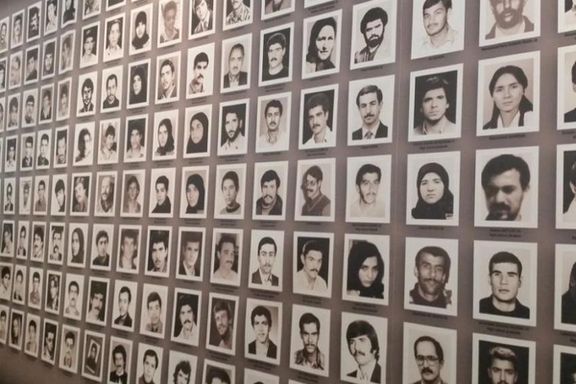
Photos of some prisoners summarily executed in Iran in 1988
Iranian security forces have once again barred family members from visiting the graves of political prisoners executed in 1988 as crackdowns on dissent continue to impact human rights.
Mansoureh Behkish, a representative of families seeking justice for those executed in 1988, said families "placed photos of their loved ones behind closed doors and showered them with flowers" at Khavaran Cemetery, east of Tehran.
Khavaran is the resting place for an undisclosed number of executed prisoners, interred in both mass and individual graves. The site was designated for the burial of non-Muslims, including Armenian Christians, Hindus, and members of the persecuted Baha'i faith.
The exact number of prisoners executed from August 1988 to February 1989 remains undisclosed by the authorities, with estimates suggesting the deaths of between 4,500 and 10,000 prisoners incarcerated at the time the clerical regime decided to eliminate those deemed oppositional. The majority of the victims were affiliated with the Mujahedin-e Khalq Organization (MEK), along with Marxists and activists from various leftist groups.
The repeated denial of entry, also enforced earlier on March 15, coincides with recent actions against the Baha'i community, where the security apparatus has forced the burial of deceased Baha'is in newly dug graves at Khavaran, continuing the harassment of Iranian Baha'i citizens.
For more than three decades since the mass execution of thousands of political prisoners in 1988 and their secretive burial in Khavaran and other locations across Iran, the government of the Islamic Republic has been actively attempting to destroy or repurpose the sites of the mass graves.
Iran has renewed its wave of executions, last year over 800 mostly political prisoners were killed as the regime struggles to fight for legitimacy on the back of the 2022 uprising which has posed the biggest challenge to the government since the founding of the Islamic Republic in 1979.
Iran announced on Saturday that the government will provide the armed forces with three billion euros to “quickly start sealing the borders” against a backdrop of recent clashes with Taliban forces.
“This comprehensive effort includes the installation of fences, walls, and intelligent border control systems, ensuring a robust defense of our borders,” Iran's Deputy Interior Minister Majid Mirahmadi said.
On Thursday, Taliban forces captured five Iranian border guards in Afghan territory and handed them over to intelligence officials. Later that day, Iranian state media reported that they had been released.
The Iranian government and the Taliban have been involved in several border disputes over recent months.
According to the representative of Sistan-Baluchestan province, a heavily drought-stricken region in southeastern Iran, the Afghan government diverts the Helmand River's water through canals and dams. Water from the river plays a crucial role in agricultural irrigation and potable water supply.
While Iran has accused Afghanistan of violating a 1973 treaty by restricting the flow of water, the Taliban has denied the claims, saying there was not enough water to flow toward the Iranian border.
Iranian authorities have claimed for the past two years that the Taliban have agreed to allot 820 million cubic meters of Iran's water share from Helmand every year. However, the Taliban has not confirmed this agreement, nor has any water been released to Iran.
Clashes at the border over water rights in May last year claimed the lives of at least two Iranians and one Taliban soldier.
Additionally, the situation has been tense along Iran's eastern borders as the insurgent Sunni Baluch group known as Jaish al-Adl (Army of Justice) has intensified its operations against Iranian security forces. A key objective of the group is to promote enhanced rights and improved living conditions for the Baluch ethnic minority.
For years, Jaish al-Adl has been a source of tension between Iran and its nuclear neighbor, Pakistan. In January, the Islamic Revolutionary Guard Corps (IRGC) attacked positions in Pakistan in what it described as an attempt to target terrorists. The Pakistani military retaliated by attacking locations in the southeastern region of Iran.
The Jaish al-Adl militants ambushed police vehicles along the Sib and Suran county routes in Sistan-Baluchistan province earlier this month, killing six law enforcement officers. During the same week, the group attacked military posts in Chabahar and Rask, killing 16 police officers; 18 Jaish al-Adl militants were also killed.
Last year, the UN Special Rapporteur on Iran stated that Baluchis are disproportionately targeted and executed by the Iranian criminal justice system. According to him, the level of killings, torture, and brutality against the Baluch minority in Iran is “shocking.”
After significant losses since January, the Iranian rial has managed to regain nearly 10 percent of its value over the past week, as tensions with Israel did not escalate as expected.
In the first two weeks of April amid worsening tensions between Iran and Israel, the foreign exchange market in Tehran witnessed an unprecedented surge, with the dollar briefly reaching the 700,000-rial threshold. Since early January, the rial had fallen by nearly 30 percent, marking the highest exchange rate recorded for the American currency in Iran. While tensions between Israel and Iran have seemingly cooled off, the rial has gained some value back, trading at 610,000 per dollar. Israel attacked Iran's consulate in Damascus on April 1, killing two Iranian Revolutionary Guard Corps (IRGC) generals and five military advisers, sharply raising tensions between the arch-enemies. Later, Iran retaliated with an unprecedented drone and missile barrage against Israel, most of which were intercepted. The tit-for-tat moves appeared to be halted after a suspected Israeli attack targeting Iran’s central city of Isfahan hit a radar system for a Russian-made air defense battery later in April. The Iranian rial has steadily lost value since the 1979 revolution, began to nosedive in 2018 after the US withdrew from the JCPOA nuclear deal and imposed sanctions on its oil exports and banking sector. In 1978, the rial was valued at 70 rials per dollar. Over the past five years, the devaluation has exacerbated inflationary pressures, resulting in millions of Iranians falling below the poverty line. Based on the debt payment calculation table published by the central bank last week, the annual inflation rate in 2023 was 52.3%, the highest in 80 years.
For several years now, I have worked to root out Iranian regime influence in the US, but I also became aware, firsthand, that Iran is seeking to maximize its influence in India, specifically in Indian Kashmir.
After speaking at a conference in India due to my work concerning Islamic extremist groups and the newly contentious Kashmir dispute between India and Pakistan, I flew to Srinigar in Indian Kashmir. I suspected I’d learn more about Sunni extremist groups such as Lashkar-e-Taiba, and how local Kashmiris were responding to the newly implemented reforms of Kashmiri governance due to changes to the Indian Constitution. But I also learned that the Iranian theocracy is very much a player in this drama too, and those who oppose its poisonous influence ought to be more aware of the threat Iran poses.
Understanding the politics of the region is key to understanding the importance of what Iran is doing. In brief, what was the princely state of Jammu and Kashmir prior to Indian independence and partition that was majority Muslim, but Hari Singh, the Maharaja, was Hindu. During partition, Pakistan invaded Kashmir, and the Indians, at Singh’s request, rushed in to defend the rest of the state. The conflict ended in a ceasefire that has functionally been in force since the late 40’s, but with numerous skirmishes and insurgent groups from Pakistan trying to reunite Kashmir over the decades.
In 2019, India removed Kashmir’s semi-independent status, a status originally intended to induce a negotiated settlement, and incorporated Kashmir fully into India. Along with a subsequent lockdown aimed at ending the ability of insurgent groups such as Hizbul Mujahideen to function, this was controversial. The Indian government has repeatedly stated that it will eventually grant full self-government to the state, including in proceedings before the Indian Supreme Court, but for the time it remains a Union territory without the same autonomy of another Indian state.
While the true views of Kashmir’s Sunni population is disputed, some support the Indian Government and at least some parts of the population are more in line with Pakistan, there is little doubt that Kashmir’s Shia community is largely favorable toward the Indian state, which they see as the better option compared to Sunni-run Pakistan. Shias are more favorable to the BJP party than your average Kashmiri, despite BJP’s reputation of having a strong Hindu identity. A local representative of a Shia community, Javid Beigh, has explained that that, in his view, “The separatist movement in Kashmir is primarily for establishment of radical Sunni Muslim Caliphate on lines of what ISIS has done in the Middle East or what Taliban did in Afghanistan.” This fear drives much of the Shia population to support the Indian Government’s actions in Kashmir.
But while Shia and Sunni Islamism can present different threats, they can also manifest as one, particularly when backed by an expansionist theocracy like Iran.
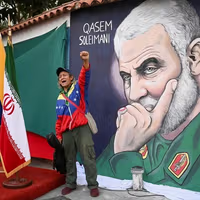
Iran’s influence in the region immediately became obvious when I visited the Hazratbal Shrine, a Kashmiri holy site that reportedly contains a lock of the Prophet Mohammad’s hair. Upon leaving, just a short drive from the Mosque, I saw a huge banner, hanging by the side of the road, that openly celebrated multiple Iranian Ayatollahs, and IRGC Quds Force Commander General Qasem Soleimani, responsible for the death of over 600 American soldiersnot counting proxy groups that functionally reported to him, and countless people of other nationalities.
A billboard near the Hazratbal Shrine in Srinigar, in the Indian State of Jammu and Kashmir (Photo by Cliff Smith)
Iran, as a Shia theocracy and a regional power determined to become a regional (and, eventually, global) hegemon, this was perhaps not shocking. Iran’s pattern of seeking influence, and indeed control, of Shias in Lebanon, Iraq, and so on, are well known. I did not expect, however, for it to be so out in the open and celebrated.
Nor was this a one-off. I repeatedly saw similar such propaganda in every neighborhood with significant Shia populations, including various parts of Srinigar, and rural areas surrounding it. They seem particularly concentrated near Shia schools.
Iranian propaganda posters on the grounds of a school in Budgam district, the most Shia heavy area of the Indian state of Jammu and Kashmir (Photo by Cliff Smith)
Nor was this influence limited to propaganda posters that were prolific in Shia heavy areas. More than once, when meeting with Shia leaders, I was greeted warmly with food that they readily, and even proudly, explained was from Iran. While India ceased buying oil from Iran under pressure from the US, there has been chatter of it resuming doing so, due to fears of disrupted transportation through the Red Sea, vis a vis the Iran backed Houthi movement. Even discounting oil, Iran and has a robust trade relationship with Iran in agricultural products. Indeed, India is Iran’s 3rd largest export destination. Thus, Iran’s influence in India is not merely about propaganda, but financial and cultural ties as well.
Iran seeks to influence Indian Shias through religious figures as well. One activist I met with, whose father was prominent Shia Cleric Aga Syed Hassan Mousavi Al-Safavi, proudly showed pictures of his father meeting with senior Iranian and Shia leaders, including the Secretary General of Hezbollah, Sheik Hassan Nasrallah, perhaps Iran’s most important terrorist proxy. Al-Safavi also retweets Iranian Supreme Leader Khamenei without further comment. So whether or not he agrees with his son, that Iranian meddling in Kashmir is “not helpful,” it remains true that Iran’s views find an open ear with at least a decent portion of India’s Shia population.
This is not true of all Shia, of course. First, there are sects of Shia, such as the Ismaili Shia Muslims, who hold a very different religious and political worldviews. Ismaili follow other clerics, currently led by Imam Shāh Karim al-Husayni, known as Aga Khan IV, the leader of the Ismaili community. Other, Twelver Shia follow Iraqi cleric Ayatollah Sistani and other clerics.
But it remains true that Iran seeks to influence Indian Shia clerics in Iran’s direction and meets with some success. Indeed, some Indian Shia clerics seek approval from Iranian clerics to join in celebrations with local Sunnis. And while it is true that there is some conflictbetween a number of Iranian clerics and the regime, scholars Reuel Marc Gerecht and Ray Takeyeh make it clear that is “no question who rules.”
The Iranian regime also reaches straight into India, using the Imam Khomeini Memorial Trust (IKMT) to train Shia clergy, particularly, but not exclusively, in the Kashmir region. IKMT makes no secret of its allegiances, posting pictures of the Iranian Supreme Leader on their Facebook page. Mohammad Prevez Bilgrami, a scholar who has extensively discussed Iran’s foreign policy, says that “India is well aware of,” Iran’s influence among Shia clerics, “(And) even silently endorses it,” stressing that “India views the Sunni Muslim fundamentalism and militancy emanating from Pakistan as its prime national-security threat.”
India is not wrong to view Pakistani radical groups, particularly backed by Pakistan’s military and intelligence, as a primary threat, and it is perhaps understandable that they seek better relations with Iran as a result. But that should not cause them to overlook the threat posed by Iran, including on the Kashmir issue. The Iranian Supreme Leader has openly raised the issue of Kashmir, comparing it to the Palestinian cause and Gaza in particular, a common tactic of Pakistani Sunni radicals as well. Particularly after October 7th, it should not take much of an imagination to realize that, if it should become convenient, Iran is capable of working with proxies to reign down death on India, just as it does Israel.
To quote former Pakistani Ambassador Hussain Haqqani, now living in exile in the United States, “Iran’s goals in Asia appear to be expansion of economic and political leverage, spread of Islamist ideology, and the recruitment of cannon fodder for its proxy wars. It also hopes to keep in check the influence of Israel, Saudi Arabia, and the United States.”
Indeed, Iran will seek to damage India’s budding and increasingly important relationship with Israel (a relationship so important and budding that Islamists and their allies on the far left openly seek to demonize the India/Israel relationship specifically) whenever it can, and will do the same with India’s close relationship with the Gulf Monarchies, as well as its increasingly close relationship with the US. Iran is already is seeking to use Indian Muslims as “cannon fodder” for its proxy wars, something Khamenei has praisedopenly.
Washington should seek to make it easier for Delhi to choose the US and its allies over Iran. But India should also be aware that Iran is trying to put its thumb on the scale against the US. India should what it can to resist the siren’s call of Iran’s influence operations because Iran has demonstrated time and time again, in Iraq, in Syria, in Lebanon, and beyond, it is no respecter of nations, and will not hesitate to tear countries apart to achieve its theocratic aims. Given enough time and resources, Iran will eventually turn its attention to India, and especially Kashmir. It’s already laying the groundwork.
A group of 61 lawyers has issued a condemnation of the morality police's aggressive tactics in Iran, particularly criticizing the controversial Nour project to enforce hijab.
Nour, the regime’s new hijab enforcement plan, has seen Iranian authorities escalate their physical efforts to enforce the Islamic Republic’s strict hijab laws. It has led to a surge in violent crackdowns targeting women on Iranian streets.
The lawyers declared such actions illegal and in violation of both the national constitution and international human rights agreements.
"Continuing these policies will undoubtedly lead to more conflict, confrontation, and insecurity in society, and will create more harmful aspects for women," read the statement.
Despite the government's efforts to enforce mandatory hijab laws, a strong wave of civil disobedience continues. Many women have been seen in public spaces without a hijab, protesting against these impositions.
Contrasting with this criticism, Grand Ayatollah Naser Makarem Shirazi sent a supportive message to Ahmadreza Radan, Iran’s Police Chief, encouraging him to enforce the hijab laws with "strength and determination." Radan echoed the sentiment, emphasizing the perceived threat if such moves are not upheld: "If the enemy overcomes the trench of chastity and hijab, nothing will remain for us."
Recent crackdowns, initiated following a directive by Supreme Leader Ali Khamenei on April 13, have led to the arrest of hundreds of women across various cities in Iran. Yet, the spirit of resistance among Iranian women remains strong. In one notable incident, a woman was arrested at the Beheshti judicial complex in Tehran for appearing without a hijab, stating, "I have come here with hijab all my life; this time I came without a hijab to reclaim my rights."
The Iranian government and its ultra-hardliner supporters advocate adding Thursdays as the second official weekend day, allegedly to avoid the Jewish Sabbath.
Currently, Friday is the only official day of rest in Iran, but many government offices and private companies also observe part-time or complete closures on Thursdays. A bill submitted to parliament last year aims to shorten the weekly work hours from 44 to 40 and will be debated in the parliament in the coming days.
Some lawmakers such as Ali-Asghar Anabestani say the parliament’s Social Committee which has reviewed the bill has been convinced by the representatives of the public institutions, including chambers of commerce, that Saturday is a better option than Thursday as the second week end day, but its advisory decision may be overturned by more hardliner lawmakers when it comes to a vote.
President Ebrahim Raisi’s parliamentary deputy, Mohammad Hosseini, said Wednesday that the government is in favor of the Thursday option.
Hardliner Iranian lawmaker Ali Asghar Anabestani
Many in Iran's private sector and others, however, say this will entail very negative consequences for Iran's foreign trade, tourism, and international relations because the workdays shared between Iran and the rest of the world will be down from Monday to Wednesday, leading to four consecutive days of no contact, if Thursday is approved.
They also argue that weekends in other Islamic countries in the region including Saudi Arabia, the UAE, Pakistan, Turkey, and Iraq is also on Friday and Saturday.
The arguments forwarded by government officials and supporters against Saturday make no reference to undesirability of having a rest day that is reminder of the Jewish Sabbath, but some private sector officials and media have disclosed that their objections are essentially ideological rather than practical or cultural as they claim.
“In various and numerous meetings with lawmakers…representatives of the chamber have pointed out the damage and erroneousness of designating Thursday as a weekend day … Their only argument against what we want is that Saturday is a Jewish day of rest!!!!” Ali Kolahi, Chairman of the Industries Committee of the Iran Chamber of Commerce posted on X on April 15.
Ideological hardliners dominating the parliament and the government have well-documented anti-Jewish and anti-Israeli positions. The Islamic Republic’s ruling regime has spent tens of billions of dollars through the past four decades to create and support anti-Israeli groups and campaigns in the region and across the world.
Those who object to designating Saturday as a day of rest cannot refute the arguments of businesspeople, an editorial by the reformist Ham-Mihan this week said. “The problem lies elsewhere, meaning that for millennia Saturday has been known as a Jewish rest day like Friday for Muslims or Sundays for the Christian,” the editorial said.
Amir-Hossein Hosseini, a businessman with hardline views, too, referred to such considerations in a tweet. Designating Saturday as a weekend day is like a “cultural, economic, religious, and social surgery” that only serves the interests of a “few members of the Chamber of Commerce”, he said while accusing them of harboring “anti-religious” thoughts.
The private sector has tried lobbying with top Shia clerics who can issue guidance in such matters to confirm that Thursday is not religiously significant or sacred like Friday and the chairman of Iran Chamber of Commerce, Samad Hassanzadeh in a letter on April 17 even appealed to Supreme Leader Ali Khamenei to support the private sector’s position.
Those in favor of Saturdays have also argued that private sector trade companies may decide to emigrate to other countries such as the UAE or Oman to facilitate their activities if Thursday is approved.