Tehran City Council Session Erupts Over Bus Contract With China
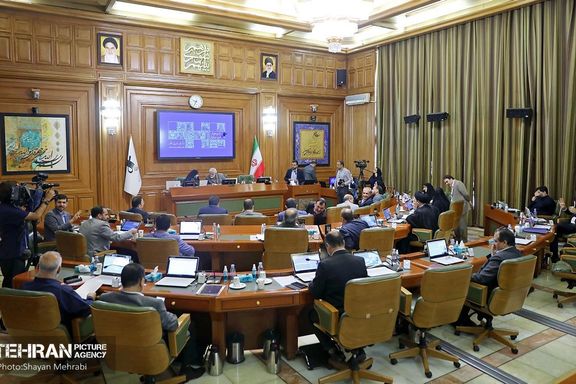
Tehran City Council members clashed on Sunday over a contract for importing electric buses following the release of a report criticizing the deal's lack of transparency.

Tehran City Council members clashed on Sunday over a contract for importing electric buses following the release of a report criticizing the deal's lack of transparency.
Media activist Yashar Soltani had earlier exposed the two billion euro contract details on his website in which he revealed that the Chinese firm involved, a construction company founded in 2010, was ill-equipped for such a deal in public transportation.
Mehdi Eghrarian, a member of the council, raised concerns about the transparency and breadth of the contracts, questioning whether other agreements had been made with Chinese entities behind closed doors.
“Our question is whether, aside from equipment and public transport facilities, other contracts have also been signed in China or not? Are there other types of equipment currently being imported into the country?” Eghrarian inquired during the session.
During the session, seven council members walked out in protest while Tehran mayor Alireza Zakani was speaking.
Zakani has defended the contract, stating that all relevant authorities, including the ministry of industry, and the central bank, were informed about the specifics of the agreement.
Criticism from council members focused on the selection of the Chinese company and the haste with which the contract was finalized, bypassing the usual protocols.
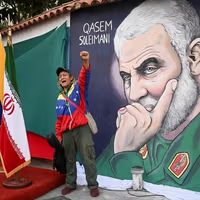
Narjes Soleimani, a city council member and daughter of slain IRGC commander Qasem Soleimani, questioned the prudence of selecting a limited liability construction firm as a financial and technological partner.
The dispute comes against the backdrop of frustrations with Tehran's aging and insufficient public transport fleet, compounded by air pollution in the city.
Council member Mohammad Aghamiri commented last year on the state of the capital's bus system, emphasizing the need for modernization and expansion to meet environmental and service standards.

In response to Iran’s missile and drone attacks on Israel, the European Union and the United States announced their intention to impose more sanctions on those involved in Tehran’s weapons proliferation.
Separately, the US Congress passed a long-stalled foreign assistance bill that contained several Iran sanctions. President Joe Biden on Wednesday signed the measures into law, including the Mahsa Act that requires the US government to impose applicable sanctions on Iranian Supreme Leader Ali Khamenei, his office and his appointees, Iran’s president, and several entities affiliated with Khamenei. The SHIP Act, another measure passed by US Congress, also targets Tehran’s illicit oil exports in defiance of US sanctions.
The fact that President Biden signed the bill was simply because it was part of military assistance to Ukraine, which his administration was desperately waiting to pass to prevent a Russian victory. Otherwise, the administration has failed to enforce oil export sanctions that are the most important punitive measure adopted by former President Donald Trump.
The US also designated four people and two companies it says were "involved in malicious cyber activity" on behalf of the country's military. The individuals and companies were working "on behalf of" Iran's Islamic Revolutionary Guard Corps Cyber Electronic Command (IRGC-CEC), the Treasury said. However, these have more of a declarative value rather than being forceful measures against a government that has supported the Hamas invasion of Israel, stockpiled enriched uranium for a nuclear bomb and sent hundreds of kamikaze drones to Russia.
IRI apologists,who have worked against major US sanctions for decades argue at the same time that these measures are not effective in putting pressure on the regime to change its behavior or to weaken its hold on power: “But, after four decades, the case of Iran shows the opposite to be true: sanctions strengthened the Iranian state, impoverished its population, increased state repression, and escalated Iran's military posture toward the US and its allies in the region.”
Let’s assume that this statement is true. Why sanctions that worked against South Africa and Iraq, are toothless against Tehran?
Is the existing sanction system against IRI effective in establishing deterrence and change the policies of the Islamic Republic? Not satisfactorily. Sanctions are effective when the economic and military establishments, the repression and propaganda machines, and the interests of the ruling elite are targeted constantly and forcefully. The purpose should be to deter, weaken, or change the regime’s behavior and not to deceive public opinion by an action that is not intended to be pursued.
Against their public gestures to “send a clear message to the Iranian regime”, Western governments have applied three methods in the past three years to minimize their sanctions:
While Europe has not imposed any significant economic sanctions on the Islamic Republic, the Biden administration has failed to vigorously enforce the oil sanctions on third parties involved in shipments from Iran. The SHIP Act promises to broaden the scope of restrictions on Iran’s crude oil exports by extending coverage to foreign ports, vessels, and refineries that knowingly engage in the trade but the Biden administration will not make any moves out of fear that they may increase the price of crude or the gasoline in the election year.
However, to what extent the administration would implement the restrictions in an election year is not certain, as they have repeatedly emphasized diplomacy with Tehran.
If the SHIP Act is implemented and enforced, the new sanctions could add as much as $8.40 to global prices, according to ClearView Energy Partners, a Washington-based consulting firm. It is clear that Biden does not want higher gas prices six months before the presidential elections.
Both the US and Europe have announced dozens of sanctions in recent past, which they call "smart" targeting individuals and entities involved in Tehran’s nefarious activities. But these measures are from exerting effective pressure on the Iranian government.
Despite publicly claiming to be pressuring Iran, the Biden administration has also released tens of billions of dollars to the Islamist regime that were blocked by US sanctions. It has effectively unfrozen an estimated $16 billion that Iraq and South Korea owed the Iran respectively but could not pay due to US sanctions.
The only time that sanctions exerted pressure was during the Trump administration’s maximum pressure policy. During Trump's tenure, the Tehran’s oil exports fell under 300k barrels per day, cutting off its major source of revenue. It was due to three factors.

As support rallies for Palestine expand across US universities, Iran has orchestrated its own university protests echoing the regime’s sentiments against Israel and the US.
The semi-official ISNA news agency reported that amid the ongoing Gaza war, “Iranian students and professors conducted rallies across Iran's universities, showing support for their Western counterparts and condemning the harsh responses of American police.”
Images from the limited gatherings at universities such as Amirkabir, Science and Technology in Tehran, and others in Qom, Kermanshah, and Tabriz were circulated by local media.
The rallies used slogans typically employed by student movements and protests against the Iranian government, which Iranian state media has co-opted in describing the US events in a bid to propagandize the support for the thousands of civilians who have died in Gaza amid the war sparked by the Iran-backed Hamas invasion of October 7.
Around 1,200 mostly civilians were murdered and Israel’s retaliation has, according to Hamas, seen the deaths of over 33,000 in Gaza.
The move is seen as an attempt to equate the US protests with those protesting the government in Iran, where government responses have been significantly more violent.
Protests have taken place in at least 18 universities in the US, leading to clashes with police and the disruption of classes.
Tasnim News Agency, affiliated with the Revolutionary Guards, has labeled the protests at American universities as a "nationwide uprising", a term widely used in Iran in 2022 after the state killing of Mahsa Amini. She was killed while in morality police custody after her arrest for alleged hijab violations.
Fars News Agency, under the headline "University is not a barracks", claimed that snipers were positioned at Ohio University, and police arrested 500 students during the "nationwide protests".
The narrative comes amid harsh criticism of Iran's own handling of protests. The Bloody Friday in Zahedan on September 30, 2022, is one of the most infamous examples, where direct government gunfire killed at least 100 people, including children.

A bus accident in southern Armenia has resulted in the deaths of at least five people, with nine others injured, according to a statement from the country's Interior Ministry released on Saturday.
The accident occurred near the village of Khotanan in the Syunik region, where the bus reportedly veered off a ravine.
According to news.am, an Armenian news website, the bus was en route from Yerevan to Iran, carrying passengers who were Iranian nationals. There are also unconfirmed reports suggesting that the bus had Iranian license plates.
Armenia has become a popular destination for Iranian tourists, especially those opting to travel by bus. Its proximity, shared historical connections, and visa-free entry for Iranian citizens making it an attractive getaway.
Traveling by bus offers an affordable route into Armenia, typically entering through the Nordooz border crossing, which is the only active border crossing between the two countries.
Iranians traveling to Armenia are often drawn by several attractive factors, including the relative ease of access to alcohol, and greater social freedoms. Armenia's liberal laws regarding alcohol consumption stand in contrast to Iran's strict prohibition, making it a particularly appealing destination for those seeking to enjoy nightlife and social gatherings without legal restrictions.
Additionally, the broader social freedoms available in Armenia, including more open expressions of culture and lifestyle, provide a refreshing change for many Iranians.

The Coordination Council of Iranian Teachers' Trade Associations has called for a nationwide rally on Thursday to address the country’s education crisis.
The council's statement points to "mismanagement and lack of foresight by officials" as the root causes behind Iran’s “academic decline, the educational exclusion of hundreds of thousands of children, dwindling student motivation, and the commercialization of education.”
The rally is part of a series of actions in recent years where Iranian teachers have protested for better pay and working conditions.
There has been an increase in the arrest of educators and the imposition of harsh prison sentences recently.
Despite facing government pushback, including summonses, detentions, and imprisonments, the educators have persistently continued their demonstrations.
Union leaders have faced harassment, prosecution, and imprisonment due to their activities.
Hundreds of teachers calling for reforms are expected to gather at 10am in front of the Planning and Budget Organization in Tehran, as well as in front of the General Departments of Education in provincial capitals, and local education offices in other cities.

The sale of the majority of the shares of Iran’s most prominent startups to quasi-governmental companies has raised concerns regarding the state’s growing influence in the sector.
Unconfirmed reports are circulating on social media that the shares of two leading Iranians startups, Digikala and Snapp, were sold to government-affiliated communication operators, Hamrah-e Aval and Irancell. Digikala is Iran’s biggest online retailer and Snapp is the country’s main ridesharing app. Likewise, half of the shares of Tapsi, another ridesharing app, was sold to Golrang Industrial Group, a government-backed holding.
In an interview with Jahan-e-Sanat daily, Mohsen Mirsadri, the chairman of the commission for new businesses and knowledge enterprises of Iran’s Chamber of Commerce, warned against the government’s rising influence in the startup sector.
“Competition is one of the main drivers of exploration and creativity, and when governments play a large role in the economy, it becomes uncompetitive. As governmental and quasi-governmental enterprises increasingly intervene in the economy, it impacts all other rival companies,” he stated amid the country's economic crisis.
In recent years, Iranian startups have been facing numerous obstacles, including long-term inflation, international sanctions against the country and the resultant problems with currency transfers, depreciation of Iran’s national currency and migration of skilled workforce, he stated, further adding that the unpredictability of Iran’s economic conditions has caused a recession in investment and the withdrawal of productive capital from the startup sector.
Under such circumstances, companies like Digikala, Snapp, and Tapsi might find no other way for survival than resorting to governmental and quasi-governmental companies.
Meanwhile, the owner of an Iran-based tourism startup who spoke to Iran International on the condition of anonymity, stressed that the government’s security and intelligence agencies have recently ramped up their efforts to control startups and digital companies.
“Intelligence agencies will initially ask digital companies to cooperate on security issues, particularly to provide users’ private data. If they refuse do so, the government will begin to exercise pressure on them in different ways,” he remarked, further adding that the government of President Ebrahim Raisi has employed a tougher stance towards independent startups after the 2022 Woman, Life, Freedom movement, triggered by the death in morality-police custody of Mahsa Amini.
“Once controlled by the government, these startups can also be a safe haven for money-laundering and thus serve the interests of people and organizations affiliated with the Islamic Republic,” he pointed out.
This is while Vice President for Science and Technology Rouhollah Dehghani Firouzabadi rejected as “rumors” recent reports regarding the government’s pressure on startups to sell their shares. Digikala and Tapsi both sought the government’s help to revamp their activities and we agreed to help them, he claimed.
In February, Hossein Shariatmadari, the editor of the hardline newspaper Kayhan and a figure close to Supreme Leader Ali Khamenei, said that the management of several digital companies, such as Digikala and Snapp, will “fortunately” be transferred to those “who serve the state.”
In August, several online shopping platforms, including Digikala, were shut down by the government over their staff’s defiance against compulsory hijab. Digikala was also accused of blasphemy in February over designing mugs, cups, and shoes with names and humorous short texts, some of which reference holy Shia figures like Fatemeh Zahra, the daughter of Islam’s prophet. Following the allegations, pro-government vigilantes wrote threatening messages on the walls of the company’s building in Tehran.