Tehran Police Urge Citizen Policing Amid Crime Spike, Hijab Crackdown
Residents in Iran’s capital are being urged to take matters into their own hands and document crimes and law violations, following a call from one of Tehran's police chiefs.

Residents in Iran’s capital are being urged to take matters into their own hands and document crimes and law violations, following a call from one of Tehran's police chiefs.
The plea by Ali Valipour Goodarzi, the head of the Tehran Police Criminal Investigation Department, follows a violent assault on a public bus last month.
The unidentified assailant assaulted a passenger with a chain, before fleeing the scene.
The video of the attack quickly spread online – reportedly assisting the police in arresting the suspect, whose motives are still unknown.
In what can be described as a self-praising statement, Goodarzi on Monday, cited the case as an example of what he labeled as the "outstanding" performance of Tehran’s police.
Goodarzi’s appeal to the public coincides with intense scrutiny of the police department's effectiveness in maintaining safety in Tehran. Despite his optimistic depiction, many residents continue to voice their dissatisfaction, particularly criticizing the force's inability to curb crime in the capital.
Recent data underscores those concerns, suggesting that incidents such as theft have risen sharply, presenting significant challenges to public safety and security.
Asghar Jahangir, the deputy of social affairs for the judiciary, noted in December 2022 that theft has been the predominant crime in Iran for the last five years.
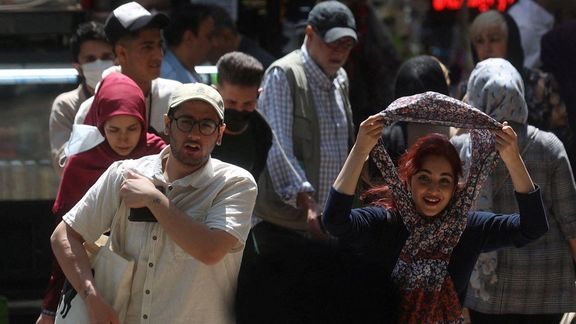
In addition, the police force’s enforcement of “Plan Nour” – which targets women refusing to wear the mandatory hijab – has further fueled the public’s discontent.
Criticism of the policy has extended beyond regime critics to include some supporters of the Islamic Republic – who don’t argue against the mandatory hijab law – but say that the police have been misallocating resources to suppress dissent rather than focusing on more prevalent criminal activities.

Pro-Palestinian student protests in the US are making headlines in Iran, as the regime and its media continue to bet on political trouble overseas to make up for lost legitimacy at home.
The ongoing encampments on campuses across the US have featured on the cover pages of many Iranian dailies in the past few days, triggering a considerable backlash from ordinary Iranians who view the stunt as ‘glaringly hypocritical’ from a regime that suspends, beats and imprisons students for much less than what students have been doing in the US in the past ten days.
“US universities are in the hands of students and professors that while condemning Israeli crimes in Gaza, are calling for the release of protesting students and the reinstatement of sacked students and members of faculty,” wrote the ultra-hardline Keyhan, which has been heralding the ‘demise’ and ‘end’ of the US and Israel for many years.
And, this time it is not just celebrating present events — but, the future, in which the author speculates that the US election hinges on the candidates’ support for Palestine.
The regime in Iran has always presented itself as the only true champion of Palestinians and their cause. This sentiment has become much stronger and prevalent since October 7th when Hamas, backed by Iran, rampaged border areas inside Israel, killing hundreds of civilians and drawing an Israeli onslaught – which has killed more than 30,0000 in Gaza.
Enraged by the Israeli military campaign in Gaza, students across the US have began organizing pro-Palestinian rallies and sit-ins to pressure their institutions to disclose and divest from funds and corporations that do business with Israel.
“See what is happening in the world,” Iran supreme leader Ali Khamenei posted on X Sunday.” In Western countries, in England and France, and in states across the US itself, people are coming out in huge numbers to chant slogans against Israel and America. US and Israel's reputation has been ruined. They truly have no solution.”
There’s little doubt that pro-Palestinian action has become more pronounced than ever. And there are many in the US who have expressed their displeasure with what they see as ‘heavy-handed’ response by university administration and law enforcement. But Khamenei may be the worst placed leader to address the issue.
The irony, as ordinary Iranians have been pointing out on social media, is hard to miss. It is a case of 'astounding hypocrisy', many say, of a regime who cheers on American students exercising their freedom of expression, while its prisons are humorously called ‘universities’ for hosting sheer numbers of students, graduates, and educators who have dared to speak their mind.
The ruling regime in Iran has a horrendous record in respecting the rights of its citizens. But its treatment of students and of modern, secular education has been particularly poor.
From shutting down universities in the name of Cultural Revolution in the early 1980s, to the bloody attack on dormitories at University of Tehran in the late 1990s, and the siege of Sharif University of Technology in 2022, the clerical regime has proven itself to be an archenemy of free and critical thinking that’s both the cornerstone and ultimate fruit of higher education.
It’s not at all surprising, then, that many Iranians, those with exposure to higher education, in particular, cannot help pointing out the regime’s hypocrisy on social media. “Those responsible for the calamity at the [University of Tehran] dorm, are now worried about American students,” posted an Iranian user on X last Friday –just one of dozens, perhaps hundreds, publicly voicing the same sentiment.

In recent days, politicians and academics in Iran have continued to highlight inefficiency, mismanagement, and negligence in President Ebrahim Raisi's government.
Some politicians, such as pro-Ahmadinejad lawmaker Ahmad Alirezabeigi who cannot believe the scale of chaos in the Raisi administration, are adamant that there are infiltrators in the administration who sabotage government's initiatives.
Others see the root of the problem in the government itself. Iranian academic Taghi Azad Armaki, a professor of sociology at the University of Tehran has been quoted by Iran International television as saying: "A government that came to power based on an ideological discourse, has no understanding of problems in the society."
Armaki also highlighted recurring news of corruption schemes. "When we ask government officials about embezzlements, they say this is done by the enemies. When we ask why the Iranian rial is falling, they promise to boost it but they do not know how."
Elsewhere in social media, Armaki said, "We are facing a weak government that is standing against a powerful nation. A large part of the government's weakness is the outcome of the inefficiency of its bureaucracy. The nation no longer trusts the government. No one in the government pays any attention to what Raisi says, although the people generally do not care what Raisi or his men in the government say."
Iran’s short-term economic outlook is bleak, according to some insiders and critics in Iran who, by and large, are allowed to comment publicly. Inflation, which stands at around 50 percent is expected to rise as the national currency has depreciated further since January.
Among regime figures, former Vice President Es'haq Jahangiri said last week that "We can hear the sound of the people's bones breaking," he remarked, emphasizing the severity of shortages. "The government must heed the people's voices and address their grievances," he added.
Sodayf Badri, a lawmaker from Ardabil told Etemad website that "There is chaos in the forex market. The Central Bank tells businesses that that it does not have any foreign currency to allocate to the importing of raw material.”
Meanwhile, ‘reformist’ politician Mahmoud Mirlohi told Khabar Online website: "Raisi has failed to stand by his promise to fight financial corruption in the government." He further charged that Raisi cannot name even two economic experts in his government.
Mirlohi highlighted the heavily politicized nature of Iran's economy, stressing that its problems are intrinsically linked to the unresolved foreign policy issues surrounding its nuclear program and the nuclear deal with world powers. He emphasized the interconnectedness of global events and Iran's economic situation, stating that "developments worldwide inevitably impact Iran's economy."
Over the past three years, many observers have criticized the weaknesses in Raisi's economic team and called for a cabinet reshuffle to address the issue. However, Raisi largely disregarded these concerns and repeatedly asserted that the country's economy was on a path to growth.
Mirlohi pointed out that “Raisi lacks both an economic plan and a coherent economic theory. Despite claiming to have a 7000-page economic plan during his 2021 presidential campaign, no one has seen even seven pages.”
Regarding Raisi's pledge to build four million houses in four years, Mirlohi expressed skepticism, stating that it is highly improbable for the administration to achieve even one million houses within the specified timeframe. He emphasized that based on Raisi's track record over the past three years, Iran's economy will continue to rely on government control, oil revenues, and concessions. Mirlohi highlighted the inherent issues with such an economy, asserting that it breeds corruption and impedes genuine progress.

Iranian lawyer Ali Mojtahedzadeh has criticized the recent death sentence for Toomaj Salehi, a dissident rapper.
Mojtahedzadeh's editorial in Etemad newspaper challenges the legal foundations of Salehi's case, noting that previous charges of "corruption on earth" were dismissed.
Despite the Supreme Court's recommendations to consider amnesty and adjust the initial sentence, the Revolutionary Court proceeded to reinstate the penalty without substantive legal justification.
“People are asking how a verdict can be issued that the majority of the country's lawyers and legal experts assess as contrary to the country's legal and judicial practices,” he added.
The lawyer lamented the judiciary's missed opportunity to enhance its credibility and foster public trust amid ongoing unrest against the government. He argued that verdicts should be “rational and convincing,” adhering to legal principles and logical reasoning to gain public support.
Toomaj Salehi, aged 33, became a prominent voice during the 2022 Woman, Life, Freedom protests. His arrest and subsequent trials have drawn attention to Iran's treatment of artists and activists who oppose the regime. Initially sentenced to death, his penalty was reduced to six years and three months in prison in July 2023, only to be abruptly reinstated under new charges.
Reports from human rights organizations also highlight the severe consequences of the protests ignited by Mahsa Amini's death in custody in 2022. The reports indicate that over 500 people, including minors, were killed, thousands sustained injuries, and around 22,000 people were detained.
The ruling for Salehi has spurred protest rallies by the Iranian diaspora in major cities worldwide. Rallies are being held in several European, US, and Canadian cities to urge their governments to halt the execution..
Multiple international organizations, including the United Nations Truth Commission, the UN Special Rapporteur on Human Rights in the Islamic Republic, among others, have also condemned the verdict and called for the immediate and unconditional release of the imprisoned artist.
In Tehran and other cities, Salehi's influence continues to resonate. Videos and images circulating online show posters and murals bearing his image, and there are reports of nightly chants and graffiti supporting the artist, signaling a growing movement against the regime's oppression.
Salehi’s defense team, led by Amir Raesian, has announced plans to appeal the ruling within the 20-day window allowed by Iranian law, setting the stage for a critical legal battle that will be closely watched both domestically and internationally.

Over 160 Iranian lawmakers have endorsed further police crackdowns on the hijab before the approval of a new bill by the Guardian Council.
The declaration was made public during a session on Sunday by parliament member Ali Karimi Firoozjaei, who indicated that the number of supporting signatures continues to rise amid deepening oppression.
The lawmakers have called on various institutions to support the renewed police crackdown.
The stance aligns with actions taken since April 13, under the Plan Noor, which have sparked debate due to their severity.
The Revolutionary Guard has also joined in supporting the police mission to further enforce hijab, which has seen violent and sexual abuse of women in Iran.
Hossein Shariatmadari, representing Supreme Leader Ali Khamenei at Kayhan newspaper, has voiced approval for the police's actions.
Passed experimentally by the parliament last September for a trial period of three years, the bill proposes severe penalties for hijab defiance, including increased fines and prison terms.
Before any legal endorsement by the Guardian Council, the police have preemptively intensified their crackdown on women and girls. According to statements on May 3 by Chief Justice Gholamhossein Mohseni Ejei, the aggressive approach was agreed upon last year in a meeting with President Ebrahim Raisi.
The escalation has sparked widespread criticism from civil rights activists and ordinary citizens, alarmed by the violent enforcement methods on the streets. Sedigheh Vasmaghi, an imprisoned scholar of Islam and vocal critic of the compulsory hijab policy, has denounced it as a failed policy.
Additionally, a group of 61 lawyers has declared the Plan Noor implementation as violating public freedoms and conflicting with both the Iranian Constitution and international human rights standards.

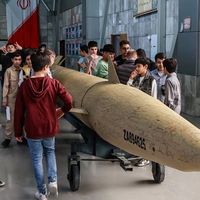
The Iranian Revolutionary Guard has unveiled a new suicide drone, engineered to fly into targets and detonate upon impact, similar to those employed by Russia in the Ukrainian conflict.
The announcement was made through the IRGC-linked Tasnim news agency, which also released a video showcasing the yet-to-be-named drone, drawing comparisons to Russia's Zala Lancet model first produced in 2020.
The new drone reportedly resembles the Lancet in its capabilities, expected to have a flight endurance between 30 to 60 minutes, carry a payload of 3 to 6 kilograms, and achieve a range of up to 40 kilometers.
Iran's history with drone technology has been marked by its extensive provision of Shahed-type drones to Russia, which have been deployed against civilian targets and residential areas in Ukraine, which has led to global sanctions on the regime.
Furthermore, Iran's recent actions include an unprecedented assault on Israel using 350 missiles and suicide drones, although they were successfully intercepted by Israel and a US-led coalition.
Additionally, drones supplied to Iranian proxy groups in Iraq, Yemen, and Lebanon have repeatedly targeted US forces, Israeli territories, and maritime assets in strategic waters, inflicting damage and escalating regional tensions.
The deployment of the new drone technology occurs in the wake of new sanctions imposed by the European Union, the United Kingdom, and the United States, aimed at curtailing Iran's missile and drone production capabilities.
In response, Nasser Kanaani, a spokesman for the Iranian foreign ministry, criticized the sanctions, asserting that they would not impede the ongoing development of Iran's drone industry.