UN Nuclear Watchdog Chief To Visit Iran
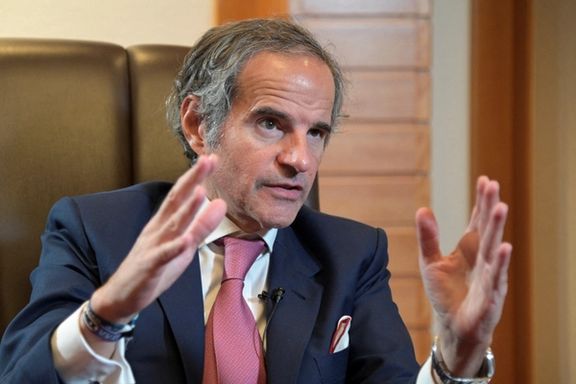
The International Atomic Energy Agency (IAEA) has confirmed that its Director-General, Rafael Grossi, will travel to Iran on May 6 to engage with high-ranking officials.
The International Atomic Energy Agency (IAEA) has confirmed that its Director-General, Rafael Grossi, will travel to Iran on May 6 to engage with high-ranking officials.
He will attend the International Conference on Nuclear Science and Technology during the visit, taking place in Isfahan, just months after officials in Iran claimed to be within reach of nuclear weapons. Grossi just days ago also claimed Iran was “weeks not months” from a nuclear weapon.
Im February Grossi admitted a "drifting apart" in relations between the agency and an increasingly defiant Iran.
Grossi noted in the same month that although the rate of uranium enrichment in Iran had decreased slightly since the previous year's end, Iran continued to enrich uranium at a significant rate of approximately 7 kg per month to 60 percent purity, near weapons grade.
Under the terms of a 2015 agreement with world powers, Iran was only permitted to enrich uranium up to 3.67 percent.
However, after former President Donald Trump withdrew the United States from the agreement in 2018 and reinstated sanctions, Iran exceeded the limits. As a result, the IAEA has stated that the 2015 nuclear deal has "all but disintegrated".

The medical community in Iran has been shaken by another suicide as physician Zahra Maleki Ghorbani reportedly took her own life amid a growing trend.
Social media posts prior to her death showcased her objections to the dire working conditions at her hospital, hers the latest case among many amid Iran’s medical crisis.
The event adds to a rising trend among medical professionals in the country committing suicide, or being found dead under suspicious circumstances.
Just days ago, Samira Al-e-Saeedi, a rheumatology specialist and professor at the University of Tehran, took her own life.
Colleague Mehdi Abdous shared on social platform X that Al-e-Saeedi had discussed her plans for suicide with peers the day before she acted on them. Abdous noted the exceptionally high levels of stress and tension doctors face compared to other professions.
The suicide of Parastoo Bakhshi, a 34-year-old cardiovascular specialist, at Noorabad Delfan Hospital in Lorestan Province, also underlined the ongoing issue.
Found by hospital staff in the dormitory, her death has been linked to "excessive workplace pressure," according to the Medical Council of Iran.
Reports reveal a 200% increase in doctors applying for immigration compared to five years ago as professionals flee to better working and living conditions amid Iran’s economic and social crisis.
The Iranian Psychiatric Scientific Association has highlighted an increase in suicides among medical professionals, noting that 16 medical residents took their own lives last year alone.

A large majority of US voters say Iran is responsible for the attack on Israel, including Hamas’ attack on October 7, 2023, according to the latest Harvard CAPS-Harris poll.
This month's poll, conducted by The Harris Poll & HarrisX, highlighted several issues regarding Iran, with the results reflecting a nationally representative sample.
Answers from over 2,000 registered American voters show that the majority see US negotiations with Iran to curb Tehran’s nuclear ambitions as futile.
While a strong majority agreed that Iran is a danger globally and should be stopped from having nuclear weapons, about 67% (2 in 3 voters) said that negotiating with Iran would not work, as Tehran will violate any deal.
Notably, skepticism over a deal with Iran over its nuclear program increased with age, with 83% of those above the age of 65 saying that Tehran would violate any deal.
Almost 70% of voters believe that sanctions and isolation are the best way to prevent Tehran from obtaining nuclear weapons.
When questioned about whether the US should impose sanctions on Iran's oil to prevent it from entering the market or allow Iran to continue selling its oil, a significant majority of voters, comprising 71%, said the US should sanction Iran's oil and restrict its access to the market.
While 80% said that Iran should not be allowed to have nuclear weapons – there was a noticeable division in the 18-24 age bracket.
They are the most supportive age group for Iran being allowed to have nuclear weapons (57%), but still, a sizable minority (43%) believes Iran should be stopped from obtaining them.
Conversely, the age cohort of 65+ is the most unified in their opinion, with an overwhelming majority (96%) believing Iran should be prevented from obtaining nuclear weapons.
US Voters Blame Iran for Hamas’ October 7 Attack on Israel
The poll also delved into American voters’ sentiments on Hamas’ attack on Israel on October 7, 2023 – when around 1,200 Israelis and foreigners were killed by thousands of gunmen. It was the worst loss of life in a single day since Israel's founding in 1948. More than 240 people were taken hostage.
Across all age groups, a large majority of almost 75% believes that Iran is responsible for the attacks on Israel by Hamas and Hezbollah – including the October 7 attack.
The poll shows that the belief in Iran's responsibility for these attacks increases with age, with the highest percentages among the 55-64 and 65+ age groups.
In response to Hamas’ attack, Israel's cabinet declared war on the terrorist group and began its aerial bombardment campaign on the Gaza Strip. Tensions in the region entered new heights, when Iran and Israel entered into a period of direct conflict this month.
When voters were asked who is to blame for the escalating conflict in the Middle East, across all age groups, there was a split opinion with a significant portion blaming Iran and another significant portion blaming Israel.
Interestingly, among the 18-24 age group, there is a slight majority blaming Israel, while in the 25-34 age group, there is a slight majority blaming Iran.
Bipartisan Voters Support NATO Backing for Israel Against Iran
Other questions, related to Iran, included NATO – where voters were asked whether members of the defense alliance have a responsibility to support Israel against Iranian aggression or not.
Both Democrats and Republicans share a majority belief that NATO countries have a responsibility to support Israel against Iranian aggression. Specifically, 71% of Democrats and 68% of Republicans hold this view.
Though Israel has not sought formal membership in NATO, voters were asked whether inviting Israel into the defense alliance would deter further attacks by Iran.
Republicans and Democrats were seemingly on the same page again here – with about 62% of Republicans and 63% of Democrats agreeing that NATO should consider bringing Israel into the alliance to prevent more attacks from Iran.

The Iranian government continues to spotlight pro-Palestinian student protests in the US and Europe aiming to bolster its international image amidst waning domestic support.
On Tuesday, members of Iran’s parliament expressed their support for the pro-Palestine student movement and condemned the police actions against academics, 150 Iranian representatives voicing their solidarity with students and professors of American universities.
The surge of student-led pro-Palestinian rallies and sit-ins across the US has been fueled by the recent Israeli military actions in Gaza in retaliation for the Iran-backed Hamas invasion of October 7. Over 1,200 mostly civilians were killed and 250 more taken hostage. Israel has since waged a relentless retaliation which Hamas claims has killed over 33,000 people in the strip.
Students in the US are pressing their institutions to reveal and withdraw investments in funds and corporations linked with Israel, giving glee to the Iranian government which longs for ties between Israel and its biggest ally, the US, to sever.
However, the support by the Iranian regime has been met with criticism from within Iran, where many view it as hypocritical given the regime's harsh treatment of its own students who dissent. Hundreds have been arrested and banned from universities amid the Women, Life, Freedom uprising which began in 2022 after the death in morality police custody of Mahsa Amini. She was arrested for the incorrect wearing of her hijab, sparking a nationwide uprising against the regime which continues until today.
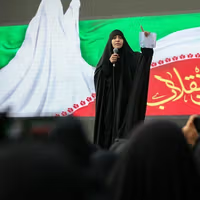
In a bizarre statement, Nasir Hosseini, Khamenei's representative in Kohgiluyeh and Boyer-Ahmad province claimed that "the voice of the Islamic Revolution is heard all around the world," and noted that American university students are echoing themes similar to those promoted by Supreme Leader Ali Khamenei and the Islamic ideology.
Mohammad Moazeni, president of Shiraz University, offered a place for students and faculty from the US and European universities who have been expelled or threatened with expulsion during anti-Israel protests to continue their education at Shiraz University, in spite of the fact that travel to Iran is all but prohibited by most countries amid Iran's hostage diplomacy policy.
The Iranian regime has long positioned itself as a defender of the Palestinian cause, supporting multiple terror groups such as Palestinian Islamic Jihad and Lions Den, in a bid to destroy its archenemy, Israel.

UK Prime Minister Rishi Sunak paid homage to jailed Iranian Nobel Peace Prize laureate Narges Mohammadi and Iran International’s host Pouria Zeraati ahead of world press freedom day.
“I’d like to take this chance to pay tribute to all those suffering behind bars in the name of freedom and democracy,” Sunak said at the Society of Editors 25th Anniversary Conference in London on Tuesday.
He expressed solidarity with Mohammadi, who is serving a 12-year prison sentence in Iran, along with facing 154 lashes, two years of exile, and various other social and political restrictions. Despite her imprisonment, Mohammadi has been vocal against the regime's human rights abuses and the mandatory hijab law.
The prime minister also addressed the recent attack on Pouria Zeraati, who was stabbed outside his London home last month. Zeraati, a prominent journalist at Iran International, suffered leg injuries. This came following multiple threats from Iranian intelligence aimed at journalists of Iran International.
Sunak's comments came as part of a broader discussion at the conference, which drew editors, academics, lawyers, and journalists together to debate the pressing issues facing the journalism industry today. He underscored the essential role of the media in strengthening democracy by holding governments accountable, exposing corruption, and elevating new voices.
Iran has one of the world’s worst records for press freedom according to Freedom House, with over 70 journalists arrested since the 2022 uprising alone. Among those were the two women to first report the arrest and subsequent death of Mahsa Amini whose death in morality police custody triggered the worst uprising in Iran since the foundation of the Islamic Republic.

After weeks of intensified and renewed crackdown to enforce the mandatory hijab in Iran, ‘reformist’ women activists have condemned it as a smokescreen to distract from the state’s own governing failures.
“The repressive policies against women under the pretext of compulsory hijab are reactionary and an attempt to distract public attention from rampant corruption and inept social administration,” the 21 women activists said in a statement posted on the Telegram channel of the Nationalist-Religious political faction Melli-Mazhabi.
Notable figures among the signatories of the statement include former lawmakers Parvaneh Salahshouri and Elaheh Koulaei.
“Women will not give up on their rightful demands,” the statement read.
Following the death of Mahsa Jina Amini at the hands of the regime’s so-called morality police in 2022 and the months of nationwide protests in Iran it sparked, more women from the “reformist” camp and religious backgrounds have changed direction and joined Iranian protesters in demanding freedom of choice.
It's significant to note that many Iranian activists have long held the belief that efforts to ‘reform’ the Islamic Republic have proven futile. They often perceive those who still adhere to such views as a faction that continues to sustain the regime's authority.
Meanwhile, Tahereh Taleghani, the daughter of Mahmoud Taleghani, a prominent cleric and figure during the 1979 Islamic Revolution, published a video on social media emphasizing that treating women under the guise of compulsory hijab has no religious basis.
Islamic scholar Sedigheh Vasmaghi has also demonstrated her support for women's right to choose by removing her hijab. After her public criticism of Supreme Leader Ali Khamenei as a dictator and her condemnation of the compulsory hijab law, she was arrested in March. She was released this week after being imprisoned at Tehran's notorious Evin Prison, where her health deteriorated drastically. During her detention, she lost her eyesight and experienced life-threatening heart issues.
The new wave of crackdowns resumed after police launched a new initiative, dubbed “Plan Noor” on April 13.
Social media has been flooded with video footage of morality police violence against women rebelling against the hijab since then; there are also allegations of police officers extorting money from women in exchange for leniency, as well as theft and sexual harassment claims.
Additionally, the Islamic Revolutionary Guards (IRGC) announced that it was joining the enforcement efforts, forming units known as “Kindness Ambassadors" (Mehr in Persian) to ensure that women maintain the regime’s strict Islamic dress code.
The situation has once again raised alarm both domestically and internationally, with human rights organizations, student groups, and prominent lawyers condemning the Iranian authorities' violations of fundamental freedoms.
Despite this, Iranian women continue to flaunt the hijab laws in acts of resistance.
One notable incident occurred at the Beheshti judicial complex in Tehran, in which a woman was arrested for not wearing a hijab. She stated, "I have come here with hijab all my life; this time, I came without a hijab to reclaim my rights.”