Iran's Housing Crisis Deepens As Inflation Soars
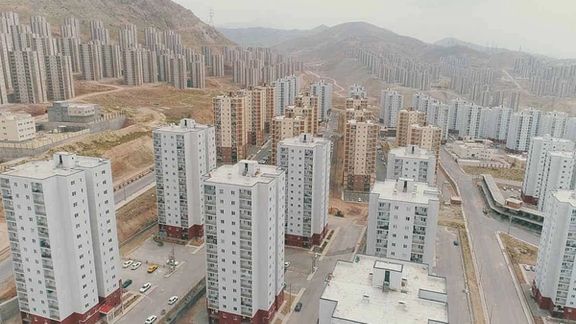
Iran is grappling with a dire housing shortfall with an annual need for one million homes but only 200,000 being constructed.
Iran is grappling with a dire housing shortfall with an annual need for one million homes but only 200,000 being constructed.
In a recent interview with Entekhab, housing expert Beitollah Sattarian highlighted the economic barriers that have made housing an "ultra-luxury and unattainable commodity" for most Iranians, except for a privileged class that thrives on a rentier and corrupt economy.
Against this backdrop, Iran's Central Bank reported an annual inflation rate of 52.3 percent last year—the highest rate in eight decades—which has exacerbated the housing crisis.
Sattarian criticized the country's macroeconomic policies for nurturing a "super-capitalist rentier economy" within a closed state framework, pushing a large segment of the population toward poverty.
The newspaper Etemad echoed the sentiments, noting that the poverty rate has increased by 10 percent over the past two years, adding approximately eight million people to the nation's poor.
"The new year, like the past fifty years, is a year of expensive housing ... When housing prices increase, all connected parameters, including rent, will increase. We may have much more than a 40 percent increase in prices and rents," noted Sattarian.
During his election campaign, President Ebrahim Raisi had promised to build one million homes annually but so far, the shortfall only continues to worsen.
After intensifying criticisms of the government's failure to fulfill the promise, First Vice President Mohammad Mokhber said: "There is a difference between building housing and constructing it by the government. The government should build part of it; we can give land to the people so they can build it themselves."
Sattarian predicts that housing prices will continue to rise sharply this year, possibly exceeding a 40 percent increase, as all connected parameters, including rent, escalate. The prediction is supported by official reports indicating a 52 percent increase in house rents in the capital over the past year.
Rents have surged by an average of 130 percent across Tehran and other cities, making housing costs a predominant economic concern among Iranians.

While the country’s GDP increased by 4.7% last year due to a 19% increase in oil production, GDP growth is projected to decline to 3.3% in 2024 and 3.1% in 2025, according to the IMF.
Iran's oil production increased by 0.5 million barrels per day (mb/d) to 3.1 mb/d last year, but it is projected to increase by only 0.1 mb/d in both the current year and 2025.
The IMF has evaluated Iran's economic performance based on official statistics and its own estimates, which include data from Iranian government sources that are not always considered reliable.
Notably, both the International Energy Agency and OPEC had projected Iran’s oil production growth for 2023 at 305,000 barrels per day, 40% less than the IMF’s estimates.
The IMF also estimated gas production growth for Iran in 2023 to exceed 6%, whereas the National Iranian Gas Company (NIGC) has reported a growth rate of approximately 1%.
The IMF also estimated a 9% increase in Iranian gas production for 2022, while BP and NIGC reported growth rates of about 1% and 1.7%, respectively, for the same year.
Before US sanctions, Iran’s crude oil output exceeded 3.8 mb/d in 2017. However, it declined to below 2 mb/d in 2020.
Iran has seen a rebound in oil production since Joe Biden assumed office at the White House, which has positively influenced its oil exports – reaching about 3.2 mb/d in March 2023, according to OPEC.
Kpler’s statistics also show that Iran’s oil exports have increased from 350,000 b/d in 2020 to about 1.5 mb/d in the first quarter of 2024.

Budget deficit
The IMF says the Iranian government needs $121/barrel oil price to avoid a budget deficit.
Currently, the Brent benchmark is sold at below $90, while the IMF predicted the average Brent price at $78.61 in 2024 and $73.68 in 2025.
Iran also offers a discount of at least $13 per barrel for Chinese refineries, a factor that the IMF did not account for in its calculation of the "breakeven oil price" for the Iranian government.
The report also says Iranian government and state enterprises’ debts would increase by $4 billion (based on NIMA exchange rate, or $1:410,000 rials) in 2024 to above $118 billion, equaling 25.5% of GDP.
NIMA is designed for exporters to sell foreign currencies at a lower rate and for importers to purchase what they need at the same low rate to finance their purchases from other countries. The official rate at NIMA is approximately 40% lower than in the foreign currency free market.
Since early 2023, the Iranian currency, the rial, has depreciated by approximately 33% in open markets, largely due to ongoing significant government budget deficits.
Recently, the Iranian Central Bank (CBI) reported that the government and state entities' debts to the banking system increased by 56% year-on-year in 2023, reaching approximately 13,100 trillion rials, equivalent to $32 billion based on NIMA rates and $21.5 billion based on open market rates. Additionally, the Iranian government's foreign debts stand at $5.8 billion, according to the CBI.
On the other hand, the National Development Fund (NDF) of Iran claims the government owes about $100 billion from this entity.
It appears that Iranian government debt is at least $11 billion higher than the IMF's estimates for 2023.
With that, Iran's financial stability remains precarious as it needs higher oil prices to prevent deficits while it grapples with mounting government debt, and contends with currency depreciation.
Inflation
The IMF estimated Iran’s inflation for 2023 at 41.5%, consistent with Iran’s Statistical Center’s official reports.
However, the Central Bank of Iran (CBI) recently released a report calculating the "payment of debt and dowry" based on a 52.3% inflation rate in 2023. This suggests that Iran's actual inflation rate is significantly higher than the official statistics indicate.
Many field research studies conducted by local media indicate that the actual inflation in the country is much higher than the official data reported by the Statistics Center or submitted to the IMF and other international entities by the Iranian government.


The NGO, vital for supporting and empowering vulnerable women, which strives to mitigate social and familial challenges faced by women and children in Iran's West Azarbaijan Province in Urmia, has become the latest victim of the government's clampdown.
This closure, reminiscent of previous shutdowns of NGOs in Iran, such as Imam Ali's Popular Student Relief Society (IAPSRS), Khaneh Khorshid, and Omid-e-Mehr Foundation reflects a disconcerting trend of governmental interference in independent charitable initiatives.
Fatemeh Babakhani, the CEO of the NGO, announced the closure on Sunday, April 28, via X platform, lamenting, "The shelter dearer than our lives, Mehre Shams Afarid non-governmental safe house, was closed in the worst possible way!".
In an earlier interview with Shargh newspaper in Tehran on Saturday, Babakhani warned of the State Welfare Organization of Iran (SWO) of West Azarbaijan Province’s attempts to close Mehre Shams Afarid. The closure comes following a tense meeting on Saturday, which Babakhani described as "resembling an interrogation," during which SWO officers scrutinized the organization's financial sources. Simultaneously, SWO’s Social Emergency Services intervened at the NGO’s safe house, relocating all the women to Social Emergency facilities, likened to "a cage" without issuing any formal verdict or written order, she added.

While the SWO officers cited financial inadequacy as the reason for closure, Babakhani refuted these claims, asserting that it was part of a broader pattern of pressure against the organization. "These words are excuses. The general director of the SWO of the province [West Azarbaijan] had threatened to close down the NGO and the safe house," Babakhani refuted.
In addition, she disclosed that the director-general had exerted pressure on her, explicitly stating, "You don't have good hijab, you are a dissident, and you have acted against Sharia customs and against the regime on social media. One of the issues raised was why you used the hashtag 'Woman, Life, Freedom' on your Instagram."
The closure of Mehre Shams Afarid is not an isolated incident.
In 2020, Iranian security forces arrested Sharmin Meymandinejad, the founder and director of the largest anti-poverty NGO in the country, Imam Ali's Popular Student Relief Society (IAPSRS), and subsequently closed down its headquarters.
Meymandinejad and two of his colleagues, Morteza Kaymanesh and Katayoun Afrazeh were arrested by the Islamic Revolutionary Guard Corps (IRGC) Intelligence Organization on 21 June 2020 on charges of "insulting" the founder of the Islamic Republic, Ruhollah Khomeini, and the Supreme Leader, Ali Khamenei, as well as "acting against national security."
Subsequently, Branch 28 of the Tehran Appeals Court has upheld the ruling to dissolve the IAPSRS, a motion that was brought against them by Iran’s Ministry of Interior. The Ministry of Interior had accused the NGO of "issuing political statements during the country's critical situation and vilification, anti-religious activities and lack of financial transparency".
The closure of IAPSRS was met with much criticism from Iranians and human rights organizations who condemned the ruling.
A year after the closure of IAPSRS, the Khaneh Khorshid, an NGO supporting women in Southern Tehran, Iran with substance abuse issues was closed in March 2022 following pressures from the Iranian authorities.
Leili Arshad and Sarvar Monshizadeh, the founders of Khaneh Khorshid announced that they were facing pressures from the Iranian government and were subsequently forced to stop their activities. In an interview with Hamshahri, Arshad said:
"They don’t want NGOs to be as active as they were before."
Similarly, in August 2019, another independent charity supporting marginalized women and girls in Tehran, Omid-e-Mehr was forcibly closed by the Iranian authorities.
Moreoever, in August 2022, another NGO supporting women with substance abuse issues and vulnerable children in Shoush, a neighborhood in southern Tehran, The Noor Sepid Hedayat, Social Harm Reduction Institute announced its closure. Without providing details, the director of Noor Sepid, Sepideh Alizadeh announced in an Instagram post, that “the operation of this center was handed over” and that the service “will be provided by another operator,”.
Amidst the Iranian government's ongoing crackdown on non-governmental organizations, the closure of these entities highlights the diminishing room for independent civil society initiatives in Iran. This trend ultimately leaves the most marginalized members of society, especially women, without the essential support they require.