Four killed in clash between police and Jaish al-Adl gunmen in southeastern Iran
Three suspected militants and a police officer were killed in an armed clash in the southeastern Iranian city of Saravan, police in Sistan and Baluchestan province said on Sunday, in the latest violence to hit the restive region.
One other police officer was wounded and taken to hospital, the provincial police information center said in a statement carried by state media.
It said security patrols in Saravan came under armed attack by the assailants, identified as members of the Sunni militant group Jaish al-Adl, who were attempting to enter a local police station.
Security forces killed three attackers and were pursuing others who fled, the statement said.
The police commander of the province said that four people were arrested, and two vehicles along with a quantity of weapons and ammunition were seized following the clash with police in Saravan.
Local rights outlet Haalvsh had earlier reported heavy gunfire in Saravan, saying several people were injured, including a passerby.
The clash comes less than two weeks after a deadly assault on a courthouse in the provincial capital, Zahedan, that killed nine people -- including three attackers -- and wounded 20.
Jaish al-Adl claimed responsibility for that attack, which involved gunmen storming the judiciary building, firing on court offices and civilians, and an explosion inside the compound.
Sistan and Baluchestan, which borders Pakistan and Afghanistan, has long been the scene of sporadic violence involving Sunni militant groups, drug smugglers, and security forces. Jaish al-Adl, designated as a terrorist organization by Iran and the United States, says it is fighting for greater rights for Iran’s Baluch minority but is accused by Tehran of links to cross-border militant networks.
Iran has stepped up executions in the province in recent months, with rights groups warning that the surge in hangings of Baluch prisoners risks fueling further unrest.
The Islamic Republic's threats to critics in Canada could grow in 2025, with Iran using organized crime networks to intimidate and harm them, Canada’s intelligence agency warned on Saturday.
“Iranian threat-related activities directed at Canada and its allies are likely to continue in 2025 and may increase depending on developments in the Middle East and the Iranian regime’s own threat perceptions,” the Canadian Security Intelligence Service said in a statement.
The CSIS told The Globe and Mail on Saturday it is actively investigating death threats in Canada linked to the Islamic Republic.
“Given the need to protect our sources, tradecraft and methods, however, we cannot confirm or deny specific investigative details,” said CSIS spokesperson Magali Hébert.
The agency’s warning follows an announcement by Iran International that two of its Canada-based journalists were targeted by the Islamic Republic in recent weeks.
"It's very, very intense and very threatening," Adam Baillie, spokesman for Iran International, told The Canadian Press.
"People get all sorts of messages of, 'We know where you live, remember we watch you, remember we know all about you, we know where your family lives.' It's that kind of thing," Baillie said.
UN appeal over threats to journalists
On Tuesday, Iran International filed an urgent appeal with United Nations experts urging them to take action against Iran over serious risks to the lives and safety of their journalists worldwide and relatives inside Iran.
Over the past six weeks, the Iranian authorities have intimidated and threatened 45 journalists and 315 of their family members with death unless they stop working for Iran International by specific deadlines, Iran International said in a statement.
Carlos Nagore Diaz, spokesperson for UN special rapporteur on freedom of expression Irene Khan, said “several UN Special Rapporteurs are considering taking urgent action on the renewed credible threats to life,” but confirmed that “any communications with the Iranian regime are currently confidential.”
In its reply to the UN, Iran’s permanent mission rejected “allegations made about the threats or kidnapping plans” and described Iran International as “an anti-Iranian network” whose operatives “will be dealt with according to the relevant laws.”
UN rapporteurs wrote in May 2024 that intimidation of the channel’s staff “may amount to violations of the sovereignty” of the countries in which they operate.
In March 2023, Iran International presenter Pouria Zeraati was stabbed in London. Two Romanian nationals were later charged.
In late June, IRGC forces in Tehran detained the family of another Iran International presenter to pressure them into ending their cooperation with the network.
CSIS’s warning also comes after an alleged Iranian plot to assassinate former Canadian justice minister Irwin Cotler, which the Royal Canadian Mounted Police says it foiled last year. Cotler remains under 24-hour police protection.
Last week, Canada joined Britain, the US, France, Germany, the Netherlands, and Denmark in condemning what they called “a growing number of threats from Iranian intelligence services on their soil,” including collaboration with organized crime networks to target dissidents.
Several Iranian officials have bristled at Donald Trump’s mocking remarks about the slain commander Qasem Soleimani, calling his assassination in a 2020 US drone strike an act of terrorism that should have been avenged by killing American leaders.
On Thursday, during a Purple Heart ceremony at the White House, Trump mentioned Soleimani by name and called him “the father of roadside bombs.”
Immediately after, Trump scoffed, “Where is he? Where is he?” As the attendees burst into laughter, he asked again, 'Where is Soleimani?'"
“There is a simple answer to the question ‘Where is Soleimani?’ He is precisely where your gaze points — at the heights of heaven,” Mohammad Hossein Ranjbaran, an advisor to Iran’s foreign minister, posted on X.
During his first term as president, Trump authorized the 2020 drone strike in Baghdad that killed the senior Iranian commander.
“They killed Haj Qasem, and we should have executed all American leaders because Haj Qasem’s worth was far greater than that,” said Elias Hazrati, head of the Government Information Council.
“But since war was not our strategy, we let it go. Then they martyred our guest Ismail Haniyeh, and still, we chose patience and silence,” Hazrati added.
Hamas leader Ismail Haniyeh was killed on July 31, 2024, along with his bodyguard inside a military-run guesthouse in Tehran shortly after attending the inauguration of President Masoud Pezeshkian.
The killing of Qasem Soleimani sparked outrage among hardliners in Iran, who vowed to exact revenge against Trump.
The Islamic Republic has relocated its surviving nuclear scientists to safe houses in Tehran and northern Iran after Israeli airstrikes killed several of them during the June conflict, The Telegraph reported on Saturday citing Iranian and Israeli sources.
A senior Iranian official was quoted as saying by The Telegraph that most remaining scientists are no longer living at their homes or teaching at universities.
"They are either moved to safe houses in Tehran or to the north,” the official was quoted as saying. “Those who were teaching at universities are replaced with people who have no connection with the nuclear program.”
The newspaper said it was shown the names of more than 15 surviving researchers on a list of around 100 figures Israel says could face further targeting.
The relocations follow the execution this week of Roozbeh Vadi, a scientist hanged on Wednesday for allegedly providing information to Israel during the 12-day war in June.
Security arrangements for scientists have been overhauled since the June conflict, when the US struck Iranian nuclear sites with bunker-busting bombs and Tehran launched missiles at Israel, the report said.
Previously, a single Revolutionary Guards unit handled their security, but multiple agencies now share protective duties after some scientists said they no longer trusted their original guards, The Telegraph added citing an Iranian official.
'Dead men walking'
Israeli experts quoted by The Telegraph described the remaining personnel as “dead men walking” despite tightened security, including round-the-clock guards.
They said Iran’s nuclear program was designed with deputies for each key scientist, working in small teams to preserve capabilities in the event of an attack.
Danny Citrinowicz, former head of the Iranian strategic desk in Israeli Defense Intelligence, told The Telegraph that those who remain “will be at the forefront of any Iranian attempt to reach a nuclear bomb” and would “automatically become targets for Israel.”
Analysts believe some survivors have taken roles in the Organization of Defensive Innovation and Research (SPND), described by the US as “the direct successor organization to Iran’s pre-2004 nuclear weapons program.”
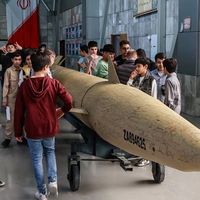
The figures had worked on adapting Shahab-3 missiles for nuclear warheads, making them “equally strategic targets” as those already killed, Ronen Solomon, an Israeli intelligence and defense analyst was quoted as saying.
Iran has long denied seeking nuclear weapons, citing a religious edict by Supreme Leader Ali Khamenei banning their use, and says its nuclear activities are entirely peaceful. Khamenei said last month that the West uses Tehran’s nuclear program as an excuse for confrontation.
Lebanon on Saturday strongly condemned the remarks made by a top advisor to Iran's Supreme Leader about Beirut's decision to disarm Tehran-backed Hezbollah, warning the Islamic Republic against interfering in its internal affairs.
Ali-Akbar Velayati, a senior foreign policy advisor to Supreme Leader Ali Khamenei, on Saturday called Hezbollah disarmament "a dream that won't come true", describing it as a policy dictated by Israel and the United States.
The Lebanese foreign ministry in a statement on X condemned the remarks as "a flagrant and unacceptable interference in Lebanon’s internal affairs," saying it will not tolerate such "unacceptable conduct under any circumstances."
"This is not the first such interference. Some senior Iranian officials have repeatedly overstepped by making unwarranted statements regarding Lebanese domestic decisions that are of no concern to the Islamic Republic," it said.
It also said that the Arab country "will not permit any external party, whether friend or foe, to speak on behalf of its people or to claim any form of tutelage over its sovereign decisions."
Velayati said on Saturday that Tehran "is definitely opposed to disarming Hezbollah; because Iran has always supported the Lebanese people and the resistance, and continues to do so now."
The decision to disarm Hezbollah "is only the desire of the US and Israel. The US and Israel think they can bring another puppet to power in Lebanon; but this dream will never come true, and Lebanon will stand firm as always."
Lebanon's cabinet instructed the army earlier this week to develop a plan by the end of the year aimed at creating a state monopoly on weapons—an implicit challenge to Hezbollah, which has resisted disarmament since last year’s war with Israel.
Hezbollah decried the move as a "grave sin" and vowed to ignore it.
On Thursday, senior Iranian military official Iraj Masjedi said efforts to disarm Hezbollah will fail. “They are seeking to disarm the resistance in Lebanon, but they will take that wish to the grave."
'Mind your own business'
The Lebanese foreign ministry "reminded the leadership in Tehran that Iran would be better served by focusing on the issues of its own people and addressing their needs and aspirations, rather than involving itself in matters that do not concern it."
"Lebanon’s future, its policies, and its political system are matters decided solely by the Lebanese people, through their democratic constitutional institutions, free from any interference, dictates, pressure, or overreach," it added.
"The Lebanese state will remain steadfast in defending its sovereignty, and will respond, in accordance with diplomatic practice, to any attempt to undermine the authority of its decisions or to incite against them."
The Lebanese government has long been under international pressure to assert monopoly over arms, particularly from Western states who view Iran-backed Hezbollah’s military structure as a parallel force within the state.
The Financial Action Task Force has invited Islamic Republic representatives to attend talks in Spain aimed at ending a seven-year impasse over the country’s blacklisting, Iran’s economy minister said.
“After the approval of Iran’s accession to the Palermo Convention, the FATF deadlock has been resolved after seven years, and Iran has now been invited for talks,” Ali Madanizadeh said in a Friday interview on state television.
The Financial Information Center, part of Iran’s Supreme Council for Combating Money Laundering and Terrorist Financing, confirmed the news on its website, saying that Hadi Khani, secretary of the council, had been invited to take part in the negotiations.
The direct talks in Madrid will address the process of normalizing Iran’s case, suspending countermeasures, and removing the country from the FATF blacklist, according to Tehran’s official statement.
Iran’s UN ambassador Saeed Iravani wrote to Secretary-General António Guterres on August 5 announcing that, on government orders, the ratification document for the UN Convention against Transnational Organized Crime—signed by Foreign Minister Abbas Araghchi—was being submitted.
Iran’s parliament passed the bill to adopt the convention in 2017, but the Guardian Council blocked it until the Expediency Council approved it in May this year. The years-long failure to ratify it left Iran unable to establish normal financial links abroad, even after the 2015 nuclear deal offered partial economic relief.
On May 21, Parliament Speaker Mohammad Bagher Ghalibaf formally notified President Pezeshkian of the law’s enactment, enabling Iran’s accession to the Palermo Convention, one of the FATF’s four core treaties.
Tehran has already joined two others: the Vienna Convention against Illicit Traffic in Narcotic Drugs and Psychotropic Substances and the UN Convention against Corruption.
The only outstanding FATF instrument is the 1999 International Convention for the Suppression of the Financing of Terrorism (CFT), designed to curb funding for armed groups and improve cross-border cooperation in tracking and cutting such flows.
The Islamic Republic has for years provided financial support to groups such as Hamas and Hezbollah, which are designated as terrorist organizations by much of the international community.
In May, Expediency Council spokesman Mohsen Dehnavi said the CFT would be addressed in upcoming sessions.
Even if Iran secures removal from the FATF blacklist, the looming prospect of UN sanctions snapback could render the move moot.
The snapback mechanism, which European parties to the 2015 nuclear deal have threatened to trigger if no deal is reached with Iran by the end of this month, would restore UN sanctions lifted under the Joint Comprehensive Plan of Action (JCPOA), from which the US unilaterally withdrew in 2018.
International banking tools may be available, but renewed sanctions could block trade even with long-standing partners such as China and Russia.