The United Nations fact-finding mission on Iran, created after mass protests were crushed in 2022, has emerged as a rare instrument of accountability whose survival now rests on the political and financial will of the international community.
For decades, oversight of Iran’s human rights record was limited to a Special Rapporteur whose reports carried weight but lacked teeth.
The new mission, however, was built not only to observe but to investigate, document and preserve evidence for criminal prosecutions—evidence that could one day bring Iranian officials before international or national courts abroad.
In just two years, it has produced thousands of pages—legal findings, testimonies and analyses on women’s and minority rights.
Together, the effort paints a grim picture of systematic human rights violations in Iran, some amounting to crimes against humanity.
Limited mandate
That phrase matters. It elevates abuses from the realm of “domestic affairs” to international crimes the world cannot ignore. It also affirms what Iranian civil society has long argued: repression is not episodic but systemic.
Yet the mission has faced constraints by design.
Its initial mandate was limited to the protests and crackdowns after death of a young woman, Mahsa Amini, in morality police custody in September 2022.
That scope left little room to probe earlier waves of dissent such as the December 2017 protests or the bloody crackdown of November 2019, despite clear evidence of the same patterns of violence and impunity.
Only in March did the Human Rights Council expand the mandate, acknowledging that accountability cannot be sliced into timeframes convenient for perpetrators.
The United Nations itself is under financial strain and political pressure from states wary of setting precedents for scrutiny. Iran continues to deny all allegations, dismissing international scrutiny as “Western interference.”
Against erasure
The mission is vital for two reasons. First, it amplifies the voices of victims and families silenced inside Iran. Second, it builds a legal infrastructure for future prosecutions, whether under universal jurisdiction abroad or in tribunals yet to be created.
•
•
These records matter: they are the antidote to impunity, preserving memory when a government seeks erasure.
On the third anniversary of the “Woman, Life, Freedom” movement, the question is whether the international community will provide the political and financial backing to keep this mechanism alive.
Civil society has done its part—collecting testimonies, documenting abuses, and risking lives for the truth. Governments must now ensure this work does not wither under budget cuts or diplomatic fatigue.
In an era of deep cynicism about international institutions, this mission is a rare instrument that offers both hope and a pathway toward justice.
An Iranian court has sentenced Reza Seghati, the former head of the Ministry of Culture and Islamic Guidance in Gilan province, to 100 lashes and exile in connection with a widely publicized same-sex scandal that cost him his post.
According to Iranian outlets including Ensaf News, the court found Seghati (also Seqati) guilty of “lavat tafkhizi,” a same-sex act defined under Iran’s Islamic penal code as non-penetrative sexual contact between men.
Both Seghati and the other man seen in a leaked video were handed 100 lashes and prison exile terms of one and two years respectively, reports said.
Iran’s penal code prescribes severe punishments for same-sex relations, including flogging and, in cases of penetrative intercourse or repeat offenses, the death penalty. Rights groups have long criticized these provisions, but Iranian authorities say they are enforcing Islamic law.
The scandal began in July 2023 when a video surfaced online allegedly showing Seghati engaged in sexual activity with another man. The leak led to his dismissal from office and triggered a political storm due to his past role as a vocal enforcer of Iran’s mandatory hijab rules.
Ensaf News, citing an image of the judgment, also reported that the son of a former senior Gilan official was sentenced to 10 years in prison and exile for orchestrating what authorities described as a criminal network that used secretly recorded videos to discredit rivals. Other defendants are said to remain under investigation.
Iran executed political prisoner Babak Shahbazi on Wednesday, state-affiliated media reported, saying he had been convicted of spying for Israel.
Shahbazi, a father of two, had been moved to solitary confinement on Tuesday after a court in Tehran rejected his third request for a retrial, sources close to the family told Iran International.
He was detained in January 2024 and later convicted of “spying for Israel” and “corruption on earth,” charges he denies.
Rights groups have described the proceedings as grossly unfair and based on forced confessions obtained under torture.
"The court rejected our request for a retrial for the third time this morning and moved him to solitary confinement by around noon," the source said.
"We are worried they may have taken him to solitary confinement in preparation for execution," the source said.
Shahbazi was being held in Ghezel Hesar prison, one of the largest in Iran, located about 20 kilometers northwest of the capital, Tehran.
His initial sentence was handed down in May 2025 by Judge Abolghasem Salavati, who was sanctioned by the United States in 2019 for presiding over unfair trials, extracting forced confessions, and imposing harsh sentences on political prisoners and journalists.
Messages to Zelensky
The source said Shahbazi had sent messages to Ukraine’s President Volodymyr Zelensky in 2022, offering help against the Russian invasion.
The messages were later falsified by Iranian authorities to make them appear as if they had been addressed to Israeli Prime Minister Benjamin Netanyahu and the Israeli military, according to the source.
“They have no evidence against him, and they haven’t even given the family a final visit, which usually happens before an execution,” the source said.
During his detention, authorities placed Shahbazi in a cell with a prisoner who was a member of the Islamic State, the Sunni Muslim militant group.
“It was as if they deliberately wanted him to be killed in prison. When the family visited him days later, both his eyes were bruised,” the source said.
Shahbazi was pressured to write dictated confessions under the promise that his death sentence would be commuted to three years if he signed them in front of his lawyer, according to the source.
“He refused to sign because he hadn’t done those things. They even slipped in pages that weren’t his writing and told him to sign, but he didn’t. Despite that, the court sentenced him to death on the basis of unsigned dictated notes,” the source said.
The source said authorities also relied on a coerced statement by Esmail Fekri, who was executed in June after being convicted of spying for Israel. Rights groups described his trial as unfair as well.
“They told him if he confessed against Babak (Shahbazi), his cryptocurrency would be returned to him. He even later wrote a letter saying he had been forced to make that confession,” the source said.
Countless young Iranians whose lives were snuffed out in the Woman, Life, Freedom protests became enduring symbols of defiance — human faces for a movement that challenged the very foundations of the Islamic Republic.
Beyond Mahsa Amini — the most internationally recognized martyr for the cause — the names of Nika Shakarami, Hadis Najafi, Sarina Esmailzadeh, Mohsen Shekari, Mohammad Hosseini and others have been engraved in the collective memory of Iranians who remember them affectionately by their first names.
Each represented a different facet of society: women demanding autonomy, teenagers daring to risk their futures, children like 10-year-old Kian Pirfalak killed by a stray bullet and young men executed for their solidarity with women's plight.
The spark: Mahsa "Jina" Amini
The protests began with the death of Mahsa "Jina" Amini, a 22-year-old Kurdish woman who was arrested by Iran’s morality police on September 13, 2022, over the state’s mandatory hijab law.
She was critically injured in custody and died days later in the hospital.
Her name became a rallying cry, her image circulated widely on social media and protest banners across Iran and beyond. Amini's innocence and tragic death resonated deeply with ordinary Iranians, making her the most enduring icon of a movement that sought not just reform but a different future.
Nika Shakarami: the young rebel
Sixteen-year-old Nika Shakarami vanished after joining a Tehran protest in the early days of the uprising. A video captured her shortly before her disappearance, standing on a trash bin, burning her headscarf and chanting “Down with the dictator" with other protesters.
Ten days later, her body was returned to her family under suspicious circumstances. Authorities claimed she fell from a building. Her relatives disputed this, saying her nose was broken and she was beaten. A BBC World report in May 2024 alleged she was sexually assaulted and murdered.
Nika was known for her creativity and love of the arts — poetry, drawing, and music. She dreamed of becoming a professional singer. Outspoken and spirited, her short life of artistic aspiration and teenage defiance became a symbol of how ordinary young Iranians risked everything for freedom.
Hadis Najafi
Hadis Najafi: 22-year-old TikToker
Hadis Najafi, 22, was shot multiple times in the face, neck, chest, abdomen and hand during a protest rally in Karaj in central Iran. Her family was pressured to announce she had died of natural causes.
Najafi frequently posted on TikTok and Instagram, sharing glimpses of her daily life. In a video recorded before she was killed, she said: “I like to think that when I look back on this a few years later, I’ll be pleased I joined the protest.”
Her mother told Iran International that Hadis joined the protests both to mourn Mahsa Amini and to oppose the theocracy's mandatory Islamic dress code for women. Before leaving home, Hadis said she hoped that years later when change comes to Iran she could look back and be glad she had taken part.
Sarina Esmailzadeh: freedom-loving teenager
Sarina Esmailzadeh and her brother in one of her cooking posts
Sixteen-year-old Sarina Esmailzadeh from Karaj was a bright, curious teenager with broad interests. She loved cooking, K-pop music and making playful videos for her YouTube and TikTok channels.
She spoke candidly about justice and freedom. In one post she asked: “What can people expect from their own country? Welfare, welfare, welfare. Nothing else. Why am I not like that teenager in New York who doesn’t have to worry about the compulsory hijab or economic hardship?”
Her online presence, blending humor, music and political awareness, made her a powerful symbol of the courage and aspirations of Iran’s Gen Z.
Mehrshad Shahidi: a voice silenced too soon
Young chef Mehrshad Shahidi at work
Security forces beat 19-year-old chef Mehrshad Shahidi to death with batons at a Revolutionary Guards detention center in Arak, a day before his twentieth birthday in October 2022. Authorities pressured his family to say he died of a heart attack.
Thousands attended his funeral, chanting anti-government slogans. Mehrshad was already head chef at a local restaurant, studying hospitality at university, and a decorated athlete in gymnastics, volleyball, and swimming.
Authorities never tried those accused of his killing, instead threatening his family with destroying his grave — a site still visited by mourners — if they held public commemorations.
Shekari and Hosseini: death sentences for defiance
Mohammd-Mehdi Karami's father holding photos of his son (left) and Mohammad Hosseini (right)
Mohsen Shekari, 23, and Mohammad Hosseini, 39, were among the first protesters executed after closed-door trials in late 2022 and early 2023. Their deaths, intended as deterrence, became instead rallying cries.
Shekari, a café worker and self-taught guitarist, was arrested during a Tehran protest. Hosseini, a martial arts champion working on a chicken farm, was arrested after attending the memorial for Hadis Najafi in Karaj, where security forces shot dead three protesters.
Shekari was arrested at a protest rally in the west of the capital. Hosseini was arrested a day after the crackdown on a remembrance ceremony for Hadis Najafi in Karaj during which three protesters were shot dead by security forces.
Both were accused of injuring Basij militia members. They denied the charges, and rights groups reported their televised confessions were extracted under torture.
Their executions underscored the movement’s human cost — ordinary men defying extraordinary repression and paying with their lives.
Iran condemned the United States on Tuesday for what it called “hypocritical and deceitful” remarks on the anniversary of a young Iranian woman's death in morality police custody in 2022, accusing Washington of decades of crimes and subversion.
“No rational and patriotic Iranian would ever believe the claim of friendship and sympathy by a regime with a long history of meddling in Iran’s affairs and committing crimes against Iranians,” the foreign ministry said in its statement.
It cited grievances ranging from a CIA-orchestrated 1953 coup and US support for Saddam Hussein during the 1980–1988 war to the downing of an Iranian passenger jet in 1988, years of sanctions and joining Israel in attacks on nuclear sites in June.
Tehran also argued that the US, as Israel’s main supporter and a country it described as steeped in racism, has “no credibility to speak on human rights.” It vowed that Iranians “will never forget or forgive” America’s actions.
Mahsa "Jina" Amini, 22, died in morality police custody on September 16 2022, igniting nationwide protests under the slogan “Woman, Life Freedom” that remain a rallying point for calls for systemic change in Iran.
In its message on the eve of the anniversary, the US State Department said it “stands with the people of Iran in their calls for dignity and a better life,” adding, “Mahsa’s name will never be forgotten” and accusing Tehran’s leaders of “crimes against humanity.”
The statement charged that Iran’s rulers had squandered the nation’s wealth on exporting ideology abroad while leaving citizens to endure “shortages of water and electricity, poverty, and crumbling infrastructure.”
The United States on Tuesday called on Iran’s leadership to move away from what it called bellicose rhetoric and focus on easing domestic hardships, saying Iranians deserve better after years of economic privations.
"The Iranian regime must focus on addressing the needs of its people instead of engaging in destructive war rhetoric," the State Department said in a post on its Persian-language account on X.
"After years of economic hardship and international isolation, the people of Iran deserve peace and prosperity."
Iranian officials, especially hardliners and military leaders, have repeatedly mooted striking Israel and the United States if attacked again following their surprise military campaign in June. Officials have also issued menacing rhetoric to dissidents abroad.
Last month, Iran's top security official Ali Larijani said the country must remain prepared for a fresh round of conflict as the war with Israel is not over despite a US-brokered ceasefire that put an end to a 12-day war between Iran and Israel in June.
The Islamic Republic needs to "create capacities so that the enemy will not be tempted to take action again," Larijani said in an interview with the Supreme Leader's official website.
His remarks were the latest in a series of sharp comments from leaders on both sides, with Israel’s army chief vowing readiness for further strikes and Iran’s General Staff warning of “a far stronger response” to any future attacks by the United States or Israel.
Meanwhile Israeli officials have frequently asserted that their military quarrel with Iran is not yet finished and continue to cite Iran as an alleged existential threat.
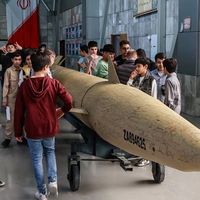
Iran’s navy test-fired a range of cruise missiles during large-scale drills last month, and the defense ministry warning of stronger response in any new war with Israel.
"Any miscalculation in the region will be met with a very strong response from Iran’s powerful armed forces,” it said in a statement.
"Senior officials of the regime have chosen to distract from internal challenges by instilling fear of external threats," the State Department said in its post.
"Iran’s leadership should instead prioritize actions that restore economic stability, improve living conditions, and rebuild trust with both its citizens and the international community."
Iran’s currency, the rial, now trades at nearly one million to the dollar, having lost almost a third of its value since Donald Trump won the US presidential election last November.
Iran faces one of the highest inflation rates in the region. According to the International Monetary Fund's estimates, the annual inflation rate has averaged above 42% since 2020, sending costs of living soaring.
Sanctions, corruption and economic mismanagement have contributed to widespread economic hardship and market instability as Iran's currency the rial has lost over 90% of its value since US sanctions were reimposed in 2018.
A poll by Iran's leading economic newspaper Donya-ye Eqtesad last month reported that just under 90% of Iranians described their level of satisfaction with government economic policies as low or very low.