Iran blames Western 'excessive demands’ for failed talks
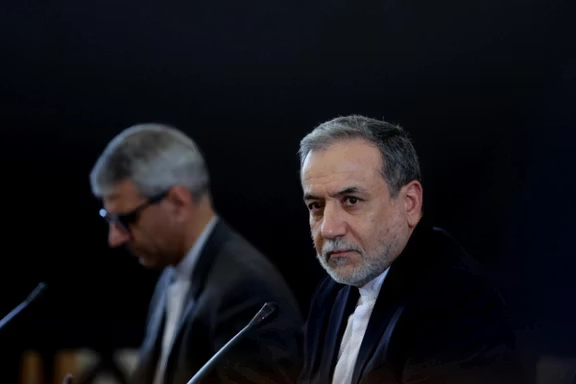
Western countries rejected renewed negotiations with Tehran because of what Iran’s Foreign Minister Abbas Araghchi described as excessive demands on Sunday.
Western countries rejected renewed negotiations with Tehran because of what Iran’s Foreign Minister Abbas Araghchi described as excessive demands on Sunday.
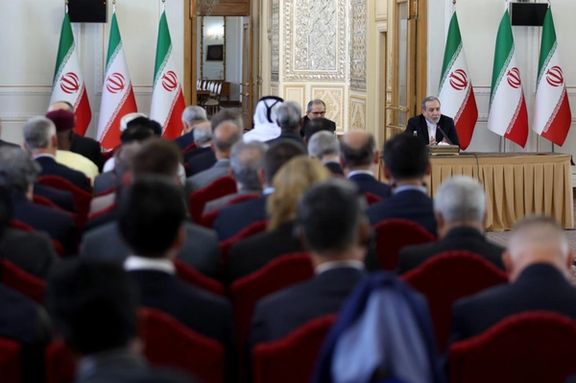
The remarks came during a meeting with foreign ambassadors in Tehran, where he said the session was held to brief diplomats on developments in New York and the reactivation of UN sanctions.
“Iran had sought a fair and balanced solution, but Western states responded negatively out of greed,” Araghchi said.
“Years of pressure had proven that there is no solution to Iran’s nuclear issue other than diplomacy...The snapback of sanctions, like military attacks, cannot work.”
All UN sanctions suspended under the 2015 deal with Iran snapped back into force on September 27, one month after European powers triggered the snapback mechanism.
The three European countries had weakened their own diplomatic role by resorting to pressure, he said
The Cairo agreement with the IAEA was no longer viable after the snapback, and Iran would redefine its framework for engagement under new conditions, according to the Iranian foreign minister.
Iran had demonstrated goodwill in its dealings with both Western powers and the IAEA, Araghchi said, adding that Tehran had “taken every step it could to reach a negotiated solution.”
“We showed goodwill through our cooperation with the Agency and our fair proposals. The West has no excuse to say Iran avoided talks, nor any justification for triggering the snapback mechanism… Iran’s position is now fully vindicated.”
The United Nations sanctions include restrictions on Iran’s nuclear and military activities, asset freezes on designated entities, and a duty to “exercise vigilance” when doing business with Iran.
France, Germany and the United Kingdom said in a joint statement the reimposition of sanctions was unavoidable after Iran’s breaches of the 2015 nuclear deal, citing enriched uranium stockpiles 48 times above agreed limits.
However, the foreign minister said Iran had proved it seeks only to secure its legitimate rights while remaining open to any fair diplomatic path.
“The last time there was an attack, more than 120 countries condemned it because Iran acted wisely,” Araghchi said. “Once again, Iran has shown it is a smart player that will not surrender its rights.”

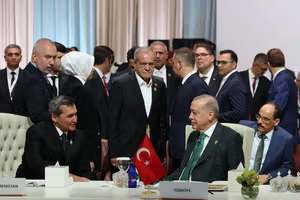
On October 1, the Turkish president froze the assets of the Atomic Energy Organization of Iran, Bank Sepah and several firms involved in nuclear fuel production and uranium conversion, moving in lockstep with the latest UN sanctions against Tehran.
Erdogan's order revived provisions of earlier UN Security Council resolutions that had been put on hold after the 2015 nuclear agreement with Tehran.
However, the Atomic Energy Organization of Iran (AEOI) rejected reports that its assets had been frozen in Turkey.
Iranian media also said that several blacklisted bodies—including Bank Sepah and the AEOI itself—have no operations in Turkey, limiting the practical effect of the order.
Still, the move was significant: so far, the E3 (France, Britain and Germany), the European Union, the United States, Japan, Australia, New Zealand, and now Turkey have announced compliance with the reinstated UN sanctions.
The United States welcomed Ankara’s step, while Russia and China dismissed the measures as “null and void.”
Iran's friend or foe?
Iranian media and political commentators reacted with sharp criticism.
“Turkey’s early alignment with anti-Iran sanctions resolutions and its symbolic recognition of them is objectionable,” the conservative daily Farhikhtegan wrote in an editorial titled “The Realities of Turkey’s Sanctions Against Iran".
Conservative commentator and former Javan editor-in-chief Abdollah Ganji expressed disbelief on X: “Apparently, Turkey has taken the lead in the snapback… it has outpaced the Westerners. It's unbelievable. 18 companies? By Erdogan's decree? Is this true? What is the opinion of the Ministry of Foreign Affairs?”
Ehsan Movahedian, another conservative analyst, told state TV: “While Russia and China have not joined anti-Iran sanctions and Pakistan seeks barter trade, Turkey has taken the lead. We must correctly identify our friends, enemies, and rivals, and act accordingly.”
Counterpoint: ‘only compliance with UN resolutions’
Not all commentary was condemnatory. Some argued Turkey’s action was more a matter of obligation than betrayal.
“Even if (Turkey) was an ally, it would still do so. So would Iran if it were in Turkey’s place,” journalist Reza Ghobeishawi wrote on X. “The problem is not with Turkey but in the mind and mistaken perceptions inside (Iran) that brought things to this point.”
Reza Nasri, an international affairs commentator, however, accused Erdogan of lacking courage to break with Western frameworks in post on X.
He argued that most states recognize that Iran's nuclear program poses no threat to international peace to be subjected to UN Charter's Chapter VII measures, so Turkey and other states have every legal justification not to comply.
“Only courage to stand by the law is required.”
Signal to the West?
Several Iranian outlets suggested Turkey’s decision was more about geopolitics than legality.
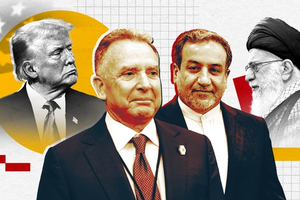
“These sanctions are mostly symbolic since many of the listed entities are not active in Turkey. Erdogan seems to be sending a message to Trump that he stands with the West,” Ali Heydari, a Turkey analyst at the IRGC-linked Tasnim News Agency, posted on X.
Shaya News argued: “At first glance, Ankara justifies the measure as compliance with international obligations and legal commitments toward the UN. But at a deeper level, the decision raises serious questions about neighborly relations, bilateral principles, and the extent of Turkey’s foreign policy independence under international pressure.”
Impact on Iran–Turkey relations
Iran’s Foreign Ministry has so far remained silent. But commentaries warn the move could hurt trust and trade between the two neighbors, particularly in energy and finance.
“This choice comes at the expense of sacrificing bilateral relations with Iran,” Shaya News wrote.
“The asset freeze not only casts a shadow over Iranian investors and businessmen’s trust in Turkey but could also deprive Turkey of the benefits of its thriving economic relations with its eastern neighbor.”
Farhikhtegan similarly warned that Tehran’s response should be “proportionate to Ankara’s alignment with the White House’s anti-Iran policies.” It added that Turkey’s status as a NATO member and US security ally cannot be ignored.
“Should Ankara move toward serious anti-Iran measures—whether sanctions or security-related—then Iran’s approach to Turkey must necessarily be recalibrated within a security framework,” the newspaper wrote.


Senior Israeli officials were quoted by Hebrew media as calling Liberman’s post on X “bizarre and detached from reality.”
Defense officials cited by Channel 13 said that such comments could lead to a “miscalculation” in which Iran might assume Israel was preparing an assault and respond preemptively.
Sources cited by Ynet said Israel had chosen not to officially reply “so as not to bolster” Liberman’s remarks, adding there was “no substance to them.”
Liberman, head of the Yisrael Beytenu party and a former defense minister, wrote on X on Friday that “whoever thinks the conflict with Iran is over is misled and misleading,” saying that Tehran was restoring activity at its nuclear sites and “trying to surprise us.”
He urged Israelis to celebrate the Sukkot holiday “close to protected spaces,” adding, “This government cannot be trusted. Until we’ve fixed their damage, we have only ourselves and the IDF to rely on.”
In a new post on Saturday, he listed what he called “open-source intelligence,” showing Iran’s missile and nuclear activity since late July, including satellite images at Natanz, reports of missile tests, and new sanctions by the United States and Europe. “All these facts together must lead us to the conclusion that the Iranians are not seeking a Nobel Peace Prize, but revenge,” he wrote, adding that the next confrontation with Iran was “not a question of if, but when.”
The IDF Home Front Command said there were “no changes to its guidelines,” while defense officials accused Liberman of fearmongering.
Officials warn against political missteps
Defense sources told Hebrew outlets that intelligence agencies have not detected preparations for a new Iranian offensive or for Israel to launch one. They warned that inflammatory rhetoric from politicians could prompt Tehran to misread Israel’s posture.
Israeli assessments cited by Ynet indicate that Iran is attempting to rebuild its air defense systems destroyed in the June war and to restart limited ballistic missile production, reportedly seeking technical help from China, Russia, and possibly North Korea. However, the reports said there are no signs Iran has resumed uranium enrichment or nuclear weapons development, and Supreme Leader Ali Khamenei has yet to decide on reactivating those programs.
Officials expressed concern that Iran’s suspension of cooperation with International Atomic Energy Agency inspectors has left critical blind spots, including uncertainty over its stockpile of roughly 400 kilograms of uranium enriched to 60 percent. Intelligence officials view the chance of Iran producing a crude device or “dirty bomb” as remote.

Kayhan says confrontation 'very probable'
In Tehran, Kayhan—a newspaper supervised by Khamenei’s office—published a Saturday editorial asserting that the world stands “on the brink of a historic turning point.” The paper said a renewed confrontation between Iran and what it called “the American-Zionist front was very probable,” citing Liberman’s own words as proof that Israel was bracing for another war it might not win.
“It is not necessarily the case that this time the opponent will strike first,” Kayhan wrote, arguing that Iran’s unity and deterrence capabilities had prevented its defeat in the 12-day war in June. The editorial linked economic volatility in Iran to foreign hybrid warfare and urged authorities to reinforce “military strength, domestic cohesion, and resistance economics” as protection against renewed aggression.
While Israel’s defense establishment insists calm prevails, Kayhan portrayed the same moment as an approaching inflection point—one in which, it warned, “the future will be shaped by vigilance and strength, or lost to weakness.”