Khamenei lifted all limits on missile range, senior Iranian MP says
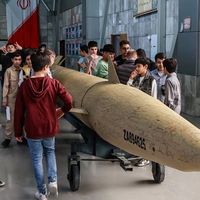
Iran test-launches a missile
A senior Iranian lawmaker said on Wednesday that Supreme Leader Ali Khamenei had lifted all limits to the range of Iran’s missiles, signaling a potential major shift to Tehran's defense posture after a punishing June war.
“The Islamic Republic has developed and will continue to develop its missile program to any extent it deems necessary,” said Ahmad Bakhshayesh Ardestani, a member of parliament’s national security committee.
While Khamenei had previously capped missile range at 2,200 kilometers, he has now “removed any such limitation,” he asserted, adding that Tehran will accept “no limits on missile range,” which he described as its “most important element of military power.”
Hardline members of Iran's fractious parliament often make hawkish statements that do not ultimately reflect policy from the theocracy's highest echelons, but it is rare of MPs to specifically invoke Khamenei in their remarks.
Bakhshayesh’s assertion came a day after Foreign Minister Abbas Araghchi accused Israel of lying about Tehran’s ambitions to develop intercontinental ballistic missiles in order to deceive Washington.
Israeli Prime Minister Benjamin Netanyahu told US podcaster Ben Shapiro that Iran was developing missiles with an 8,000-kilometer range, capable of hitting major American cities including New York, Boston, Washington, and Miami.
“Israel … finally managed to deceive the U.S. into attacking the Iranian people,” Araghchi wrote on X, referring to Israeli and American strikes on Iran in June.
“With the failure of that action, Israel is now trying to make an imaginary threat out of our defense capabilities.”
'Not on the table'
On Tuesday, another senior Iranian official also rejected the idea of limiting Iran’s missile program, saying Washington’s proposal to cap missile range was unacceptable.
“Americans will take the wish of reducing Iran’s missile range to below 500 kilometers to the grave,” Armed Forces Judiciary chief Ahmadreza Pourkhaghan said during a meeting with Revolutionary Guard aerospace commanders.
He added that Iran is prepared to negotiate over its nuclear program but “will not hold any talks” about missiles.
Tehran's security chief Ali Larijani confirmed last month that Washington had floated the idea to limit Iran's missiles' range.
“No honorable person would accept such a condition,” Larijani said in response.
The head of Iran’s Basij domestic militia on Wednesday alleged that the recent renaming of the US Department of Defense to the Department of War signals that Iran and Israel are pursuing new wars.
Gholamreza Soleimani, commander of the Basij, said at an event in the holy city of Mashhad that the move reflects America’s intention to “ideologize its army” on a global scale, according to Iranian state media.
The group he leads, formally called the Organization for Mobilization of the Oppressed, is part of the Islamic Revolutionary Guard Corps, a sprawling military body which oversees Tehran's support for armed affiliates in the Middle East.
"The renaming of the US Department of Defense to the Department of War shows that (Washington) has stationed its forces worldwide to threaten nations and seeks to ideologize his army. The future of nations will be shaped by war,” Soleimani said.
“The enemy has imposed not only military and media wars on Iran but also an economic war—our front-line fighters today are producers and merchants,” he added.
Problems at home
In September, US President Donald Trump signed an executive order rebranding the Department of Defense to the Department of War, its name for nearly 160 years before 1947.
The move aims, in the administration's framing, to refocus US military attention on deterring foes and winning wars but has not yet been ratified by Congress.
Iran is currently grappling with high inflation and rising prices amid the reimposition of UN sanctions last month, which the government claims have little effect on the economy or markets but have throttled the Iranian currency.
The IRGC is reeling from a punishing 12-day June war in which its top leadership was assassinated in Israeli attacks and its missile stocks were largely destroyed.
'US may collapse soon'
The Basij commander, whose force is under US sanctions, alleged that Iran is among the countries labeled as threats by the United States and Israel.
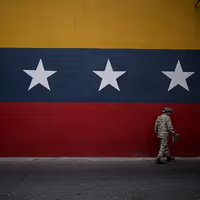
“America and the Zionists see five main threats: China, Russia, Venezuela, Bagram Air Base,and Iran—a historical irony,” Soleimani said.
In September, Trump also demanded that the Taliban return control of Afghanistan’s Bagram Air Base to the United States, warning that “bad things are going to happen” should it not comply.
“If America fails to achieve its goals by 2025, its global power will collapse,” Soleimani added. “This echoes the words of Zionist lobbies, which shape the thinking of America and Trump.”
The Basij was sanctioned by the United States in 2011 for human rights violations and has been accused by human rights groups of torture, rape and repressing peaceful protests with deadly force.
Israel’s Shin Bet security agency said on Wednesday that it thwarted an Iranian operation to move a large cache of advanced weaponry into the occupied West Bank for planned attacks on Israeli targets.
The haul contained dozens of explosive devices, drones, anti-tank weapons, grenades, handguns, rifles, machine guns and hundreds of rounds of ammunition, according to the security agency. Similar smuggling attempts were blocked in March and November last year, it said.
The investigation began months ago after Israel’s military arrested a weapons dealer near the Ramallah area of the West Bank.
His questioning led Shin Bet investigators to a wider network of smugglers and eventually to the shipment.
Shin Bet said Iran’s Islamic Revolutionary Guard Corps was behind the operation through its Unit 400, led by Jawad Ghafari, and Unit 18840 in Syria, which it said reports to Asghar Bakri, the head of the covert Unit 840.
Two IRGC operatives, Salah al-Husseini and Muhammad Shuayb, who were killed in Israeli strikes in Lebanon in July, were also allegedly involved in the smuggling network.
The agency said the plot was part of a broader Iranian strategy to supply armed groups in the West Bank with weapons to carry out attacks on Israeli civilians and military personnel.
Iran and its armed allies in the region have suffered punishing Israeli blows over the course of a two-year war regional conflict sparked by a Hamas-led attack on Israel on Oct. 7, 2023 which killed 1,200 Israelis and abducted 251.
Tehran-backed Hamas and Islamic Jihad militants mostly based in Gaza have been worn down by a devastating Israeli incursion into the coastal enclave which local health officials say killed at least 67,000 people.
The groups have a smaller presence in the West Bank, which Israel has occupied since a 1967 Mideast war, and have faced off with Israeli forces in sporadic clashes.
Iran’s judiciary has indicted 17 foreign nationals accused of smuggling fuel after their tanker was seized in the Gulf of Oman in July, the head of Hormozgan province’s justice department said on Wednesday.
Mojtaba Ghahremani said the suspects, from four different countries, were detained when Iranian forces intercepted the vessel east of Hormozgan province. The ship was carrying more than 2.3 million liters of diesel, he said, adding that the case has now been sent to court for trial.
The indictment follows the July 14 seizure, when Iranian border guards and naval units boarded the tanker near the port of Jask. State media later identified the vessel as the Phoenix, sailing under the Cook Islands flag. Authorities at the time said the ship was transporting smuggled fuel, with the cargo valued at roughly $840,000.
Iran has stepped up maritime enforcement in the region, citing large-scale fuel smuggling driven by price differences with neighboring countries. In recent months, the Revolutionary Guard and other security forces have reported multiple operations in the Gulf of Oman and the Strait of Hormuz — a strategic waterway for global oil shipments.
In April, the IRGC Navy said it intercepted a vessel carrying about 100,000 liters of fuel and arrested six crew members. Around the same time, two other tankers alleged to be transporting more than 3 million liters of diesel were seized and taken to the port of Bushehr.
Australia has introduced legislation that would, for the first time, allow its government to designate foreign state entities -- including Iran’s Islamic Revolutionary Guard Corps (IRGC) -- as terrorist organizations.
Attorney-General Michelle Rowland presented the bill to Parliament, saying it aims to close a major legal gap in Australia’s counterterrorism framework by permitting the listing of state-backed organizations accused of supporting or conducting terrorist acts.
The move follows findings by the Australian Security Intelligence Organization (ASIO) that the IRGC was involved in two anti-Semitic attacks in Sydney and Melbourne in 2024.
Rowland said the new Criminal Code Amendment (State Sponsors of Terrorism) Bill 2025 would strengthen Australia’s ability to respond to “malicious foreign actors” and serve as a warning to any state seeking to threaten the country through violence or coercion.
“This bill strengthens Australia’s counterterrorism framework, creating an environment in which it is more difficult, more risky, and more costly for foreign actors to cause harm,” she told Parliament.
Under the proposed law, the government would gain the power to list foreign state agencies or entities as state sponsors of terrorism if they are found to have directly or indirectly planned, supported, or financed acts of terrorism against Australia.
Once listed, it would become a criminal offence to collaborate with, fund, or provide material assistance to those entities. Limited exemptions would apply for diplomatic or legal obligations.
The legislation introduces new criminal offences, including preparing or participating in state-sponsored terrorist acts and offering material support to listed state actors. Intelligence and law enforcement agencies would also receive expanded powers to investigate and disrupt suspected state-linked terrorism.
A flag flutters above the Embassy of the Islamic Republic of Iran in Canberra, Australia, August 26, 2025.
ASIO findings link IRGC to attacks in Australia
The bill comes after a series of actions by Canberra against Tehran. In August, Prime Minister Anthony Albanese expelled Iranian Ambassador Ahmad Sadeghi following ASIO’s conclusion that the IRGC directed two arson attacks on Jewish sites -- one at a kosher restaurant in Sydney and another at a synagogue in Melbourne.
“ASIO has now gathered enough credible intelligence to reach a deeply disturbing conclusion that the Iranian government directed at least two of these attacks. Iran has sought to disguise its involvement,” Albanese said.
He described the incidents as “extraordinary acts of aggression orchestrated by a foreign nation on Australian soil.”
The proposed law would align Australia more closely with allies such as the United States, which designated the IRGC as a terrorist organization in 2019.
The group, established in 1979 after Iran’s Islamic Revolution, reports directly to Supreme Leader Ali Khamenei and wields significant military, political, and economic influence at home and abroad. Its Quds Force oversees operations that have supported armed groups in Lebanon, Gaza, Yemen, and Syria.
Australia’s move follows its decision last week, along with New Zealand, to implement revived United Nations sanctions on Iran after European powers triggered the snapback mechanism over Tehran’s nuclear program. The sanctions reimposed restrictions on arms, finance, and missile activities.
Canberra has also joined G7 nations in condemning Iran’s repression of dissidents abroad and intimidation of diaspora communities. In September, Australia warned of “transnational repression” targeting journalists and Jewish groups.
Rowland said the latest legislative step reflects Australia’s evolving security environment. “The threats we face are changing,” she said. “This bill ensures that our national security laws remain fit for purpose -- robust, balanced, and capable of protecting all Australians.”
Two years after Hamas-led October 7 attack on Israel, Daniel Lifshitz believes the tragedy that shattered his family was aided by Iran but insists peace, not vengeance, must define the future.
“The wound is very open,” he told Iran International.
“Forty-eight people are still in Gaza, nine from my community. Every time we mark this date, it feels like a funeral all over again.”
Daniel’s grandparents, Oded and Yocheved Lifshitz, were abducted from Kibbutz Nir Oz, a community near the Gaza border that lost more than a quarter of its residents that day, killed and captured.
They were lifelong peace activists who ferried Gazan patients to Israeli hospitals and spent decades advocating coexistence.
Daniel Lifshitz holding a photo of his grandfather Oded Lifshitz.
Yocheved, then 85, was released after 16 days — frail and traumatized. Oded, 83, was shot and dragged unconscious into Gaza, where he later died in captivity.
“He was a journalist, the first (Israeli) to interview Yasser Arafat,” Daniel said. “He warned everyone about Hamas.”
During captivity, Yocheved came face-to-face with Hamas leader Yahya Sinwar, who assured her in Hebrew she would soon be freed.
“She was only released because she was hours from dying,” Daniel said. Even now, he added, “she wakes every morning saying she still feels like she’s in a tunnel.”
Photo of Oded and Yocheved Lifshitz.
Daniel was in Paris when the attack began; his mother and daughter had left the kibbutz just hours earlier. His best friend, Dolev Yahud, was murdered, while Dolev’s sister, Arbel, spent 482 days in captivity before her release.
Although Daniel blames Iran’s longtime backing of Hamas for making the massacre possible, his message this year is clear: no more war.
Earlier this year, Daniel spoke at a two-state solution conference in Paris, where he called for renewed education and engagement between Israelis and Palestinians. “Everything begins with education,” he said.
“We don’t want any war between Israel and Iran,” Daniel said. “Change in Iran must come from the Iranian people.”
But Daniel also directed anger toward Israel’s own leadership, saying years of complacency and misjudgment left the country vulnerable.
“I do blame 100 percent our Prime Minister,” he said. “He’s been the Prime Minister for the last 20 years, and it’s his decision to neglect the diplomatic arena.”
Reflecting on Israel’s past strategy toward Hamas, Daniel said leaders wrongly believed the group could be managed or pacified through financial incentives.
He praised the Iranian diaspora for their empathy and courage. “The only people outside Israel who truly understood our pain were Iranians abroad,” he said. “They know what it’s like to live under terror.”
Standing on Tel Aviv’s Pinsker Street — one of those struck by Iranian missile fire earlier this year — Daniel reflected on resilience. “If we lose compassion, we lose who we are.”
Israel says the attack by Palestinian militants two years ago killed 1,200 people, most of them civilians, and took 251 people captive in Gaza, of whom some 20 are believed to be still alive there.
Palestinian health authorities say Israel's subsequent ground incursion and air attacks have killed more than 67,000 Palestinians.
In Washington, US President Donald Trump said this week that Iran had sent “a very strong signal” it wanted progress toward a Gaza agreement, describing “tremendous progress” in talks.
Iranian spokeswoman Fatemeh Mohajerani responded that Tehran would support any “lasting peace that benefits the people of Palestine and helps stop genocide.”
For Daniel, those diplomatic signals matter most if they lead to the end of the war and the return of the hostages.
“I hope the mark of two years will bring us to a year of healing,” he said. “Not another year of trauma.”
Daniel says he now carries his grandfather’s mission with him — the conviction that peace, empathy, and education are the only weapons strong enough to outlast war.