Sanctioned Iranian ship unloads urea in Brazil, port data shows
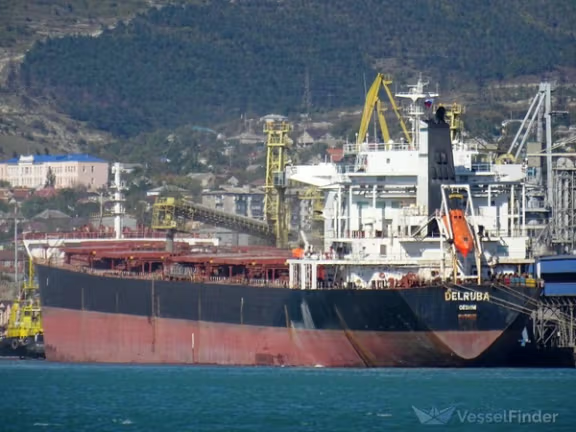
A US-sanctioned Iranian cargo ship has discharged a 60,000-ton shipment of urea at a Brazilian port this week, according to official maritime data reviewed on Thursday in São Francisco do Sul.
The vessel Delruba, part of Tehran’s state-linked IRISL fleet, has been under US Treasury sanctions since June 2020, restricting American and allied entities from providing insurance, financing, or services to it. Port records list the ship at berth 301 of the Terminal Portuário de Santa Catarina since early October.
The arrival took place on Saturday, October 4, and unloading was completed on Wednesday, October 8, according to port authorities. The cargo, valued at roughly $24.4 million, consisted of granulated urea bound for Brazil’s fertilizer industry.
Customs documentation shows the fertilizer originated from Pardis Petrochemical Company, an Iranian producer accused by US officials of financing the Islamic Revolutionary Guards Corps, Brazilian investigative outlets reported.
The documents have not been made public, but port schedules corroborate the vessel’s presence.
The US Office of Foreign Assets Control currently lists DELRUBA as a designated vessel, though Pardis Petrochemical itself is not individually blacklisted. The company operates within Iran’s petrochemical sector, a field subject to sweeping secondary restrictions that expose foreign traders to penalties.
Iran, embroiled in disputes with the United States, is the world’s third-largest urea exporter, producing about 4.8 million tons annually—around ten percent of global supply.
If confirmed, the ship’s docking underscores a widening gap between US sanction enforcement and Brazil’s trade engagement with Tehran.
Thai police arrested a 43-year-old Iranian man in Pattaya, a seaside resort city southeast of Bangkok, for posing as a police officer and extorting money from two Indian nationals, local media reported on Tuesday.
The suspect, identified as Noureddin Morteza Imani, allegedly demanded US$300 from the victims on Sukhumvit Road on October 1 after claiming they had committed offenses, Daily News reported. CCTV footage later showed him exchanging the cash at a money exchange shop, police said.
The two victims, Gaganddepp Singh, 32, and Prabhdeep Singh, 20, filed a complaint on October 5 at Bang Lamung Police Station. Police traced the rented motorcycle used in the incident and arrested Imani at his residence, where they also found he had overstayed his visa by more than a month.
Imani denied direct involvement and blamed a friend, but police said video evidence linked him to the extortion. Authorities are still searching for the second suspect.
Police said Imani faces extortion charges carrying up to five years in prison and a fine of 100,000 baht, along with immigration charges for overstaying his visa.
A Russian delegation led by Rosatom Deputy Head Nikolai Spassky met with Iranian Nuclear Chief Mohammad Eslami in Tehran to discuss nuclear cooperation, Iranian state media reported on Wednesday.
The meeting followed Eslami’s trip to Moscow last week, where Iran and Russia signed agreements on small reactors and a $25 billion project for four large nuclear power units in Hormozgan province.
The talks also covered small modular reactors and 1,250 megawatt power units, the report said.
The two sides reviewed current projects and stressed the need to speed up joint work, Iranian officials said. They also agreed Rosatom Director Alexey Likhachev would visit Iran soon to inspect progress on units two and three of the Bushehr nuclear plant.
The discussions came as a new strategic partnership treaty between Iran and Russia entered into force after approval by Russia’s lower house of parliament. The agreement covers wide cooperation in areas including nuclear energy.
The nuclear meetings followed reports this week that Iran has a €6 billion agreement with Russia for 48 Su-35 fighter jets, with deliveries expected between 2026 and 2028. Iranian lawmakers have said Moscow has already sent MiG-29 aircraft and that more advanced systems such as Su-35s and S-400 air defenses will follow.
Australia’s planned designation of Iran’s Revolutionary Guards as as a terror group will be “targeted and appropriate," a spokesperson at the Attorney-General's Department told Iran International, meaning conscripts may be spared any punishments.
Prime Minister Anthony Albanese announced in August that the government would legislate to list the Islamic Revolutionary Guard Corps as a terrorist organization.
The IRGC has long been sanctioned by the United States, citing its support for armed groups like Hamas and Hezbollah across the Middle East and repression at home.
The legislation to enable the listing was introduced to parliament on Wednesday by Attorney-General Michelle Rowland.
The move follows similar steps by the United States, which listed the IRGC in 2019, and Canada, which designated the force in 2023.
Following these listings, many ordinary Iranians who were not members of the force but were conscripted into the IRGC faced obstacles with visa applications, including tourist and student renewals, and residency permits, leading rights groups and the Iranian diaspora community in Australia to wonder about the new move's scope.
Iran International reached out to Australian authorities to ask whether the legislation would distinguish between IRGC members and conscripts and how it might affect visa or immigration applications.
"The Australian Government is committed to ensuring our new legislation to amend the Criminal Code to allow the listing of state entities as terrorist organizations is targeted and appropriate," the spokesperson at the Attorney-General’s Department told Iran International.
Australia’s Home Affairs Department, which is responsible for immigration and border security, said all non-citizens must meet character requirements under section 501 of the Migration Act.
“The Department of Home Affairs works with law enforcement and intelligence partners to cancel or refuse visas of non-citizens who are a risk to Australia’s national security,” a spokesperson said. “All visa applications are assessed on a case by case basis and all criteria must be satisfied before a visa can be granted.”
'Character test'
A person can fail the character test for several reasons, the spokesperson added, including “where a non-citizen has a substantial criminal record, is suspected of associating with, or being a member of, a group involved in criminal conduct, or where the individual may have been assessed as a risk to Australia’s national security.”
“The new framework within the Criminal Code will target state sponsors of terrorism by criminalizing certain interactions with or by the listed entity, criminalizing support for the listed entity, and hardening the Australian environment against the activities of listed entities,” the spokesperson added.
Senator Claire Chandler, who has long advocated tougher measures against the IRGC, asked about the legislation's impact on conscripts, said the opposition would back the government’s plan but scrutinize it to avoid unintended consequences.
“We will be supporting the change and will examine the legislation closely to make sure it is focused on genuine security risks and does not result in unintended harm to individuals caught up in the designation,” the Tasmania lawmaker from the opposition Liberal Party told Iran International.
Iranian activists in Canada who had advocated for designating the IRGC said they were assured by Canada's government the listing would avoid harming former conscripts, however, many soon faced immigration issues after being branded IRGC members.
Iran summoned European ambassadors in Tehran on Wednesday to protest what it called interventionist and baseless remarks made in a joint statement by the European Union and the Gulf Cooperation Council (GCC) on its territorial claims and defense policies.
Political Deputy Foreign Minister Majid Takht-Ravanchi said the envoys and heads of European missions were called in after the EU-GCC communiqué questioned Iran’s sovereignty over three islands in the Persian Gulf and criticized its missile and regional activities.
“The summons followed the meddlesome allegations in the joint statement of the EU and GCC foreign ministers regarding Iran’s islands and its defensive issues,” Takht-Ravanchi said, according to state media.
The move is a response to an EU-GCC meeting whose final statement backed the UAE’s claim to Abu Musa, Greater Tunb and Lesser Tunb -- urging a peaceful settlement or referral to the ICJ -- and called for a strictly peaceful Iranian nuclear program, and curbs on the proliferation of missiles, drones and related technology.
Tehran rejects the UAE’s claims, says the three islands are integral Iranian territory, and accuses Western and Persian Gulf states of undermining its sovereignty.
The statement also called on Iran to restore full cooperation with the UN nuclear watchdog. It also pressed Yemen’s Iran-aligned Houthis to join UN-led talks, halt Red Sea attacks and free detained aid workers.
The move comes amid heightened tensions after UN sanctions were reimposed and renewed Western pressure over Iran’s nuclear and regional activities.
Speaking at the EU-GCC High-Level Forum on Regional Security and Cooperation in Kuwait, EU foreign policy chief Kaja Kallas said the bloc sought to “encourage Iran to act as a responsible power in the Middle East” while acknowledging that the return of UN sanctions was “a setback but not the end of diplomacy.”
Kallas also linked instability in the Red Sea to Iran’s support for Yemen’s Houthi group and urged continued dialogue to reduce tensions.
Germany’s Foreign Minister Johann Wadephul also accused Tehran of “projecting destabilizing influence” through its regional proxies and warned that Houthi attacks were endangering both Israel and international shipping routes.
Iran’s Foreign Ministry has dismissed such criticism as politically motivated.
Spokesman Esmail Baghaei said Tuesday that “those who reimposed restrictions on Iran and accuse us of destabilization have no right to lecture us,” describing the remarks as shameful and hypocritical.
Baghaei added that European governments, which he said spend “hundreds of billions of dollars” on advanced weaponry, were in no position to question Iran’s indigenous defense capabilities.
Australia has introduced legislation that would, for the first time, allow its government to designate foreign state entities -- including Iran’s Islamic Revolutionary Guard Corps (IRGC) -- as terrorist organizations.
Attorney-General Michelle Rowland presented the bill to Parliament, saying it aims to close a major legal gap in Australia’s counterterrorism framework by permitting the listing of state-backed organizations accused of supporting or conducting terrorist acts.
The move follows findings by the Australian Security Intelligence Organization (ASIO) that the IRGC was involved in two anti-Semitic attacks in Sydney and Melbourne in 2024.
Rowland said the new Criminal Code Amendment (State Sponsors of Terrorism) Bill 2025 would strengthen Australia’s ability to respond to “malicious foreign actors” and serve as a warning to any state seeking to threaten the country through violence or coercion.
“This bill strengthens Australia’s counterterrorism framework, creating an environment in which it is more difficult, more risky, and more costly for foreign actors to cause harm,” she told Parliament.
Under the proposed law, the government would gain the power to list foreign state agencies or entities as state sponsors of terrorism if they are found to have directly or indirectly planned, supported, or financed acts of terrorism against Australia.
Once listed, it would become a criminal offence to collaborate with, fund, or provide material assistance to those entities. Limited exemptions would apply for diplomatic or legal obligations.
The legislation introduces new criminal offences, including preparing or participating in state-sponsored terrorist acts and offering material support to listed state actors. Intelligence and law enforcement agencies would also receive expanded powers to investigate and disrupt suspected state-linked terrorism.
A flag flutters above the Embassy of the Islamic Republic of Iran in Canberra, Australia, August 26, 2025.
ASIO findings link IRGC to attacks in Australia
The bill comes after a series of actions by Canberra against Tehran. In August, Prime Minister Anthony Albanese expelled Iranian Ambassador Ahmad Sadeghi following ASIO’s conclusion that the IRGC directed two arson attacks on Jewish sites -- one at a kosher restaurant in Sydney and another at a synagogue in Melbourne.
“ASIO has now gathered enough credible intelligence to reach a deeply disturbing conclusion that the Iranian government directed at least two of these attacks. Iran has sought to disguise its involvement,” Albanese said.
He described the incidents as “extraordinary acts of aggression orchestrated by a foreign nation on Australian soil.”
The proposed law would align Australia more closely with allies such as the United States, which designated the IRGC as a terrorist organization in 2019.
The group, established in 1979 after Iran’s Islamic Revolution, reports directly to Supreme Leader Ali Khamenei and wields significant military, political, and economic influence at home and abroad. Its Quds Force oversees operations that have supported armed groups in Lebanon, Gaza, Yemen, and Syria.
Australia’s move follows its decision last week, along with New Zealand, to implement revived United Nations sanctions on Iran after European powers triggered the snapback mechanism over Tehran’s nuclear program. The sanctions reimposed restrictions on arms, finance, and missile activities.
Canberra has also joined G7 nations in condemning Iran’s repression of dissidents abroad and intimidation of diaspora communities. In September, Australia warned of “transnational repression” targeting journalists and Jewish groups.
Rowland said the latest legislative step reflects Australia’s evolving security environment. “The threats we face are changing,” she said. “This bill ensures that our national security laws remain fit for purpose -- robust, balanced, and capable of protecting all Australians.”