Iran army chief says foreign powers must leave region
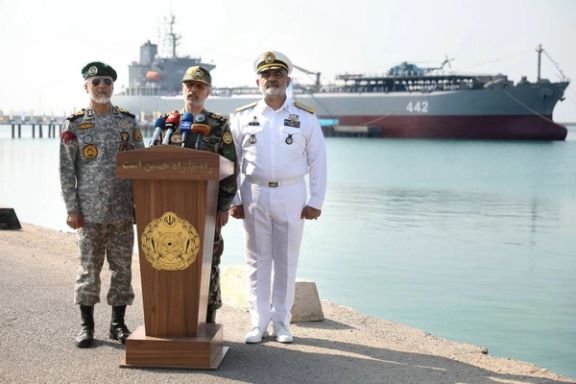
Iran’s army chief said on Saturday that foreign forces should leave the region, saying regional states are capable of maintaining security in the strategic Strait of Hormuz, state media reported.

Iran’s army chief said on Saturday that foreign forces should leave the region, saying regional states are capable of maintaining security in the strategic Strait of Hormuz, state media reported.
“Peace, stability and security in the vital and strategic Strait of Hormuz are important for all nations of the region, including the Islamic Republic of Iran, and we are their guardians,” Major General Amir Hatami said at a naval ceremony in southern Iran.
He said Iran and its neighbors have lived and worked in the region for centuries, adding that “those who are not from this region and have no place here should leave.”
Hatami said any attempt to disrupt regional stability would “create disorder,” and that the countries bordering the Persian Gulf should share its benefits “under fair conditions.”
Iran adds repaired destroyer and floating base
The remarks came as Iran added the destroyer Sahand and the floating base Kordestan to its navy, in what the army described as a move to strengthen maritime power and technical self-reliance.
The Sahand, a domestically built Moudge-class frigate fitted with cruise missiles and radar-evading technology, capsized during repairs at the southern port of Bandar Abbas last year after water entered its ballast tanks. The Navy later refloated and restored it.
The Kordestan floating base is designed to serve as a mobile port supporting naval and non-naval units far from Iranian shores. Mehr news agency said it “can play an important role in supporting combat and logistics operations at sea.”
Hatami said Iran’s forces remain ready to respond to any threat. “Our forces will not wait for an enemy to attack,” he said. “We are ready to deliver a decisive and crushing response wherever our national interests require.”

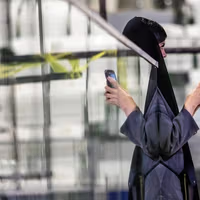
Defiance of compulsory veiling is now widespread in Iran, the Associated Press reported, after a government-approved visit in November found women and girls appearing in public without headscarves in one of the most visible social shifts since Mahsa Amini’s death in 2022.
The outlet’s journalists observed women and girls moving openly through public spaces without headscarves, a practice once met with immediate censure under years of tight enforcement. Along northern Tehran’s Vali-e Asr Street, uncovered hair was common among women of all ages.
“When I moved to Iran in 1999, letting a single strand of hair show would immediately prompt someone to tell me to tuck it back under my headscarf out of fear of the morality police taking me away,” Holly Dagres, a senior fellow at the Washington Institute for Near East Policy, told AP. “To see where Iran is today feels unimaginable: Women and girls openly defying mandatory hijab.”
“Authorities are overwhelmed by the sheer numbers across the country and worry that if they crack down – at a delicate time marked by power blackouts, water shortages, and a rotten economy – they could spur Iranians to return to the streets,” Dagres added.
Scenes around Tajrish Square, north of Tehran, according to the report, showed schoolgirls shedding their headscarves immediately after class and women shopping uncovered at the bazaar as police officers stood by.
“All of my life I had to wear hijab… at school, at university, everywhere in public,” an Iranian woman who recently emigrated to Canada told AP. “I always tried to follow the rules but it made me feel a lack of confidence… because I wore the hijab and I didn’t believe in that.”

Dissatisfaction acknowledged at the top
Iran’s rulers have long relied on strict hijab enforcement by police and Basij forces, with only limited periods of relaxed oversight. The current hesitation comes amid persistent power cuts, water shortages and a weakened economy, all of which risk fueling further anger, the report added.
Supreme Leader Ali Khamenei has so far avoided directly addressing the issue since the year’s war with Israel and US strikes on nuclear sites.
The protests that erupted after the 2022 death of Mahsa Amini, a 22-year-old Kurdish Iranian woman detained by the morality police for allegedly violating Iran’s veiling rules, marked a turning point. Her death sparked some of the largest demonstrations in decades, with women publicly removing or burning their headscarves in defiance of the compulsory veiling law.
AP cited comments by President Masoud Pezeshkian’s social affairs adviser Mohammad-Javad Javadi-Yeganeh, who said unpublished polling by the Iranian Students Polling Agency shows widespread public discontent. The findings align with low turnout in last year’s presidential vote and continuing frustration over inflation, currency volatility and unemployment.
“We are answerable since we cannot provide services to people,” Pezeshkian said recently.
Elias Hazrati, head of the Pezeshkian administration’s information council, confirmed earlier this week that Khamenei had sent directives on hijab enforcement to the government, describing opponents of mandatory hijab as “a small number of people” engaged in “social disorder.” Days earlier, Pezeshkian told the Supreme Council of the Cultural Revolution that state bodies “must adhere to national laws and norms” on hijab.
Judiciary chief Gholamhossein Mohseni-Ejei also instructed prosecutors to act against what he called “organized, foreign-linked” groups involved in “social disorder.”
For Iranians worn down by years of sanctions, economic stagnation and the fear of renewed conflict, uncertainty persists.
“Sometimes that fear is with me,” the woman in Canada said. “Sometimes when I’m behind the wheel, I try to find my headscarf on my head. That fear is still with me.”

Under unprecedented strain at home and abroad after the June war, Tehran is adopting new tones and messaging to steady its own base.
The clearest example comes from a darkened political talk show where once-unshakeable Iranian commanders now appear compelled to sit for unusually probing interviews.
A general adjusts the ring on his finger before answering. Another clears his throat to buy time. All are addressing—or attempting to address—now-unavoidable questions verbalised by host Javad Mogui, a documentary filmmaker long aligned with the establishment.
Since the 12-day war with Israel, the show’s tone has visibly shifted: clipped, direct, and edged with the frustrations circulating inside the system.
‘Too soft on the US’
One recent guest was senior Revolutionary Guards commander Mohammad Reza Naghdi.Mogui asked him about Iran’s retaliatory strike on a US base in Iraq following the killing of Quds Force commander Qassem Soleimani in January 2020.
“Many believe the roots of the recent war go back to that moment,” Mogui said in the dim light. “That our response was too soft.” Then, quietly: “Do you accept that we did not hit the Americans well enough?”
Naghdi smiled, though not comfortably. His replacement was quietly confirmed days later.
No Americans were killed in that attack, not least because Tehran reportedly telegraphed its intentions to Washington with enough notice.
‘At home’
In another episode Mogui asked air defence chief Gholamreza Jalali where he had been when Israel struck Tehran, killing many of Iran’s top brass.
“I was at home,” Jalali said. Mogui paused. “Should the armed forces not have been ready?” Jalali replied: “We did not expect that they would target the homes of commanders.”
Other senior figures have appeared under the same narrow pool of light: foreign minister Abbas Araghchi, parliament speaker Mohammad Bagher Ghalibaf, IRGC chief’s top adviser Ahmad Vahidi among others.
Each was asked about missed signals and the war’s opening hours—unamiganable without a nod from the highest authorities.
Political analyst Jaber Rajabi told Iran International TV that the candor reflects unease inside the system.
“The questions the host asks are the same ones being asked within the Revolutionary Guards and among pro-government supporters,” he said. “If they do not hear convincing answers, it could cause defections within these ranks.”
Patriotic turn
That insecurity is mirrored in Tehran’s cultural messaging.
In recent weeks the city unveiled a towering statue in Revolution Square depicting the Roman emperor Valerian kneeling before Shapur I, echoing a Sasanian relief.
The project anchors a campaign titled “You will kneel before Iran again,” launched near the anniversary of the 1979 embassy seizure.
Beneath the statue sit twelve panels narrating moments of “resistance” from Persian myth to the fight against ISIS and the recent twelve-day war.
The unveiling featured mobile LED trucks and orchestral performances, but officials insisted it was not a promotional event.
“This is the continuation of a historical truth: every invader has bowed before the will of the Iranian people,” the head of Tehran’s Beautification Organization said.
Tone not intent
Foreign reporting has noticed the same shift.
The Financial Times this week highlighted insiders arguing that Iran “must decide whether it wants to be a force that challenges or supports regional security.”
The Economist, asked whether the regime can survive five more years, replied that it likely will, though the “big question” is whether a change of leader would mean a change of regime.
Middle East correspondent Nicolas Pelham added that Iran appears to be “trying to reinvent itself,” pointing to the rise of explicit nationalist symbols.
Together, these strands point to a tactical revision rather than transformation: a state unsettled enough to justify decisions it once presented as self-evident, and determined to wrap that unease in a grander narrative of historical inevitability.
It is a shift more in register than structure—an Iran 0.2 more than 2.0.

Iranian authorities said they seized two vessels carrying 80,000 liters of smuggled fuel near the island of Kish in the Persian Gulf on Saturday.
Ali Salemizadeh, the prosecutor of Kish, said the boats were stopped under a judicial order as part of operations by a naval task force formed to combat fuel smuggling. He said the alleged smugglers had modified the structure of the boats and installed extra tanks on deck to move the fuel out of the country.
No details were given about the ownership, registration, or crew of the vessels, or about where they were headed.
Salemizadeh said authorities would continue to act firmly against fuel trafficking networks, which officials in Tehran say cause heavy losses to the state due to large price gaps with neighboring countries. Fuel smuggling is common in southern Iran, where heavily subsidized prices make it profitable to resell fuel abroad.
The announcement came amid a series of maritime enforcement operations by Iran in recent months. Earlier this month, Iran’s Revolutionary Guards said they had seized a Marshall Islands–flagged tanker off the coast of Makran, confirming reports from maritime security firms that the ship had been diverted toward Iranian waters after being approached by small boats in the Gulf of Oman.
Iran says such seizures are carried out under judicial orders to prevent illegal fuel or cargo transfers. But Western officials and shipping sources say the country has often used maritime enforcement as leverage in regional and sanctions-related disputes.
Iran’s coast and the Strait of Hormuz are key routes for global oil shipments, and Tehran has increased patrols there as part of what it calls efforts to safeguard national interests and counter smuggling.

Iran added the floating base Kordestan and the destroyer Sahand to its navy on Saturday, the army said, in a move it described as a boost to its maritime power and technical self-reliance.
Sahand, a Moudge-class frigate built in Iran, joined the navy in 2018 and is equipped with cruise missiles and stealth technology designed to evade radar detection, state media said. It sank last year during repairs at the southern port of Bandar Abbas after water entered its ballast tanks, causing it to lose balance and partially submerge. The navy said it later refloated and repaired the ship.
The Sahand had been readied for an anti-piracy mission in the Indian Ocean after leading an Iranian flotilla to the Red Sea and Gulf of Aden amid attacks on commercial vessels in the region, according to state media. In 2021, it drew international attention when a US diplomatic campaign stopped it from docking in the Western Hemisphere. Washington believed it was carrying weapons and heading toward Venezuela, but the vessel eventually changed course toward the west coast of Africa, US officials said at the time.
The Kordestan floating base is designed to act as a mobile port city capable of supporting naval and non-naval combat units far from Iranian shores. Mehr news agency said the base “is essentially a port city that can play an important role in supporting naval and non-naval combat units at sea.”
The army also unveiled new missile-equipped speedboats, unmanned aerial and underwater systems, and electronic and coastal defense equipment during the ceremony.
Major General Amir Hatami, commander of the Iranian army, and Rear Admiral Shahram Irani, head of the navy, attended the event along with provincial governors, lawmakers, clerics and families of fallen navy personnel.

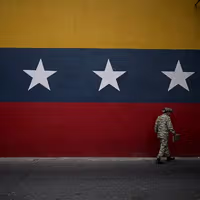
A vast US military buildup in the Caribbean aims to pile pressure not just on Venezuela but fellow adversaries of the United States like Iran, retired four-star General and ex-commander of US Central Command Joseph Votel said on Eye for Iran podcast.
Votel, who oversaw American operations in the Middle East from March 2016 to March 2019, emphasized in an interview with Eye for Iran that the primary objective is countering narcotics trafficking.
But the show of force could also aim to deter Washington's arch-nemesis in the Middle East, Votel added.
"The presence of a carrier is a huge message that we're sending not just to the region, but to others who would be supporters of Venezuela,” he said. "Venezuela has been a place where ... we've seen Iranian advisors, the IRGC, Quds Force and others for a long period of time who developed a relationship."
"They look for this as an opportunity for strategic competition against us in an area of a sphere of our influence here ... it's going to be mostly indirect on Iran.”
The administration of US President Donald Trump has been amassing forces in the Caribbean in the biggest military buildup in the region for decades.
Washington accuses Venezuelan President Nicolas Maduro of narco-terrorism and has offered a $50 million dollar reward for information leading to his arrest. The US strategy remains unclear but appears aimed at unseating the leftist populist.
Caracas and Tehran are sharp critics of US foreign policy and are sworn to opposing US influence in their regions.
“Iran has been a vocal supporter of Venezuela … they obviously have relationships with the Venezuelan government," Votel added.
Iran has bristled at the US maneuvers and says they show Washington's true face.
Foreign Minister Abbas Araghchi this week condemned what he called US bullying and aggression toward the oil-rich South American country, according to a readout of a phone call he made to his Venezuelan counterpart.
Yvan Gil Pinto in turn thanked Iran for its support and vowed that Venezuela would resist US interference.
In a defiant speech on Thursday, Iran's Supreme Leader Ali Khamenei condemned US designs on Venezuela as a cynical play for its energy wealth which threatens chaos.
“Wherever the US intervenes, the outcome is war-mongering, genocide, destruction, and displacement," he said. "Because of oil and underground resources, they are willing to ignite conflicts anywhere in the world — and this warmongering has now reached Latin America as well."
The Iran-Venezuela strategic partnership dates back nearly 25 years. Since the two countries signed a 20-year cooperation agreement in 2022, they have expanded coordination in energy, security and trade.
Iran’s footprint in Venezuela includes an undetermined number of Islamic Revolutionary Guard Corps personnel and military advisers.
Venezuela, in turn, provides Iran with access, alternative markets for sanctions evasion and a platform in the US near its borders.
The power of deterrence
Despite those ties, Votel stressed that the US key focus was on Venezuela, which has long been an irritant for Washington in the region.
“What we’re doing right now appears to principally be focused on the narco-terrorism,” he said.
Still, the scale of the deployment matters — and Tehran will not miss the message.
The arrival of the USS Gerald R. Ford carrier strike group, supported by 70–80 aircraft and more than 12,000 US personnel, marks one of the most significant American naval postures in the Western Hemisphere since the Cuban Missile Crisis.
Votel underscored just how substantial this deployment is: “We’re talking 12,000 troops. This is more than we had in Afghanistan for the last several years we were there.”
Washington has also conducted roughly 20 airstrikes against suspected drug-trafficking vessels in the Caribbean and eastern Pacific, killing more than 80 people.
Votel added that while Iran could theoretically respond asymmetrically in the Persian Gulf, Iraq, or elsewhere, Tehran is significantly weaker today than a year ago, with its networks degraded and its security architecture shaken by US and Israeli strikes.
“They’re not in a great position to do that right now,” he said, “but again, we can never count out Iran in any of this.”
The US posture in the Caribbean also reflects a broader strategy of deterrence: using visible military force and the information environment — including openly discussing covert options to pressure Maduro’s government and shape the behavior of states aligned with it.
Votel said that the fact Washington is publicly talking about covert options is itself a message.
“In most cases, we wouldn’t normally talk about covert operations, but in this case, our government has made the decision to do that … to ramp up the pressure on the Maduro regime.”
You can watch the full episode of Eye for Iran on YouTube or listen on any podcast platform of your choosing.