Iran condemns US closure of Venezuela airspace, warns of consequences
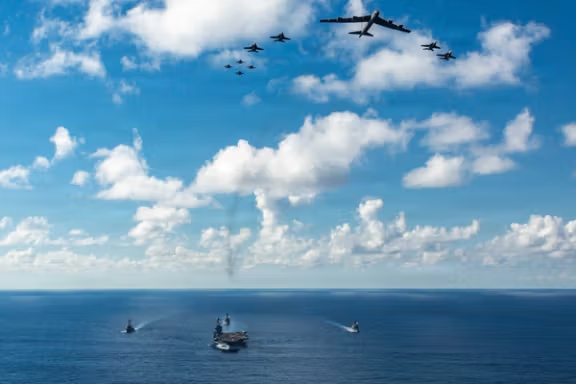
The US Navy’s Gerald R Ford Carrier Strike Group, including the flagship USS Gerald R Ford, USS Winston S Churchill, USS Mahan and USS Bainbridge, sails towards the Caribbean Sea under F/A-18E/F Super Hornets and a US Air Force B-52 Stratofortress, in the Atlantic Ocean, November 13, 2025
Iran's foreign ministry on Saturday denounced US President Donald Trump’s announcement of a closure of Venezuela’s airspace, calling it a serious breach of international law and a threat to global aviation safety.
The ministry's spokesman Esmail Baqaei said Trump’s "unilateral move amounted to a flagrant violation of established international norms governing cross-border air transport."
"The US action is part of a series of provocative and illegal measures Washington has taken against Venezuela’s national sovereignty and territorial integrity," Baqaei said, according to a foreign ministry statement.
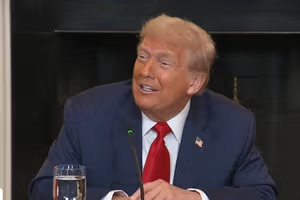
Trump said on Saturday that all airspace over and around Venezuela should be considered as fully closed, offering no additional details as Washington intensifies pressure on President Nicolás Maduro’s government.
"To all Airlines, Pilots, Drug Dealers, and Human Traffickers, please consider THE AIRSPACE ABOVE AND SURROUNDING VENEZUELA TO BE CLOSED IN ITS ENTIRETY," Trump said in a Truth Social post.
Iran's foreign ministry spokesman warned that the measure poses unprecedented risks to international aviation safety and could have dangerous consequences for the rule of law, as well as for global peace and security.
He urged the international community to take note of what he called a destabilizing step that undermines long-standing principles of international conduct.
Reuters said American officials it contacted were surprised by Trump's announcement and unaware of any ongoing US military operations to enforce a closure of Venezuelan airspace.
Retired four-star General and ex-commander of US Central Command Joseph Votel said on Eye for Iran podcast the vast US military buildup in the Caribbean aims to pile pressure not just on Venezuela but fellow adversaries of the United States like Iran.
Votel, who oversaw American operations in the Middle East from March 2016 to March 2019, emphasized that the primary objective is countering narcotics trafficking.
But the show of force could also aim to deter Washington's arch-nemesis in the Middle East, Votel added.
"The presence of a carrier is a huge message that we're sending not just to the region, but to others who would be supporters of Venezuela,” he said. "Venezuela has been a place where ... we've seen Iranian advisors, the IRGC, Quds Force and others for a long period of time who developed a relationship."
The UN nuclear watchdog’s latest rebuke shows that Iran’s turn to nuclear ambiguity is deepening concerns and may accelerate an escalation that all sides insist they want to avoid.
The IAEA Board of Governors’ late-November resolution delivered one of the clearest signals yet that global patience with Iran’s nuclear posture has reached its limit.
Passed by a wide majority, the measure criticized Tehran’s “lack of serious cooperation,” echoing Director General Rafael Grossi’s warning that inspectors still lack access to critical facilities damaged in the June 2025 Iran–Israel conflict.
Equally significant was the political alignment behind the vote. European governments that once urged restraint joined the United States in backing public censure, arguing that Iran’s growing stockpile of 60% enriched uranium and continued restrictions on inspectors have rendered partial transparency untenable.
Only Russia and China opposed the resolution; most others abstained rather than defend Tehran.
Iran responded with open defiance, calling the resolution “political” and voiding a September agreement with Grossi that both sides had said would open the door to renewed inspections.
Shortly after the Vienna vote, atomic energy chief Mohammad Eslami ordered the expansion of enrichment.
State media framed the move as “a clear message” to the West—pressure rather than engagement. Increasingly mistrustful of the IAEA, Tehran now portrays the Agency as an extension of hostile powers.
The view from Israel, US
The dispute has shifted from a technical compliance issue to a broader strategic challenge the international community is no longer willing to overlook.
For Israel, the resolution reinforces long-standing fears that Iran is concealing elements of its program. The vote adds urgency by validating the view that transparency is deteriorating.
Israeli planners argue that without swift diplomatic progress, preemptive action may become unavoidable. The June 2025 conflict—sparked soon after an IAEA report found Iran in non-compliance—remains a fresh precedent.
Washington and European capitals are recalibrating as well. U.S. rhetoric has sharpened, with officials stressing that “all options are on the table.”
According to diplomatic intermediaries, Washington recently conveyed a pointed message urging Tehran to re-engage—possibly through a Saudi-facilitated track.
Siege mentality, asymmetric escalation
Tehran interprets these developments as part of a coordinated pressure strategy aimed at weakening the Islamic Republic.
The June strikes, snapback-style sanctions, and the latest IAEA censure are portrayed domestically as evidence that diplomacy is futile. That narrative deepens the sense of encirclement and pushes Tehran toward deterrence calculations rooted in worst-case assumptions.
Iran’s strategy increasingly reflects the belief that it cannot win a conventional confrontation.
After the June war, which damaged key radar and air-defense nodes, Tehran has struggled to restore parts of its network and appears to be prioritizing asymmetric survivability: mobile missile units, underground facilities, and electronic-warfare assets.
Rebuilding a much-depleted Hezbollah appears to be another priority, with Israeli officials warning repeatedly of new money and arms transfers.
Shrinking paths
That trajectory is unsurprising given the belief in Tehran—expressed almost daily by officials and pundits—that another military conflict with Israel is a distinct possibility. The standoff with the IAEA only hardens that outlook.
By refusing meaningful cooperation, Tehran closes off opportunities to rebuild trust or stabilize the situation. Its growing reliance on asymmetric deterrence could rais the risk of miscalculation.
Israel and the West, seeing a regime that appears cornered and increasingly unpredictable, may conclude that delay only increases future costs.
Pressured militarily and strained economically, the Islamic Republic now faces a shrinking set of choices that increasingly converge on a binary: compromise or confrontation. What is clear after this week’s IAEA resolution is that Iran has rarely been more isolated—or more on edge.
A vast US military buildup in the Caribbean aims to pile pressure not just on Venezuela but fellow adversaries of the United States like Iran, retired four-star General and ex-commander of US Central Command Joseph Votel said on Eye for Iran podcast.
Votel, who oversaw American operations in the Middle East from March 2016 to March 2019, emphasized in an interview with Eye for Iran that the primary objective is countering narcotics trafficking.
But the show of force could also aim to deter Washington's arch-nemesis in the Middle East, Votel added.
"The presence of a carrier is a huge message that we're sending not just to the region, but to others who would be supporters of Venezuela,” he said. "Venezuela has been a place where ... we've seen Iranian advisors, the IRGC, Quds Force and others for a long period of time who developed a relationship."
"They look for this as an opportunity for strategic competition against us in an area of a sphere of our influence here ... it's going to be mostly indirect on Iran.”
The administration of US President Donald Trump has been amassing forces in the Caribbean in the biggest military buildup in the region for decades.
Washington accuses Venezuelan President Nicolas Maduro of narco-terrorism and has offered a $50 million dollar reward for information leading to his arrest. The US strategy remains unclear but appears aimed at unseating the leftist populist.
Caracas and Tehran are sharp critics of US foreign policy and are sworn to opposing US influence in their regions.
“Iran has been a vocal supporter of Venezuela … they obviously have relationships with the Venezuelan government," Votel added.
Iran has bristled at the US maneuvers and says they show Washington's true face.
Foreign Minister Abbas Araghchi this week condemned what he called US bullying and aggression toward the oil-rich South American country, according to a readout of a phone call he made to his Venezuelan counterpart.
Yvan Gil Pinto in turn thanked Iran for its support and vowed that Venezuela would resist US interference.
In a defiant speech on Thursday, Iran's Supreme Leader Ali Khamenei condemned US designs on Venezuela as a cynical play for its energy wealth which threatens chaos.
“Wherever the US intervenes, the outcome is war-mongering, genocide, destruction, and displacement," he said. "Because of oil and underground resources, they are willing to ignite conflicts anywhere in the world — and this warmongering has now reached Latin America as well."
The Iran-Venezuela strategic partnership dates back nearly 25 years. Since the two countries signed a 20-year cooperation agreement in 2022, they have expanded coordination in energy, security and trade.
Iran’s footprint in Venezuela includes an undetermined number of Islamic Revolutionary Guard Corps personnel and military advisers.
Venezuela, in turn, provides Iran with access, alternative markets for sanctions evasion and a platform in the US near its borders.
The power of deterrence
Despite those ties, Votel stressed that the US key focus was on Venezuela, which has long been an irritant for Washington in the region.
“What we’re doing right now appears to principally be focused on the narco-terrorism,” he said.
Still, the scale of the deployment matters — and Tehran will not miss the message.
The arrival of the USS Gerald R. Ford carrier strike group, supported by 70–80 aircraft and more than 12,000 US personnel, marks one of the most significant American naval postures in the Western Hemisphere since the Cuban Missile Crisis.
Votel underscored just how substantial this deployment is: “We’re talking 12,000 troops. This is more than we had in Afghanistan for the last several years we were there.”
Washington has also conducted roughly 20 airstrikes against suspected drug-trafficking vessels in the Caribbean and eastern Pacific, killing more than 80 people.
Votel added that while Iran could theoretically respond asymmetrically in the Persian Gulf, Iraq, or elsewhere, Tehran is significantly weaker today than a year ago, with its networks degraded and its security architecture shaken by US and Israeli strikes.
“They’re not in a great position to do that right now,” he said, “but again, we can never count out Iran in any of this.”
The US posture in the Caribbean also reflects a broader strategy of deterrence: using visible military force and the information environment — including openly discussing covert options to pressure Maduro’s government and shape the behavior of states aligned with it.
Votel said that the fact Washington is publicly talking about covert options is itself a message.
“In most cases, we wouldn’t normally talk about covert operations, but in this case, our government has made the decision to do that … to ramp up the pressure on the Maduro regime.”
You can watch the full episode of Eye for Iran on YouTube or listen on any podcast platform of your choosing.
The US State Department on Friday hit out at Iran's government for providing officials and loyal elites access to uncensored internet through so-called “white SIM cards,” while ordinary Iranians remain restricted and forced to rely on VPNs.
In a post on X, the department’s Persian-language USAbehFarsi account wrote that access to information “is a fundamental right, not a privilege for a select few.”
"The United States condemns the regime’s discrimination and stands firmly with the people of Iran in their fight for internet freedom," it said.
The statement comes amid public backlash sparked by X’s new location feature, which shows the approximate location from which users are posting.
The update exposed numerous pro-government figures and individuals tied to the Islamic Republic posting freely from inside Iran where most people have to bypass the restrictions on social media using tools like VPN.
"The Islamic Republic regime, while imposing severe restrictions and censorship on the Iranian people, hypocritically provides its own officials with special access to the internet," the US State Department posted to X.
The new feature on the X platform "has revealed that many Islamic Republic officials, pro-government activists, and affiliated journalists have access to privileged internet,” political activist Hossein Ronaghi wrote on X.
The revelations indicate that those at the top are using so-called “white SIM cards” — special, unrestricted whitelisted mobile lines exempt from the state’s filtering system. These lines provide uninterrupted access to platforms like Instagram, Telegram, and WhatsApp, which remain blocked for the general population.
Public anger quickly concentrated on high-profile figures whose X accounts showed their connection country as Iran, including former and current lawmakers, government spokespeople, and several media personalities — even though some had publicly claimed they used VPNs.
Government spokesperson Fatemeh Mohajerani, who had previously been asked whether she used an unrestricted line, insisted she relied on VPNs.
“I use anti-filters like everyone else, and my son and daughter-in-law help me with the setups,” she said.
After screenshots circulated showing her location as Iran, users accused her of being dishonest.
One user pointed to the location tag on the account of Amirhossein Sabeti, a lawmaker and staunch supporter of internet filtering, and mocking his use of an iPhone wrote: “An American phone, an American app, white internet. What he prescribes for the public: ‘resistance economy.’”
Many accounts linked to pro-government figures quickly changed their region settings to West Asia after the controversy escalated. Some apologized and some deactivated their accounts.
The Islamic Republic spends at least $4.5 billion to suppress digital information access according to the US government.
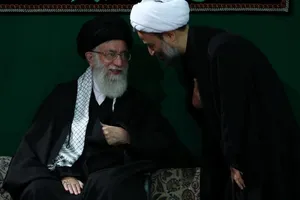
Supreme Leader Ali Khamenei on Thursday denied reports that Tehran had sought to enlist Riyadh as an intermediary in talks with Washington, saying outreach to President Donald Trump was beneath Iran's dignity.
“They fabricate rumors claiming that Iran has sent a message to the United States through some country. It is pure lies. Nothing of the sort ever happened," Khamenei said in a defiant speech for a day celebrating the country's Basij domestic militia.
"The Americans betray even their own friends ... Because of oil and underground resources, they are willing to ignite conflicts anywhere in the world — and this warmongering has now reached Latin America as well. A government of this kind certainly does not deserve for a state such as the Islamic Republic to seek relations or cooperation with it."
Last week, Reuters reported citing two sources familiar with the exchange that Iran's President Masoud Pezeshkian had urged Saudi Crown Prince Mohammed bin Salman to help persuade US President Donald Trump to revive nuclear talks.
The crown prince visited Washington last week and has a warm relationship with Trump.
Iranian officials have criticized a US military buildup in the Caribbean aimed at Venezuela, an ally which under leftist populist President Nicolas Maduro has been a strong critic of its neighbor to the north.
'US getting more isolated'
Khamenei mocked Trump's bid to resolve the war in Ukraine and said Washington's international standing was on the wane.
“Day by day, the United States is becoming more isolated in the world. Even if the leaders of some countries flatter it, among nations it is becoming more and more disliked," he said.
"It was the United States that started the war in Ukraine, and it has not achieved any results. The current US president had said he would resolve the issue in three days, yet now, after a year, he is trying to force through a 28-point plan," the Supreme Leader said.
'Iran defeated US and Israel'
The 86-year-old theocrat, who is the ultimate decision-maker on domestic and foreign policy, lamented not being able to give the speech to an audience. He spoke from behind a lectern in a video message, having sharply reined in his public appearances after Israeli assassinations of scores of military officials in a surprise June conflict.
"We suffered losses. We lost dear lives — there is no doubt about that. It is the nature of war. But the Islamic Republic showed that it can stand up to the enemy," he said.
Khamenei added that Israel and the United States failed to achieve its objectives in the war, and that its Mideast arch-foe's main goal of provoking an uprising had come to naught.
“They spent 20 years planning for a war to break out in Iran, hoping to provoke the people, rally them to their side, and turn them against the system. But they returned empty-handed; the outcome was the opposite, and they failed," he said.
"Even those who had differences with the system stood by it. A broad public unity emerged — something that must be appreciated."
Despite rising costs of living and a harsh post-war crackdown on political dissent even as some social strictures were relaxed, there have been few large-scale protests against authorities.
'Let us support Pezeshkian'
Khamenei gave a fresh public endorsement to Pezeshkian, a relative moderate who has absorbed wide criticism for the economic malaise and is under pressure from hardliners over his cabinet's performance.
“Let us support the esteemed president and the well-serving government. They have begun good initiatives, and God willing, their results will be seen later," he said. "The government carries a heavy burden. Running the country is not easy, and the government must be supported.”
A drought which is depleting reservoirs has added to Iranians' woes and Khamenei urged people to pray for rain.
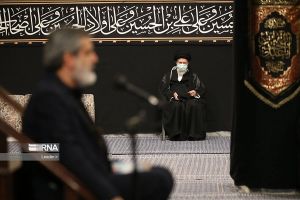
At an official ceremony in Supreme Leader Ali Khamenei's compound on Thursday, a religious official chanted to congregants that US President Donald Trump's death was nigh and that Iran would vanquish Israel.
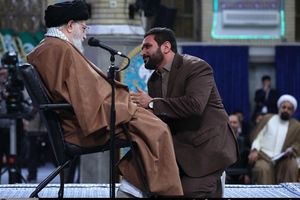
Mehdi Rasouli, a well-known maddah or religious eulogist and chant leader, performed at the Imam Khomeini Hussainiyah in Tehran. It is the main auditorium within Khamenei's office complex known as Beyt-e Rahbari or the Leader's house.
“From now on, we have one goal — and that is the heart of Tel Aviv,” he said. "Your accursed name will no longer remain in this world. Tell that yellow-haired murderer he will be no more," he said in reference to Donald Trump to loud assent from attendees.
The event held earlier this week formed part of ceremonies marking Basij Day, when Iran’s volunteer paramilitary force is feted.
Eulogists in Iran's Shi'ite Muslim tradition deploy chants and poetry to encourage enthusiasm in religious gatherings. Since the 1979 Islamic Revolution which ushered in a theocracy, the content of their presentations reflect state political ideology.
"Bullies stronger than you lie buried under piles of earth," Rasouli continued. "You will not see Iran’s surrender even in your dreams ... Are you too, like Pharaoh, thinking you will not die?"
"Death does not hesitate even a moment to take your soul. It wouldn’t hurt to visit the graves of Carter and Reagan once in a while," he said.
Crowd reactions followed the familiar arc of such performances – chants at crescendos, brief laughter at lines like “If you mention the name of Iran, be polite,” and tears as Rasouli invoked recent war dead, including Revolutionary Guard commanders killed in clashes with Israel.
He delivered the poem in epic, martial cadences, and the audience periodically answered with slogans.
The recital ended with pledges of allegiance to the Supreme Leader, prompting the hall to respond “Labbayk, labbayk” – an Arabic formula of assent meaning “at your service” in a show of allegiance to Khamenei.
A maddah is a lay performer, not a cleric. Over three decades, their role has expanded from mourning rites to emotionally charged performances that can carry political overtones.
Their verses, set to strong rhythms, aim to stir grief for the martyrs of Karbala, devotion to the Prophet’s family, and, increasingly, political zeal.
When delivered at the leader’s own venue, the rhetoric carries extra weight for loyalists – even as officials can argue that maddahs speak for themselves, not for the state.
Rasouli’s text stitched together recurring motifs. He opened by hailing Iranian resilience and vowing ultimate triumph – “In the end, Iran will be the victor of the battle” – before pivoting to taunts of US and Israeli leaders.
At another point he warned: “Ajal does not delay in taking your soul,” using the Persian term ajal – the appointed time of death – to suggest that fate, or the Angel of Death, does not pause, a standard rhetorical device in Persian oratory.
The poem drew on classical Persian epic and Shi'ite sacred history.
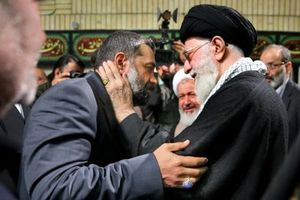
Mehdi Rasouli and Supreme Leader Ali Khamenei
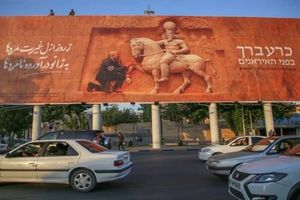
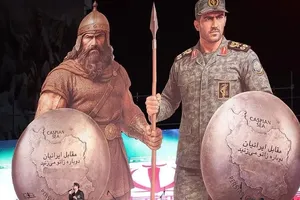
Rasouli invoked Rostam, the pre-Islamic epic hero of Ferdowsi’s Shahnameh, likening Israel to a div (demon) and rhyming “div” with “Aviv” to fix the poem’s “final aim on the heart of Tel Aviv.”
He also reached for Shi'ite iconography, saying Ali, the first Shi'ite Imam, would come for Israel with his bifurcated sword Zolfaghar, a symbol widely recognized in Iran.
The barbs sat alongside appeals to faith and fidelity: victory, he said, hinges on obedience to the Supreme Leader – a cue for synchronized chants of “Labayk.”
Modern military references appeared in the poem too. In a couplet that played on rhyme and Iranian missiles, Rasouli said: “If you have bunker-busters, we have Kheibar-Shekan,” pairing the Persian for “bunker-breaker” (sangar-shekan) with Kheibar-Shekan (Khaybar-Breaker), the name of an Iranian solid-fuel medium-range ballistic missile unveiled in 2022.
Khaybar also refers to a 7th-century Jewish oasis near Medina and, in Shi'ite lore, to Imam Ali’s breaching of its fort – a religious touchstone repurposed in modern rhetoric.
Under Ali Khamenei, maddahs regularly perform at his residence on major religious occasions and enjoy networks of patronage that can extend through state and quasi-state institutions.
Analysts say eulogists act as emotional amplifiers: knitting mourning, nationalism and loyalty into a single ritual package.
Within pro-government circles, however, the venue and proximity to power matter; when a poem is staged at the leader’s inner sanctum, supporters treat it as consonant with the leadership’s mood, if not a formal policy.
The eulogist scene is diverse, spanning apolitical performers, staunch loyalists to the leadership, and figures tied to rival conservative factions.
Celebrity maddahs have campaigned for candidates, criticized senior officials, and at times helped mobilize crowds.
Their hey’ats (religious associations) fund and stage mass ceremonies during Muharram and Arbaeen, and some maintain close ties with the Revolutionary Guards’ Basij militia.
In a genre long fused with piety and politics, Rasouli leaned into a newer twist: Persian epic motifs spliced onto Shi'ite heroism – a form once anchored almost entirely in Shi'ite themes.
Shahnameh references now sit alongside invocations of Ali and the “martyrs,” recasting loss and defiance in a national-myth frame.
Inside the hall, the result is part sermon, part rally, part catharsis.