Iran warns Isfahan’s drying river and wetland at ‘point of no return’
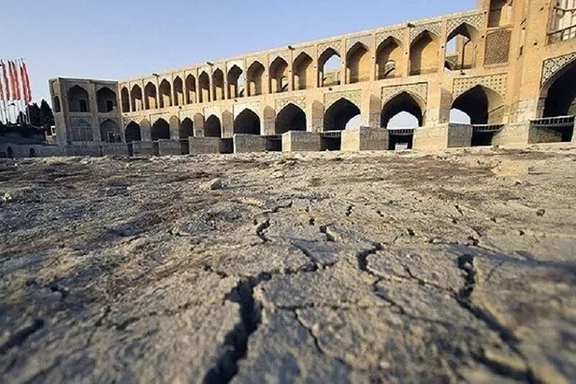
Prolonged drought and the halt to permanent flows in the Zayandeh-Roud river have driven land subsidence and the Gavkhouni wetland toward an apparent point of no return, raising risks to Isfahan’s drinking-water supply, a provincial environmental official said.
“The continued drying and the cut in permanent flows have brought land subsidence and the death of Gavkhouni to a point of no return and even put drinking water on the threshold of threat,” said Dariush Golalizadeh, the provincial environment department chief.
“The Zayandeh-Roud played a key role in recharging aquifers and preventing subsidence. With multi-year drought and sharply reduced inflows, alongside heavier pumping from wells and wastewater use, subsidence has intensified alarmingly.”
Golalizadeh said the internationally listed Gavkhouni wetland downstream of Isfahan is turning into a dust hotspot. “When the wetland falls apart, it means there are serious problems in water and land management above it.”
He linked the ecological stress to livelihoods, saying orchards, urban green spaces and farmers have been hit across the basin. Authorities are now working on support programs for Isfahan’s eastern districts to soften the blow to agriculture, he said.
The official urged emergency measures to keep minimum flows to the river and wetland.
“At present, because of the sharp drop in river yield, drinking water is under threat,” he said. “We are looking to other sources, but rising temperatures and drought have cut inflows to a minimum.”
The US dollar surged to 1,160,000 rials in Iran’s unofficial market on Saturday, adding to inflationary pressures and deepening worries about the country’s worsening economic outlook.
The US dollar, which traded at about 140,000 rials in 2018, has risen roughly eight-fold since Donald Trump restored US sanctions on Iran seven years ago.
The current dollar rate of 1.16 million rials is just shy of the all-time high of 1.17 million recorded on September 30.
The reimposition of UN sanctions in September deepened the currency shock, Parliamentarian Valiollah Bayati said last month. Addressing President Masoud Pezeshkian, Bayati said public anxiety was mounting.
The sanctions were restored 30 days after Britain, France and Germany triggered the so-called snapback mechanism under the UN Security Council Resolution 2231, citing Iran's failure to comply with its nuclear obligations.
The move restored UN penalties previously suspended under the resolution, tightening external constraints on Iran’s economy.
Farid Mousavi, a member of parliament’s economic committee, warned earlier this month that the currency rise could accelerate in coming weeks. “With inflation continuing at this pace, a 1.3 million-rial dollar rate in winter is not far-fetched."
Official figures show food costs up more than 66 percent over the past year, with bread and grains up 100 percent, fruit and nuts 108 percent, and vegetables almost 69 percent.
The central bank’s latest report also indicates a record surge in capital flight during the spring, underscoring dwindling market confidence.
Rising fuel costs compound volatility
The currency rise follows a domestic fuel-price increase that legislators warn will spill into transport and retail markets.
Mohsen Biglari, secretary of parliament’s budget committee, told the Rouydad24 outlet that higher gasoline costs would influence prices across sectors. “If people have to buy fifty-thousand-rial gasoline, it will certainly affect other goods and services."
The government’s new fuel pricing system, announced on Tuesday, introduces a third rate of 50,000 rials per liter (4.4 cents per the free market rate) for drivers refueling without smart rationing cards or beyond their quota, while keeping existing 15,000- and 30,000-rial rates ((1.3 and 2.6 cents, respectively).
The accelerating dollar, mounting household costs, and weakening investor sentiment together signal a deepening inflationary cycle likely to shape Iran’s economic trajectory in the months ahead.
Iran’s Karkheh Dam hydroelectric power plant has stopped generating electricity because of a sharp drop in the reservoir’s water level, state media reported on Saturday.
Amir Mahmoudi, head of the Karkheh Dam and power plant, said water is now being released through lower outlets to supply downstream needs after the generating units went offline. He said the dam’s reservoir currently holds about one billion cubic meters of water, with the water level 40 meters below normal operating height.
Mahmoudi said the Karkheh basin has endured several years of drought and low rainfall, urging conservation of water for drinking, farming, livestock, and industrial use.
The Karkheh Dam, one of the largest earthen dams in the world and the biggest in Iran and the Middle East, was built on the Karkheh River about 22 kilometers northwest of Andimeshk in Khuzestan province. It has a total generating capacity of 400 megawatts.
The shutdown comes as Iran faces one of its worst droughts in decades, with reservoirs across the country running dangerously low. Domestic media have reported steep drops at Tehran’s Karaj and Latian dams, while officials in Mashhad, Kerman and Yazd warn of collapsing aquifers and forced water rationing.
The Kurdish rights group Hengaw said this week that authorities in western Iran have also increased pressure on local journalists covering the crisis. Reporters in the city of Baneh were summoned or threatened by security agents after publishing reports on water shortages that left some neighborhoods without running water for more than three days.
The group said some journalists were accused of “spreading public anxiety” and forced to sign written pledges not to report further on the issue.
Iran’s army chief said on Saturday that foreign forces should leave the region, saying regional states are capable of maintaining security in the strategic Strait of Hormuz, state media reported.
“Peace, stability and security in the vital and strategic Strait of Hormuz are important for all nations of the region, including the Islamic Republic of Iran, and we are their guardians,” Major General Amir Hatami said at a naval ceremony in southern Iran.
He said Iran and its neighbors have lived and worked in the region for centuries, adding that “those who are not from this region and have no place here should leave.”
Hatami said any attempt to disrupt regional stability would “create disorder,” and that the countries bordering the Persian Gulf should share its benefits “under fair conditions.”
Iran adds repaired destroyer and floating base
The remarks came as Iran added the destroyer Sahand and the floating base Kordestan to its navy, in what the army described as a move to strengthen maritime power and technical self-reliance.
The Sahand, a domestically built Moudge-class frigate fitted with cruise missiles and radar-evading technology, capsized during repairs at the southern port of Bandar Abbas last year after water entered its ballast tanks. The Navy later refloated and restored it.
The Kordestan floating base is designed to serve as a mobile port supporting naval and non-naval units far from Iranian shores. Mehr news agency said it “can play an important role in supporting combat and logistics operations at sea.”
Hatami said Iran’s forces remain ready to respond to any threat. “Our forces will not wait for an enemy to attack,” he said. “We are ready to deliver a decisive and crushing response wherever our national interests require.”
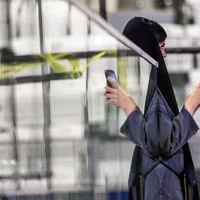
Defiance of compulsory veiling is now widespread in Iran, the Associated Press reported, after a government-approved visit in November found women and girls appearing in public without headscarves in one of the most visible social shifts since Mahsa Amini’s death in 2022.
The outlet’s journalists observed women and girls moving openly through public spaces without headscarves, a practice once met with immediate censure under years of tight enforcement. Along northern Tehran’s Vali-e Asr Street, uncovered hair was common among women of all ages.
“When I moved to Iran in 1999, letting a single strand of hair show would immediately prompt someone to tell me to tuck it back under my headscarf out of fear of the morality police taking me away,” Holly Dagres, a senior fellow at the Washington Institute for Near East Policy, told AP. “To see where Iran is today feels unimaginable: Women and girls openly defying mandatory hijab.”
“Authorities are overwhelmed by the sheer numbers across the country and worry that if they crack down – at a delicate time marked by power blackouts, water shortages, and a rotten economy – they could spur Iranians to return to the streets,” Dagres added.
Scenes around Tajrish Square, north of Tehran, according to the report, showed schoolgirls shedding their headscarves immediately after class and women shopping uncovered at the bazaar as police officers stood by.
“All of my life I had to wear hijab… at school, at university, everywhere in public,” an Iranian woman who recently emigrated to Canada told AP. “I always tried to follow the rules but it made me feel a lack of confidence… because I wore the hijab and I didn’t believe in that.”
Dissatisfaction acknowledged at the top
Iran’s rulers have long relied on strict hijab enforcement by police and Basij forces, with only limited periods of relaxed oversight. The current hesitation comes amid persistent power cuts, water shortages and a weakened economy, all of which risk fueling further anger, the report added.
Supreme Leader Ali Khamenei has so far avoided directly addressing the issue since the year’s war with Israel and US strikes on nuclear sites.
The protests that erupted after the 2022 death of Mahsa Amini, a 22-year-old Kurdish Iranian woman detained by the morality police for allegedly violating Iran’s veiling rules, marked a turning point. Her death sparked some of the largest demonstrations in decades, with women publicly removing or burning their headscarves in defiance of the compulsory veiling law.
AP cited comments by President Masoud Pezeshkian’s social affairs adviser Mohammad-Javad Javadi-Yeganeh, who said unpublished polling by the Iranian Students Polling Agency shows widespread public discontent. The findings align with low turnout in last year’s presidential vote and continuing frustration over inflation, currency volatility and unemployment.
“We are answerable since we cannot provide services to people,” Pezeshkian said recently.
Elias Hazrati, head of the Pezeshkian administration’s information council, confirmed earlier this week that Khamenei had sent directives on hijab enforcement to the government, describing opponents of mandatory hijab as “a small number of people” engaged in “social disorder.” Days earlier, Pezeshkian told the Supreme Council of the Cultural Revolution that state bodies “must adhere to national laws and norms” on hijab.
Judiciary chief Gholamhossein Mohseni-Ejei also instructed prosecutors to act against what he called “organized, foreign-linked” groups involved in “social disorder.”
“Sometimes that fear is with me,” the woman in Canada said. “Sometimes when I’m behind the wheel, I try to find my headscarf on my head. That fear is still with me.”
Iranian authorities said they seized two vessels carrying 80,000 liters of smuggled fuel near the island of Kish in the Persian Gulf on Saturday.
Ali Salemizadeh, the prosecutor of Kish, said the boats were stopped under a judicial order as part of operations by a naval task force formed to combat fuel smuggling. He said the alleged smugglers had modified the structure of the boats and installed extra tanks on deck to move the fuel out of the country.
No details were given about the ownership, registration, or crew of the vessels, or about where they were headed.
Salemizadeh said authorities would continue to act firmly against fuel trafficking networks, which officials in Tehran say cause heavy losses to the state due to large price gaps with neighboring countries. Fuel smuggling is common in southern Iran, where heavily subsidized prices make it profitable to resell fuel abroad.
The announcement came amid a series of maritime enforcement operations by Iran in recent months. Earlier this month, Iran’s Revolutionary Guards said they had seized a Marshall Islands–flagged tanker off the coast of Makran, confirming reports from maritime security firms that the ship had been diverted toward Iranian waters after being approached by small boats in the Gulf of Oman.
Iran says such seizures are carried out under judicial orders to prevent illegal fuel or cargo transfers. But Western officials and shipping sources say the country has often used maritime enforcement as leverage in regional and sanctions-related disputes.
Iran’s coast and the Strait of Hormuz are key routes for global oil shipments, and Tehran has increased patrols there as part of what it calls efforts to safeguard national interests and counter smuggling.