Lawmakers accuse Iran’s judiciary of inaction on hijab enforcement
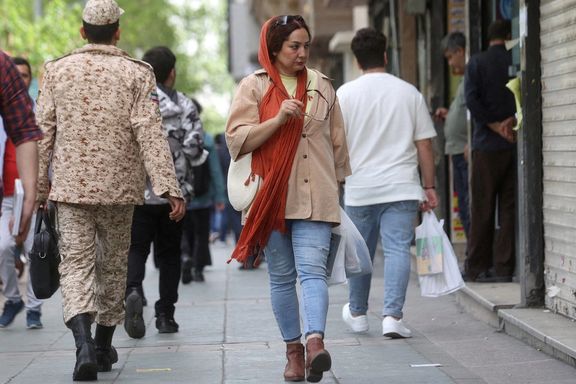
An Iranian woman walks in a street in Tehran, Iran
More than 150 Iranian lawmakers have accused the judiciary of failing to act against growing public defiance of the hijab, saying inaction has fueled what they called lawlessness in society, state media reported on Tuesday.
In a letter addressed to Judiciary Chief Gholamhossein Mohseni Ejei, 155 members of parliament said the judiciary had become passive in applying regulations on Islamic dress and public behavior.
They urged the courts to “restore governance” by ensuring that all state bodies enforce existing rules while the government’s postponed hijab law remains under review.
“The judiciary cannot remain passive toward failures by executive bodies,” the lawmakers wrote, accusing some judges and officials of “negligence” that had allowed “moral decline” and “social abnormalities” to spread.
The lawmakers urged action on the Chastity and Hijab law—formally called the Law on Protection of the Family Through Promotion of Chastity and Hijab—which was approved by parliament but has yet to be sent to the government for implementation.
Parliament Speaker Mohammad Bagher Ghalibaf has faced mounting criticism from hardline lawmakers who accuse him of withholding the legislation.
Tehran MP Kamran Ghazanfari on Tuesday said Ghalibaf had refused to finalize the law since September last year, calling the delay a violation of his legal duty.
“This means obstructing the implementation of a Quranic and divine command,” he told parliament, accusing the speaker of “ignoring repeated calls” from clerics and legislators and allowing “immodesty and corruption” to spread.
Government signals caution
Also on Tuesday, government spokeswoman Fatemeh Mohajerani said ministries have submitted periodic reports on the status of hijab enforcement to President Masoud Pezeshkian and Supreme Leader Ali Khamenei.
“The hijab report has been delivered on time to the president and the Supreme Leader, and action will be taken to curb organized movements,” she said, adding that each ministry provides updates according to its responsibilities within specific time frames.
•
•
Supreme leader’s directive
Tensions rose further last week when a leaked audio file suggested Supreme Leader Ali Khamenei had issued a written order to step up enforcement of Islamic dress codes after reviewing an intelligence ministry report warning of “erosion of discipline.”
Officials later confirmed the directive but denied any dispute within the cabinet. Conservative outlets described it as an “explicit call for decisive action” against violations of the hijab law.
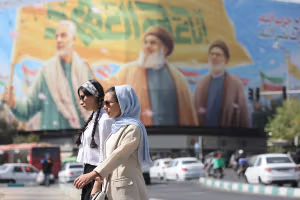
Despite growing pressure, many women and girls continue to appear unveiled in public. The Associated Press reported last week that uncovered women were seen walking freely in Tehran’s markets, metro stations and schools, often without interference from police.
Analysts say authorities are wary of large-scale crackdowns that could reignite unrest. “The scale of disobedience is unprecedented,” said Iran analyst Holly Dagres. “Another coercive campaign could spark protests they cannot contain.”
An Iranian court said it has ordered the United States government to pay more than $22 billion in damages for what it described as support for protesters during the 2022 Woman, Life, Freedom movement, state media reported on Tuesday.
The verdict, announced by Tehran’s civil court, was described by state media as stemming from a lawsuit filed by 607 people said to be families of those killed or injured during the unrest that followed the death of Mahsa Amini in police custody.
The court accused Washington of providing “financial and moral backing” to what Iranian officials call “rioters.”
Iran’s judiciary said the US actions violated the country’s sovereignty and international law. The ruling cited several Iranian laws addressing what Tehran terms “terrorist or subversive acts” by the United States.
According to the court, the damages include $5.8 billion in material losses, $11.6 billion for moral damages, and billions more in punitive payments, totaling more than $22 billion.
The judgment is largely symbolic since Iranian court rulings against the United States are not enforceable abroad. Similar verdicts in past years have served as political statements amid strained relations between Tehran and Washington.
'Woman, Life, Freedom'
The Woman, Life, Freedom movement began after 22-year-old Mahsa Amini died in the custody of Iran’s morality police in September 2022. Her death sparked months of nationwide protests demanding greater freedoms and an end to compulsory hijab laws.
Rights groups say hundreds were killed and thousands detained in the crackdown that followed. Iranian authorities have blamed the United States and Israel for inciting the unrest—allegations Washington denies.
A UN fact-finding mission later concluded that Iran’s security forces committed crimes against humanity during the protests.
The mission said it found evidence that state agents were responsible for the “physical violence” that led to Amini’s death and the killing of at least 551 protesters, including 49 women and 68 children. It also documented cases of rape and other sexual violence against women and girls in custody.
Senior clerics have since framed women who refuse to wear the headscarf as acting under foreign influence. In a recent sermon, Tehran’s Friday prayer leader Ahmad Khatami said defiance of the hijab amounted to collaboration with Israel and the United States.
Despite such rhetoric, many women continue to appear unveiled in public spaces, and enforcement of dress codes has weakened.
The US State Department’s Persian-language account on X criticized Iranian authorities over the detention of guests at a private birthday gathering in Tehran and the in-absentia sentencing of award-winning filmmaker Jafar Panahi.
Iranian media last week reported police raided a film star’s home in Tehran, detaining more than 20 people and seizing homemade alcohol – contraband under Iranian law – with several attendees later freed on undertakings or bail.
“In today’s Iran, no one outside the ruling inner circle is safe from state intrusion—even as officials enjoy lavish parties of their own, laying bare the hypocrisy behind what they call upholding values... While officials claim to defend Islamic values, their real objective is absolute control over society,” read the post.
Authorities frequently announce closures and arrests tied to alcohol, mixed-gender events or dress-code enforcement as part of broader morality crackdowns, according to state-aligned and independent outlets.
Panahi – one of Iran’s most acclaimed directors and a recent Palme d’Or winner at Cannes – has faced recurring curbs on his work and movement over the past decade.
Alcohol has been banned in Iran since 1979, with violations punishable by fines, lashings or prison, and tougher penalties for production and distribution.
Publicized raids on cafés and private venues have increased in recent years, while rights groups and local officials periodically report poisonings from unregulated liquor in the underground market.
Iranian officials say strict enforcement upholds Islamic norms and deters smuggling; critics argue decades of prohibition have pushed consumption into riskier, unregulated channels.
Tehran may be poised to carry out a politically explosive crackdown on Islamic veiling after Supreme Leader Ali Khamenei issued a directive to step up enforcement according to a leaked directive.
An audio file surfaced online in which senior cleric Hossein Rafiei asserted that Khamenei had instructed the government to step up enforcement of the Islamic dress code on Iranian women.
Official scrutiny of women's dress had eased in the year's since the death of a young woman, Mahsa Amini, sparked nationwide protests in 2022 which were violently suppressed.
The laxness had appeared to reach new levels following a 12-day war with Israel and the United States in June, as authorities appeared keen not to stoke public anger.
Rafiei said Khamenei issued the written order after reviewing an intelligence ministry report completed three months after the conflict. The precise timing was not clear.
Several cabinet members, he alleged, had initially objected but President Masoud Pezeshkian “insisted on abiding by the order.”
One of the ministers, the head of the Government Information Counci Elias Hazrati later confirmed the directive but denied any cabinet dispute.
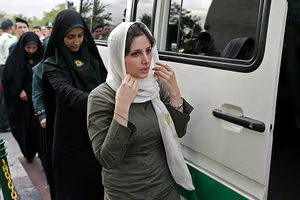
The president and ministers, he said, oppose “coercive methods such as the morality patrols” that have often “worsened the situation.”
Hardline mobilization
Hardline factions seized on the revelation as a mandate to intensify pressure on women.
They quickly organized a social campaign for a November 28 march, coinciding with the traditional death anniversary of Fatima, the Prophet Mohammed’s daughter.
“The Leader’s remarks on the report … have shaken officials,” lawmaker Ghasem Ravanbakhsh said at an event in Tehran on Friday.
“(Khamenei) emphasized in his message that supervisory bodies are obliged to identify and take action against organizers and agents responsible for the problems that have arisen regarding hijab and chastity.”
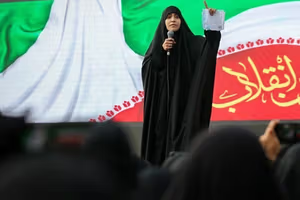
Poster for Friday's hijab march
‘Government’s obligation’
The conservative daily Khorasan, aligned with Speaker Mohammad-Bagher Ghalibaf, bashed Hazrati for implying that Iran’s leadership was divided on the issue.
Khamenei’s directive, the editorial asserted, was an “explicit directive” for decisive action against those who disrupt public and social order, invoking a criminal offense under Iranian law.
The paper warned that “the slightest misunderstanding … or conflation of ‘enforcement’ with ‘tension’ could once again pave the way for a repeat of bitter past experiences.”
Khamenei’s reserved position
Khamenei had refrained from explicitly addressing the hijab issue in public for a year, but on November 3 urged women to “remind” those around them of its religious significance.
His last major intervention before that was in April 2023, when he accused foreign intelligence services of encouraging hijab defiance and called such acts “religiously and politically haram (forbidden).”
It remains unclear when Khamenei reviewed the intelligence report or issued his directive, but the leak reframes several recent official comments.
On November 18, during a Cultural Revolution Council meeting, Pezeshkian said adherence to hijab norms “should begin from within government bodies,” not through coercion or confrontation.
On August 30, he had warned that strict enforcement could “create conflict in society” and spark tensions the government may be unable to contain.
‘Enemy tools’
A string of recent cultural events in Tehran has drawn backlash after videos showed participants ignoring hijab rules.
Tehran Design Week, held at the University of Tehran’s Fine Arts campus, was shut down earlier this month after a Basij student protest accused the venue of becoming a site for “inappropriate entertainment.” The Basij is a domestic enforcement militia.
Since August, at least 20 cafes, restaurants and wedding halls have been closed nationwide for alleged violations ranging from “serving alcohol” to “nudity” and “mixed-gender dancing,” according to the reformist daily Ham Mihan.
Recent reports also indicate expanding non-coercive enforcement tools, including digital and administrative controls such as disabling SIM cards of violators and heightened scrutiny of celebrities and influencers who openly reject the hijab.
Chief Justice Gholamhossein Mohseni-Ejei has described the undermining of the veil as among the “enemy’s tools” and warned that event organizers—as well as authorities issuing permits—could be prosecuted as accomplices if violations occur under their watch.
Iranian Foreign Minister Abbas Araghchi said a 12-day war with Israel in June allowed Tehran to close many security gaps, calling it a miscalculation by the Jewish state that would end with the same result if repeated.
“The recent war enabled us to close many of our security gaps. The war gave us valuable experience because it revealed our weaknesses and we eliminated them,” Araghchi cited in an interview with Omani broadcaster Moosa Al-Farei, published on Monday.
Araghchi said the surprise military campaign by Israel in June, did not achieve the objectives and was a miscalculation.
“They (Israel) imagined that if this war began, the Iranian nation would take to the streets and protest against the government and the system. But what happened was exactly the opposite: the nation came out into the streets to support the government and the country,” Araghchi said.
Israel attacks killed over 20 senior commanders, including Mohammad Bagheri, Chief of Staff of Iran's Armed Forces; Hossein Salami, Islamic Revolutionary Guards Corps (IRGC) Commander-in-chief; and Gholamali Rashid, Head of Khatam al-Anbiya Central Headquarters.
The attacks on June 21 also struck the IRGC’s external arm, killing Mohammad Saeed Izadi, who oversaw Palestinian operations, and Mohammadreza Nasirbaghban, the Quds Force’s deputy for intelligence.
“They thought that if our military commanders were assassinated in the first hours of the war, our armed forces would collapse. On the contrary, replacement commanders were immediately appointed, and the armed forces fought with even higher morale,” Araghchi said.
“This war that the Zionist regime started was based on miscalculation and misunderstanding. As I said, repeating this mistake will bring nothing but a similar defeat,” he added.
The United States held five rounds of negotiations with Tehran over its disputed nuclear program earlier this year, for which President Donald Trump set a 60-day ultimatum.
When no agreement was reached by the 61st day Israel launched a surprise military offensive on June 13, followed by US strikes on June 22 targeting key nuclear facilities in Isfahan, Natanz and Fordow.
Israel’s Iron Beam high-power laser interception system will enter initial operational service with the Israel Defense Forces by 30 December, officials announced on Monday.
Brigadier General Daniel Gold, head of the Defense Ministry’s Research and Development Directorate, confirmed the handover date at the International Defense Tech Summit in Tel Aviv.
“With development complete and a comprehensive testing program that has validated the system’s capabilities, we are prepared to deliver initial operational capability to the IDF on 30 December 2025,” Gold said. “The Iron Beam laser system is expected to fundamentally change the rules of engagement on the battlefield.”
‘Shoot down with light’
Yuval Steinitz, chairman of Rafael Advanced Defense Systems and former Israeli finance minister, described Iron Beam as a “laser revolution.”
“For the first time in human history, we are able to shoot down missiles, rockets, even artillery shells, mortar shells, cruise missiles, and airplanes, not with projectiles but with light,” Steinitz cited by the Misgav Mideast Horizons Podcast.
Steinitz said that Lite Beam, a smaller version, already intercepted around 50 Hezbollah drones in October 2024.
"Each Iron Beam interception costs about $3 - compared with $50,000 for an Iron Dome missile and $5,000–$10,000 for enemy rockets - and operates at the speed of light, enabling immediate interception over launch areas and reducing shelter alerts," Jewish Insider cited Steinitz as saying.
“Combined with Iron Dome and David’s Sling, the system will push interception rates close to 100 percent against threats from Gaza and Lebanon,” Steinitz said, adding that lasers will not fully replace kinetic interceptors in the near term due to weather and saturation issues.
Israel currently operates a multi-layered missile defense network comprising Iron Dome, David’s Sling, Arrow 2, Arrow 3 and the forthcoming Arrow 4.
The Iron Dome is a short-range system that intercepts rockets and artillery shells with a range of 4-70 km (2-43 miles). It uses radar to detect and track threats, and its interceptors destroy them mid-air.
Arrow 3 and Arrow 4 are long-range ballistic missile defense systems. Arrow 2 intercepts missiles in the upper atmosphere, while Arrow 3 targets them in space, making it effective against threats such as Iran’s ballistic missiles.
David’s Sling is a medium-range defense, intercepts tactical ballistic missiles, cruise missiles, and drones (40-300 km, 24-186 miles range).
Steinitz said Rafael likely might develop longer-range laser systems to counter missiles fired by Iran and Yemen’s Houthis in recent years.
Despite high rate of interception rate, some Iranian missiles penetrated Israel's multi-layered defense systems during a12-Day war in June.