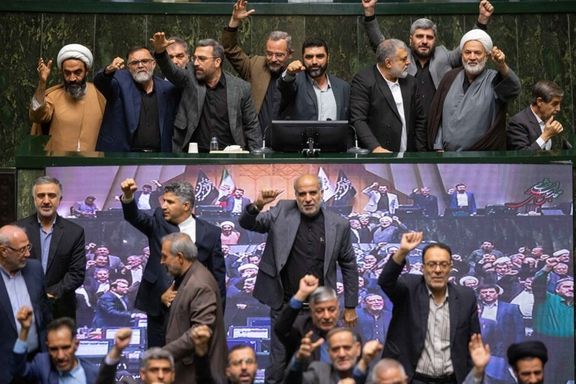
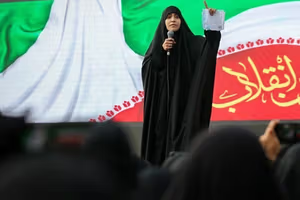
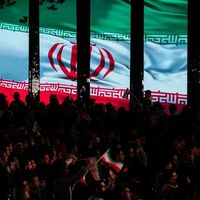
MPs chant in support of the Islamic Republic and against the United States in a session coinciding with the anniversary of the seizure of the US embassy in Tehran in 1979, November 2025
Iran’s fractious parliament is the crosshairs of increasingly strident criticism as factional infighting has precluded any concerted response to a deepening economic and ecological crisis.
Tehran media marked Parliament Day on Monday not with praise but with pointed attacks on lawmakers and the institution itself.
The centrist Ham Mihan called the Majles an example of “institutional backwardness,” arguing that the body has undergone “too many negative changes” compared even to the first post-revolutionary parliament.
Moderate outlet Khabar Online highlighted what it described as lawmakers’ exclusive perks, even as they fail to advance legislation that addresses worsening economic hardship as the rial plumbed new lows against the dollar this week.
The institution that Iran’s first Supreme Leader Ruhollah Khomeini, once branded “above all else” has seen its role steadily diminished—at times bypassed altogether, such as when Supreme Leader Ali Khamenei tasked the heads of the three branches with drafting the annual budget.
‘Indifferent to public’
Ham Mihan noted that today’s Majles bears little resemblance to the institution defined in the Constitution, accusing lawmakers of corruption and poor judgment for pursuing restrictions on personal freedoms rather than alleviating public distress.
Former lawmaker Mahmoud Abbas Zadeh Meshkini told Khabar Online that MPs enjoy government-funded vehicles and special traffic lanes in Tehran, while many or their relatives sit on the boards of major companies.
He accused lawmakers of ignoring the plight of ordinary Iranians and argued that the Majles is no longer capable of overseeing government performance.
Another former lawmaker, Moineddin Saeedi, said legislators have grown indifferent to public concerns, consumed instead by factional disputes and personal gain.
Addressing the broader infighting, Saeedi said: “The people do not care about these matters and find the constant fight between reformists and conservatives laughable.”
Factional interests
The parliament has been the central platform for attacking Iran’s moderates in the past year, with the administration of Masoud Pezeshkian getting the most heat.
Lawmakers—led by Speaker Mohammad Bagher Ghalibaf, who lost the 2024 presidential race to Pezeshkian—have repeatedly summoned ministers, launched probes and used floor debates to chip away at the government’s credibility.
Last week, the establishment daily, Ettela’at, criticized MPs for spending more time attacking the administration and prominent moderates—former Foreign Minister Javad Zarif and former President Hassan Rouhani—than on substantive legislation.
Even the conservative Jomhouri Eslami weighed in against the legislature on Monday, blaming Iran’s Guardian Council for what it described as a biased vetting process that undermines genuine representation.
Many sitting MPs won their seats with under 5 percent of eligible votes in low-turnout elections in March and May 2024.
Iran’s online media regulator has suspended the platform streaming a hit reality show after a segment showing contestants pelting targets resembling ancient Persian emblems sparked a public backlash, the latest move in a push to rally support via once-taboo nationalism.
The Organization for Regulating Audio-Visual Media in Cyberspace (known as SATRA) said the platform carrying Bazmandeh (Survivor or The Last One) was stopped for posting a video deemed to include “insults to national and patriotic symbols,” and for lacking required licenses, according to statements carried by state media.
SATRA officials added that the show and its distributor had not obtained valid production or release permits.
Coverage of the story across Iranian media described the act as disrespect toward symbols tied to Iran’s pre-Islamic heritage.
Cultural scholars quoted by the official ISNA news agency called the sequence “symbolic violence,” urging tighter editorial standards around heritage imagery and pointing out that entertainment formats typically use neutral targets rather than identity-laden icons.
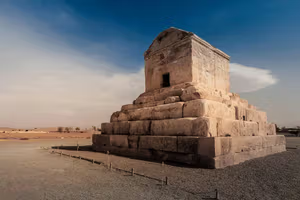
The debate drew thousands of online comments and highlighted heightened sensitivities around Achaemenid-era motifs such as Persepolis reliefs.
An ISNA article said the show’s producers lacked a current SATRA license and that the platform was taken offline pending legal follow-up. SATRA did not say whether Bazmandeh would be allowed to resume or face additional penalties.
Separate coverage by Rouydad24 detailed the symbols shown and amplified criticism from social media users who argued that converting the Homa and Derafsh Kaviani into “smash targets” trivialized collective identity.
Some posts also faulted presenters Siamak Ansari and Mehran Ghafourian; the report paraphrased producers as saying their intent was to showcase national identity, a rationale that critics rejected.
Siamak Ansari (left) and Mehran Ghafourian (2nd left) behind the scenes of the show
In recent days some outlets framed the controversy as a test of media ethics and licensing oversight in Iran’s streaming sector.
Alireza Hasanzadeh, anthropologist and associate professor at Iran’s Research Institute of Cultural Heritage and Tourism, told ISNA, “Professional broadcasters follow a clear code of ethics: identity symbols must not be subjected to symbolic violence, insult or defacement... Attacking identity, cultural and national symbols is effectively an attack on the identity of a people and a land.”
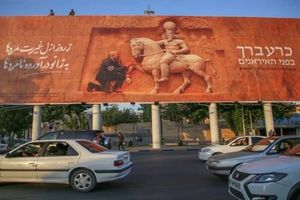
Iranian officials have increasingly highlighted pre-Islamic history and iconic figures – once marginalized in official narratives – to promote unity and reclaim legitimacy after the June war with Israel and deepening domestic discontent.
For decades, authorities suppressed many expressions linked to Iran’s ancient heritage, viewing them as rivals to the Islamic Republic’s ideological identity.
Now, however, the same symbols are being invoked to police behavior, discipline artists, and regulate digital platforms, even as critics argue the sudden embrace of nationalism is a performative response to a legitimacy crisis rather than a genuine cultural reorientation.
The move against the reality show comes weeks after Iranian authorities handed a six-month prison sentence to comedian Zeinab Mousavi for a joke about Ferdowsi, the 10th-century poet behind Iran’s national epic, the Shahnameh.
Mousavi, known for her satirical online persona “Empress Kuzcooo,” was convicted over a comedy segment reciting verses from the Shahnameh with irreverent commentary.
The court ordered her to prepare a supervised thesis on Ferdowsi’s role in Iran’s national identity and to conduct at least 120 hours of storytelling sessions for children using Shahnameh material.
The Shahnameh (Book of Kings) by Ferdowsi tells mainly the mythical and to some extent the historical past of the Persian Empire from the creation of the world until the Arab invasion of Persia in the seventh century, which turned the country into a Muslim state.
Clips from the Bazmaneh reality competition showed contestants hurling objects at a wall of puzzle tiles decorated with stylized versions of well-known motifs from ancient Iran.
Viewers and local outlets said the designs evoked three icons: the Homa (a mythic bird of fortune), the Derafsh Kaviani (the epic banner of revolt), and a griffin (shir-dal) like those carved at Persepolis.
The imagery was illustrative – patterns inspired by antiquity rather than replicas of any single artifact – but it touched a nerve because these motifs sit at the heart of Iran’s cultural memory.
The Homa – often conflated in everyday speech with the Simurgh – is a legendary bird in Persian lore said to bestow luck or even kingship when its shadow falls on someone.
As a benevolent emblem, it appears in poetry, miniature painting, carpets, and public art, making it a shorthand for good fortune and legitimacy.
The Derafsh Kaviani is the banner raised by Kaveh the Blacksmith in Ferdowsi’s Shahnameh against the tyrant Zahhak. Over centuries it has become a literary symbol of justice, resistance, and popular sovereignty – less a military standard than a moral one.
That association is why many viewers read the scene as an affront to a core tale of Iranian defiance.
The griffin (shir-dal) – a composite lion-eagle – repeats across Achaemenid art, including architectural elements and reliefs at Persepolis.
In plain terms, it works as a guardian motif: the lion for strength, the eagle for vigilance and vision. To many Iranians, it signals royal authority and protective power, so depicting it as a target struck some as trivializing a protective emblem woven into the country’s ancient visual language.
More than 150 Iranian lawmakers have accused the judiciary of failing to act against growing public defiance of the hijab, saying inaction has fueled what they called lawlessness in society, state media reported on Tuesday.
In a letter addressed to Judiciary Chief Gholamhossein Mohseni Ejei, 155 members of parliament said the judiciary had become passive in applying regulations on Islamic dress and public behavior.
They urged the courts to “restore governance” by ensuring that all state bodies enforce existing rules while the government’s postponed hijab law remains under review.
“The judiciary cannot remain passive toward failures by executive bodies,” the lawmakers wrote, accusing some judges and officials of “negligence” that had allowed “moral decline” and “social abnormalities” to spread.
The lawmakers urged action on the Chastity and Hijab law—formally called the Law on Protection of the Family Through Promotion of Chastity and Hijab—which was approved by parliament but has yet to be sent to the government for implementation.
Parliament Speaker Mohammad Bagher Ghalibaf has faced mounting criticism from hardline lawmakers who accuse him of withholding the legislation.
Tehran MP Kamran Ghazanfari on Tuesday said Ghalibaf had refused to finalize the law since September last year, calling the delay a violation of his legal duty.
“This means obstructing the implementation of a Quranic and divine command,” he told parliament, accusing the speaker of “ignoring repeated calls” from clerics and legislators and allowing “immodesty and corruption” to spread.
Government signals caution
Also on Tuesday, government spokeswoman Fatemeh Mohajerani said ministries have submitted periodic reports on the status of hijab enforcement to President Masoud Pezeshkian and Supreme Leader Ali Khamenei.
“The hijab report has been delivered on time to the president and the Supreme Leader, and action will be taken to curb organized movements,” she said, adding that each ministry provides updates according to its responsibilities within specific time frames.
Tensions rose further last week when a leaked audio file suggested Supreme Leader Ali Khamenei had issued a written order to step up enforcement of Islamic dress codes after reviewing an intelligence ministry report warning of “erosion of discipline.”
Officials later confirmed the directive but denied any dispute within the cabinet. Conservative outlets described it as an “explicit call for decisive action” against violations of the hijab law.
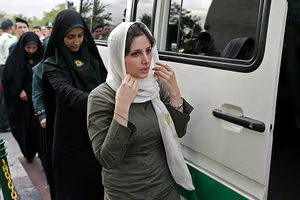
Despite growing pressure, many women and girls continue to appear unveiled in public. The Associated Press reported last week that uncovered women were seen walking freely in Tehran’s markets, metro stations and schools, often without interference from police.
Analysts say authorities are wary of large-scale crackdowns that could reignite unrest. “The scale of disobedience is unprecedented,” said Iran analyst Holly Dagres. “Another coercive campaign could spark protests they cannot contain.”
Tehran may be poised to carry out a politically explosive crackdown on Islamic veiling after Supreme Leader Ali Khamenei issued a directive to step up enforcement according to a leaked directive.
An audio file surfaced online in which senior cleric Hossein Rafiei asserted that Khamenei had instructed the government to step up enforcement of the Islamic dress code on Iranian women.
Official scrutiny of women's dress had eased in the year's since the death of a young woman, Mahsa Amini, sparked nationwide protests in 2022 which were violently suppressed.
The laxness had appeared to reach new levels following a 12-day war with Israel and the United States in June, as authorities appeared keen not to stoke public anger.
Rafiei said Khamenei issued the written order after reviewing an intelligence ministry report completed three months after the conflict. The precise timing was not clear.
Several cabinet members, he alleged, had initially objected but President Masoud Pezeshkian “insisted on abiding by the order.”
One of the ministers, the head of the Government Information Counci Elias Hazrati later confirmed the directive but denied any cabinet dispute.
The president and ministers, he said, oppose “coercive methods such as the morality patrols” that have often “worsened the situation.”
Hardline mobilization
Hardline factions seized on the revelation as a mandate to intensify pressure on women.
They quickly organized a social campaign for a November 28 march, coinciding with the traditional death anniversary of Fatima, the Prophet Mohammed’s daughter.
“The Leader’s remarks on the report … have shaken officials,” lawmaker Ghasem Ravanbakhsh said at an event in Tehran on Friday.
“(Khamenei) emphasized in his message that supervisory bodies are obliged to identify and take action against organizers and agents responsible for the problems that have arisen regarding hijab and chastity.”
Poster for Friday's hijab march
‘Government’s obligation’
The conservative daily Khorasan, aligned with Speaker Mohammad-Bagher Ghalibaf, bashed Hazrati for implying that Iran’s leadership was divided on the issue.
Khamenei’s directive, the editorial asserted, was an “explicit directive” for decisive action against those who disrupt public and social order, invoking a criminal offense under Iranian law.
The paper warned that “the slightest misunderstanding … or conflation of ‘enforcement’ with ‘tension’ could once again pave the way for a repeat of bitter past experiences.”
Khamenei’s reserved position
Khamenei had refrained from explicitly addressing the hijab issue in public for a year, but on November 3 urged women to “remind” those around them of its religious significance.
His last major intervention before that was in April 2023, when he accused foreign intelligence services of encouraging hijab defiance and called such acts “religiously and politically haram (forbidden).”
It remains unclear when Khamenei reviewed the intelligence report or issued his directive, but the leak reframes several recent official comments.
On November 18, during a Cultural Revolution Council meeting, Pezeshkian said adherence to hijab norms “should begin from within government bodies,” not through coercion or confrontation.
On August 30, he had warned that strict enforcement could “create conflict in society” and spark tensions the government may be unable to contain.
‘Enemy tools’
A string of recent cultural events in Tehran has drawn backlash after videos showed participants ignoring hijab rules.
Tehran Design Week, held at the University of Tehran’s Fine Arts campus, was shut down earlier this month after a Basij student protest accused the venue of becoming a site for “inappropriate entertainment.” The Basij is a domestic enforcement militia.
Since August, at least 20 cafes, restaurants and wedding halls have been closed nationwide for alleged violations ranging from “serving alcohol” to “nudity” and “mixed-gender dancing,” according to the reformist daily Ham Mihan.
Recent reports also indicate expanding non-coercive enforcement tools, including digital and administrative controls such as disabling SIM cards of violators and heightened scrutiny of celebrities and influencers who openly reject the hijab.
Chief Justice Gholamhossein Mohseni-Ejei has described the undermining of the veil as among the “enemy’s tools” and warned that event organizers—as well as authorities issuing permits—could be prosecuted as accomplices if violations occur under their watch.
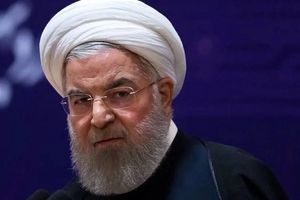
Former Iranian president Hassan Rouhani said Iran remains in a fragile security limbo months after the 12-day war in June, warning that the country cannot restore stability or economic confidence without rebuilding deterrence and addressing persistent public insecurity.
Rouhani told former ministers and senior officials that Iran had entered a prolonged period of strategic uncertainty following the 12-day confrontation, arguing that the absence of clear deterrence has left the country exposed to regional pressures and foreign threats.
Rouhani said that “after five months have passed since the 12-day war, we are still in a situation of neither war nor peace, and there is no sense of security in the country. Whether actual security exists or not is another matter.”
He added that “when people do not feel secure, talking about economic growth, lowering inflation or attracting investment has little meaning. This feeling of insecurity – psychological insecurity, social insecurity, intellectual insecurity, mental insecurity – exists.”
He said national security in any country rests on deterrence and on stopping adversaries from initiating conflict.
Rouhani tied Iran’s own shortfalls in deterrence to regional instability, saying neighboring states still rely heavily on the United States and Israel for security. He said Iraq, Syria, Lebanon and Jordan do not control their airspace or security environments in ways that would limit hostile activity, and that this has reduced Iran’s strategic buffer zone.
“Unfortunately, we do not currently have broad regional deterrence. Our neighboring countries – Iraq, Syria, Lebanon and Jordan – are, unfortunately, operating in environments largely shaped by the United States and Israel.”
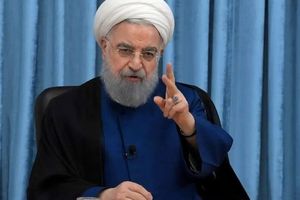
Former Iranian president Hassan Rouhani during a meeting with former ministers and senior officials in Tehran on November 26, 2025
He warned that this landscape has created what he described as unusually free access for Israel, saying “Israel moves up to our borders in undefended and open airspace” and “the sky up to Iran has become completely safe for the enemy.”
Rouhani said national cohesion and accurate assessments of Iran’s own capabilities remain essential for maintaining deterrence. He cautioned against overestimating Iran’s military or technological strengths and said misjudging adversaries could lead to strategic miscalculations.
Rouhani said renewed diplomacy remains essential even if political negotiations are difficult. “In politics, a complete dead end is very rare. We must make extra efforts to resolve issues.”
He said avoiding a renewed conflict ultimately rests with Iran, adding “whether war happens again is in our hands.”
The decision by Iran’s state broadcaster to produce a film about a female presenter whose image went viral when Israeli missiles hit its headquarters has sparked a wave of criticism and accusations of political propaganda.
The planned feature, Re-Birth, casts actress Atefeh Habibi as Sahar Emami—presented by state media as a symbol of defiance during Iran’s 12-day war with Israel in June.
Emami was on air when IRIB’s Glass Building in Tehran was bombed on June 16. She rushed out of the studio but returned to present from another set within minutes.
“(She) bravely continued her program after the attack,” the film’s promoter asserted Thursday, branding her a hero.
But many remain unconvinced, accusing the broadcaster of glossing over “real heroes” and victims of the war.
'Propaganda’
“Making a film about Sahar Emami is not a cultural choice. It is a propaganda project,” a commentary in the moderate outlet Rouydad24 argued.
“What is it that makes her stand out from all others?” it asked, offering a characteristically factional answer: “It is easy propaganda that conveys their ideological perspective,” referring to IRIB’s leadership and its ties to the ultrahardline Paydari Front.
The commentary also criticised the lack of scrutiny of the broadcaster itself.
In the days after the attack, state TV filled its programming with tributes to Emami, sponsored billboards across Tehran, and received praise from senior officials—including Supreme Leader Ali Khamenei—for her “bravery.”
Critics said the network was exploiting the incident to deflect attention from its declining viewership.
Dwindling popularity
IRIB holds a legal monopoly over broadcasting in Iran; private television networks are not permitted.
In recent years, however, a proliferation of digital platforms—often backed by different branches of the state or powerful institutions—has begun to challenge that dominance in entertainment.
In news, IRIB’s audience has been shrinking for years, with Persian-language broadcasters in exile becoming the main source of information for most people inside Iran.
An official survey in late 2024 put IRIB’s popularity at just 12.5%, while the head of its internal polling unit claimed it was closer to 72%, adding the figure “could have been higher if, like elsewhere in the world, Generation Z had not turned away from national television.”
A survey by the Netherlands-based polling institute GAMAAN also found that only a small minority of Iranians tuned in to IRIB during and after the June war with Israel.
The broadcaster’s chief has since requested additional funding to rebuild the damaged headquarters, saying rubble will be cleared by January with reconstruction to follow.
Critics note that IRIB’s current budget of 350 trillion rials (more than $300 million) exceeds that of ten ministries combined.
The broadcaster also receives ad-hoc allocations in US dollars from the national reserve alongside lucrative advertising revenue.