Germany says Iran withholds visas for diplomats, crippling embassy operations
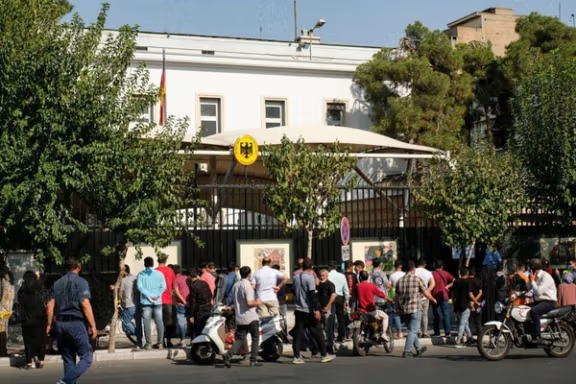
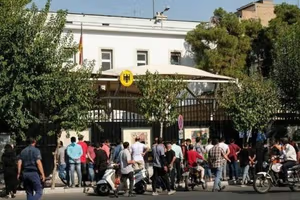
File photo shows visa applicants gathering outside the German embassy in Tehran.
Germany’s embassy in Tehran is operating with sharply reduced visa capacity and expects constraints to persist, the Foreign Office said, citing Iran’s restrictive accreditation of diplomatic staff and significant technical hurdles at post.
The ministry told Iran International that since the June 2025 Iran-Israel hostilities, the embassy has worked in a limited capacity, and both the embassy and its visa section “will, for the foreseeable future, have only a fraction of the personnel” they had before the temporary shutdown.
The reduction of operations “is due in particular to Iran’s restrictive policy on accrediting diplomatic personnel,” read the statement.
Despite the squeeze, Berlin said processing has been gradually expanded in recent weeks by outsourcing application intake to an external service provider and moving case handling to the Federal Office for Foreign Affairs.
“These steps have created additional processing capacity,” the ministry said, adding that the changes especially benefit student-visa applicants and Iranian physicians applying for visas to complete professional recognition procedures in Germany.
Appointment rules have also been adjusted “to ensure the largest possible number of applications can be accepted via the external provider,” the Foreign Office said.
It cautioned, however, that “despite these tangible improvements,” limitations at the Tehran post will remain for the time being.
Germany’s visa services in Tehran have operated at reduced capacity since the June 2025 Iran–Israel conflict, when the embassy temporarily closed, canceled appointments, and said new dates would be issued automatically as capacity allows.
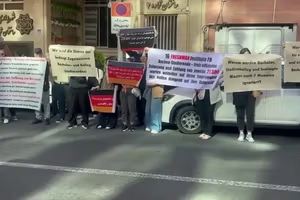
Applicants report prolonged delays and uncertainty, staging weekly protests outside the embassy and TLScontact.
Iranian paper Shargh estimated more than 6,000 delayed cases, including about 4,000 family-reunification files, while IRNA previously put 3,000–4,000 Iranian passports as stuck in foreign missions after wartime closures.
Dozens of foreign tankers suspected of transporting sanctioned crude for Iran and Russia sailed under the Cook Islands flag in 2024-2025, according to an AFP analysis of US and UK sanctions data.
AFP reported that at least 34 ships linked to suspected sanctions evasion were Cook Islands–flagged over the period, including 20 cited on US sanctions lists and a further 14 on a British blacklist.
The flag is administered by Maritime Cook Islands, a private operator that runs the registry for the self-governing Pacific territory.
The analysis said shipowners could obtain Cook Islands papers without visiting the country, using a small beachside office – located next to a pizza shop – as their point of contact. The office serves as the headquarters for what AFP described as one of the world’s fastest-growing shipping registries.
New Zealand, which has a free-association relationship with the Cook Islands and retains responsibilities that include foreign affairs, said the findings show a policy divergence with the microstate and that Wellington has repeatedly raised concerns with its government.
“New Zealand continues to hold serious concerns about how the Cook Islands has been managing its shipping registry, which it has repeatedly expressed to the Cook Islands government over many years... This is a completely unacceptable and untenable foreign policy divergence,” said a spokesman for Foreign Minister Winston Peters.
Maritime Cook Islands said it does not harbor sanctioned vessels and that any ships accused of sanctions-busting are promptly deleted from the registry, adding that it conducts due diligence checks before registration.
Western sanctions aim to limit oil revenue for Tehran and Moscow.
Analysts say a “shadow fleet” uses reflagging, opaque ownership and ship-to-ship transfers to move cargoes outside mainstream maritime services – a practice that places added scrutiny on flag registries as enforcement widens to entities connected to suspect voyages.
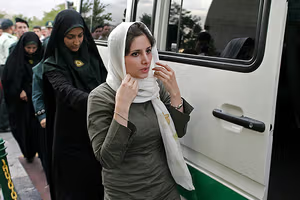
More than 150 Iranian lawmakers have accused the judiciary of failing to act against growing public defiance of the hijab, saying inaction has fueled what they called lawlessness in society, state media reported on Tuesday.
In a letter addressed to Judiciary Chief Gholamhossein Mohseni Ejei, 155 members of parliament said the judiciary had become passive in applying regulations on Islamic dress and public behavior.
They urged the courts to “restore governance” by ensuring that all state bodies enforce existing rules while the government’s postponed hijab law remains under review.
“The judiciary cannot remain passive toward failures by executive bodies,” the lawmakers wrote, accusing some judges and officials of “negligence” that had allowed “moral decline” and “social abnormalities” to spread.
The lawmakers urged action on the Chastity and Hijab law—formally called the Law on Protection of the Family Through Promotion of Chastity and Hijab—which was approved by parliament but has yet to be sent to the government for implementation.
Parliament Speaker Mohammad Bagher Ghalibaf has faced mounting criticism from hardline lawmakers who accuse him of withholding the legislation.
Tehran MP Kamran Ghazanfari on Tuesday said Ghalibaf had refused to finalize the law since September last year, calling the delay a violation of his legal duty.
“This means obstructing the implementation of a Quranic and divine command,” he told parliament, accusing the speaker of “ignoring repeated calls” from clerics and legislators and allowing “immodesty and corruption” to spread.
Government signals caution
Also on Tuesday, government spokeswoman Fatemeh Mohajerani said ministries have submitted periodic reports on the status of hijab enforcement to President Masoud Pezeshkian and Supreme Leader Ali Khamenei.
“The hijab report has been delivered on time to the president and the Supreme Leader, and action will be taken to curb organized movements,” she said, adding that each ministry provides updates according to its responsibilities within specific time frames.
Tensions rose further last week when a leaked audio file suggested Supreme Leader Ali Khamenei had issued a written order to step up enforcement of Islamic dress codes after reviewing an intelligence ministry report warning of “erosion of discipline.”
Officials later confirmed the directive but denied any dispute within the cabinet. Conservative outlets described it as an “explicit call for decisive action” against violations of the hijab law.
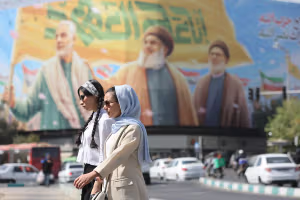
Despite growing pressure, many women and girls continue to appear unveiled in public. The Associated Press reported last week that uncovered women were seen walking freely in Tehran’s markets, metro stations and schools, often without interference from police.
Analysts say authorities are wary of large-scale crackdowns that could reignite unrest. “The scale of disobedience is unprecedented,” said Iran analyst Holly Dagres. “Another coercive campaign could spark protests they cannot contain.”
An Iranian court said it has ordered the United States government to pay more than $22 billion in damages for what it described as support for protesters during the 2022 Woman, Life, Freedom movement, state media reported on Tuesday.
The verdict, announced by Tehran’s civil court, was described by state media as stemming from a lawsuit filed by 607 people said to be families of those killed or injured during the unrest that followed the death of Mahsa Amini in police custody.
The court accused Washington of providing “financial and moral backing” to what Iranian officials call “rioters.”
Iran’s judiciary said the US actions violated the country’s sovereignty and international law. The ruling cited several Iranian laws addressing what Tehran terms “terrorist or subversive acts” by the United States.
According to the court, the damages include $5.8 billion in material losses, $11.6 billion for moral damages, and billions more in punitive payments, totaling more than $22 billion.
The judgment is largely symbolic since Iranian court rulings against the United States are not enforceable abroad. Similar verdicts in past years have served as political statements amid strained relations between Tehran and Washington.
'Woman, Life, Freedom'
The Woman, Life, Freedom movement began after 22-year-old Mahsa Amini died in the custody of Iran’s morality police in September 2022. Her death sparked months of nationwide protests demanding greater freedoms and an end to compulsory hijab laws.
Rights groups say hundreds were killed and thousands detained in the crackdown that followed. Iranian authorities have blamed the United States and Israel for inciting the unrest—allegations Washington denies.
A UN fact-finding mission later concluded that Iran’s security forces committed crimes against humanity during the protests.
The mission said it found evidence that state agents were responsible for the “physical violence” that led to Amini’s death and the killing of at least 551 protesters, including 49 women and 68 children. It also documented cases of rape and other sexual violence against women and girls in custody.
Senior clerics have since framed women who refuse to wear the headscarf as acting under foreign influence. In a recent sermon, Tehran’s Friday prayer leader Ahmad Khatami said defiance of the hijab amounted to collaboration with Israel and the United States.
Despite such rhetoric, many women continue to appear unveiled in public spaces, and enforcement of dress codes has weakened.
South Korea’s foreign ministry said on Monday that South Korean nationals have been arrested in Iran on suspicion of smuggling, adding its embassy is in contact with Iranian authorities and providing consular assistance.
The ministry declined to confirm how many were detained or give details of their occupations or the alleged offenses.
South Korean media outlet Yonhap, citing diplomatic sources, reported that two South Koreans and an Iranian national were taken into custody around November 20 in Iran’s southwest on smuggling charges.
One of the South Koreans was described as an employee of a Korean public institution and the other a Korean resident in Iran, Yonhap said.
It added that Seoul officials have been liaising with Iran since the incident and are offering consular support.
The South Korean ministry said it could not disclose further information while the case remains under investigation by Iranian authorities.
Iran’s foreign ministry accused the United States of endangering international peace at its weekly briefing on Monday, responding to Washington’s latest warnings against Venezuela and remarks by President Donald Trump about closing the country’s airspace.
“The United States has turned into the biggest threat to international peace and security with the conduct it has displayed in recent years,” Foreign ministry spokesman Esmail Baghaei said.
He said Washington had used coercive pressure across the Western Hemisphere – citing Venezuela, Cuba, Nicaragua, Brazil and Mexico – and called the proposed airspace closure “an unprecedented act that violates international law, especially aviation safety norms.”
Baghaei said such measures should be scrutinized by the UN Security Council as “clear violations of the UN Charter’s prohibition on the use or threat of force.”
His comments followed confirmation by Trump on Sunday that he had spoken by phone with Venezuelan President Nicolás Maduro.
Washington’s confrontation with Caracas has escalated as US officials accuse figures around Maduro of involvement in narcotics trafficking through the so-called Cartel de los Soles.
The US has increased maritime and air patrols in the Caribbean and carried out interdictions of suspected smuggling vessels. Caracas has denounced the operations as unlawful aggression.
Over the weekend, Trump said Venezuela’s surrounding airspace should be considered “closed in its entirety,” a declaration that heightened uncertainty in Caracas as pressure on Maduro intensifies.
Asked whether the comment implied imminent military action, Trump said, “Don’t read anything into it.”
Saudi deputy foreign minister visits Tehran
Baghaei also addressed the visit of Saudi Arabia’s deputy foreign minister, saying the trip extended a two-year process of rebuilding bilateral relations.
He said discussions covered both Iran-Saudi ties and shared regional concerns, including the situations in Lebanon and Syria.
Iran's Foreign Ministry Spokesman Esmail Baghaei
“This is a process both countries are determined to continue in order to strengthen trust and understanding among regional states,” Baghaei said.
Contacts with Europe
Foreign Minister Abbas Araghchi’s recent visit to France, Baghaei said, was held at the invitation of his French counterpart to discuss bilateral and international matters.
The nuclear file, he said, was among the topics raised but not the sole focus.
A separate call between Araghchi and EU foreign policy chief Kaja Kallas had been arranged earlier, he added, though the Paris trip was also discussed during their conversation.
Iran’s nuclear case remains at an impasse as tensions persist between Iran and Western powers led by the United States over uranium enrichment and international inspections. The International Atomic Energy Agency continues to warn about reduced monitoring access.
Iran’s engagement with European officials, he said, remained “ongoing and structured,” with diplomacy aimed at clarifying positions rather than opening new channels.