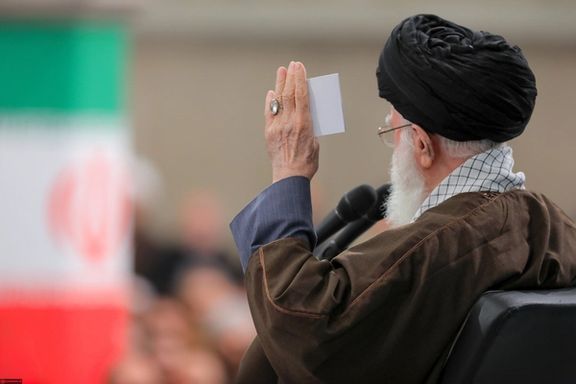
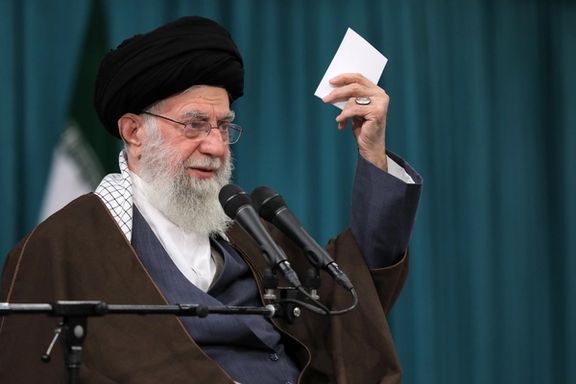
Iran’s ruler Ali Khamenei during a meeting with first-time voters in Tehran (February 28, 2024)
Iran's Supreme Leader struck an unusually mild tone in a speech aimed at convincing those hesitant to participate in the March 1 elections that voting is crucial for the country's security.
“We should view the elections from the national interests’ perspective, not from factional perspectives. If the election [turnout] is weak, the loss will affect everyone,” Ali Khamenei told the youth voting for the first time and the families of martyrs Wednesday while stressing that he was not “accusing anyone”. Amid expectations of very low turnout, Khamenei appeared to be pleading with people to go to the polls on Friday.
Khamenei underscored the link between national power and security, cautioning that perceived weakness could embolden adversaries to threaten Iran's security. “If the enemy feels that you are not capable, [and] the Iranian nation has no power, they will threaten your security in every way,” he said. He urged individuals expressing reluctance to vote, and those dissuading others from doing so, to contemplate the implications, and “think some more.”.
“National security is all that matters. If there is no security, nothing else will remain. The enemy is opposed to our national power. Therefore, they oppose everything that is a manifestation of national power, including elections."
The extensive disqualification of candidates by the Khamenei-appointed Guardian Council, coupled with dire economic conditions and regime crackdowns on protesters, have led many ordinary Iranians to question the legitimacy of elections they perceive as orchestrated and unlikely to bring meaningful change.
Iran’s ruler Ali Khamenei during a meeting with first-time voters in Tehran (February 28, 2024)
Former President Hassan Rouhani, despite being disqualified from running in the Assembly of Experts elections, is urging voters to participate, framing it as a form of protest against the current circumstances and a call for reform to improve livelihoods, increase freedom, and enhance national prosperity.
Rouhani stressed the importance of voting for candidates who openly oppose the status quo and advocate for substantive change, acknowledging that the path to desired reforms may be long and challenging.
However, it is not clear which candidates the former president was referring to as almost all critical voices have been barred from competing as candidates.
While Rouhani criticized authorities for failing to foster conditions conducive to broad participation and fair competition, he also cautioned against neglecting the security and integrity of the electoral process.
In the past few days, state-affiliated media affiliated and the spokesman of the Guardian Council, Hadi Tahan-Nazif, have claimed that new polls conducted indicate interest in the elections and prospects for a higher turnout have increased. However, some former officials claim that turnout can be as low as 10 percent, while hardliners, who have already secured their victory claim that up to 70 percent may turn out to vote.
ISPA says 38.5 percent of the 5121 respondents to its recent poll conducted on February 26 and 27 said they would “definitely” take part in the elections against 32.6 percent who were determined not to vote, claiming that the percentage of those who have decided to vote has gone up by 11.1 percent from 27.9 percent in its earlier poll in late October.
Iran's quest for an agreement with Afghanistan to share water from the Hirmand River has been hit by a new setback despite the Islamic Republic’s desperate need for the resource.
The river, known as Helmand in Afghanistan, plays a pivotal role as a critical source for agriculture and drinking water.
Now a further delay has pushed back the schedule for any agreement to share the waters from the river which originates in the Afghan mountains.
Reports from Iranian media in November highlighted the Kabul government's failure to allocate any portion of the Hirmand River's water to Iran, sparking concerns about water scarcity in the region.
Ali-Mohammad Tahmasbi, advisor to the head of Iran's Department of Environment, revealed a verbal commitment from Abdul Ghani Baradar, the Acting Deputy Prime Minister for Economic Affairs of Afghanistan during discussions in Tehran, suggesting that Iran would receive water from the Hirmand once conditions permit.
Hassan Kazemi Qomi, President Ebrahim Raisi's special envoy for Afghan affairs, expressed cautious optimism, aiming for water entry from the Hirmand into Iran by October 2024.
However, he acknowledged the uncertainty surrounding the new timeline, citing unsuccessful negotiations between Iran and Afghanistan over the Hirmand water dispute.
Despite Iranian claims of an agreement with the Taliban to allocate 820 million cubic meters of water annually, no formal confirmation has been provided, and no water has been directed towards Iran over the past two years.
Two days before Iran's parliamentary elections, there is a stark contrast between politicians' and the government's predictions regarding voter turnout.
This occurs amid the Iranian government's apparent directive to the media not to report on any polling data regarding the expected turnout for the upcoming elections.
Former reformist lawmaker Mahmoud Sadeghi disclosed on Monday that recent polls conducted in Tehran suggest a turnout ranging between 6 to 9 percent. Additionally, he indicated that turnout in provincial capitals and other major Iranian cities might hover around 20 percent, with an overall national turnout forecast of 24 to 27 percent. These predictions were last updated in August during the initial round of candidate registration.
Alternate forecasts peg Tehran's turnout at approximately 15 percent, in contrast to a nationwide forecast of around 30 percent. The 2020 parliamentary elections turnout was also below 50 percent, but closer to 40 percent, which at the time was considered an all-time low.
In previous election cycles, polling agencies routinely published monthly turnout forecasts based on opinion polls. However, this year, the government imposed a ban on publishing such results starting in October. Despite objections from many journalists and politicians, the government's decision remained in effect.
An event to encourage people to vote in the parliamentary election, Tehran, February 27, 2024
In another development, the Iranian state TV reported the details of Fars News Agency's poll, adding that 41.5 percent of those responding to the agency's poll said they will definitely take part in the elections, 29.5 percent said they were still undecided by Tuesday morning, and 29 percent said they will definitely not take part in the elections. However, the TV report quoted Fars as saying that 16.3 percent of those who were still undecided had indicated the likelihood of going to the polls on Friday.
In the meantime, clerics in Iran have been going out of their way to encourage Iranians to vote. An un-named seminarian was quoted as saying that not voting will delay the re-emergence of the Shiites' hidden Imam from the occult. Another cleric, Mohammad Bagher Mohammadi Laini, who is Supreme Leader Ali Khamenei's representative in Mazandaran Province said, "If you ask the martyrs, they would suggest that you should definitely take part in the elections."
At the same time, doubts and opposition are also on the rise as the election date nears. Election banners were reportedly set ablaze in Sistan-Baluchestan Province. In Tehran, while a moderate conservative candidate was defending the Iranian Constitutional Law, a student lashed out at him, telling him it was irrelevant to talk about the law at a university where students have been beaten and arrested for defending the same law.
The governor general of Tehran told reporters that during his meetings with the people many asked why they should go to the polls as elections are not likely to change anything in Iran.
Meanwhile, in an article in the centrist daily Ham Mihan, social media researcher Mohammad Raahbari wrote that some popular politicians avoid encouraging others to take part in the elections as they are aware that doing so will endanger their social credibility among some of the elite and their friends at a time when the government's legitimacy is in decline. Rahbari argued that when the people cannot trust the organizers of the election and the candidates alike, naturally, calling on others to take part in the election will harm one's reputation.
A gang of hackers linked to Iran is targeting aerospace and defense firms in Israel and the UAE, according to Google’s security arm.
The group named UNC 1549 – also known as Smoke Sandstorm and Tortoiseshell – have been using a variety of tactics to breach corporate security.
These include ‘spear fishing’ – sending links that appear to relate to a targeted individual’s interests – and ‘watering hole attacks’, in which hackers infect websites they believe someone to visit regularly.
UNC 1549 is known to be linked to the Iranian Revolutionary Guard Corps (IGRC).
According to Jonathan Leathery, principal analyst for Mandiant, the group's tactics make detection challenging: "The most notable part is how illusive this threat can be to discover and track — they clearly have access to significant resources and are selective in their targeting."
Microsoft has previously observed a shift in tactics by Iranian threat groups, particularly targeting IT services firms as a means to infiltrate government networks. Smoke Sandstorm, for instance, compromised a Bahrain-based IT integrator in 2021, indicating a broader strategic agenda.
Initially concentrating on IT service providers, UNC1549 has broadened its scope to encompass aerospace and defense sectors. Its operations transcend the Middle East, suggesting potential links to cyberattacks in Albania, India, and Turkey.
"The intelligence collected on these entities is of relevance to strategic Iranian interests, and may be leveraged for espionage as well as kinetic operations," Google wrote. "This is further supported by the potential ties between UNC1549 and the Iranian IRGC."
Companies are urged to enhance cybersecurity measures, including blocking untrusted links and providing comprehensive awareness training to employees.
The crew of an unflagged ship allegedly smuggling missile parts to Houthi rebels were talking by satellite phone to Revolutionary Guard members, according to an FBI affidavit.
The revelation comes as the captain and three other men from the dhow are due to appear in a federal court in Virginia on Tuesday.
The vessel was intercepted by US naval forces in January in the Arabian Sea amid continuing Houthi attacks on shipping in the region. Two American Navy SEALs drowned in the operation.
The captain, Pakistani national Muhammad Pahlawan, refused to slow the ship when the US Navy began its boarding attempt.
Instead he “shouted for the crew to burn the boat before the Navy could board it,” according to court documents filed in the federal court in Richmond.
Upon searching the vessel, US forces seized Iranian-made weaponry consistent with Houthi attacks, marking the first confiscation of such weapons since the current series of attacks on shipping began in November.
“Initial analysis indicates these same weapons have been employed by the Houthis to threaten and attack innocent mariners,” an FBI agent wrote, quoting Central Command.
Crew members were in communication with a member of Iran’s Revolutionary Guard via satellite phone, according to the FBI.
Pahlawan and the other crew membesr, Mohammad Mazhar, Ghufran Ullah, and Izhar Muhammad, face charges of attempting to smuggle missile components and providing false information. They are accused of misleading authorities about the ship's origin and cargo.
Their legal representatives have yet to comment on the case. A further 10 crew members are being detained as material witnesses under federal law.
Iran sponsors the Houthis, providing funding, weapons, and even direct support on the ground. While Iranian officials claim the Houthis operate independently, recent events suggest Iran can influence their actions, as seen in Syria and Iraq.
One of the oddities in Iranian elections over the years is the dwindling presence of clerics in parliament, while the regime shifts towards greater ideological rigidity and less tolerance.
When questioned about the absence of clerics on his candidate list for Tehran, Ali Motahhari, a former deputy speaker of the Majles (parliament) and current candidate, responded candidly. He explained, "There was no deliberate exclusion of clerics from our list. However, among the nominated clerics, we couldn't find anyone who would add more depth or interest to our lineup."
Motahhari, the son of Morteza Motahhari, a prominent ideologue of the Islamic Republic and a cleric himself, has long been known as a staunch defender of the regime's policies, including obligatory hijab. However, he has recognized a notable shift in the preferences of voters participating in the sham elections, indicating a declining demand for clerical representation in parliament.
The diminishing support for clerics as parliamentary representatives has been a persistent trend in the Islamic Republic over the years. In the early years of the regime, during the first Majles (1980-1984), over 50 percent of the seats were occupied by clerics.
However, this proportion dwindled significantly to just 5.5% (16 out of 290 seats) in the tenth Majles (2016-2020). This decline has been evident irrespective of whether the majority voted for the reformist or principlist camp or how the Guardian Council handled candidate disqualifications.
(Sources: Tabnak and Tasnim)
Why is this phenomenon occurring in a regime where clerics hold significant sway in politics and are pervasive throughout society? Several social trends may shed light on the declining representation of clerics in parliament.
Firstly, government incompetence plays a significant role. Across various facets of life, public services and infrastructure development have faltered and deteriorated. According to a confidential survey conducted by the Ministry of Islamic Guidance and Culture in 2023, a staggering 73 percent of Iranians, in a confidential surveyconducted by the government, expressed the view that clerics should retreat to their mosques and relinquish their involvement in government affairs.
This marked a notable increase from about 31 percent recorded in 2015. This shift in public sentiment has been a gradual trend within Iranian society spanning over four decades.
Another trend is the de-Islamization of society. Despite the regime's efforts to enforce Islamic practices through incentives and penalties, society has moved in the opposite direction.
The Mahsa Movement of 2022 can be seen as a national and social response to the stringent imposition of Sharia law in the public sphere. Iranians are holding Shia clerics accountable for these stringent regulations and oppressions, and as a result, they advocate for reduced clerical influence in the government.
Two clerics preparing a turban for a ceremony where new mullahs are officially given the right to put on a turban, Gorgan, Golestan province, northern Iran (February 2024)
The third trend involves the gradual erosion of public trust in Shia clerics. Prior to the 1979 Revolution, clerics enjoyed some of the highest levels of public trust compared to other societal groups. However, according to the same confidential survey, approximately 56 percent of respondents now express little to no trust in the clergy, while about 25 percent still hold some level of trust in them. Another 18 percent fall somewhere in the middle of the spectrum. Even in Qom, the primary base of Shia clerics, 51 percent of individuals exhibit limited or very limited trust in this group. This marks a significant decline.
The fourth trend pertains to an increasing disillusionment with government propaganda permeating every aspect of life. The religious establishment spearheads the government's indoctrination efforts across various sectors including sports, arts, public education, universities, media, and governance. This propaganda campaign, funded by billions of dollars annually allocated to the Shia clergy, has left the public weary of being force-fed such rhetoric.
In response, wherever possible, the public vehemently expresses its disdain for this manipulation. During election periods, this sentiment manifests in two distinct ways: a significant portion of the population opts to abstain from voting altogether, while those who do participate tend to favor non-clerical candidates. Unfortunately, the regime has yet to heed this message.
However, the composition of the Majles, whether predominantly clerical or not, holds little sway over its function within the system governed by the Guardian Jurist. With its oversight powers effectively neutered, the Majles has been relegated to a ceremonial role, while authority lies with 15 councils such as the Expediency Council and Supreme Council of Cultural Revolution, which regularly legislate.
Consequently, the dwindling presence of clerics in the Majles has negligible impact on the performance of this beleaguered institution. What truly matters is the shift in public sentiment: not only are people disillusioned with clerics' ability to improve their lives, but they also harbor a conviction that their influence may exacerbate their circumstances.