Canada To Extend Temporary Residence For Iranians
The Canadian government has announced it will continue to facilitate the process for Iranian temporary residents in Canada looking to extend their stay for another year.
The Canadian government has announced it will continue to facilitate the process for Iranian temporary residents in Canada looking to extend their stay for another year.
Measures which were adopted in February 2023 and came into effect from March 1, 2024, will continue to be implemented until February 28, 2025, the Canadian government said.
According to the portal of the Canadian government, applicants for extension of current temporary resident status in Canada or change of status will continue to be exempted from application or biometric fees. Those with Canadian citizenship and permanent residence who live in Iran can continue to apply for some documents including limited validity Canadian passport and citizenship certificate could apply for these documents for free.
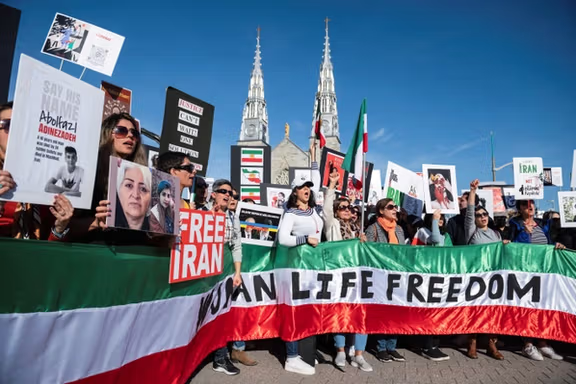
In February 2023, the Canadian government announced the adoption of these measures to support Iranian temporary residents “in light of the gross and systematic human rights violations being committed by the Iranian regime” during the crackdown on Woman, Life, Freedom protestors.
The measures adopted last year were meant to make it easier for these Iranians to extend their temporary status in Canada and to move between temporary streams so they could continue studying, working, or visiting family by applying for a new permit from inside Canada.

Titled "White Torture," the documentary, showcased at an event organized by the Nobel Foundation, illuminated the isolation techniques employed in Iranian prisons to break prisoners and highlights the plight of political detainees enduring prolonged periods of solitary confinement, as recounted by Mohammadi's interviews.
Initially screened online by human rights organizations, including Amnesty International, in November 2021, the documentary has since been presented in numerous cities worldwide.
Mohammadi, who herself endured four periods of solitary confinement, denounces it as a "cruel and inhumane punishment." In her book, "White Torture: Interviews with Iranian Women Prisoners," she vows to tirelessly advocate for its abolition.
The outspoken rights defender who is currently serving a 12-year sentence has also written a book entitled White Torture: Interviews with Iranian Women Prisoners “I will not rest until it is abolished,” she said in her book.

Originally published in London in 2022, Mohammadi's book, a two-volume anthology featuring interviews with fellow inmates, has been translated into English, Swedish, German, and French.
To mark the release of her book White Torture in France, Le Monde sent Mohammadi questions via an underground network of activists. Two weeks later, Mohammadi’s answers to the questions were received.
“I consider the practice of ‘white torture,’ in other words incarceration in solitary confinement by the government, to be unjust and brutal. The solitary confinement cell is the ‘mother’ of all executions in Iran,” she told Le Monde.
“In the course of my work on human rights and against the death penalty, I have learned that many of those executed, were subjected to the physical, mental and psychological torture of incarceration in solitary confinement. They made false confessions which then formed the basis, unlawful, of their death sentence,” The outspoken campaigner against the death penalty added.
The families and lawyers of several of the nine Woman, Life, Freedom protesters executed by the regime since December 2022, have alleged that the victims were subjected to various physical and psychological tortures including solitary confinement to make false confessions against themselves which were then used as proof of their “crimes” and eventual execution.
The torture-induced confessions of protesters including Mohsen Shekari and Majidreza Rahnavard were shown on state television even before their trials were held.
White torture, in the sense used by Mohammadi, is different from white room torture, another form of psychological torture technique aimed at complete sensory deprivation and isolation that can lead to hallucinations and psychosis.
In the latter form, which has also been employed in the prisons of the Islamic Republic, the prisoner is held for long stretches of time in a soundproofed cell with white walls and no windows, given white clothing and food such as rice, and is often deprived from sleep. Amir-Abbas Fakhravar, then a freelance journalist, was subjected to this kind of torture at Evin Prison for eight months in 2004.


Iran’s regime launched a high-intensity campaign to stop boycotts of the parliament and Assembly of Experts elections.
Tehran-born Ben Sabti, an expert on Iranian Jews from the Israeli National Security and Strategy Institute, told Iran International that there are reports from Tehran that the government "is pressuring the Jews to vote.” He said the regime is exploiting the Jews to promote the elections and “make propaganda for the election.”
Initial reports from Iran, as well as opinion surveys conducted from abroad, speak of the lowest ever turnout on Friday, as Iranians have become more disillusioned with the Islamic Republic and its highly controlled and manipulated elections.
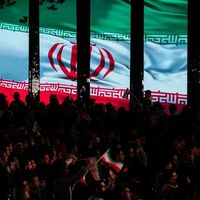
Sabti said he does not recall such an organized campaign in the past. The Iranian Jewish community were provided buses to take members to a stadium to promote the election and had a “festival of joy” about the election. The Jewish community also notified its members that there are "five or six synagogues” where Jews can vote, according to Sabti.
Dr. Homayoun Sameyah, the Chair of the Tehran Jewish Association, who is also a member of Iran’s regime-controlled parliament, launched an attack against Israel.

According to a report in the Islamic Republic News Agency, Sameyah discussed the “crimes of the Zionist regime” on Tuesday. He noted that Ayatollah Ruhollah Khomeini separated Zionism from the Jewish religion. Sameyeh said that Zionism is not only limited to Judaism, it also exists in Christianity (Christian Zionism). He also propagated a wild anti-Israel conspiracy theory advocated by Iran's rulers: "The ISIS terrorist group was created by Zionists.”
According to the authoritative website Jewish Virtual Library (JVL), “The Jews live under the status of dhimmi, with the restrictions imposed on religious minorities. Jewish leaders fear government reprisals if they draw attention to the official mistreatment of their community. Iran’s official government-controlled media often issue anti-Semitic propaganda.”
The JVL noted that “A prime example is the government’s publishing of the Protocols of the Elders of Zion, a notorious Czarist forgery, in 1994 and 1999. Jews also suffer varying degrees of officially sanctioned discrimination, particularly in the areas of employment, education, and public accommodations.”
Prior to the 1979 Islamic Revolution, there were as many as 100,000 Jews living in Iran. The majority fled Iran after Islamists seized power.
Iran’s regime has intensified its crackdown over the last five months on the country’s tiny Jewish community after the Hamas attack on Israel.
Iran International reported in October on rising pressure on Tehran’s Jewish community, which serves as an umbrella organization for the estimated 9,000 Jews, to bash Israel for its war against the Iran-backed Hamas terrorist organization. Hamas invaded Israel on October 7 and slaughtered 1,200 people. The Sunni terrorist movement Hamas kidnapped over 240 people.
In September, Iran International reported in connection with the one-year anniversary of Mahsa Amini’s murder, which coincided with the Jewish New Year on September 16, that Jewish community leaders warned Jews to stay off the streets during anticipated protests.
A Telegram posting from Iran’s Jewish community wrote “All worshipers are strongly requested to refrain from stopping and gathering in the streets for any reason during Rosh Hashanah and after performing religious duties in synagogues.”