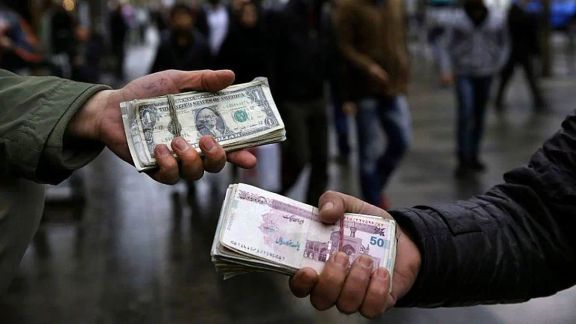
Money changers holding Iranian rial and US dollar banknotes in Tehran's business district
Months away from the looming US presidential elections, the possibility of a return of a Donald Trump administration and the anti-JCPOA lobby in Iran's next parliament is already causing negative shockwaves to Iran's national currency.
In 2018, Trump pulled out of the 2015 nuclear deal – known as the Joint Comprehensive Plan of Actions or JCPOA – and imposed ‘maximum pressure’ sanctions on Tehran, practically reducing Iran’s oil exports to less than 500,000 barrels per day and blocking the revenues in foreign banks.
Afghah noted that a myriad of factors play a role in the devaluation of the rial such as the country's foreign policy and the regional tensions over the war in Gaza. Iran backs several regional militia groups in Lebanon, Iraq and Syria as well as Yemen that have escalated attacks on US and Israeli targets in allegiance with Hamas.
The Iran-backed Islamist group invaded Israel on October 7, killed about 1,200 mostly civilians and took about 240 hostages, igniting the worst Middle East conflict in years. Meanwhile, Iran's Yemeni militia, the Houthis, are now imposing a blockade on trade routes around the Red Sea in support of Hamas in Gaza, causing huge economic implications to global trade.
•
•
Economist Morteza Afghah
According to Afghah, another factor that has been fueling the rise of foreign currency rates against the rial is the high demand for dollars and euros in the last weeks of the Iranian year, which ends on March 20 and ushers the Noruz (Nowruz) in Iran. During the two-week holidays, many Iranians take trips abroad, making the demand for foreign currency far higher than the Iranian authorities can supply.
Afghah made the remarks after the rial hit a low of about 600,000 against the dollar on Sunday. The Central Bank of Iran (CBI) has been injecting foreign currency into the market to curb the devaluation of the rial but after a historic low turnout in Iran’s elections on March 1 and the prospects of Trump winning the office in the US, the CBI’s efforts seem inconsequential.
The analyst says the fall of rial will continue until at least the end of March and the CBI does not have enough foreign currency supply to control the market as the administration has been draining all its strategic reserves, including the National Development Fund, in the past two years to balance its budget deficit.
Former US president Trump swept a trio of states Saturday, inching his way closer to a formal Republican party nomination for president. But the weekend also featured a bright spot for Nikki Haley, who won her first state in the nominating cycle with a victory in Sunday's Washington, DC, primaries. However, even Haley is a tough critic of the Iranian regime and strongly defended Trump’s decision to withdraw from the JCPOA.
For critics outside Iran, the JCPOA symbolizes a policy of appeasement with Tehran’s destabilizing acts across the region and human rights violations at home. Dissidents and critics of the regime in Tehran view the nuclear deal as the West tolerating Iran’s military adventurism and crackdown on dissent as a measure to keep the path of diplomacy open. The majority of the Iranian population and a large number of foreign officials believe that years of punitive measures against Tehran have proved that sanctions and condemnations will not lead to a change in the regime's behavior, only becoming further emboldened in its policy of hostage-taking and accelerating its nuclear program in the face of sanctions.
Ruling hardliners in Iran are growing increasingly apprehensive about the possibility of a Republican victory in US presidential elections, leading to a tougher stance towards Tehran. Trump's withdrawal from the JCPOA shattered the hopes of both Iranian hardliners and moderates, who had envisioned reaping benefits from the nuclear deal with the West in exchange for curbing their nuclear ambitions, while expanding their conventional capabilities and regional influence.
Although the Biden Administration has been too lenient on Iran and often turned a blind eye in the face of mischiefs by the regime, politicians in Tehran still believe that Biden could have done more than giving billions of dollars to Iran in return for releasing US hostages and releasing Iran's frozen assets in South Korea, Iraq and elsewhere.
Making matters worse, the results of Iran’s March 1 elections show that some of Iran's lawmakers known to be staunch critics of the JCPOA have been reelected for the parliament. Morteza Ezzati, an economic analyst, told Rouydad24, “The representatives who will apparently be in the next parliament are known to be anti-JCPOA, which could seriously threaten the public interest and also provoke a reaction from the global community.”
He noted that the history of hardliners at the helm shows that whenever they are the decision makers, they have dragged the economy to the brink of bankruptcy.
In his latest report, the UN Special Rapporteur on Iran highlighted the recent use of international courts in holding Iranian regime authorities accountable for human rights abuses committed.
Lamenting the absence of accountability measures in Iran, Javaid Rehman pointed to recent cases where international law and universal jurisdiction were used to hold individuals and Iran accountable.
For this avenue to be pursued, Iranian officials, whether former or current, would need to be apprehended outside of Iran.
In a landmark case in 2022, former Iranian prison official Hamid Nouri was convicted of war crimes and murder by the Stockholm District Court, leveraging universal jurisdiction.
Nouri was ultimately sentenced to life imprisonment for his involvement in the 1988 prison massacres in Iran, where thousands of political prisoners were executed on the orders of Iran’s former ruler, Ayatollah Ruhollah Khomeini.
The UN official also highlighted a forthcoming case at the International Court of Justice concerning the 2020 shootdown of Ukrainian International Airlines Flight PS752 by the Islamic Revolutionary Guard Corps (IRGC).
A placard is seen during a protest against the Islamic regime of Iran following the death of Mahsa Amini, in Berlin, Germany, December 10, 2022.
Canada, Sweden, Ukraine, and the United Kingdom, whose citizens were among those killed in the flight, are pursuing legal action against Iran for the unlawful downing of the passenger jet by the IRGC.
Initially, the Islamic Republic denied it fired the two missiles, and has yet to be held accountable for the attack that led to the death of all 176 people on board.
Rehman pointed to the absence of an independent judiciary, which has long been politicized, as one of the key causes of continued impunity and lack of accountability in the Islamic Republic.
UN Official expresses alarm over surge in executions
The UN expert’s 42-page report also gave an updated view of the Iranian regime’s gross human rights violations.
Rehman wrote that 2023 saw a spike of death penalty sentences and executions, with at least 834 people hanged – marking a 43% increase compared to the previous year.
Over half of the reported executions were for drug-related charges.
Iran also remains one of the leading executioners of women, with at least 22 women executed last year, with the report noting that many were victims of domestic violence or child marriage.
The Special Rapporteur particularly expressed alarm over the disproportionate number of executions of all kinds of members of minority communities, in particular the Baluchi and Kurdish minorities.
Death sentences handed down after unfair trials, torture and denial of legal representation disproportionately affected “ethnic and religious minorities, particularly Baluchis, in Iran,” the report read.
The latest numbers suggest at least 170 Baluchis and 181 Kurdish prisoners were executed last year.
Over 80 offenses in the Islamic Republic’s criminal justice system that are punishable by the death penalty do not meet the criteria for "most serious crimes." These include ambiguous national security charges and non-violent crimes, which contravene international human rights standards.
The report says at least 39 persons were executed after being convicted of national security charges.
The above-mentioned figures represent official executions and frequently exclude arbitrary killings perpetrated by Iranian authorities, whether in the streets amid protests or within prisons.
The Special Rapporteur called for the Islamic Republic to abolish the death penalty immediately, for all offenses.
While the UN official provided a comprehensive list of recommendations, he acknowledged that none of his previous suggestions to end institutional impunity and ensure accountability for serious human rights violations have been implemented.
In the face of skyrocketing prices for red and white meat, Iranians are increasingly relying on eggs as their primary source of protein.
The cost of household consumption basket has surged to 300 million rials (approximately $500 =) in major cities, making it difficult for people to afford meat products.The price of boneless mutton has reached 9,000,000 rials or about $15 per kilogram. With the minimum monthly salary barely exceeding $150 to $200 per month, many Iranian workers find themselves unable to afford any meat at all.
According to a report by the ILNA news agency, the removal of meat from many household tables has led to eggs becoming the sole protein option for families across the country. The shift reflects the reality of economic challenges faced by Iranians, with meat becoming a luxury beyond reach for many.
The elimination of meat from the diets of many households has resulted in eggs becoming the primary source of protein for families throughout the country, with meat being considered an unaffordable luxury.
Adding to the economic strain, Iran's currency, the rial, on Monday hit an all-time low of 606,000 against the US dollar. The depreciation has further exacerbated the affordability crisis for meat products.
Additionally, the decline in the value of the national currency has led to a surge in fish exports, as it has become more profitable for producers. Consequently, domestic availability of fish has dwindled, exacerbating the protein shortage for consumers.
Three days after Iran's elections in which as much as 90 percent of the country boycotted the polls, Supreme Leader Ali Khamenei remains silent, shamed by the country's rejection of the sham elections.
It is the lowest turnout in the regime's history, with voting figures ranging from 10 to 27 percent, reflecting the government's struggle to retain legitimacy in the face of mass discontent.
While Khamenei stays silent, other regime officials attempt to portray the elections in a positive light, with Minister of Interior Ahmad Vahidi labeling them as "magnificent" and boasting of "the highest standards." However, the claims lack substantiation.
Despite efforts to boost participation, including extending voting hours, the government failed to bring people to the polls. The elections also mark the first since the 2022 mass protests sparked by the death of Mahsa Amini, further highlighting underlying tensions within the nation.
Out of the 290 parliamentary races, results show that Iranian hardline politicians maintained dominance, winning 200 out of the 245 decided seats. The remaining 45 seats will proceed to runoff elections due to candidates failing to secure the mandatory 20% of the vote.
Authorities in Iran are evidently manipulating the vote count to secure a predetermined outcome of Friday’s parliamentary elections amidst a notably effective boycott campaign.
Turnout
The Guardian Council’s extensive disqualification of candidates prior to the March 1 parliamentary and Assembly of Experts elections gave rise to huge popular discontent. Authorities resorted to relentless propaganda and various measures to ensure the boycott did not affect the turnout.
In the face of polls conducted by government agencies that predicted a very low turnout, state media and those controlled by hardliners, as well as hardline political parties and groups launched a massive campaign before the elections, to ensure high turnout.
The polls were inexplicably extended by six hours although citizen reports indicated that the polling stations were not busy at all even during the regular voting hours.
Voting regulations including requirement of birth certificates, which was necessary in all previous elections, were abolished and voters were allowed to use one of several other forms of IDs including passports. Ballot boxes were provided in many crowded public venues in addition to polling stations.
These measures, however, backfired and many social media users alleged they were only meant to facilitate fraudulent voting.
Not only anti-regime voters, but also many former regime insiders, including Reformists, abstained from voting.
Iranian Interior Minister Ahmad Vahidi speaks during a press conference after the parliamentary elections in Tehran, Iran, March 4, 2024.
The Phenomenon of Void and Blank Votes
Authorities claim 41 percent of eligible voters participated in the elections. This figure, the lowest in the four-decade history of the Islamic Republic, seems to include the void and blank votes. The total number of votes and blank and void votes has not yet been announced.
Void and blank ballots were abnormally high in nearly every constituency. In some constituencies such as Yazd the number of blank and void ballots is higher than most of the constituency’s top elected representatives.
Blank and void votes are usually cast by those who may have been rounded up and forced to vote against their wish such as government employees, soldiers, and athletes, and could be interpreted as “protest votes”.
According to official figures the number of eligible voters has increased from 57.9 million four years ago to 61.1 million.
A newspaper with a cover picture of Speaker of the Parliament of Iran Mohamed Bagher Ghalibaf, is seen in Tehran, Iran March 3, 2024.
Suspicions of Revolutionary Guards Role in Engineering Results
Given the low turnout, the election headquarters of the interior ministry, has been taking their time, despite claims of employing better technology such as computers, to manipulate the numbers, critics say.
After the closure of the polls, the media affiliated with the Revolutionary Guard, including Fars News Agency, announced what they claimed was the turnout figures before the election authorities had provided any information.
Such moves exacerbated suspicions of involvement of the Revolutionary Guards in election engineering and manipulation of numbers. The interior ministry, the principal election authority, only announced partial turnout figures two days later.
The opaque vote count process, coupled with the slow and irregular announcement of results, bears a striking resemblance to the parliamentary elections of 2004, which reformists alleged were engineered by the Khamenei-appointed Guardian Council.
In the presidential elections of 2009, the interior ministry was accused of joining forces with the Guardian Council to ensure the re-election of Mahmoud Ahmadinejad.
In both cases, the Revolutionary Guards was accused of masterminding the manipulation of the vote.
Dubious Mandate for Those Elected
The very low number of votes cast in nearly every constituency, notwithstanding the doubts about the accuracy of the figures announced officially, casts doubt on the mandate of those who will be representing constituencies in the parliament.
In many constituencies run-off elections are required and many of those who have secured their seats in the parliament in the first round have only managed to get a fraction of the votes of those eligible in their constituencies.
In the capital Tehran, which has 30 seats and over 7.5 million eligible voters, for instance, the front-runner candidate Mahmoud Nabavian is the only one with over 500,000 votes. The other 13 elected candidates in this round have acquired between 316,000 and 487,000 votes and the remaining 16 will be chosen in the run-off.
Nabavian’s 597,000 votes suggest he will be representing less than 8 percent of the eligible voters. In another constituency – Tabriz, Azarshahr and Oskou – the top elected lawmaker’s votes fall below 100,000, making him the representative of less than 10 percent of the eligible voters.
The recent rise in the Hirmand river has sparked renewed tensions as Iran accuses the Taliban of withholding its agreed water allocations.
In spite of both rainfall and flooding, Isa Bozorgzadeh, spokesperson for the Water Industry, told state-owned ILNA on Monday, "The water inflow from Afghanistan to Iran is zero."
Sher Mohammad Abbas Stanikzai, the Taliban's Deputy Minister of Foreign Affairs, claimed Afghan citizens' needs come before international allocations. "Currently, there is only enough water to meet the needs of the Afghan citizens, and it is not sufficient to be released towards Iran."
The river, known as Helmand in Afghanistan, holds significant importance as a primary source for agricultural irrigation and potable water supply.
The statements come as, according to the representative of Sistan and Baluchestan, Afghan authorities divert the water of the Helmand River inside their country through canal construction and dams, preventing it from entering Iran.
In the past two years, Iranian authorities have claimed that the Taliban has agreed to allocate 820 million cubic meters of Iran's water share from the Helmand annually, but neither the Taliban has confirmed such an agreement nor has any water been released towards Iran.