Iran Supplies Russia With Ballistic Missiles, Says UK Defense Secretary
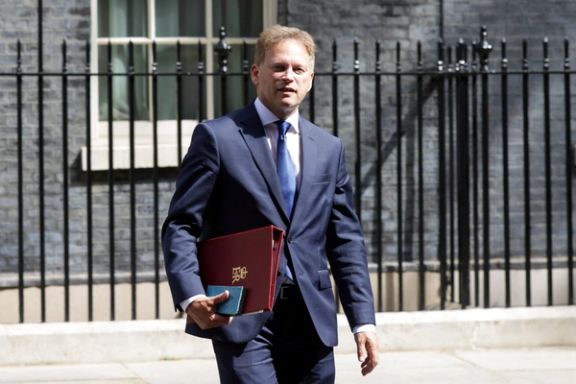
UK Defense Secretary Grant Shapps walking on Downing Street in London, Britain, July 18, 2023.
UK Defense Secretary Grant Shapps has accused Iran of supplying Russia with ballistic missiles for use in Ukraine, claiming the regime is a "bad influence" not only on the Middle East but in Europe too.
While Shapps confirmed the UK's possession of information regarding the alleged provision of surface-to-surface missiles from Iran to Russia, he refrained from delving into specifics, saying only that he "can't go into detail".
In an interview with the House Magazine, the senior minister said, “Whether it's ballistic missiles, or the Shahed drones that they supplied Russia with, we've seen that if there's a struggle in the world, often Iran are egging it on, or helping to supply the food chain in this case"..
The revelation follows a report by Reuters in February, which suggested that the Iranian regime had furnished Russia with a significant quantity of ballistic missiles. The report prompted a reaction from the United States, warning Iran of severe consequences from the international community if the claims were substantiated.
Iran has publicly refuted allegations of supplying missiles to Russia. However, Shapps implied that Britain possesses intelligence supporting the claim.
In October, UN Security Council restrictions on Iran's export of certain missiles, drones, and related technologies expired. Nonetheless, the United States and European Union maintained sanctions on Iran's ballistic missile program, citing worries over the export of weaponry to its proxies in the Middle East and to Russia.
Iranian authorities have demolished more than 30 graves belonging to the Baha'i community at a mass gravesite in Tehran this week as oppression of the minority continues.
The act, which involved the removal of grave markers and the flattening of resting places using bulldozers, was slammed by rights activists, the latest in a series of actions taken against the community which has been systematically targeted since the founding of the Islamic Republic in 1979.
Simin Fahandej, Representative of the Baha'i International Community to the United Nations in Geneva, said, “In the last few months, the deceased loved ones of the Baha’is have been forcibly buried by government agents in the Khavaran mass grave site, further desecrating a burial place sacred to many.
"Now these same new graves have been destroyed. It is clear that this was always their plan. All Iranians are weighed down by unprecedented social and economic challenges, and amid this general suffering, Baha’is have been targeted by intensified and brutal new tactics in the Iranian government’s persecution of its community".
Before the 1979 Islamic Revolution, Tehran's Baha'i community owned two large cemeteries, both of which were confiscated by the Islamic Republic in the 1980s. Thousands of graves were demolished at the Khavaran cemetery, and the Baha'is were given limited access to a smaller property known as Golestan Javid. However, Ministry of Intelligence agents took over Golestan Javid in 2021, making it increasingly difficult for Baha'is to use their own cemetery.
Unofficial estimates suggest that more than 300,000 Baha'i people live in Iran. However, the Constitution officially acknowledges only Islam, Christianity, Judaism, and Zoroastrianism, thereby rendering Baha'is the most significant non-Muslim religious minority in the country.
Following the low-turnout March 1 elections in Iran, newspapers are criticizing the electoral system and the Interior Ministry for their conduct and handling of the election results.
Some newspapers such as Ham Mihan and Sazandegi, along with the pro-reform Arman Melli, delved into significant issues with headlines such as "The Decline of Politics in Iranian Society," "Ethnic Groups Supplanting Political Parties," and "A Silent Protest." Meanwhile, hardline dailies like Kayhan offered congratulations to the government, celebrating "the high voter turnout" without acknowledging the sizeable majority of eligible voters who abstained.
However, Kayhan, linked to Supreme Leader Ali Khamenei’s office, failed to mention that from nearly 62 million eligible voters, some 36 million refused to take part in the elections, even according to the inflated numbers announced by the government.
Ham Mihan pointed out that with this election "political activity in Iran has become banal," as young individuals with little political experience will enter the Iranian parliament next summer. The daily quoted social scientist Kazem Kardavani as saying that "The Iranian society will not be able to solve its problem as long as politics is reduced to a vulgar matter." The daily reiterated that no man in the street can become a political leader overnight.
The paper further observed that the conservative camp, in its pursuit of political purification, has sidelined experienced politicians like Gholam-Ali Haddad Adel. It warned that this trend could extend to other prominent figures, including current Majles Speaker Mohammad Bagher Ghalibaf.
Iranian politician Gholam-Ali Haddad Adel after voting in March 1 elections in Tehran
In an article for Sazandegi, Hossein Marashi of the centrist Executives of Construction Party pointed out the replacement of political parties by ethnic groups in the election, attributing it to government filtering of political parties and the expectation of a Tehran boycott, which shifted political activity to smaller towns with stronger ethnic identities.
Marashi cited Urmia's election outcome, where ethnic Kurds triumphed over ethnic Azaris, as evidence. He issued a stark warning against the ultraconservative Paydari Party, suggesting it could seize control of both the parliament and the country, urging vigilance against its totalitarian tendencies.
Meanwhile, in a stark warning to Supreme Leader Ali Khamenei who has reportedly engineered the elections, Marashi said that the leading ultraconservative Paydari Party is likely to take over not only the parliament, but probably the whole country. Marashi wrote: "After the election, the Islamic Republic should closely watch Paydari and its totalitarian tendencies. The leaders of the regime will have to note that Paydari can turn into a nuisance that can disrupt everything.
Marashi warned that "if Ghalibaf cannot control the parliament, Paydari will take over the helm and control the legislature. In that case the only solution for the regime is to give an opportunity to reformists to face down Paydari." However, the reformists' ability to do so is doubtful.
Arman Melli quoted reformist activist Saeed Shariati as saying that election turnout was terribly low in all the elections since 2020, and that this situation will not change as long as the people's trust in the election system and in the performance of the Majles is not restored. Shariati said that the people do not trust an election whose candidates are nominated by the Guardian Council rather than by people or political parties. On the other hand, the Majles has done nothing to restore people's trust in the legislative system.
The daily reiterated that by not voting, or by casting blank votes, Iranians have silently voiced their dissatisfaction with the country's current situation.
Fariba Balouch, a prominent women's rights activist from Iran’s Baluchestan, was honored with the International Women of Courage Award 2024 at a ceremony held at the White House.
In the event, attended by Jill Biden, the US First Lady, and Antony Blinken, the Secretary of State, former teacher Balouch, now living in the UK, underscored her dedication to representing the courageous women of Baluchistan and Iran, reiterating her mission to shed light on the appalling situation facing women in Iran.
“For these women and so many activists like them around the world, courage is a deliberate and daily choice,” Blinken said during remarks at the ceremony. “Women and girls demonstrate similar bravery in places that are wracked by conflict and insecurity even as they are disproportionately harmed by that violence.”
Earlier on Friday, the State Department spokesperson highlighted Balouch's courage, stating that she "continues to advocate for Iranian women’s rights and to draw attention to the Iranian regime’s gender, ethnicity, and sect-based discrimination."
In a report last year, Human Rights Watch wrote that "Iranian women experience discrimination in law and in practice in ways that deeply impact their lives, particularly with regard to marriage, divorce and custody issues". Since 2022 and the Women, Life, Freedom uprising sparked by the death in morality police custody of Mahsa Amini, arrested for not wearing her hijab properly, women continue to face persecution for non-compliance with Islamic dress codes, leading to arbitrary arrests, exclusion from public places, work and education.
This year's awards were presented to women from various countries including Afghanistan, Bangladesh, Belarus, Bosnia and Herzegovina, Myanmar, Cuba, Ecuador, Gambia, Iran, Japan, Morocco, Nicaragua, and Uganda.
A concert of Iran's Alireza Ghorbani has been cancelled by Iranian officials in Esfahan, citing the presence of female musicians on stage, amid the regime's continued crackdown on women's rights.
"Bringing a female musician, according to the fatwa of the scholars, is not permissible if there is a possibility of corruption," claimed the Headquarters for Enjoining the Good and Forbidding the Evil in a statement.
The cancellation marks the second time Ghorbani's concert has been banned. On Monday evening, despite hundreds of ticket holders gathering at the venue, the event was halted by hardline forces preventing the artists from performing.
Expressing his frustration on Instagram on October 16, Ghorbani highlighted the "Herculean efforts" of his team to organize the concert, only to face permit denial.
The lack of women's rights in Iran has drawn intense scrutiny following the death of Mahsa Amini in September 2022. Amini's death while in morality police custody for a headscarf defiance sparked nationwide protests in Iran, with women and schoolgirls demonstrating unprecedented support for women's rights, posing a significant challenge to the Islamic government.
US-based non-profit advocacy organization United Against Nuclear Iran (UANI) has issued a letter calling for action against Qatar for hosting Iran’s Revolutionary Guards officials at a military exhibition in Doha.
Urging the Biden administration to hold Qatar accountable for violating Washington's sanctions against Tehran, the letter was released ahead ofthe Sixth US-Qatar Strategic Dialogue scheduled to be hosted at the US Department of State on Tuesday.
Former US Ambassador to UN and UANI CEO Mark D. Wallace,stated, "Qatar’s Prime Minister and Minister of Foreign Affairs deserves to walk into the US-Qatar Strategic Dialogue tomorrow and have his government rocked to its core by US officials unwilling to extend a free pass to Doha for its robust ties with both state sponsors of terrorism and US-designated Foreign Terrorist Organizations."
Pointing out that Qatar is hosting leaders of designated entities that facilitate arms deals for adversarial regimes, Wallace emphasized, "It is abhorrent but clarifying that this so-called ally has welcomed the Islamic Revolutionary Guard Corps (IRGC), sanctions-designated Iranian military officials, and Iran’s Ministry of Defense and Armed Forces Logistics (MODAFL), not to mention a Russian warship on an official visit."
UANI called on the US to suspend Qatar's official status as a major non-NATO ally, impose sanctions against the Persian Gulf kingdom, and denounce the Doha International Maritime Defense Exhibition and Conference (DIMDEX) along with its organizers, including the Al Thani royal family. Qatar also hosts offices of Hamas and Taliban officials.
"Qatar is not an ally; it is an enabler of the most bloodthirsty regime on earth," Wallace said.