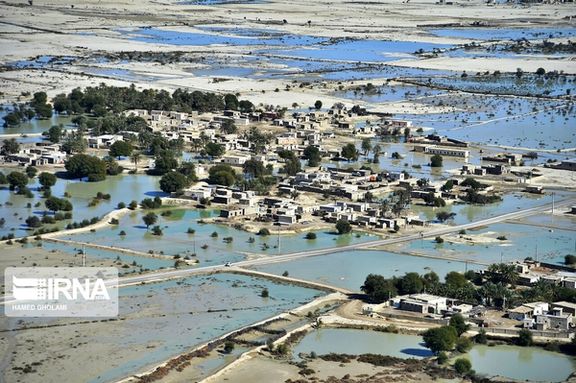
A view of flood-hit areas in Sistan-Baluchestan province (March 2024)
About two weeks since the onset of floods in eastern Iran, closed roads and tens of thousands stranded without access to food and water have prompted the president to visit the region in response to widespread criticism.
Dozens of villages have been affected with citizens independently working to reopen roads to deliver aid. Frustration mounts among local residents as governmental aid remains scarce. "Not even a helicopter has been sent for aid to the flood victims of Sistan and Baluchestan; only provincial and national officials flew over once and left!" remarked a local official.
Finally, after over a week of silence, government authorities have acknowledged the crisis. Supreme Leader Ali Khamenei admitted on Tuesday that the floods have inflicted significant damage on the people of Sistan and Baluchestan in a nod to the disaster facing the population.
President Ebrahim Raisi started a tour of the region on Wednesday. Earlier in the day, Sepehr Khalaji, Raisi’s chief publicity man, reacted to the criticism about the government’s handling of the situation, saying that although the Interior Ministry was busy with the elections, rescue and relief teams were dispatched and the minister himself visited the flood-affected areas. “All necessary work has been done... people are not abandoned.”
On Tuesday, Ali Akbar Mehrabian, the Minister of Energy, traveled to Sistan-Baluchestan to assess the extent of damage to infrastructure, according to reports from media affiliated with the government in Iran.
Despite claims from government spokesman Ali Bahadori Jahromi that relief efforts were initiated promptly, access roads to 46 flood-affected villages remain blocked, and 31 villages are still grappling with water shortages.
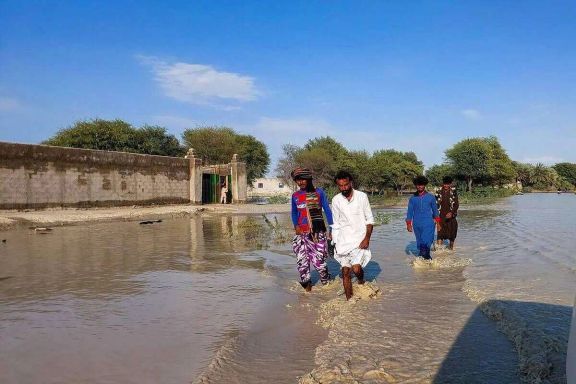
People walking in flood-hit areas in Sistan-Baluchestan province (March 2024)
Since the floods began on February 25, more than 10,000 people have been affected. Official reports indicate the destruction of at least 300 homes and damage to over 1,500 others. Agricultural land, orchards, wells, greenhouses, livestock units, and historical sites have also suffered extensive damage.
Mojtaba Saadatian, the deputy for cultural heritage, handicrafts, and tourism of Sistan and Baluchestan, stated that due to the extreme weather, 37 historical sites in the province have been damaged.
•
•
The crisis looks set to continue over the coming days as the Meteorological Organization forecasts intensifying rainfall. An earthquake with a magnitude of 5.6 further rattled the province, highlighting the vulnerability of the affected areas.
Criticism mounts against governmental priorities, with citizens accusing authorities of neglecting flood victims in favor of political pursuits. Reports emerged of ballot boxes for Friday's elections being dispatched to flood-affected areas amidst the ongoing crisis, fueling public outrage.
Mowlavi Abdolhamid, the outspoken Sunni Friday prayer leader of Zahedan, has condemned the government's failure to plan and provide infrastructure to mitigate floods. Calls for assistance persist, with appeals for heating appliances, blankets, mattresses, hygiene items, food supplies, mineral water, and tents to support flood victims.
He was banned from visiting the affected areas this week, his convoy intercepted by security forces at a police checkpoint along the Zahedan-Khash road, with two of his teenage sons detained.
Mohammad Mehdi Sajjadi, CEO of the Red Crescent, said on Saturday that water levels had risen up to half a meter and even more in many flood-affected villages.
"The floods are severe to the extent that even rescue operations are challenging, and teams sent to deliver supplies to areas besieged by floods could not return and are trapped in the region," he said.
However, many of the stranded victims have been reluctant to leave their homes, he explained, "complicating relief efforts".
It is unclear how many people have lost their lives amid the crisis. Official statistics claim there have as yet been no deaths, but Baluch sources say at least five have died.
The Iranian government has finally admitted that the son of Mohammad Bagher Ghalibaf, the Speaker of the Iranian Parliament, applied for residency in Canada, but had his application denied.
Mehdi Mohammadi, who works alongside Ghalibaf, responding to a tweet questioning Es'haq's desire to relocate to Canada, clarified on the X social network platform, "He has never gone to Canada nor was he planning to. Due to his father's affiliation with the Revolutionary Guards, his request for residency, aimed at reducing educational expenses, was rejected, and he has filed a complaint with the court."
Earlier, it came to light that Es’haq had been pursuing Canadian residency for five years, engaging legal assistance and even eliciting follow-ups from a Canadian lawmaker, Pierre Poilievre, the leader of the opposition Conservative Party. According to court documents, Polivier's office had made "repeated inquiries" regarding the progress of Es'haq's application.
Following the circulation of reports online, two petitions surfaced urging the Canadian government to halt Es'haq's visa approval, citing his familial ties to a former top Revolutionary Guard commander.
In 2022, Es’haq sought judicial review of the processing time of his immigration application at a Canadian Federal Court, resulting in Justice John Norris ruling in favor of granting his application. However, with sanctions against a multitude of individuals affiliated with the IRGC now underway globally,including Canada, the application remains in question.
Supreme Leader Ali Khamenei hailed Iran’s elections as "great and epic" on Tuesday, despite the boycott by a large majority of voters and the lowest turnout in the history of the Islamic Republic.
“The Iranian nation did a jihad and fulfilled their social and civil duties,” he said, and as usual, accused “enemies” of trying to dissuade Iranians from voting. However, he claimed that they were defeated by the people’s “epic turnout and jihad.”
“Don’t the sixty percent who did not vote count as Iranians?”, former reformist lawmaker Mahmoud Sadeghi tweeted after Khamenei’s remarks.
According to official figures, 61.1 million Iranians were eligible to vote, and 41 percent turned out at polling stations including at least 5 percent who cast void and blank votes. However, they were so many electoral gimmicks before and during the election day that few believe even the modest turnout numbers claimed by the government.
Blank and void votes are usually cast by those who may have been rounded up and forced to vote against their wish such as government employees, soldiers, and athletes, and could be interpreted as “protest votes”.
In a note from Tehran’s Evin Prison, dissident reformist politician Mostafa Tajzadeh called the elections “engineered” and a “historic failure” of the system and the person of Khamenei, both in terms of turnout and mandate of those to occupy the seats of the parliament in a few months from now.
Reformist politician Mostafa Tajzadeh
Tajzadeh was responsible for holding the parliamentary elections of 2000 as deputy interior minister. An outspoken critic of Khamenei since the controversial presidential elections of 2009, he has spent more than eight years behind bars since then.
The regime made every effort to ensure a high turnout in a bid to prove its legitimacy both domestically and internationally, but many social media users claim the election boycott was extremely successful and “epic”.
They point out that for the first time in the history of the Islamic Republic, at least 60 percent of eligible voters chose not to vote in elections that they considered stage-managed in every step of the way and extremely unfair.
Many social media users have also alleged that the official turnout figure of 41 percent is nothing to be proud of, by Khamenei’s own standards, even if it were true.
Social media users have also extensively shared the video of a Khamenei’s sermon in 2001 in which he mocked Western countries for low turnout in their elections. He said in his sermon that a turnout of 40 percent was a cause of shame and indicated that the citizens of these countries, including the United States, did not trust their political system.
The extremely low mandate of top candidates in all constituencies could only mean a much lower turnout, many argue.
Mahmoud Nabavian who has the highest number of votes in the parliamentary elections this time, with around 600,000 ballots, had ranked 52nd in the elections of 2015 with 692,000 votes. The total number of his votes is slightly more than the last of Tehran’s 30 representatives in the parliamentary elections of 2020.
The number of eligible voters in Tehran was 7.77 million in these elections so Nabavian is representing 7.7 percent of the eligible voters. According to official figures, only 24 percent of Tehran’s eligible population voted.
The top elected candidate in Tehran has never had less than 844,000 in previous elections.
Nabavian is a member of the small but very influential ultra-hardliner Paydari Party.
The current speaker, Mohammad-Bagher Ghalibaf, has dropped to the 4th place in Tehran this time and only received 447,000 votes. His weaker position may become a challenge to his ambitions of leading the next parliament, analysts say.
Iran executed at least 834 people last year, a new record for the regime since 2015 as capital punishment is surging in the country, two rights groups said Tuesday.
The annual report published by the Norway-based Iran Human Rights (IHRNGO) and Paris-based Together Against the Death Penalty (ECPM), indicates that the executions were up some 43 percent in comparison with the figure in 2022. It is only the second time in two decades that over 800 executions were recorded in a year, after 972 executions in 2015.
The numbers coincide with a report released in January from the United Nationsciting 834 executions in 2023, also suggesting the number could be more. A statement claimed it was an "unprecedented rise" which saw "at least" 834 people executed, including eight associated with the nationwide protests.
According to the latest rights groups' report, in 2023, the number of public hangings in Iran tripled compared to 2022, with seven people being hanged in public spaces, including a beach park. Iran also violated international obligations by executing juvenile offenders, with at least two juveniles put to death, one of whom was 17 at the time of execution. At least 22 women were executed, marking the highest number in the past decade.
The majority of those executed were convicted of drug-related offenses. However, the report also said that eight protesters were executed in 2023 after being convicted in "grossly unfair trials" that lacked due process. The rights groups said that the surge in executions was aimed at intimidating the Iranian people against further protests following the nationwide uprising that erupted in 2022 after 22-year-old Mahsa Amini was killed in police custody after she was arrested for “improper” hijab by the country’s morality police. At least two people were executed for "insulting the Islam prophet.”
Members of ethnic minorities, notably the Sunni Baluch from the southeast of Iran, are "grossly overrepresented amongst those executed" on drug-related charges, the report said. At least 167 members of the Baluch minority were executed in total, accounting for 20 percent of the total executions in 2023, even though the minority accounts for only around five percent of Iran's population.
The report noted that the increase in executions in Iran is part of a broader pattern of human rights abuses by the government. The report claimed that the lack of international attention to the human rights situation in Iran has emboldened the regime to continue its crackdown on dissent.
Urging the international community to take action to pressure Iran to end its use of the death penalty, the groups also called for an X (formerly twitter) campaign against the death penalty in Iran with the hashtag #StopExecutionsInIran.
The campaigners also pointed out that Iran executed at least 176 people in the two months following the Hamas invasion of Israel on October 7, taking advantage of the global attention to the war. “The average number of daily executions rose from 2 before the onset of the war in Gaza to an average of 3-4 executions per day during the war," Iran Human Rights Director Mahmood Amiry-Moghaddam said.
“The Iranian regime uses the death penalty to prolong its survival. We are dealing with a regime that is oppressive, corrupt and incompetent to solve people’s daily problems. Instilling societal fear is the regime’s only way to hold on to power, and the death penalty is its most important instrument."
The Iranian government has defended its use of the death penalty, saying that it is a necessary deterrent to crime. However, human rights groups say that the death penalty is often used as a tool of political repression.
Amiry-Moghaddam said, “The inconsistency in the international community’s reaction to the executions in Iran is unfortunate and sends the wrong signal to the authorities.”
The UK's media regulator, Ofcom, has upheld a complaint by Iran International against Al Jazeera over allegations made against Iran International by a Tehran-based “analyst”, who is considered a regime insider.
In a video interview with Al Jazeera’s News Hour on January 7, 2023, government mouthpiece Mohammad Marandi defended the executions of Mohammad Mehdi Karami and Mohammad Hosseini, both accused of participating in anti-government protests and allegedly being involved in the killing of Basij member, Ruhollah Ajamian.
A figure close to Supreme Leader Ali Khamenei, Marandi accused London-based Persian networks such as Iran International, of provoking unrest in Iran during the Woman, Life, Freedom movement, further claiming these media “have repeatedly called, … have legitimized and praised beating police officers, burning them alive and murdering them.”
Following Marandi’s remarks, Iran International filed a complaint with Ofcom about Al Jazeera, arguing that “it was treated unjustly or unfairly in the program as broadcast.”
According to the complaint, “at no point during the program did the presenter challenge, correct or seek to contextualize Mr. Marandi’s incorrect and harmful comments about Iran International.”
Iran International also emphasized that no case has ever been filed against the network in Ofcom on the charges claimed by the commentator and that the network has never been accused of violating the principles of news coverage.
Mohammad Marandi's father with Supreme Leader Ali Khamenei in 2020
“Marandi … had made statements before in which he defended the actions and policies of the Iranian government, and criticized public figures and governments in Western democracies,” Iran International said, adding that “Marandi’s alleged reputation should have alerted Al Jazeera in advance to the probability that he would make comments on air which would be potentially unfair or unjust to individuals or organizations.”
In his interview on Al Jazeera’s News Hour, Marandi named and lambasted at least five human rights organizations, including Amnesty International, and other Persian-language media outlets in his interview, such as VoA and BBC Persian.
Al Jazeera said its presenter was not able to challenge Marandi’s assertions on each allegation he made.
But Ofcom did not accept this and upheld Iran International’s complaint, ruling that media outlets should take reasonable care before broadcasting a program to make sure that the materials would not be unfair to individuals and organizations. Ofcom said that Marandi’s “serious allegations” about Iran International made on News Hour “were not challenged or put into context”, resulting in unfairness to Iran International.
Ofcom referred to the fact that Marandi was there to provide a pro-Iranian government view and that while Al Jazeera introduced Marandi as a “political analyst” and “professor at the University of Tehran,” it did not point to his affiliation with the Iranian government. According to the regulator, this manner of introduction “may have led some viewers to expect Mr. Marandi’s comments to have been objective.”
Mohammad Marandi appears with some regularity on other Western news channels, including the BBC. Marandi is the son of Alireza Marandi, Iran’s former Health Minister and the head of the medical team of the Supreme Leader.
Ofcom also referred to the record of the Iranian government's actions and measures against Iran International and its designating the Channel as a terrorist organisation.
Earlier in the month, a leaked document revealed that Tehran’s Revolutionary Court convicted 44 foreign-based journalists and media activists in absentia two years ago over the allegation of “propaganda against the government.”
The names included prominent figures affiliated with Iran International, such as Mahmoud Enayat, Aliasghar Ramezanpour, Mehdi Parpanchi, Fardad Farahzad and Morteza Kazemian.
A reported deal between the BBC and authorities in Tehran over the coverage of Iran's controversial elections has outraged its Persian service staffers, Iran International has learned.
The BBC's decision to send its correspondent Caroline Davies to cover Iran's elections in Tehran has resulted in internal tensions at the broadcaster, as managers are believed to have acquiesced to the Iranian regime's condition that its Persian broadcast department be barred from using her reports and videos.
Staff members of the Persian service believe "by accepting this conditionality, the BBC has allowed the Iranian government to dictate the terms of BBC's reporting."
They have warned that BBC's decision "isolates" them, "divides the BBC, and signals to the Iranian government that BBC Persian is fair game for harassment and persecution," particularly of their families in Iran.
BBC has repeatedly stated in recent years that the Islamic Republic has harassed, intimidated, and threatened BBC Persian journalists and their families in Iran over the past decade, including death threats against BBC journalists and their families in London, blocking their assets in Iran, and online harassment, and sexual assaults against female journalists.
The Persian service staff members say they had made it clear to the BBC's top management a few years ago that such decisions are "unacceptable". However, "it has happened again."
Asked about the issue, a BBC spokesperson told Iran International, "The BBC is committed to providing our UK and global audiences with impartial coverage of the Iran elections and our correspondent, Caroline Davies, has been granted rare access to the country to report for BBC News across TV, radio and online."
"The BBC has not been able to report from Iran since 2019. Reporting from the country at this critical time does not reduce our condemnation for the harassment faced by BBC News Persian staff and we continue to call out the utterly unacceptable treatment for those simply doing their jobs," the spokesperson added.
BBC Persian, which broadcasts on TV, on radio and online, is banned in Iran. BBC Persian obtained in 2017 a court order that listed the names of 152 staff, former staff and contributors whose non-liquid assets were frozen by Iran's judiciary.
BBC Persian journalists had not been able to return to Iran for fear of arrest, while family members had been subjected to travel bans, interrogated and arbitrarily detained.
Iranian social media users have in recent days criticized the BBC correspondent's reports from Tehran, saying she did not cover the key issues including the widespread boycott of elections. There is also a perception that the BBC had not acted impartially in its reporting. Iranian users specifically compared Caroline Davies's reports with those of Deutsche Welle’s (DW) correspondent whose reports from Tehran covered issues like the election boycott, compulsory hijab, and the impact of the Woman, Life, Freedom movement on these elections.
Back in 2019, the Huffington Post reported that the BBC had "agreed to conditions set by the Islamic Republic of Iran to not share reporting materials it gathers in Iran with its Persian-language channel, BBC Persian, in exchange for Iran allowing a BBC correspondent into the country."
"The agreement represents a capitulation to a government that has been hostile to press freedom. The Iranian government routinely shuts down media organizations critical of the regime and imprisons, tortures and executes journalists," the Post reported at the time.