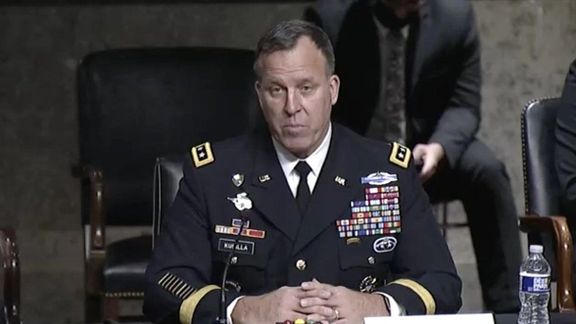
CENTCOM Commander Gen. Erik Kurilla. File photo 2022
Amid Iran-backed Houthi attacks on vessels in the Red Sea, the head of the US military's Central Command says Tehran is escaping accountability for its nefarious activities across the Middle East.
“Iran is not paying a cost,” CENTCOM Commander Gen. Erik Kurilla told the Senate Armed Services Committee on Thursday.
Repeated retaliatory strikes by US and UK forces – meant to limit the capacities of the Houthis to target ships – have so far failed to deter the militant group from hitting one of the world's busiest trade lanes.
This week alone, a Houthi missile attack killed three civilian seafarers on a merchant ship, marking the first deaths caused by the group's attacks on merchant vessels.
The Iranian regime-backed group started attacking ships in the Red Sea in November in what they say is a campaign in solidarity with Palestinians during the war in Gaza.
CENTCOM needs POTUS approval to sink Iranian ships
Republican Senator Sullivan questioned Gen. Kurilla on why the US hasn't escalated its response to these attacks by targeting Iranian spy ships, which provide intelligence used to harm American sailors.
The CENTCOM Chief maintained he is not authorized to take action against Iranian naval vessels – without permission from POTUS to do so.
In response to largely Democratic lawmakers raising the alarm of a confrontation with Iran and the risk of “escalation”, parallels were drawn several times to Operation Praying Mantis.
That military operation on April 18, 1988, saw the US retaliate for the Iranian mining of the Persian Gulf during the Iran-Iraq War.
Republican lawmakers insisted that the US was able to destroy Iran’s naval capacity with that operation, without risking a wider war.
While Democratic Senator Jack Reed expressed optimism regarding a temporary pause in Iran-backed attacks against US forces in Iraq and Syria, Gen. Kurilla maintained several times that Iran continues to be undeterred in its support to the Houthis, Hezbollah, Hamas, and factions in the West Bank.
Real Estate and gold prices in Iran try to catch up with the rising value of foreign currencies as the rial sank to its lowest point in history this week, heralding higher inflation.
Since early January, the US dollar has risen from 500,000 rials to more than 600,000, a 20-percent rise against the Iranian currency.
Since early 2018, the rial has fallen 15-fold as the United States imposed economic sanctions when it withdrew from the JCPOA nuclear deal.
Media in Tehran reported on Friday that real estate prices are rising to be on par with the dollar. Real estate is treated as capital investment by Iranians, who are not willing to sell cheaper when the rial falls against major currencies.
The same also applies to gold, cars and imported merchandise. The US dollar was trading at 600,800 rials on Friday as the euro rose to 666,000 and the British pound to 780,000 rials. Friday is a weekend day in Iran and most markets are closed.
Media reports say that as the new week begins on Saturday, the rial can take another hit. One news website reported that the government is auctioning gold at much higher prices, signaling that the rial can sharply fall in the coming days.
Official annual inflation hovers near 50 percent, but the rial’s fall can directly impact prices and push the inflation rate to near hyper-inflation levels in the coming months.
A UN fact-finding mission says the Iranian regime's crackdown on 2022 protests – including killings, imprisonment, torture, and sexual violence – amounts to crimes against humanity.
The Fact-Finding Mission (FFM) was established by the UN human rights council in November 2022, two months after the Woman, Life, Freedom protests swept the country in response to the death in custody of 22-year-old Mahsa Amini. The mission published its first report on Friday after 18 months of investigations with help from experts, witnesses and victims, who will be corroborating the report's findings on a panel at the UN in Geneva later in the year.
The FFM concluded that Iran is responsible for the “physical violence” that led to the death of Amini in September 2022. The clerical regime has denied being responsible for her death or that she had been beaten, with authorities blaming a medical condition Amini had from childhood after a surgery. The UN report dismissed that as a cause of her death, confirming “the existence of evidence of trauma to Ms. Amini’s body, inflicted while in the custody of the morality police.”
Newspapers, with a cover picture of Mahsa Amini, are seen in Tehran, September 18, 2022.
“Credible figures suggest that as many as 551 protesters were killed by the security forces, among them at least 49 women and 68 children. Most deaths were caused by firearms, including assault rifles,” according to the report.
The violations and crimes include extra-judicial and unlawful killings and murder, unnecessary and disproportionate use of force, arbitrary deprivation of liberty, torture, rape, enforced disappearances, and gender persecution, the mission said. "The Mission found cases of women and girls subjected to rape and other forms of sexual and gender-based violence, including gang rape, rape with an object, electrocution of genitalia, forced nudity and groping,” the UN said.
It added that the regime carried out widespread and sustained human rights violations, which broke international laws and disproportionately targeted women and girls as well as children and members of ethnic and religious minorities. “The Mission found that gender persecution intersected with discrimination on the basis of ethnicity and religion.”
The report also confirmed that Iranian security forces used shotguns, assault rifles and submachine guns against demonstrators “in situations where there was no imminent threat of death or serious injury” to them, “thereby committing unlawful and extrajudicial killings.” It also found a pattern of protesters being shot intentionally in the eye, saying that “A pattern of extensive injuries to protesters’ eyes caused the blinding of scores of women, men and children, branding them for life.”
“These acts form part of a widespread and systematic attack directed against the civilian population in Iran, namely against women, girls, boys and men who have demanded freedom, equality, dignity and accountability,” said Sara Hossain, chair of the Fact-Finding Mission. “We urge the Government to immediately halt the repression of those who have engaged in peaceful protests, in particular women and girls.”
The mission also said the Government arbitrarily executed at least nine young men from December 2022 to January 2024 after summary trials based on torture-coerced confessions. “Dozens of individuals, remain at risk of execution or receiving a death sentence in relation to the protests.”
“We urge the Iranian authorities to halt all executions and immediately and unconditionally release all persons arbitrarily arrested and detained in the context of the protests, and to end the repression of protesters, their families and supporters of the Woman, Life, Freedom movement,” said Shaheen Sardar Ali, a member of the mission.
Authorities are doubling down on their repression of families of victims, journalists, human rights defenders, lawyers, medical doctors and many others simply for expressing their views, supporting the protesters or seeking truth and justice for victims, the mission underlined.
In addition to crackdown on journalists at home, the mission has further established that Iran harassed, threatened and intimidated journalists and other media employees working outside the country, including those at Iran International, the BBC Persian service and others.
“The Iranian authorities summoned, threatened and in some cases arrested, detained and charged the family members of those journalists and media workers in an apparent effort to exert pressure on them and prevent them from reporting on the country.”
In October 2022, Iran sanctioned the BBC Persian service and Iran International television, and imposed asset freezes on their staff. Journalists also received serious threats, including to their lives and personal safety, leading to the involvement of the police in some countries.
In February 2023, Iran International TV had to temporarily relocate its offices in London to Washington DC, after the UK’s security forces determined it could no longer keep the staff safe following assassination attempts by Iran’s IRGC. However, the network reopened its offices in September 2023 at a new location amid tighter security.
“The Islamic Republic of Iran has the obligation to uphold the rights of women and children, and to ensure the right to truth, justice, and reparations of all victims,” said Viviana Krsticevic, another member of the Mission. “Given our findings, this would entail, among other measures, an overhaul of criminal and civil laws, a reform of the justice system, and measures for accountability.”
US Senator Tom Cotton has voiced concerns over Iran's increasing aggression against US forces across the Middle East, saying Tehran-backed militants know the US would not confront them.
“Iran’s proxies have attacked Americans in Iraq and Syria over 170 times. We have responded 8 times,” Cotton (R-AR) said. “Iran and its terror groups know President Joe Biden and Secretary of Defense Lloyd Austin won’t stand up to them.”
The Senator's comments underscore growing concerns among lawmakers about the Biden administration's approach to Iran, particularly in light of recent provocations by Iranian-backed militias. Many lawmakers argue that a stronger response is needed to prevent further escalation and protect American interests in the region.
Iran is currently at the helm of a regional proxy war which has seen its militias come out in support of the Hamas attack on Israel on October 7, in a war which has escalated to draw in international players including the US and UK. Particularly worrisome are attacks by Yemen's Houthi militants, armed and supported by Tehran, who have unleashed deadly drone and missile attacks against commercial vessels in the Red Sea.
In a joint operation with Britain in February, the United States initiated dozens of strikes against Iran-backed groups in Iraq and Syria as well as its Yemeni proxy, the Houthis. The Houthis are currently blockading the Red Sea in a bid to force Israel into a ceasefire amidst the war in Gaza against the Iran-backed Hamas militia. Around 1,200 mostly civilians were murdered and at least 250 more taken hostage in the October 7 attack.
The US State Department's Office of Religious Freedom on Thursday condemned the destruction of 30 graves of Baha'i citizens in Tehran, as government persecution against the minority continues.
"We condemn the destruction of 30 graves by authorities at the Khavaran Cemetery near Tehran this week," the office said in a statement. "Baha'is in Iran continue to face violations of funeral and burial rights."
The act, which involved the removal of grave markers and the flattening of resting places using bulldozers, was also slammed by rights activists, the latest in a series of actions taken against the community which has been systematically targeted since the founding of the Islamic Republic in 1979.
The statement also noted other methods of pressure and intimidation. “We have also seen the regime dramatically increase Baha’i property seizures and use sham trials to subject Baha’is to extended prison sentences,” the statement said. “We will continue to use all available tools to confront the regime’s human rights abuses.”
Simin Fahandej, Representative of the Baha'i International Community to the United Nations in Geneva, said, “In the last few months, the deceased loved ones of the Baha’is have been forcibly buried by government agents in the Khavaran mass grave site, further desecrating a burial place sacred to many.
Before the 1979 Islamic Revolution, Tehran's Baha'i community owned two large cemeteries, both of which were confiscated by the Islamic Republic in the 1980s.
Unofficial estimates suggest that more than 300,000 Baha'i people live in Iran. However, the Constitution officially acknowledges only Islam, Christianity, Judaism, and Zoroastrianism, thereby rendering Baha'is the most significant non-Muslim religious minority in the country. Iran's clerical rulers regard the Baha'is as heretics.
A former Iranian minister has made unprecedented comments about the disastrous economic and cultural situation in the country that has prompted Iranians to believe that change is inevitable.
The website quoted Amiri, a former Minister of Culture under President Hassan Rouhani's administration, as stating: "You cannot speak of effective governance in a country where 60 percent of the population goes to bed hungry." Amiri emphasized that Iran is grappling with an ever-growing segment of its population facing hunger.
Amiri also highlighted that all cultural institutions in Iran are mired in stagnation, and there is a prevailing belief among Iranians that change is inevitable. Speaking at the annual gathering of the Iranian Association of Political Scientists, Amiri noted that widespread despair has eroded the government's social capital, while widening social disparities have pushed society to the brink of a perilous collapse.
The former minister further underscored the lack of discourse and viable solutions within Iran's institutions to address the current predicament. He observed that while society is moving towards change, the government persists in outdated policies due to the absence of a viable governance model.
Reza Salehi Amiri, Former Minister of Culture and Islamic Guidance of Iran
"Iran is entangled in a faulty governance cycle and the government does not realize the need for change," Amiri said, adding that latest elections in Iran were a good manifestation of the failure of the political system. The government is inefficient and incapable of meeting the nation's demands, he noted.
Iranian analyst Ali Hossein Ghazizadeh told Iran International TV on Thursday "following such a low-turnout election, any responsible government would have been introspective about the reasons behind public dissatisfaction. However, Supreme Leader Ali Khamenei and his associates prefer to rely on a like-minded minority to suppress and silence the majority. What could prompt change is the people's discontent."
Meanwhile, Iranian journalist Ali Shirazi told Iran International TV, referred to Khamenei’s long-standing anti-US ideology and said that in a recent speech, Khamenei advised newly elected members of the Assembly of Experts to continue the policy. “However, he failed to address the consequences of his longstanding opposition [to the US], which has led to sanctions and economic challenges for the people. Khamenei has never been held accountable for the repercussions of severing Iran's ties with the West."
Shirazi added, "In recent years, we have witnessed various segments of Iranian society, including teachers, workers, and government employees, demand social justice based on legislation passed by the Iranian parliament but never implemented. This renders Khamenei's emphasis on social justice meaningless."
Furthermore, Shirazi questioned Khamenei's pledge to combat corruption while serving as the senior Iranian official responsible for the corrupt government for over three decades.
He said the low turnout showed that the people believe elected institutions in Iran are not efficient. They also believe their votes cannot change their own fate. On the other hand, impolite comments by the novice politicians against experienced lawmakers and their own patrons have introduced them to the nation as individuals with no principles.
Falahatpisheh stressed that the government's disregard for the views of the 60 percent of eligible voters who abstained from voting poses a threat to Iran's national security and serves no one's interests.
Despite these concerns, forceful words on Iran were notably absent from President Joe Biden’s State of the Union speech on Thursday night.
For numerous analysts, this mirrors the absence of a coherent US policy aimed at deterring Tehran from its malicious activities throughout the Middle East.
Former CENTCOM Chiefs critical of US approach
But, Republicans aren’t the only critics of the current strategy to contain Iran’s proxy attacks.
Several high-ranking former senior armed forces officials have gone on record with their criticism for the lack of accountability the regime in Tehran faces.
Retired Vice Adm. John Miller, who oversaw all US naval activities in the Middle East until 2022, told POLITICO that his country is “not taking this seriously” and “not deterring anybody right now”.
Ret. Gen. Frank McKenzie, who commanded US forces in the Middle East during both the Trump and Biden administrations, also told the same news outlet recently, that Iran perceives the absence of a robust US military reaction to the recent Houthi attacks as encouragement to persist in its aggressive actions.
“We’ve given them no reason not to continue [attacking],” he said of the Houthis.
In an interview with Breaking Defense, Gen. Joseph Votel voiced his view that problems started when the US administration under President Barack Obama decided to “pivot” to Asia and reduced its involvement in the Middle East region.
The former US Central Command chief said that the administration focused only on brokering an agreement on the Iranian nuclear program, which neglected the growing threat of its proxy groups in the region.
Meanwhile, the leader of Yemen’s Houthi militia seemingly bragged about his group’s missile striking capabilities in a televised speech on Thursday.
“In [Wednesday’s] strike, there was amazement at the precision of the attack and the power of damage,” Abdul Malik Al-Houthi said.
“Discovering ships and hitting them with such precision using ballistic missiles for the first time is an achievement in every sense of the word”, he said.