IRGC Commander Receives Medal From Khamenei Amid Calls For Designation
Hossein Salami, the Commander of the Revolutionary Guard (IRGC)
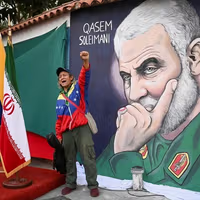
Hossein Salami, the Commander of the Revolutionary Guard (IRGC), has been awarded a ‘medal of conquest’ by Iran's Supreme Leader amidst growing calls for the designation of the IRGC.
Salami announced that he had a meeting with Khamenei on Sunday to receive the medal.
During the ceremony on Sunday, Salami stated, "This medal is the result of all the efforts of the IRGC, which was symbolically awarded to me ... It belongs to our brothers who defend the dignity and independence of this land in sub-zero temperatures with steadfast hearts, firm steps, and hands on the trigger," likely referring to IRGC proxy groups in the region.
The conflict has drawn in international players, including the US and UK since Yemen's Houthi militants, armed and supported by Tehran, have launched deadly drone and missile attacks against commercial vessels in the Red Sea.
In February, the United States, in a joint operation with Britain, initiated dozens of strikes against Iran-backed groups in Iraq and Syria, as well as its Yemeni proxy, the Houthis
Masoud Dorosti, CEO of Tehran Metro Company, has quit following sanctions imposed by Canada for his part in the city's crackdown on women defying hijab.
Hewas added to Canada's sanctions list on International Women's Day and the sanctions coincided with Dorosti's family's preparations to relocate to Canada, plans which will now have fallen flat.
It was Canada's 17th package of sanctions against Iran since Mahsa Amini's death in morality police custody in September 2022, targeting Dorosti and senior MP Zohreh Elahian for their "participation in violent repression of Iranian citizens", particularly women and girls. It takes the total to 153 individuals and 87 entities sanctioned.
Mélanie Joly, Minister of Foreign Affairs, said, “Canada will always defend the rights of women and girls. The Iranian regime and its supporters’ continued use of cruel and violent tactics against any demonstration of liberty of choices and free speech has led to an increasingly repressive environment in which women and girls face injury or death simply for expressing themselves or demanding their basic human rights.
"Our message is clear: this must end. We will continue to shine a spotlight on these blatant violations of human rights and call for the perpetrators to be held to account.”
Tehran metro has been the scene of heavy hijab patrols, last year leading to the death of a 16-year-old Iranian who was confronted by morality police for not complying with hijab rules.
Armita Geravand, a teenage student in Tehran, was assaulted by hijab enforcers in the metro, subsequently falling into a coma. She passed away after 28 days in hospital.
Amini's death in custody sparked the Women, Life, Freedom protests which have since triggered a nationwide hijab rebellion in which authorities have become increasingly brutal in fighting, including arbitrary arrest, sexual violence, and deepened surveillance.
Opinion -- When Princeton University hired Hossein Mousavian in 2009, I believed he had defected from the Iranian regime, relocated to the United States, and aimed to work against it.
The passage of time, however, proved that I was mistaken. His intention was to continue serving a regime that had afforded him ample opportunities, enabling him to exert influence over two major newspapers, rise from a street activist to Iran’s ambassador in Germany, and subsequently become a chief negotiator in nuclear talks with the West.
Throughout his career, Mousavian has demonstrated unwavering loyalty to the Islamic Republic. From his tenure as a member of the Resalat Daily editorial board and his leadership role at Tehran Times to his diplomatic endeavors in Europe as Iran's top diplomat, he has consistently upheld the regime's interests. Even upon relocating to the US, his advocacy for the controversial JCPOA nuclear deal and defense of Iran's nuclear program as peaceful persisted.
Mohammad Javad Zarif attests to Mousavian's commitment to the regime, having entrusted him with representation at various European events during Zarif's tenure at the Ministry of Foreign Affairs. Zarif lauds Mousavian's adept defense of the regime's positions, acknowledging his efforts in international forums across America and Europe.
However, Mousavian has crafted various narratives portraying himself as a regime critic. One such claim involves being listed as a target for internal assassination in the 1990s, an assertion lacking substantiation or evidence. Lists of assassination targets from the 1990s, provided by reputable sources, notably exclude Mousavian's name, indicating a discrepancy in his narrative. I have personally seen two lists for assassinations in the 1990s (one list provided to me by Saeed Hajjarian, a high-ranking security official) and Mousavian was not on those lists. The internal terror project in that period was planned to be carried out inside the country and not in Europe.
Princeton University academic Hossein Mousavian
Terror-oriented ideology and discourse
During the 1980s, the regime's ideological priorities differed from its current agenda. Anti-semitism, nuclear armament, and Shia imperialism were not prominent; instead, the focus was on the Iran-Iraq war, domestic stability through terror tactics, and ideological rivalries within Islamist factions. Amidst escalating tensions and internal dissent, internal targeted killings emerged as a pivotal tool to safeguard the regime's survival.
Islamist terrorism, characterized by fatwas and militant recruitment, was instrumentalized by the regime to suppress dissent and eliminate opposition voices. This was a time when the war with Iraq was not going well and numerous opposition figures abroad were plotting the regime’s overthrow. Survival of the clerical rulers was the top priority. Mousavian, along with his counterparts at Resalat, played a pivotal role in legitimizing and normalizing this terror narrative, perpetuating a culture of fear and coercion within Iranian society.
Ali Khamenei had the same feeling of fragility in his first years in office and began killing intellectuals and political dissidents in the 1990s. Resalat did the same job to promote and normalize terror in this decade even when Mousavian was out. It was in its DNA.
Mousavian played a key role in the covering up of the Mykonos terror attack and denying Iran's role in this terror attack: "Personally I had more than 300 meetings with the [people in] the [German] Ministry of Foreign Affairs, the judiciary, the German Parliament, the Chancellor's office and even with the heads of the German media to show that the [Iranian] government had no role in the event.”
According to Parviz Dastmalchi, who witnessed the assassinations, Abolghasem Mesbahi, known as 'Witness C,' one of the founders of the IRI’s Ministry of Intelligence and Security, testified in February 1997 under oath before the German court regarding the role of Hossein Mousavian in the assassination of Kurdish leaders at the Mykonos restaurant: "Mr. Mousavian has participated in most of the assassinations committed in Europe."
Terrorism, as exemplified by Mousavian's actions, is a grave matter not to be trivialized. His cavalier attitude towards terrorizing American authorities, as evidenced by his gleeful recollection of Bryan Hook's wife's distress, underscores the severity of his involvement in Iran's state-sponsored terrorism. Such callous disregard for human life is reprehensible and underscores the urgent need for accountability.
Opinions expressed by the author are not necessarily the views of Iran International - The author signed a petition to oust Mousavian from his Princeton position.
A virology journal has retracted a paper detailing the first human trials of an Iran-made vaccine against the COVID-19 virus following criticism from scientists questioning the efficacy of the vaccine.
Published in 2022 in the Journal of Medical Virology, the now-retracted study described the clinical development of the Noora vaccine, which had been licensed for emergency use in Iran in the same year.
Scientists worldwide, including Donald Forthal, Chief of Infectious Diseases at the University of California, raised doubts about the validity of the study. Despite the critiques, the paper had undergone multiple rounds of review before publication.
In January, additional concerns regarding data integrity and potential conflicts of interest were raised by epidemiologist Gideon Meyerowitz-Katz on PubPeer. Subsequently, on March 2, the Journal of Medical Virology announced the retraction of the paper citing inconsistencies in the data and the authors' failure to disclose potential conflicts of interest.
Corresponding author Hassan Abolghasemi of the IRGC-affiliated Baqiyatallah University of Medical Sciences in Tehran disputed the retraction, alleging it was politically motivated. Abolghasemi claimed that pressure was exerted on the journal due to "apartheid scientific issues" and stated that their response to criticisms was not accepted for publication.
Last year, a report claimed that over 75,000 Covid deaths could have been prevented in Iran if the regime had permitted global vaccines, banned by Iran's supreme leader who ruled out importing United States and British made Covid vaccines in January 2021, arguing that Western countries could not be trusted.
He claimed Iran was well placed to develop its own vaccines or should take them from more reliable sources as at the time, the US-German Pfizer, US-made Moderna and the British-made AstraZeneca were the only vaccines approved internationally.
A paper published in association with the British Medical Journal and Yale last year called, ‘A quantitative evaluation of the impact of vaccine roll-out rate and coverage on reducing deaths from COVID-19: a counterfactual study on the impact of the delayed vaccination programme in Iran,’ a team of experts have found evidence to show mass neglect on the part of the regime.
An analysis of posts on Persian social media indicate that fast-growing residential rents have turned into one of the most serious economic concerns among Iranians.
After enduring a more-than-40% annual inflation rate for the past five years and seeing their purchasing power slashed to a fraction of what it was in 2018, Iranians now have to struggle with rising rents that are surpassing the monthly salary of an ordinary employee.
Iranians voice deep concern on a daily basis on social media about inflation and rising rents. The common thread among these posts is the citizens’ inability to pay rents, particularly in the capital city Tehran.
A user wrote on X: “I realized I only have money for four months of rent, and a little more to cover my monthly expenses. I got a few steps closer to mental breakdown.”
Another X user noted that she was unable to pay her rent last month due to medical expenses, further adding the economic situation in Iran is so dire that a friend asked me to lend him 1 million rials (less than $2) so that he could buy some bread and potatoes. The only cause behind poverty, corruption and exorbitant prices in Iran is the "terrorist regime" of the Islamic Republic, she stressed.
According to a poll conducted in October 2023, housing is the most important issue for Tehran residents, with problems such as low income and general inflation ranking next.
A view from the capital Tehran
The findings of the poll indicated that rent accounts for an average of more than 50% of a household’s expenses in the capital where residents pay an average of 15 million rials ($300). This is while more than more than 50% respondents of the poll reported their monthly salary as less than 160 million rials ($320).
This has resulted in the migration of some Tehran residents to smaller towns around the capital such as Parand, Pardis, Hashtgerd, and Pakdasht, where they can afford the rents.
According to Iran's leading economic daily Donyaye Eqtesad (World of Economy), the national rent growth in the first half of the year hit a 12-year high of 38.5%.
In 2022, Abdollah Otadi, a board member of the Tehran Real Estate Consultants Union, said rents had risen 300 percent in the last three years in the capital.
Examining the ratio of rent inflation to general inflation in Iran, Etemad daily wrote on Saturday that rent inflation has exceeded the monthly general inflation rate since September. A comparison between rent inflation over the past two years demonstrates that Iranian tenants have had a much tougher time this year to make ends meet, the report added.
The continuous devaluation of the rial, particularly since the US withdrawal from the JCPOA nuclear deal in 2018, has fueled inflation and plunged millions into poverty. Over the past six years, the rial has fallen 15-fold, from 40,000 per dollar to more than 600,000.
Official annual inflation hovers near 50 percent, but the rial’s continuous fall can directly impact prices and push the inflation rate to near hyper-inflation levels in the coming months. Earlier in the month, Eqtesad 24 daily warned that nearly one-third of Iranians struggle below the poverty line. The report projected a worrying escalation in poverty rates, foreseeing that by the end of the current Iranian year on March 20th, “the proportion of individuals below the poverty line could soar to 37 to 40 percent.”
The economic crisis has also eroded the government's legitimacy, with a historic low voter turnout of 40% in the March 1 elections. Experts contend that economic turmoil is likely to worsen in Iran, with no end in site to its confrontational nuclear and regional policies.
Due to the rising inflation rate, real estate, like gold and foreign currencies, has been treated as capital investment in Iran, with many trying to avoid the rapid depreciation of their cash by buying houses and apartments. Real estate prices rise in tandem with the rising dollar.
According to Donyaye Eqtesad, owning a home in Tehran has become virtually impossible while the key indicators of the quality of life are also in decline. The average time people need to save money to be able to buy a residence in Tehran has increased to a staggering 112 years, from about 22 years in 2005, the report added.
The Israeli foreign minister says Turkey is the biggest state supporter of terrorism in the world after Iran.
Israel Katz slammed the Turkish president's recent stance on Israel, saying "The murders and sex crimes of Hamas against Jews and the State of Israel makes it one of the greatest acts of oppression and antisemitism in history, and Turkey as the biggest supporter of terrorism in the world right after Iran."
In a speech on Saturday, Recep Tayyip Erdogan made comparisons between Netanyahu and historical fascist leaders including the architect of the Holocaust, Adolf Hitler.
Erdogan voiced support for terror group Hamas and the attacks of October 7, instead describing Israel as "the Nazis of our time committing humanitarian crimes in Gaza."
He added, "We cannot be coerced into designating Hamas as a terrorist organization. We communicate with them openly and stand behind them."
On October 7, Iran-backed Hamas killed at least 1,200 mostly civilians in Israel and kidnapped at least 250 more to Gaza.
In a war of words, Netanyahu stated, "Israel observes the laws of war and will not be subject to moral preaching from Erdogan, who supports murderers and rapists of the Hamas terrorist organization, denies the Armenian genocide, massacres Kurds in his own country, and cracks down on regime opponents and journalists."
Benny Gantz, leader of the National Unity Party, also slammed Erdogan for his support of Hamas, stating, "Erdogan standing with Hamas makes him a supporter of crimes against humanity, and comparing the Prime Minister of Israel to dictators is the height of hypocrisy."
Despite both countries recalling their ambassadors, their official relations have not been severed.