Belgian parliament backs resolution on IRGC terror listing
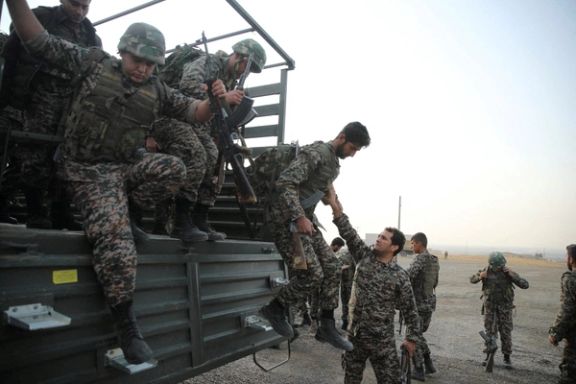
Members of the Islamic Revolutionary Guard Corps (IRGC) attend an IRGC ground forces military drill in the Aras area, East Azerbaijan province, Iran, October 17, 2022.
Belgium’s parliament passed a resolution early Friday backing efforts to designate the Revolutionary Guards (IRGC) as a terrorist organization on the EU list, with lawmaker Darya Safai calling the move a strong political signal.
Safai, who led the years-long push, said the resolution was approved at 2:30 a.m. with 135 votes in favor, 14 abstentions, and none opposed. “Today is the day that justice will be served, a day that the victims of this regime will always remember as a victory against their murderers,” she wrote on X.
"My resolution to designate the Islamic Revolutionary Guard Corps (IRGC) of the Iranian regime as a terrorist organization was approved today in the Belgian Parliament," Safai added.
She said the resolution not only calls for the EU to designate the IRGC but also urges “the unconditional and immediate release of Ahmadreza Djalali” and an end to executions by Iranian authorities. Djalali, a Swedish-Iranian academic arrested in Iran in 2016, was sentenced to death on espionage charges, which he denies.
Safai described the IRGC as “a murder machine that not only wages war against the Iranian people in Iran, but also spreads terror and murder throughout the region through its proxies.” In an earlier post, she said the IRGC is involved in terrorism, arms trafficking, and support for groups such as Hezbollah, Hamas and the Houthis, and accused it of fueling conflicts in Iraq, Syria, Libya, Afghanistan, and Ukraine.
The new Belgian government, led by Bart De Wever, reaffirmed that position in its coalition agreement, which said "The government advocates for the inclusion of the Iranian Islamic Revolutionary Guard Corps on the European Union's list of terrorist organizations."
The IRGC, a powerful branch of Iran’s armed forces, was designated a terrorist organization by the United States in 2019 under President Donald Trump. The US and Canada have urged their European allies to follow suit.
Iran on Thursday denied sending weapons to Yemen’s Houthis a day after the US military said Yemeni forces made the largest-ever seizure of conventional Iranian arms bound for the Tehran-backed group.
Foreign ministry spokesman Esmail Baqaei on Thursday called the claim "baseless and part of a media campaign against Iran.”
Yemeni forces fighting the Iran-backed Houthi movement have carried out their largest ever seizure of advanced Iranian conventional weapons bound for the group, US Central Command (CENTCOM) said on Wednesday.
CENTCOM said the National Resistance Forces (NRF) confiscated over 750 tons of advanced weaponry including anti-ship and anti-aircraft missiles, warheads, hundreds of drone engines, air defense equipment, radar systems and communications equipment.
The NRF is an anti-Houthi force led by General Tareq Saleh, nephew of Yemen’s former President Ali Abdullah Saleh, and operates independently of the internationally recognized government.
CENTCOM added that many of the systems were manufactured by a company affiliated with Iran’s defense ministry and included manuals in Farsi.
“We commend the legitimate government forces of Yemen who continue to interdict the flow of Iranian munitions bound for the Houthis," General Michael Erik Kurilla, commander of CENTCOM said in a statement.
"The interdiction of this massive Iranian shipment shows that Iran remains the most destabilizing actor in the region. Limiting the free flow of Iranian support to the Houthis is critic to regional security, stability, and freedom of navigation,” he added.
Since the outbreak of the Gaza war, Yemen’s Houthis have launched missiles, rockets, and drones toward Israel and enforced a maritime disruption in the Red Sea, in what it describes as support for Palestinians in Gaza.
Last month, the group's rivals in Yemeni government said that Iran is transferring parts of its military industry, including ballistic missile and drone production to Houthi-controlled areas in Saada, Hajjah, and the outskirts of Sanaa.
The Houthis resumed attacks on the high seas following a June 24 ceasefire ending a 12-day war between Israel and Iran.
Houthi forces sank a Liberian-flagged carrier on July 6 with rockets and explosive drone boats. The group, which controls most of Yemen's population centers, says its maritime attacks are in solidarity with Palestinians in Gaza.
A Norwegian-operated oil field in Iraqi Kurdistan was hit by a drone strike on Thursday, in the second attack in as many days which local officials cited by Reuters blamed on Iran-backed groups.
The attack targeted a DNO-operated oil field in Tawke, located in the Zakho area. A day earlier, the US-based Hunt Oil facility at the Ain Sifni oilfield in the Dohuk region was also attacked.
No group has claimed responsibility, but local officials cited by Reuters blamed Iran-backed Iraqi militias.
No casualties were reported in either incident but the attacks dented oil production by 140,000 to 150,000 barrels per day (bpd) according to two energy officials cited by the news agency. The region’s total oil output is reportedly around 280,000 bpd.
On July 13, Iraqi media reported that the United States warned Iraq it could face sanctions over alleged Iranian oil smuggling and ties to armed groups, including threats to freeze millions in revenue and target the state oil firm SOMO.
The United States opposes the presence of Iranian-backed armed groups in Iraq's security apparatus.
These militias, including Kata'ib Hezbollah and Asa'ib Ahl al-Haq, are part of the Popular Mobilization Forces (PMF) grouping which joined forces with the Iraqi military to confront Islamic State militants in Iraq.
Washington accuses them of receiving support from the Revolutionary Guard Corps-Quds Force to attack US personnel in Iraq.
Iran's armed allies in the region have been dealt heavy blows as a region-wide conflict between Israel and Iran has seethed.
The armed Houthi group in Yemen resumed attacks on the high seas following a June 24 ceasefire ending a 12-day war between Israel and Iran.
Houthi forces sank a Liberian-flagged carrier on July 6 with rockets and explosive drone boats. The group, which controls most of Yemen's population centers, says its maritime attacks are in solidarity with Palestinians in Gaza.
Yemeni forces fighting the Houthis carried out their largest ever seizure of advanced Iranian conventional weapons bound for the group, US Central Command (CENTCOM) said on Wednesday.
Israel's police announced on Thursday it had arrested an Israeli soldier they say was in contact with Iranian operatives and took money in exchange for information.
“The investigation's findings revealed that the soldier knowingly maintained contact with Iranian elements and, in this context, carried out tasks for them, including transferring a video of interceptions and photographs of missile impacts and strikes in Israel," the police said in a statement.
"It should be noted that the information did not come to him by virtue of his military role,” it added.
The arrest comes on the back of a new ad campaign by the Israeli government warning citizens against spying for Iran.
Israeli authorities say they have uncovered more than 25 cases of Iranian recruitment over the past year, with more than 35 people indicted on serious security charges.
“The campaign carries significant national importance, especially in the aftermath of (the war with Iran), after which Iranian efforts to recruit operatives and execute missions inside Israel are expected to intensify,” said Israel's National Public Diplomacy Directorate, which along with domestic security service the Shin Bet, is behind the campaign.
“For 5,000 shekels, is it worth ruining your life or family?” reads one of the campaign's video adverts, referencing the reported amounts some individuals have received for passing information to Tehran.
Since the Gaza war, there has been a 400% surge in arrests related to alleged Iran-backed spy plots, according to the Israeli security services.
The official website of Iranian Supreme Leader Ali Khamenei on Thursday published an AI-generated cartoon appearing to depict Jews and Israeli soldiers as frightened rats fleeing Iranian missiles on an American flag-draped vessel at sea.
The caption to the cartoon cites part of a speech Khamenei made the previous day in which he said Iranian attacks forced Israel to seek US intervention.
"If (Israel) hadn’t bowed down, if it hadn’t collapsed to the ground, if it didn’t need help, if it were capable of defending itself, it wouldn’t have resorted to the United States like that. Turning to the United States means it realized it could not handle the Islamic Republic."
In the speech, Khamenei added, "we deem the Zionist regime a cancer," and called Israel America's "rabid dog".
Iranian officialdom has repeatedly declared victory following a 12-day war with Israel last month in which its Mideast nemesis pounded military bases and nuclear sites and killed hundreds of personnel, nuclear scientists and civilians.
Retaliatory Iranian missile salvos killed 27 Israeli civilians. The conflict was capped by US attacks on three Iranian nuclear sites which President Donald Trump said "obliterated" Tehran's disputed program.
Following the conflict, Iranian state TV aired a song calling for “uprooting the Jews” which aired July 2.
“Behind Ali, obedient to the Leader’s command, we are all proud soldiers; we will uproot the Jews with power,” the song said.
Iran’s state media has repeatedly promoted antisemitic themes across films, festivals, and official speeches.
In 2001, the government aired a mini-series titled Saint Mary that depicted Jewish communities at the time of Jesus’s birth as “lacking compassion and rationality.” The Jewish Association of Tehran criticized the series for reinforcing harmful stereotypes.
In 2005, then-President Mahmoud Ahmadinejad hosted an international Holocaust cartoon competition. Ahmadinejad, who publicly denied the Holocaust, once said Israel should be “wiped off the map.” The contest continues today with backing from official cultural institutions.
Despite the official hostility, Iran maintains a Jewish population estimated between 8,000 and 10,000. The World Jewish Congress notes the community’s historical presence in Iran since 586 BCE, with roughly 100 synagogues still in operation.
Iran’s top military commanders warned on Thursday that the armed forces are ready to resume fighting in the wake of the 12-day war with Israel amid a ceasefire brokered by the US.
“Our forces are fully prepared to resume combat from exactly where it stopped,” said Major General Mohammad Pakpour, commander-in-chief of the Islamic Revolutionary Guards Corps (IRGC), during a meeting in Tehran with Major General Amir Hatami, commander-in-chief of Iran’s army.
“The aggressors will not be spared,” he added. “The will and resolve of the Iranian people and our armed forces have triumphed. We stand together.”
Earlier in the day, a senior Iranian lawmaker also warned that Iran would respond to any future Israeli attack with a blow more severe than last month’s conflict.
“If the Zionist regime again makes the mistake of acting against the Islamic Republic, it will be hit even harder than it was in Operation True Promise 3,” Esmail Kowsari, a member of parliament’s national security and foreign policy committee, told reporters i Tehran.
Hatami said Iran would not wait for external threats to materialize. Last week, Israel's Prime Minister Benjamin Netanyahu warned that the war with Iran "is not over".
“The Zionist regime is a danger to regional and global peace,” Hatami said. “If given the opportunity, it would strike others in the region. We will not allow it.”
The commanders’ statements came amid Israel’s airstrikes on Damascus. Israel wants a demilitarised buffer zone in southern Syria.
US President Donald Trump expects Iran to return to nuclear negotiations, saying that diplomacy is in Tehran's best interest, according to the State Department Spokeswoman Tammy Bruce.
“I know that he expects them to begin to negotiate because that's in their best interest,” Bruce said in an interview with Fox News. “He has believed and continues to believe that diplomacy will work here."
Trump has warned that if Iran's nuclear program continues to pose a threat, he would "absolutely" consider more strikes, "without a question".