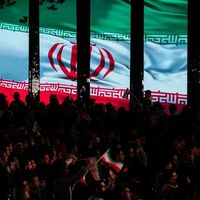
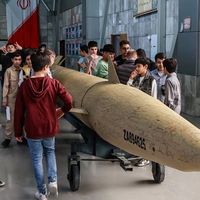
File photo of a rocket launch during a military exercise by the Revolutionary Guards in the Persian Gulf
Iran’s Revolutionary Guard and the Armed Forces General Staff have been negotiating with commercial partners in China to acquire missiles, drones and air defense systems as payment for oil shipments, an informed source told Iran International.
According to the source, the Islamic Revolutionary Guard Corps' main Chinese partner is Haokun Energy Group, a Beijing-based company that owes Iran nearly $1 billion for oil transactions with IRGC-linked firms over the past several years.
An oil firm closely linked to Iran's conventional armed forces has been pursuing air defense kit from a Chinese customer, the source added.
"The oil headquarters in the Armed Forces General Staff and the IRGC are using their commercial connections in China to contact Chinese companies for procurement of Chinese strategic weapons systems, mainly missiles, UAVs and air defense systems," the source told Iran International.
The Iranian military organizations, the source added, want the Chinese companies act as intermediaries and facilitators for Chinese state-owned defense manufacturers, to settle debts or structure oil-for-arms deals.
Haokun Energy, which is operated by former Chinese military officials, was sanctioned by the US Treasury Department in May 2022 for allegedly purchasing millions of barrels of oil from IRGC foreign operations division, the Quds Force.
“A high-ranking IRGC delegation in September visited China to negotiate with Haokun executives over the settlement of the outstanding debt,” the source said.
Although official reports made no mention of the IRGC visit, a separate Iranian government delegation led by President Masoud Pezeshkian traveled to China around the same time. Pezeshkian announced that during the trip, “good agreements” were reached with Chinese officials.
The source confirmed that one of these agreements proposed involved Haokan settling part of its oil debt by transferring weapons directly to the IRGC.
It remains unclear whether the deal has been finalized, but if confirmed, it would mark the first reported instance of China providing military equipment to Iran as payment for oil.
Haokan Energy did not respond to an Iran International request for comment.
•
•
Iran’s defense systems need
Iran’s efforts to purchase weapons from China come as its air defense infrastructure was largely destroyed during a 12-day conflict with Israel in June, leaving the restoration of its replenishment a top priority for Tehran.
Field and military assessments indicate widespread destruction of Iran’s defense installations in that war, including the loss of more than 70 key air defense systems and radar units, significantly reducing the country’s operational capability.
The reimposition of UN sanctions last month triggered by European powers skeptical of Tehran's nuclear program has likely rendered Iran's ability to rebuild its arsenal more difficult.
Under the sanctions, the export or import of weapons to or from Iran — including small arms, heavy weapons, ammunition and missile systems — is prohibited. Iran is barred from acquiring or selling any military equipment, whether through official or unofficial means.
All activities related to ballistic missiles, including testing, production, research, development or supply of components and related technologies, are also banned by the new measures.
China opposed the reactivation of the snapback mechanism and has so far not announced any intention to comply with the sanctions, which are codified in a UN Security Council resolution and apply to all member states.
Beijing is secretly funneling billions of dollars to Iran through a covert payment system that bypasses international sanctions by swapping oil for infrastructure projects, The Wall Street Journal reported on Monday, saying the hidden conduit enabled Tehran to receive up to $8.4 billion last year.
Citing Western officials, the report said the mechanism -- linking state-owned firms, a government insurer, and an unregistered financial intermediary -- has provided a critical lifeline to Iran’s sanctions-hit economy, with state insurer Sinosure and a little-known financial vehicle called “Chuxin” channeling the money to Chinese contractors working in Iran.
A second channel for Chinese arms procurement
In addition to the IRGC’s direct contacts with Haokan, Majid Azami, CEO of Sepehr Energy, a company affiliated with the Armed Forces General Staff, has also played a key role in parallel negotiations for weapons purchases from China, the source said.
The source said that during meetings with representatives of an energy and oil company based in Hong Kong, Azami proposed the purchase of advanced air defense systems for Iran.
Iran International is withholding the name of the firm pending its response to a request for comment.
Through these arrangements, oil brokers affiliated with Iran’s armed forces, like those tied to the IRGC, have leveraged their connections in China’s energy sector to pursue weapons deals.
It may not be the first time Chinese companies have provided materials or equipment for Iran’s military programs.
A Chinese company, Lion Commodities Holdings Limited, had signed a contract with an Iranian firm linked to the General Staff to supply thousands of tons of ammonium perchlorate, a chemical used in rocket fuel, Wall Streel Journal reported in June.
China’s proposal
"The Chinese side explicitly stated its willingness to sell weapons systems to Iran, similar to its existing arms trade with Pakistan," the source said.
Earlier, the Hudson Institute had reported Iran’s growing interest in acquiring a wide range of Chinese military hardware, including fighter jets, air defense systems, and missiles.
Less than a month after the 12-day war, Newsweek also published a report on Iran’s efforts to procure Chinese weapons.
On July 6, Middle East Eye, citing an Arab diplomatic source, reported that China had transferred advanced surface-to-air missile systems to Iran in the weeks following the ceasefire between Tehran and Tel Aviv, in exchange for oil shipments.
Military control over oil
A significant portion of Iran’s oil exports are handled by Sepehr Energy Jahan Nama Pars, a company affiliated with the General Staff of the Armed Forces, according to several US Treasury Department statements. Its multi-billion-dollar annual revenues are directed toward the IRGC, Quds Force, and the General Staff.
The Treasury said that in December 2024 alone, this company and its network exported nearly two million barrels of oil worth over $100 million to China.
A Reuters investigation found that by late 2024, the IRGC controlled nearly 50 percent of Iran’s oil exports primarily to China through a shadow fleet and front companies, up from about 20 percent in 2021.
Haokan’s failed investments in Iran
According to Iran International’s source, Haokan has in recent years attempted to settle part of its debt to the Iranian military through contracts with Khatam al-Anbiya Construction Headquarters and by transferring a passenger aircraft.
Haokan Energy on May had bartered two Airbus A330 aircraft, each worth under $30 million, for Iranian oil at a total value of $116 million, Iran's semi-official news agency ILNA reported.
It added that Haokan joined the project to expand Tehran’s Imam Khomeini Airport Phase II during Ebrahim Raisi’s presidency but abandoned it after the groundbreaking ceremony. Its other attempts to enter railway, wagon procurement and Tehran–Mashhad electrification projects also failed.
History of Iran-China military
During the 1980s and 1990s, Iran purchased anti-ship cruise missiles from China, which later served as the basis for domestically produced Noor, Nasr and Kosar missiles through reverse engineering.
According to the US Institute of Peace, the years 1991–1994 marked a peak in Iran’s arms imports from China. In 2010, Iran inaugurated the production line of the Chinese-origin Nasr-1 missile, but Beijing withdrew from the project following the imposition of UN sanctions.
Research reports indicate that since 2015, no record of direct Chinese arms sales to Iran has been documented. Military cooperation between the two countries appears to have been limited to dual-use components, chemicals and technologies rather than large-scale weapons transfers.
Germany’s foreign ministry told Iran International that the European Union’s reimposed sanctions on Iran include financial restrictions but still allow limited personal money transfers.
“The measures contain restrictions in the financial sector, but provide exceptions, thresholds or authorizations to enable certain transactions, for example money transfers with Iranian persons in limited amounts as well as certain private transactions,” the ministry said in a written response to a query on Tuesday.
It added that EU sanctions regulations are directly applicable in Germany and that Berlin has not introduced additional national restrictions. “Possible further measures taken by banks or other private actors on their own responsibility are not necessarily based on sanctions law,” the ministry said.
The EU sanctions were restored last month after Britain, France and Germany triggered the United Nations “snapback” mechanism over what they called Iran’s repeated breaches of the 2015 nuclear deal. Six previous Security Council resolutions on Iran’s nuclear and missile activities were reinstated, along with autonomous EU measures.
Last week, German Foreign Minister Johann Wadephul said the return of sanctions was unavoidable because of Tehran’s actions, adding that “Iran must never come into possession of a nuclear weapon.”
Iran has rejected the sanctions as illegal and said it will not recognize any attempt to revive measures that expired under Resolution 2231.
Iran said on Tuesday it would soon stage a joint naval exercise in the Caspian Sea with the other four littoral states, saying the sea was off-limits to outside powers.
“The Caspian Sea belongs only to its five coastal states – Iran, Russia, Kazakhstan, Turkmenistan and Azerbaijan – and they will resolve related issues themselves,” navy commander Shahram Irani said at a gathering of naval chiefs in St. Petersburg.
Irani said the littoral states had developed “very good relations” in security, economic and environmental fields and had the capability to ensure stability without foreign involvement. “There is no place in the Caspian Sea for extra-regional powers,” he said.
He said a recent joint exercise in Iran’s Bandar Anzali and along the southern Caspian coast had strengthened cooperation, and that another drill would be held soon.
Iran navy chief Rear Admiral Shahram Irani meets commanders of Caspian littoral states in St. Petersburg, Russia.
Iran maintains two distinct naval forces. The army navy, commanded by Irani, operates in the Gulf of Oman, the Indian Ocean, and the Caspian Sea, while the Revolutionary Guard navy controls the Persian Gulf and Strait of Hormuz.
In August, Iran’s army navy fired a range of anti-ship cruise missiles in large-scale exercises in the Gulf of Oman and northern Indian Ocean, following a separate Iran-Russia drill in the Caspian a month earlier. Officials said the systems were radar-evading and high-precision, and warned that any new conflict with Israel would bring a stronger response from Tehran.
The Caspian Sea, bordered only by the five littoral states, has long been treated by Tehran and Moscow as off-limits to foreign militaries.
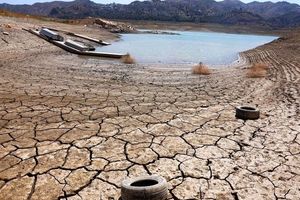
The Sarab Niloufar spring, one of western Iran’s most iconic natural landmarks, has dried up, local environmental officials said, warning that years of groundwater depletion, unregulated farming and drought have destroyed the 25-meter-deep lake once covered in lotus flowers.
Located near the city of Kermanshah, Sarab Niloufar -- famous for its blue lotus flowers and migratory birds -- has turned into cracked earth after years of over-extraction of groundwater, repeated droughts, and unregulated farming, Tasnim reported on Tuesday.
Provincial authorities blamed excessive water use for crop irrigation, illegal wells, and reduced rainfall for the collapse of the lake’s ecosystem.
Soraya Ghorbani, deputy head of Kermanshah’s Department of Environment, said this week that more than half of the factors driving the crisis stem from “repeated planting of water-intensive crops and poor management of groundwater resources.”
She warned that even heavy rainfall would no longer be enough to restore the body of water due to severe shortage of its groundwater.
A view from Sarab Niloufar lake in Kermanshah province in a recent photo
Experts say the drying of Sarab Niloufar mirrors a national trend of environmental decline.
A new satellite-based study shows that Iran is undergoing severe land subsidence across 106 regions covering about 31,400 square kilometers -- an area roughly the size of Belgium -- mainly due to excessive groundwater extraction for agriculture.
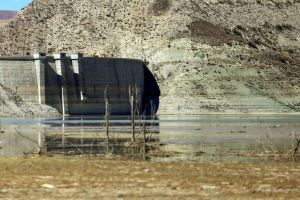
Iran’s water reservoirs have reached their lowest levels in decades -- with only 35% of dam capacity remaining, according to government data -- while 19 major dams are nearing depletion and three have already run dry.
Across the north, wetlands in Golestan Province have also shrunk dramatically after years of drought and dam construction, leaving vast tracts of land barren and driving away hundreds of thousands of migratory birds.
Environmentalists warn that the loss of these wetlands could turn fertile regions into new dust storm hotspots, worsening air quality and threatening nearby farms.
In western Iran, the crisis has both ecological and social dimensions. Once a key habitat and tourist attraction, Sarab Niloufar supported local livelihoods and served as a natural water reservoir.
Officials say its disappearance shows how climate change, mismanagement, and overuse are converging to push Iran’s fragile water systems toward collapse.
“Without immediate national action on sustainable agriculture, groundwater control and interprovincial water sharing, more wetlands will follow the same fate,” Ghorbani said.
Israeli Prime Minister Benjamin Netanyahu said Iran is developing long-range ballistic missiles capable of reaching the United States, warning that Tehran’s expanding weapons program poses a global security threat.
“Iran can blackmail any American city,” Netanyahu warned in an interview with Ben Shapiro, alleging that Tehran is developing intercontinental ballistic missiles with a range of 8,000 kilometers.
“People don’t believe it. Iran is developing intercontinental missiles with a range of 8,000 kilometres, add another 3,000, and they can get to the East Coast of the US.”
He said the missiles could “put New York City, Boston, Washington or Miami under their atomic guns.”
“That’s a really big danger, you don’t want to be under the nuclear gun of these people, who are not necessarily rational and chant ‘death to America,’” he added.
Netanyahu said Israel is “doing great work keeping that away,” crediting cooperation with Washington for bolstering regional defense.
He said Israel and the United States are co-developing “the most advanced offensive weapons on the planet,” and claimed Israeli intelligence had prevented attacks by ISIS, including plots against US targets.
Turning to Gaza, he said Israel is “close to the end of the war, but not there yet,” adding that “we smashed the Iranian axis with most of their proxies.”
Netanyahu said Israel’s campaign would only conclude once Hamas rule in Gaza ends and the remaining hostages are freed.
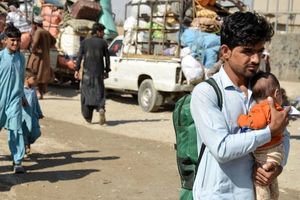
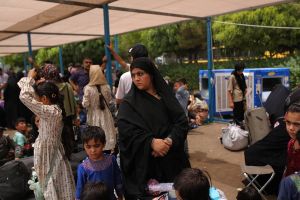
Attempts by Afghan citizens to cross illegally into Iran have doubled over the past six months compared with the same period last year, a senior Iranian border commander said, as Tehran accelerates deportations and tightens control along its frontier with Afghanistan.
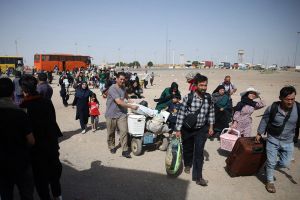
Majid Shoja, border guard commander for Iran’s Khorasan Razavi province, said this week that more than 1.5 million Afghan nationals had returned to their country since the start of the Persian year in March -- triple the number from last year.
About 500,000 of them left legally after their residence permits expired, mostly through the official crossings of Dogharoun and Taybad, he said.
Shoja added that around 40,000 illegal crossings were prevented in the first half of the year, double the figure from the same period in 2024.
Iran, he said, is expanding its eastern border sealing project, including the construction of a 300-kilometer border wall, of which 100 kilometers have been completed, and the installation of thermal cameras, acoustic sensors, and 360-degree watchtowers.
These systems, he said, can detect movement up to 45 kilometers away and reduce reliance on manpower.
The commander described the use of advanced surveillance and what he called border diplomacy with Afghanistan and Turkmenistan as key to enhancing security and managing migration.
He also reported a 12% rise in cross-border vehicle traffic and the growing importance of the Taybad free-trade zone and the Khaf–Herat railway link for legal commerce.
The tighter border measures come amid a nationwide crackdown on undocumented Afghans. In late August, an Interior Ministry official said Iran had expelled 1.8 million migrants over the past year -- most of them Afghans -- and planned to deport at least 800,000 more under a new removal plan.
Rights groups have reported several deadly incidents involving Afghan migrants. On September 8, border guards in Sistan-Baluchestan province opened fire on about 120 Afghans attempting to cross, killing six and wounding five, according to the Baluch rights group Haalvsh.
Human rights monitors, including HRANA, condemned the use of heavy weapons and described the incident as a violation of international law.
The United Nations has warned that mass deportations could trigger a humanitarian crisis in Afghanistan, where the Taliban government is struggling to absorb the influx.
Tehran says its policies are aimed at enforcing immigration law and protecting its borders, insisting that Afghan migrants are treated in accordance with domestic and international norms.