Iran seizes 2,800-year-old artifacts, arrests four
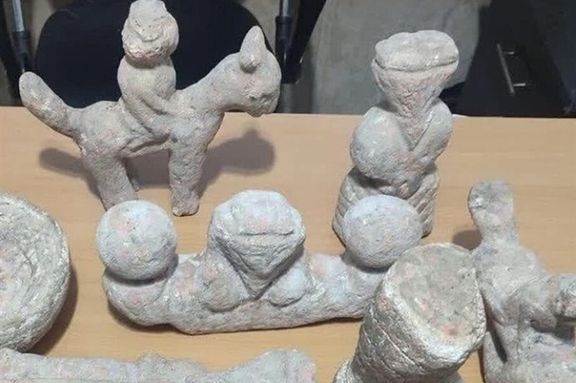
Iranian officials said a large haul of ancient artifacts estimated to be about 2,800 years old has been seized in the northern town of Fereydunkenar in Mazandaran Province and four main suspects have been detained.
Local prosecutor Gholamhossein Asghari said police acted “immediately” after receiving a report about suspected illegal activity involving historical objects. He said a joint team with cultural heritage experts and the economic security police uncovered “a considerable number of prohibited and historical items that belong to the cultural heritage of the country.” Initial assessments put their value at around one thousand billion tomans (8.4 million USD). Three vehicles tied to the case were also impounded, he said.
Iran continues to face extensive trafficking of antiquities despite laws that classify such items as national heritage and ban their sale or export without official approval. Smuggling networks operate across the region, taking advantage of high demand. In one case reported by the outlet SedayeMiras, Achaemenid era gold artifacts smuggled out of Iran were sold on the black market in Dubai for about 1.1 million dollars, far below their estimated value of three million dollars. The report said the pieces included a gold pendant depicting Darius I, gold armlets, Achaemenid era jewelry and a 2,500 year old gold diadem.
Heritage experts say inadequate maintenance, limited protection and environmental damage have left many historical sites vulnerable. Asghari said cultural heritage is central to Iran’s identity and that any harm to it amounts to an attack on the nation’s history.
A post on X by Iran's Supreme Leader Ali Khamenei's highlighting income inequality between women and men in the West stoked criticism by users who pointed to the Islamic theocracy's record on women's rights.
“In many Western countries today, women are paid less than men for doing the same work." Khamenei’s official English-language account posted on Wednesday. "That’s how they are today, which is totally unjust.”
The message echoed parts of a speech he delivered the same day to an audience of women and girls, in which he defended the compulsory Islamic veil and criticized the treatment of women in the West.
A "readers added context" note under his post, a feature introduced under the platform's new owner Elon Musk which collates users' responses, said bluntly: "Iran has a greater gender inequality than the entire west."
X user Guney Yazar quipped: "So the guy who jails women for not covering their hair now lectures the West on pay equity. The irony’s richer than any oil field."
One user prompted Grok, the artificial intelligence feature on X, to describe the punishment for defying the hijab under the 86-year-old theocrat.
"Under Iran's 2024 Hijab and Chastity law, women not wearing the hijab face fines from 15 million to 500 million rials ($24–$790), escalating to up to 1.5 billion rials, travel/online bans, and prison up to 5-15 years for repeats," it said.
"Severe cases may invoke the death penalty under 'corruption on earth.' A recent Supreme Leader directive calls for stricter enforcement, though many women continue to defy it."
'Enslaving not liberating'
The nearly 50-year-old system over which Khamenei presides views the veil as an emblem of Islamic identity and chastity.
One of the gravest sins of Western capitalist logic and culture is that they deceitfully label corruption and promiscuity as 'freedom,' he added in another post. "And when they try to spread that culture, they say, 'We're liberating you!' But in fact, they're enslaving people."
Other users cited data from the US Bureau of Labor Statistics and the Organization for Economic Co-operation and Development (OECD) appearing to confirm an element of Khamenei's assertion.
The bodies found that, adjusted for experience and hours, the gender pay gap in Western countries stands at around 1-4%.
But both the World Bank and the International Labor Organization (ILO) list Iran’s gender pay gap for identical roles at 35%, fueled by laws requiring male guardian permission for women to travel, work or study.
Gender rights record
Users also replied with pre-1979 Islamic Revolution photos of unveiled Iranian women, images of morality police violence and memorials to a young woman named Mahsa Amini whose death in morality police custody stoked mass protests in 2022.
The demonstrations were quashed with deadly force.
Iran ranks 143 out of 146 countries in the latest World Economic Forum Global Gender Gap Report.
Amnesty International has documented systemic gender discrimination in Iran in its 2024 report, including up to 74 lashes for defying hijab rules and frequent impunity for honor killings.
A poll by the Ronald Reagan Institute released on Thursday indicated broad public support for air strikes launched by the administration of President Donald Trump on three major Iranian nuclear sites on June 22.
“With respect to Iran, the public is not only supportive of the airstrikes conducted last summer, they are keen on several forceful responses to preventing Iran from developing a nuclear device,” the Washington DC-based organization, which is dedicated to advancing the late Republican president's ideals, said in its findings.
The Reagan National Defense Survey, conducted in the last week of October and first week of November by Beacon Research and Shaw & Company, examines American views on threats and US military posture toward allies and adversaries.
“Americans back further economic sanctions 73%, deploying US cyber capabilities 70%, renegotiating the Iranian nuclear deal 66% and even using US military force 54% in the service of thwarting Iran’s nuclear weapons program,” the findings added.
Iran denies seeking a nuclear weapon but Israel, the United States and other Western powers doubt its intentions.
China remains the top perceived US threat 29%," the poll added, "followed by Russia 21% and North Korea 9%, with Iran at 3%."
77% Republican respondents supported the June strikes compared to 39% of Democrats.
“This year’s survey underscores a clear message: Americans believe US leadership is indispensable to global security and peace,” said Roger Zakheim, Director of the Ronald Reagan Institute, said in a statement.
The United States held five rounds of negotiations with Tehran over its disputed nuclear program earlier this year after President Donald Trump set a 60-day ultimatum.
When no agreement was reached, Israel launched a surprise offensive on June 13, followed by US strikes on June 22 targeting key nuclear facilities in Isfahan, Natanz and Fordow.
Dissident Iranian filmmaker Jafar Panahi said he will return to Iran after completing the Oscar campaign for his latest film, despite being sentenced in absentia this week to one year in prison on charges of propaganda against the state.
“This sentence happened in the middle of this process, but I will finish this campaign and go back to Iran as soon as possible after,” Variety magazine quoted Panahi as saying at the Marrakech Film Festival in Morocco.
“I have only one passport … the passport of my country, and I wish to keep it,” Panahi added. “Although I was given the opportunity, even in the hardest years, I never considered leaving my country and being a refugee elsewhere.”
Panahi’s remarks come after his lawyer, Mostafa Nili, announced the prison sentence issued against the filmmaker in absentia earlier this week.
Panahi, whose movies have repeatedly brought him into conflict with Iranian authorities, said he is aware of the risks of returning.
“I know my films don’t please the government,” he said. “But that’s not a reason for me not to go back to my country.”
Panahi’s latest film, It Was Just an Accident, inspired by his experience as a political prisoner, is France’s submission for the Oscars and screened at the Marrakech festival on Thursday.
It was filmed in secret in Iran and follows the moral journey of a group of former political prisoners who believe they have captured their torturer.
In May, Panahi received the Palme d’Or at the 78th Cannes Film Festival for the film.
Panahi has faced restrictions and arrests for more than a decade.
He was sentenced in 2010 to six years in prison and a 20-year ban on filmmaking, travel and giving interviews, though he continued to work in secret. In 2022, he was detained again and spent seven months in prison before launching a hunger strike that led to his release in early 2023.
Some Iranian youths disillusioned by poor amenities in the Islamic theocracy are increasingly taking to a homemade codeine drink known as lean, education and health professionals told Iran International.
Lean is a mixture made by combining cough syrups containing codeine with sweetened beverages. The name lean refers to the sedating effect of codeine, which can make users feel unsteady or inclined to recline.
Long popular abroad and popularized in some corners of American hip hop culture, the habit is potential fatal.
It is sometimes known as purple drink because certain cough syrups contain dyes that turn the mixture violet, though local versions in Iran often appear in other colors depending on the medicines used.
The mixture, according to the expert, spreads easily because it can be prepared with medicines already found in many Iranian homes or purchased cheaply over the counter.
Alcohol and drugs are strictly forbidden in the Islamic Republic, and authorities have executed hundreds of people this year accused of drug offenses.
But basic codeine syrups and antihistamines require no special authorization, making the drink inexpensive, discreet and accessible to young people with limited means.
'Highly addictive'
The counsellor, who asked not to be named due to security concerns, said the mixture first surfaced in parks and schoolyards where teenagers gather after long days in classrooms where education is often by rote and has a strong focus on ideological content conforming to the ruling theocracy.
Students, she said, were searching for “something that breaks the monotony” after hours spent in lessons centered on ideological narratives and obligatory religious themes.
She described the drink’s beginnings as “born out of boredom,” saying that many adolescents felt they had no engaging place to spend their time.
“Recreation is squeezed, cultural choice is narrow and even access to a simple beer is criminalized,” she said. “When all conventional outlets are shut, young people invent alternatives.”
Lean is a highly addictive mixture that slows the body’s functions and can cause drowsiness, euphoria, nausea, dizziness, visual disturbances and hallucinations.
Mixing it with alcohol or sedatives greatly increases the risk of dangerously slowed breathing, low oxygen levels, brain injury, seizures, coma or death.
Long-term use can damage teeth, impair memory and vision and lead to serious heart and breathing problems.
Government oversight
Health professionals say the drink spread quietly because Iran lacks a unified system to track unusual purchases of over-the-counter medicines. Basic cough syrups containing codeine are widely available, and the country’s fragmented regulatory framework does not flag high-volume sales or patterns of youth misuse.
A Tehran pharmacist, Omid, said its abuse was predictable.
“When oversight is inconsistent and pharmacies operate without shared monitoring tools, teenagers can gather ingredients unnoticed,” he said. “These medicines sit in almost every home, and no authority has built a mechanism to prevent misuse.”
Omid told Iran International that the state’s regulatory posture has long focused on punitive measures against alcohol while failing to address practical gaps in the medical supply chain. “The priorities are mismatched,” he said.
Education system failure
The trend, according to the counsellor, also reflects shortcomings within classrooms where students rarely receive consistent health education or clear information about the dangers of misusing common medicines.
Instead, timetables remain filled with obligatory ideological material that leaves little room for life-skills programs or discussions about adolescent well-being.
Parents, the counsellor said, receive almost no guidance from schools on the needs of Gen Z or the pressures they experience. “Families are left to guess what their children are going through,” she said.
“Instead of equipping parents with tools, the curriculum focuses on messaging that feels distant from young people’s realities.”
Many teenagers, she added, report feeling disconnected from school content and turn to private rituals and drink simply to “break the cycle” of pressure they cannot voice openly.
Families on their own
Parents who encounter the issue typically do so after it has taken root. This late detection, according to the pharmacist, reflects a systemic failure.
“There is no coordinated pathway between schools, clinics and households,” he said. “Warnings come only after the consequences appear.”
Gen Z’s experimentation, the counsellor added, reflects unmet needs rather than deliberate risk-taking. “If young Iranians had engaging cultural venues, balanced schooling and genuine recreation, this drink would never have become a pattern.”
The two experts said the drink’s spread among 13- to 28-year-olds is a direct product of policy choices: narrow social freedoms, numbing school content, criminalization of ordinary leisure, fragmented pharmaceutical oversight and insufficient support for parents.
Iran will attend the draw for the 2026 World Cup in Washington DC on Friday after initially threating a boycott, while a travel ban looks set to bar Iranian fans.
Iran had sought nine visas for its delegation but only four were granted, including for head coach Amir Ghalenoei, spokesman Amir Mehdi Alavi said on Thursday.
Mehdi Taj, the federation’s president, did not receive a visa.
Earlier in the week, Iran's football authorities said they would boycott a draw for the US-hosted 2026 World Cup in Washington DC slated for Friday after visas for two top officials were rejected.
But on Thursday, Iranian media reported that the federation will now send Ghalenoei and Omid Jamali, the head of its international relations office, to attend the draw.
The White House on Wednesday said Iran’s national team will be allowed to enter the US for the World Cup but suggested that Iranian fans will be barred, citing existing travel bans and declined to rule out immigration raids at matches.
“The President has, in his executive order, certainly named Iran as one of the countries whose teams will be exempt to come here,” the head of the White House task force on the World Cup, Andrew Giuliani, told reporters.
Asked whether there would be ICE raids at matches, Giuliani said “the President does not rule out anything that will help make American citizens safer.”
Iran will play in their fourth straight World Cup finals when the tournament opens across the United States, Canada and Mexico on June 11.
Football fandom is endemic in Iran despite only lukewarm endorsement by the ruling Islamic theocracy and its team regularly qualifies for the World Cup.