Recent Data Reveal Regional Intensity Of 2022 Iranian Protests
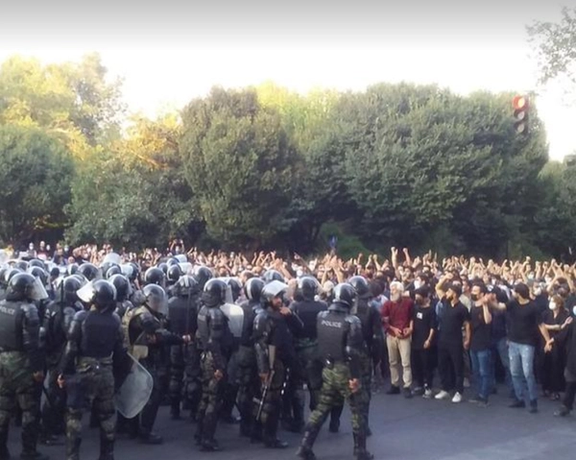
Recent statistics on the 2022 and 2023 protests in Iran against the Islamic Republic have shed light on the scale and geographic distribution of protests across the country.

Recent statistics on the 2022 and 2023 protests in Iran against the Islamic Republic have shed light on the scale and geographic distribution of protests across the country.
Figures released at a research seminar indicate that Tehran and Kordestan provinces were hotspots for demonstrations during the period.
The uprising, sparked by the death of 22-year-old Mahsa Amini in September 2022 while in the custody of the morality police, saw a wave of outrage sweep through Iran. Reports suggest that over 550 demonstrators lost their lives at the hands of the regime’s security forces in a matter of weeks, hundreds seriously injured and more than 20,000 people arrested.
Details of the geographic atlas documenting the protests were unveiled at the Sixth National Conference on Social and Cultural Research in Iranian Society. According to the atlas, provinces such as Esfahan, East Azarbaijan, Kermanshah, and Khuzestan experienced moderate levels of protests, while Kerman, Bushehr, Markazi, and Qazvin saw demonstrations to a lesser extent.
In contrast, the geographical atlas of the 2022 protests revealed that Ardebil, Qom, Yazd, Hamedan, Zanjan, Hormozgan, Bandar Abbas, Ilam, Lorestan, Golestan, and Chaharmahal-Bakhtiari provinces witnessed minimal protest activity.
The global community has denounced Iran's suppression of dissent, yet these condemnations have yet to yield tangible benefits for the populace. In response, the US enacted the MAHSA Act, significantly bolstering Washington's sanctions against the regime for its human rights violations.

The 2024 elections in Iran mirror past ones under the Islamist regime in various aspects, such as the arbitrary disqualification of candidates, and dwindling participation rates.
Amid numerous crises gripping the nation, the regime, under the control of its 84-year-old ruler Ali Khamenei, is striving desperately to achieve a high turnout to demonstrate that it still maintains popularity and a degree of legitimacy.
However, the rejection of hundreds of candidates has led to voter disillusionment and a shortage of candidates in certain provinces rendering the Assembly of Experts elections virtually non-competitive. There is also public disillusionment regarding the elections' impact, and the presence of mobile ballot boxes, which facilitate fraud, accounting for up to one-third of all voting stations. Similarly to prior elections, the Interior Ministry has reduced the eligible voting population from 65.7 million to 61 million, artificially inflating the turnout figures.
However, several distinctive features characterize this particular election cycle.
Lack of unity among hardliners
Facing no serious challenge after disqualifying rival candidates, the principlists, or pro-Khamenei hardliners, have no intention to unite. Instead, four sub-factions have emerged, each with its own list of candidates. Amidst this chaos, Ali Motahhari, an independent conservative, is offering his list of ex-officials and lesser-known university students for Tehran. This further compounds the confusion among the small but motivated pro-regime constituency.

Lack of issue-based debates and campaigns
Neither individual candidates nor groups and coalitions have articulated their plans should they enter parliament. No public discourse on issues is evident. In a society grappling with myriad challenges such as near 50-percent inflation rates, water scarcity, educational dropout rates, child labor, soaring healthcare costs, alarmingly high unemployment (up to 40 percent for university graduates), brain drain, skilled worker emigration, increasing crime rates, mental health issues affecting up to 25 percent of the population, and a housing crisis, the silence on these critical matters is striking and begs for public engagement.
Despite all these, candidates vie primarily to demonstrate their allegiance to the regime and Supreme Leader Ali Khamenei. They recognize that the public remains skeptical no matter what they pledge yet anticipate securing seats without addressing these concerns. Their focus is not on serving the people but on appeasing the ruling elite.
Lowering voter ID requirements
This time it appears people can vote as many times as they want. Their national IDs will not be stamped after casting a ballot and voters can show other IDs. According to the Interior Ministry’s election headquarter, voters can substitute “birth certificates, driver’s license, military service card and passport.” There is no local voting registration system in Iran. It seems that the government needs more votes and has opened the gate for as many as it can get.
Public apathy
Not only are over 75 percent of the population not planning to vote, but a significant portion of them are also unaware of the upcoming election in Iran. According to a Gamaan survey titled "Iranians' Attitudes Towards the 2024 Elections," conducted from January 31st to February 7th, 2024, approximately 38 percent of the population were unaware of the timing of the elections scheduled for March 1st.
Seriousness
Even the regime's propaganda machinery doesn't treat this political event with gravity. A good example is the comic street shows to encourage participation. Weeks before the controversial election day, the Ministry of Islamic Guidance and Culture hired Basij members to perform street shows to send supposedly convey the message that the “enemies” (Israel and the US) discourage people from voting. In these dramatic displays, they urge citizens “to strike a blow against imperialism” by turning out to vote in large numbers.
Above all, elections
The fundamental requirements for any election include freedom of speech, media, association, and assembly. However, under the Islamist regime, these freedoms are nonexistent. Citizens are only permitted to engage in state-sponsored rallies, parrot state-approved messages, join government-endorsed parties, and consume content from state-controlled media outlets. In such a stifling environment, genuine political competition, substantive debates on issues, and truly free and fair elections become unattainable.

In the midst of Iran's escalating proxy war, Tehran has leveled accusations of war crimes against the West, just hours after more joint US-UK attack on Yemen's Houthis.
The Iranian foreign ministry spokesperson criticized the United States and the United Kingdom for a series of extensive military attacks on Yemen, stating that “they have once again shown support for the war crimes and genocide perpetrated by the Zionist regime in Gaza and the West Bank.”
The US and UK launched strikes on 18 Houthi sites on Saturday night which included underground weapons and missile storage facilities, as a response to continuous attacks by the Iran-backed group on shipping in the region. The strikes, spread across eight locations, also targeted air defense systems, radars, and a helicopter.
The attacks come as the Houthis continue to wage a naval blockade on the Red Sea and surrounding area. Beginning as a show of solidarity with Iran-backed Hamas in Gaza, targeting Israeli linked vessels, last week, the terror group as designated by the US and others, announced the US and UK were officially targets too, in response to their support for Israel's right to defend itself.
The conflict was sparked by the Hamas invasion of Israel on October 7, met with a relentless retaliation by Israel, which has become the bloodiest Gaza war since Hamas took control of the strip.
A more than 20-nation coalition has since been formed, led by the US, to counter the Iran-instigated blockade, safeguarding the trade route responsible for at least 12 percent of global trade.
In November, the Houthis hijacked the Galaxy Leader and its 25 crew members who remain in Yemen. Since then, dozens of attacks have been launched by the Houthis towards both Israel and vessels in the area.

A free tribune board in Tehran has revealed the vast array of discontent with Iranian government policies, with people declaring their refusal to participate in the upcoming elections.
At Amirkabir University, an image captured from the Free Tribune board showed a statement that read: "I do not vote because the parliament serves Gaza, Syria, and the officials' offspring." Another declared, "I abstain from voting due to soaring prices; officials have plundered all wealth, rendering the parliament non-representative."
A third opinion criticized the electoral process as a "pure dictatorship" fostering corruption.
Recent years have seen a notable decline in voter turnout attributed to economic hardships, suppression of dissent, and oversight by the Guardian Council. The trend has led to a crisis of legitimacy for the Islamic Republic.
Iranians are increasingly frustrated with the government's failure to address demands for increased freedoms and economic progress. Official figures show an inflation rate nearing 50%, with essential goods, particularly food, facing steep price rises.
The harsh crackdown on the 2022 protests has further stoked internal dissent, resulting in deaths, injuries, and arrests, amid ongoing social and economic oppression. The enforcement of hijab laws and internet censorship by hardline authorities have heightened surveillance, exacerbating public discontent.
With parliamentary and Assembly of Experts elections slated for March 1, anticipation mounts for historically low voter participation.

The reformist Etehad-e Mellat (Nation’s Unity) party has declared its decision not to endorse any candidates in Iran’s March 1 elections for the parliament and the Assembly of Experts.
This announcement, made through a statement on the party's website, signifies a notable departure from active participation without outrightly boycotting the electoral process.
The issue of participation has caused a rift among reformists. The general assembly of the Reformist Front decided earlier this week that Reformists could not participate in elections that are “devoid of meaning, uncompetitive, unfair, and ineffective in the management of the country but earlier this week 110 reformist figures in a statement urged their comrades not to shun the vote while admitting that the elections are going to be far from fair and free.
Prominent figures like Iran's imprisoned Nobel Peace laureate Narges Mohammadi have chosen to boycott the elections unequivocally. Mohammadi's declaration, made via authorized social media accounts, underscores a growing sentiment against what she perceives as the government's orchestrated electoral process.
Etehad-e Mellat, in its statement, criticized the discretionary oversight of the election watchdog, the Guardian Council, which it argues undermines the democratic process by limiting genuine choices for the electorate. The Council's stringent vetting process has effectively marginalized not only reformists but also moderate conservatives from the electoral arena.
In addition to the parliament, the election of a new Assembly of Experts, is important given the constitutionally designated body’s authority to select the future Supreme Leader. The widespread disqualification of candidates paves the way for strengthening the ruling hardliners’ full sway on all centers of power.
The party highlighted the prevailing disillusionment among the populace regarding the electoral system, a sentiment echoed in recent surveys. A survey by the Netherlands-based Gamaan institute revealed widespread disengagement, with a significant majority expressing disinterest or outright refusal to participate in the elections.
The survey found that nearly three quarter of all eligible voters who responded to its poll had decided not to vote including 39 percent of those who had voted in the parliamentary elections in February 2020.
The same survey found that if a referendum was held, nearly 75 percent of its respondents would say no to the Islamic Republic.
The Guardian Council, originally empowered to interpret the Constitution, review legislation, and supervise elections, bestowed upon itself discretionary supervisory powers over elections in 1991, giving it the final say on candidate eligibility.
Established in 2015, Hezb-e Etehad-e Mellat-e Iran Eslami comprises veteran Reformist politicians, many of whom were formerly associated with the influential Jebhe-ye Mosharekat (Participation Front). Mosharekat, which dominated the parliament between 2000-2004 during Mohammad Khatami's presidency (1997-2005), faced significant setbacks when its members were later barred from electoral participation by the Guardian Council.
Etehad-e Mellat, the only major Iranian political party with a female secretary general, Azar Mansouri, last year demanded the abolition of compulsory hijab in Iran and discrimination against women in higher education and in the law.
Deprived of their own candidates, in 2013 and 2017 Reformists including Etehad-e Mellat helped the moderate conservative Hassan Rouhani to win the presidency.
The Party, considered as the most influential member of the Reformist Front at the time, was banned in 2009 in the aftermath of the disputed elections that brought the hardliner Mahmoud Ahmadinejad to power for a second term, and many of its leading figures were imprisoned. The party did not declare itself secular but did promote the separation of religion and state.

Former Israeli Prime Minister Ehud Olmert claims that Israel's air force lacks the necessary resources to halt Iran's nuclear program through military action amid the two nations' shadow war.
In an interview with The National Olmert said, "We can destroy their headquarters, important projects, railways, roads, and airports .. Israel can do a lot to damage Iran's infrastructure, but Israel has no means to be able to destroy the nuclear program of Iran."
Despite Israel's longstanding threats to dismantle Iran's nuclear facilities if they approached weapons-grade enrichment, Olmert dismissed the option due to the logistical challenges involved, Israel's air force lacking the capability to penetrate the fortified mountain bunkers housing Iran's nuclear sites.
Olmert pointed out that Israel's advanced F-35A stealth aircraft, with a maximum range of 2,200km, cannot reach Tehran and return without sufficient in-flight refueling tankers. Additionally, Iran's major military sites, such as the Bandar Abbas airbase, are located over 2,000km away from Israel's immediate border.
IAEA Chief Rafael Grossi stated last week that Iran continues enriching uranium beyond commercial needs, reaching 60% purity at a rate of 7 kg per month.
Enriching uranium to 60% approaches weapons-grade purity, unnecessary for civilian nuclear energy. While Iran denies nuclear weapon ambitions, no nation has enriched to this level without weaponization intent.
Tehran has long threatened to destroy Israel with clocks around Iran counting down until the day the supreme leader predicts that will be. The nuclear issue lies at the heart of the shadow war between the archenemies with Israeli PM Benjamin Netanyahu demanding stronger action from the US and international community in the face of further enrichment.
Last year, he said: “Eight years ago, the Western powers promised that if Iran violated the nuclear deal, the sanctions would be snapped back. Well, Iran is violating the deal, but the sanctions have not been snapped back. To stop Iran’s nuclear ambitions, this policy must change. Sanctions must be snapped back."